Showing posts with label mindfulness. Show all posts

Saturday, 9 August 2014

The Buddhist Path as Therapy

Amber Larson and Seth Auberon (eds.), Wisdom Quarterly; Ven. Thanissaro, "Healing Power of the Precepts" (Noble Strategy); Mary Loftus (Psychology Today, Sept. 5, 2013); Sunny
Fairness or martyrdom? When virtue becomes a vice (Jeff Riedel/psychologytoday.com)
.
Virtue becomes a vice? (PT)
The Buddha was a kind of doctor [referred to in some sutras as a "master physician"], treating the spiritual ills of living beings [human and devas, also referred to as "the teacher of gods and humans].

The path of practice he taught was like a course of therapy for suffering (disappointed) hearts and minds. This way of understanding the Buddha and his teachings or Dharma dates back to the earliest texts, and yet it is also very current.

Buddhist meditation practice is often advertised as a form of healing, and quite a few psychotherapists now recommend that their patients try (mindfulness based) meditation as part of their treatment.
 
After several years of teaching and practicing meditation as "therapy," however, many of us have found that meditation on its own is not enough.

Psycho Mike (Suicidal T.)
In my own experience as a Western monk and abbot of Wat Forest Monastery in California (Thai Theravada), I have found that Western meditators tend to be afflicted more with a certain grimness and lack of self-esteem than any Asians I have ever taught.

Our psyches are so wounded by modern civilization that we tend to lack the resilience and persistence needed before concentration (serenity) and insight practices can be genuinely therapeutic.
 
Other teachers have noted this problem as well and, as a result, many of them have decided that the Buddhist path is insufficient for our particular needs. To make up for this insufficiency they have experimented with ways of supplementing meditation practice, combining it with such things as myth, poetry, psychotherapy, social activism, sweat lodges, mourning rituals, and even drumming.

The Buddha's full course
The problem, though, may not be that there is anything lacking in the Buddhist path, but that we simply haven't been following the Buddha's full course of therapy.
 
The Buddha's path consists not only of mindfulness, concentration, and insight practices, but also of virtue (sila), beginning with the Five Precepts. In fact, the precepts constitute the first and most basic step on the Buddhist path.
 
Balance? (Jeff Riedel/PT)
There is a tendency in the West to dismiss the Five Precepts as Sunday-school rules bound to old cultural norms that no longer apply to our modern society. But this misses the role the Buddha intended for them: They are part of a course of therapy for wounded minds/hearts. In particular, they are aimed at curing two ailments that underlie low self-esteem, regret and denial.
 
When our actions do not measure up to certain standards of behavior, we either regret the actions or, worse, engage in one of two kinds of denial -- either denying that our actions did in fact happen or denying that the standards of measurement are actually valid. These reactions are like wounds in the mind... More


(Sunny and the Sunliners) Self-esteem low? Depressed after a bad relationship? "It's Okay," says Sunny. "Ha, ha, ha/ It's all right/ I've been hurt before/ It's all right/ You don't love me anymore/ Maybe someday/ I'll find a way without you/ Ha, ha, ha/ Who am I kidding?/ It's okay/ Baby, I can see/ It's okay/ But, but would it make you happy?/ Maybe someday/ I'll find a way without you./Ha, ha, ha/ Someday, it won't be long/ You're gonna find yourself all alone/ It's okay/ Baby, I can say see/ It's okay/ I will set you free..."

Wednesday, 11 June 2014

Psychology: "mindfulness" in science (audio)

Amber Larson, Dhr. Seven, CC Liu, Crystal Quintero, Wisdom Quarterly; Ven. Nyanatiloka; Professor Ellen Langer (Harvard/ellenlanger.com), Krista Tippett (onbeing.org, 5-29-14)
What could Sid or the Buddha teach Ziggy Freud on the psychotherapeutic couch?
Note the Buddha heads behind Dr. Freud's chair. This is the original therapy couch (HW)
Langer says keep it simple; notice things rather than practicing mindlessness (Kris Krug)
 
Science of Mindlessness and Mindfulness
Counter Clockwise
Harvard University social psychologist Prof. Ellen Langer's unconventional studies have long suggested what brain science is now revealing: 

Our "experiences" are formed by the words and ideas we attach to them, that is, the labels we add to our cognitions. Naming something "play" rather than "work" can mean the difference between delight and drudgery. 

She is one of the early pioneers -- along with figures like Buddhist researcher Jon Kabat-Zinn and Herbert Benson -- drawing a connection between mindlessness and unhappiness and between mindfulness and health. 

Going deeper
"Mind" (citta) is a process, not a thing.
Buddhism is not mere material "science" (the particle physics the Buddha talked about in terms of kalapas) but goes beyond materiality to mental- and mystical-experience, detailing processes that science has yet to acknowledge, detail, or come anywhere near explaining.
 
The Buddha meant two distinct practices, mindfulness/clarity (sati-sampajañña) -- present time awareness that does not reach back into the past or project forward into the future -- and the fourfold setting up of mindfulness (satipatthana/vipassana) as a formal meditation practice that, on top of absorption, leads to insight and liberation of mind and heart.
 
Buddha's Brain (Dr. Rick Hanson)
Dr. Langer describes just the initial practice of "mindfulness," bare awareness, which is possible without formal meditation or yoga.

She recommends the basic practice of “the simple act of actively noticing things.”
 
This is bare awareness, which in a Buddhist context is practiced as "presence of mind" in the absence of the internal distractions that come from discursive elaboration (thinking about), mental proliferation (papañca), and interpretation/color-commenting based on our mental formations and fabrications (sankharas).
Psychologists distinguish "top-down processing" (projecting, seeing what one thinks is there, going from the mind to the outside world) from "bottom-up processing" (going from what's actually there to the mind that perceives it and attempts to understand it free of prejudice).

What is "mind"?
This gray material goo is not "mind."
MIND in Buddhism can refer to consciousness (viññāṇa), knowing (ñāna, one of the "psychic powers" or iddhis, a synonym of wisdom/paññā, the best and hightest being aññā), discrete mental processes (cittas), the "mind door" near the heart, perception (saññā), the ~50 mental formations (sankharas) led by volition/will (which is the basis of karma), or more comprehensively as the Four Aggregates (Sanskrit skandhas, Pali khandhas) apart from the first, namely, form or materiality (rūpa). More

Placebo? Mind over Muscle at Harvard

Wisdom Quarterly; Alia Crum, Ellen Langer (Harvard), Psychological Science (18, 2: 165-171)
(Chauncey McDermott) Mind over matter: "You can do it, Duffy Moon!"

Mind-Set Matters: Exercise and the Placebo Effect
ABSTRACT—In a study testing whether the relationship between exercise and health is moderated by one’s mindset, 84 female room attendants working in seven different hotels were measured on physiological health variables affected by exercise. Those in the informed condition were told that the work they do (cleaning hotel rooms) is good exercise and satisfies the Surgeon General’s recommendations for an active lifestyle. Examples of how their work was exercise were provided. Subjects in the control group were not given this information. Although actual behavior did not change, 4 weeks after the intervention, the informed group perceived themselves to be getting significantly more exercise than before. As a result, compared with the control group, they showed a decrease in weight, blood pressure, body fat, waist-to-hip ratio, and body mass index. These results support the hypothesis that exercise affects health in part or in whole via the placebo effect.

Shhhh. These are just sugar pills.
The placebo effect is any effect that is not attributed to an actual pharmaceutical drug or remedy, but rather is attributed to the individual’s mind-set (mindless beliefs and expectations).

The therapeutic benefit of the placebo effect is so widely accepted that accounting for it has become a standard in clinical drug trials to distinguish pharmaceutical effects from the placebo effect and the placebo effect from other possible confounding factors, including spontaneous remission and the natural history of the condition (Benson & McCallie, 1979; Brody, 1980; Nesbitt Shanor, 1999; Spiro, 1986). Kirsh and Sapirstein (1998), in a meta-analysis of 2,318 clinical drug trials for antidepressant medication, found that [only] a quarter (25.16%) of the patients’ responses were due to the actual drug effect, another quarter (23.87%) were due to the natural history of depression, and half (50.97%) were due to the placebo effect.

Scholar Shelly Brown: "Bridging science and religion" (news.harvard.edu)
  
Powerful love medicine (glucose, FD&C red)
The placebo effect extends much further than medications or therapy: Subjects exposed to fake poison ivy developed real rashes (Blakeslee, 1998), people imbibing placebo caffeine experienced increased motor performance and heart rate (and other effects congruent with the subjects’ beliefs and not with the pharmacological effects of caffeine; Kirsch & Sapirstein, 1998), and patients given anesthesia and a fake knee operation experienced reduced pain and swelling in their ‘‘healed’’ tendons and ligaments (Blakeslee, 1998). More generally, studies suggest that 60 to 90% of drugs and other therapies prescribed by physicians depend on the placebo effect for their effectiveness (Benson & Freedman, 1996; Nesbitt Shanor, 1999).

The placebo effect does not have to involve inert pills or sham procedures. Symbols, beliefs, and expectations can elicit powerful physiological occurrences, both positive and negative (Hahn & Kleinman, 1983; Roberts, Kewman, & Mercie, 1993).

Prof. Ellen Langer, Harvard University
For example, the mere presence of a doctor increases patients’ blood pressure (the ‘‘white coat effect’’), reinterpreting pain in nonthreatening ways (e.g., as sensations) prompts patients to take fewer sedatives and leave the hospital sooner; and the health decline of cancer patients often has less to do with the actual course of the illness and more to do with their negative expectations regarding the disease (Langer, 1989).

EXERCISE AND THE PLACEBO EFFECT
As the most common health threats are now infectious rather than chronic, remedies have also changed. Doctors now prescribe behavioral changes such as exercise for chronic diseases like diabetes, heart disease, and even cancer. We wondered whether the well-known benefits of exercise are in whole or in part the result of the placebo effect. A positive finding would speak to the potentially powerful... More

Thursday, 29 May 2014

BuddhaFest (June 19-22, 2014)

Ashley Wells and CC Liu, Wisdom Quarterly; BuddhaFest.org via Tricycle.com
BuddhaFest 2014: A Festival for Heart and Mind. The fest is inspired by the principles of mindfulness and compassion and features four days of films, talks, Buddhist meditation, and music at the Spectrum Theatre at Artisphere in the Rosslyn area of Arlington, VA, just outside of Washington, D.C. (See complete BuddhaFest Schedule)
Opening Night Film: "Blood Brother," Sundance Grand Jury and Audience Award winner!
"Good Morning America" (GMA/ABC) panicky Weekend Anchor Dan Harris will speak on opening night about the spiritual odyssey that led him to Buddhist principles and mindfulness.
Sign up for updates, and events (buddhafest.org/sign-up-for-updates/)

Tuesday, 11 February 2014

Mindfulness: Business and Behavioral Sciences


Innovation and creativity are understood as necessary skills for thriving in a dynamic economy, but what is often left out is the role of transforming the mind itself -- as the Buddha recommended.

Today's overwhelming challenges require leaders to move beyond "being effective" to fundamentally change themselves and how they see and relate to the world. How can individuals and organizations let go of ego and transform mindsets to evoke creativity, productivity, and innovation?

In this edition of Southern California Public Radio's Drucker Business Forum series SCPR hears about a new model for creative and productive leaders, a model in which innovation is actually a complete mentality, not a business-led process.

Nick Udall, Ph.D., is CEO of nowhere (now-here.com) and chair of the World Economic Forum's Global Agenda Council on New Models of Leadership, puts it this way: leaders have to "stop taking up space and start making and holding space" to help their organizations deal with facing the unknown.  They must turn the notion of leadership on its head and move beyond their own egos. Udall sits down with Drucker School Assistant Professor of Practice Jeremy Hunter, Ph.D. (Claremont Graduate University, co-author chapter "Making the Mindful Leader: Cultivating Skills for Facing Adaptive Challenges" in the new The Wiley-Blackwell Handbook of the Psychology of Leadership, Change, and Organizational Development.  They will explore how transforming the way leaders and groups relate, learn, and organize can lead to new patterns of thought and innovative action.

This insightful conversation will draw on their personal and organizational skills to show how awareness, perception, consciousness, and mindfulness can lead to more purposeful, sustainable, innovative -- and successful -- organizations.
 
Nick Udall works with CEOs and executive leaders of global businesses to develop breakthrough strategies and build cultures of innovation; Chair of the World Economic Forum's Global Agenda Council on New Models of Leadership. His new book, Riding the Creative Rollercoaster: How Leaders Evoke Creativity, Productivity and Innovation, is out this month.

Friday, 20 December 2013

The Science of Mindfulness (video)


Becoming Conscious: The Science of Mindfulness
Scientific inquiry (nourfoundation.com)
Many of us go through daily life on autopilot, not being fully aware of our conscious experience.

Neuroscientists Richard Davidson and Amishi Jha join Buddhist clinical mindfulness expert Jon Kabat-Zinn (UMass) to explore the role of consciousness in mental and physical health, how we can train the mind (heart) to become more flexible and adaptable, and what cutting-edge neuroscience is revealing about the transformation of consciousness through mindfulness and contemplative practice.

This event is part of The Emerging Science of Consciousness Series (nourfoundation.com), which brings together leading experts from various fields to discuss how the latest research is challenging our understanding of the very nature and function of consciousness in our daily lives. February 6, 2013 at the New York Academy of Sciences.

Tuesday, 12 November 2013

Is Eckhart Tolle Buddhist? (video)

Ashley Wells, CC Liu, Wisdom Quarterly; video (Learning the Secret)

Be here now, sati-sampajjana (P-A)
Sitting on a park bench, not listening to Jethro Tull but talking with Eckhart Tolle (pronounced eK-heart TOLL-lay), after his own independent "awakening" to the power of NOW. There is this moment, the present moment, and it is always only this moment. So live now. The mind will complicate things. Pain will encourage suffering, but suffering is optional and mind-made. How can we live in the now?

Presence -- even if being only in the company of someone speaking from presence (mindfulness, presence of mind, alert, constantly aware that it is only the now, what the Buddha referred to as sati-sampajjanna or "mindfulness and clear comprehension) -- keeps us powerful and in the now.

Tolle seems to have realized, at least intellectually, that there is no self, no permanent "I" to identify with thoughts, feelings, perceptions, and so on. If he has had this realization to the profound level of a stream enterer, one who has entered upon the first stage of what the historical Buddha described as "enlightenment" (bodhi), glimpsing nirvana, certain to make an end of rebirth and all suffering within seven lives, that is doubtful or at least unclear. He does not make that claim. But his realization, however it happened and however he phrases it (since, by his own admission, Tolle is only ever saying the same thing, making the same point in a hundred different ways. See Even the Sun Will Die, a Sounds True double CD interview with Tami Simon), puts him in line with Buddhism. See Minute 28:55, where Tolle begins to talk about the Buddha and the conception of "emptiness" or "spaciousness" (shunyata), what he claims Jesus called "the fullness of life." And he often speaks highly of the Buddha and Buddha's teachings (Dharma).

He may only have come to a Vedantic conception of reality, the "Timeless or Eternal Truth" (Sanatan Dharma, as Hinduism refers to itself). The Buddha was aware of this perspective, which lives on very strongly in many Mahayana Buddhist conceptions. But the historical Buddha went beyond, to talk about things never heard by the Brahmin priests and ancient Vedic "seers" (rishis) thought to have composed the very ancient Vedas ("Knowledge Books" of the Indus Valley Civilization preserved as India's sacred texts). The Buddha rejected the authority of the Vedas and became not a teacher aligned with the Brahmins, but a Shraman (shramana movement) teacher, the iconoclastic tradition of "wandering ascetics" rejecting the Vedas and independent of Brahmin temple priests, engaged in ritual and memorizing Vedic verses).

The Power of (the bench) Now
Under a tree: girlfriend, Eckhart, and filmmaker
Eckhart Tolle's profound yet simple teachings have already helped countless people throughout the world find inner peace and greater fulfillment in life.

At the core of his teachings lies the transformation of consciousness, a spiritual awakening that he sees as the next step in human evolution that leaves behind suffering (i.e., mentally-produced pain).
 
An essential aspect of this awakening consists in transcending our ego-based state of consciousness. This is a prerequisite not only for personal happiness but also for the ending of collective violence on the planet.

Eckhart Tolle is a much sought-after public speaker who teaches and travels extensively. Many of his talks, weekend intensives, and retreats are published as CDs and DVDs. Most of the teachings are given in English, but occasionally he also gives teaches in German and Spanish. 

He is a pioneer in using technology to disseminate his teachings. At EckhartTolleTV.com, he gives monthly talks, live meditations, and answers questions from viewers. In addition to The Power of Now and A New Earth, he has written a book designed for meditative (contemplative) reading entitled Stillness Speaks. And a book consisting of selections from The Power of Now is also available, entitled Practicing the Power of Now.
  • There is a lot of money to be made selling what we have difficulty finding as simple as we are told it is. Billionaire media mogul Oprah (oprah.com) pushes and capitalizes on Tolle, too: "I keep Eckhart's book at my bedside. I think it's essential spiritual teaching. It's one of the most valuable books I've ever read."
Final commentary
Many ask, "How can I achieve what you have clearly achieved?" To that Tolle has no answer, except to say that he sees it happening more and more, presumably spontaneously and only to a select few. This leaves us to wonder if he thinks no one can hasten the unfoldment, make faster progress, advance the process along, blossom more quickly the way the Buddha taught followers to blossom.
 
Eckhart Tolle may be a Buddhist at heart, or very close to liberating-insight, but he is not one publicly so. He speaks highly of the Buddha and speaks highly of the Dalai Lama (Minute 44:00), as if the Dalai Lama were an example of enlightenment, which the Dalai Lama very clearly says he is not. And given the way Tolle defines "self" (Minute 1:55) -- whether as presence, a watcher, the wider space in which things happen, the spaciousness in which experience unfolds, or as consciousness itself -- these are all very Hindu/Eastern philosophical conclusions that fall short of what a "stream enterer" realizes in order to make the breakthrough into what the historical Buddha defined as just the first stage of "enlightenment." As Mahayana-Buddhist as all his beautiful teachings may sound at times, it is not in line with the core Mahayana teaching of the Heart Sutra, namely that what is taken as "self" is actually devoid of self, is empty (shunyata). This is the epitome of the perfection of wisdom that liberates Kwan Yin/Avalokitateshvara, the protagonist in the great sutra and climactic mantra known in Sanskrit as the Prajna Paramita.
 
Hinduism points and says, "Thou art that." It is the twin teaching along with, "Thou art not that." Yet, constantly seeking identification with anything, the realization never dawns (on the Five Aggregates) that things arise dependently originated, not from an eternal "self" or "ego," not from an independent doer, watcher, or experiencer behind the experience. Without this monumental realization, one clings to one or more of the Five Aggregates of Clinging and calls it "self." Ego is bound in ignorance (avidya), bound by the Wheel of Rebirth and Suffering (samsara); ego is not released (moksha) by the ultimate (nirvana).

Friday, 8 November 2013

Sitting with Thich Nhat Hanh (2013)

Yogi David Ibrahim (DivineYogaLA.com), CC Liu, Ashley Wells, Wisdom Quarterly, time with Thay, Oct. 20, 2013
Thich Nhat Hanh (R) with peace activist and civil rights leader Dr. Martin Luther King, Jr. when Christians and Buddhists worked together for peace, justice, and an end to racism.
  
Bell rings. "Breathing in, I feel tension; breathing out, I release."

​People are so busy today we do not live anymore. We suffer. But compassion (karuna, active efforts to help others out of friendliness, kindness, love) heals. It can even heal chronic inflammation in the body. 
 
Caretakers must listen to the suffering of many people. If they do not know how to nourish themselves -- to nurture, heal, create joy, and happiness for themselves and those around them -- then there is no source of nourishment to continue. One tires from being touched by other people's suffering, never regenerating their own. We need to produce the energy of compassion, which is an energy like light. We are like plants being energized, like suns brightening worlds. Every breath and every mindful step helps us produce it.
 
​ We all need moments of joy and contented happiness or we will not have enough material to feel compassion. And without nourishing, how can we heal? We may need to learn how to produce that energy daily or risk running out. Compassion is a life force. It is goodness. But we need to learn how to generate it daily to take care of ourselves and by extension others.

We run out of it because we are tired and draining without replenishing. Everyone experience suffering (dukkha, discontent, disappointment, lack of fulfillment, woe), anger, and despair. But most of us do not have time to take care of the pain. Do we have time for the pain? Apparently. We do not have time for self-care, which means we must have time for the pain. We feel it unpleasant to "waste" time caring for ourselves. What are we afraid of?
 
We are afraid of are own pain, that we will be overwhelmed by it. So we run from it, even in thought. We cannot block the pain, so we block the very thought of it. We will not "indulge" in self-care! If we eat, it might not be out of hunger but to stuff or stifle our pain, to cover it up. We have an inner loneliness. 

Reading magazines, gossiping, fascination with celebrity -- this is our entire civilization. We run and run from themselves. They (we) have no time to heal themselves or others. We must run. If we never learn or take the time to heal ourselves, how are we really helping others? Martyrdom, resentment, robotic behavior?
 
"How can I run?" That becomes the real question. What can I immerse myself in? Parenting? Gadgets? Volunteering? Drinking? TV? TV, the ultimate time dump.

American kids use electronics more than eight hours a day. Parents in the US are "busy," always busy, too busy to care about themselves or others. Home and work are falling apart, but workaholism is also a popular distraction. We are overworked, and nearly everyone is undercompensated. Where can we find refuge? Videogames? Weed? Weightwatchers?

We are not immune to toxic conversations -- news of neighbors and faraway strangers, news filled with despair. We take in and take in these toxins. Even an hour is too much, but it's not nearly enough. We fill our brains with toxins until they're overflowing. Suffering grows in us.

How do we handle it? In other words, how do we heal ourselves?

There is no one close to ask, as two people who suffer can hardly communicate. In anger, we block communication. "I can hardly bear to look at you; how am I to speak?!" So what time is there for family, for "us," for anything but me? But I will not even take time for that most precious person, the one I know best, the one I wake up with every single day...me.

But, but, but...
There is a popular belief that happiness is impossible without enough money or social recognition. So in our desire for happiness, we run after objects of our craving. We chase them, hunt them down, and claim we'll do anything to get them. Happiness is not possible. Who has time? We're too busy running, but this time chasing as we run.

We harm body and mind. When is there time to heal, to nurture? Maybe in the hospital, maybe when the body finally says, "No!" Dr. Gabor Mate warned about this well in advance, but what time did we have to listen?

We think money cures insecurity and fear. We live in fear of fear. We are even afraid of the problem itself, which soon becomes stress, the great debilitator and exterminator of happiness.

If only we could learn compassion to make energy! That would protect us far better than money!

The Buddha had a benefactor who was very generous and conscientious. He gave, he supported others (even the poorest, a practice after which he was given the name Anathapindika), he provided for strangers in need and friends. But he went bankrupt. His friends, and he had many, helped him rebuild his fortune. The Buddha helped teach business leaders. Why? We can be happy and successful here and now -- with compassion. We can learn to go home, here and now, learn happiness right here and right now, learn to live happily in the present moment. (There never is any other moment after all. As Thich Nhat Hanh's special watch says where we expect to find numbers to tell us the time, "Right Now").
​ How to balance life and work? If we work until we are sick, we may end up using all our earning to make ourselves well again. We could have done it ourselves, but we like writing checks to Big Pharma and big medical institutions. We must. We do it enough.

Buddhism asks us how we walk from the parking lot to work, which may be say 300 feet (100 meters). We cannot take the car into the office or we surely would: we would drive up to desks or machinery and reach out of the window like we were reaching for extra fries and a sugar-loaded soda.

Do we walk quickly or take our time, living now, mindful of every step? We think and think, and our minds race when we could be focusing on our in breath and out breath, which are only ever happening right now. Come into the present moment. "Be here now" rather than later. Arrive in the here and now. The past is past and gone. The future is future and not here. All nourishment is in the now, the present moment, this moment. It does not pass. It is always now; look at the watch.

Why not live as if this were life rather than a dress rehearsal for life? What if this were life? Can you imagine how silly we would feel to have been putting it off as if life would be lived later, and later, and later, always in the future?

Our appointment with life is the here. It's right now.
 
Touch the wonder of life. What wonder? Walk like a buddha, with the bearing of a healer, with every step. We train ourselves to walk. Who else could train us? Others only advise. Only we can break the habit of running.

Only we can keep the present moment in mind without leaving it behind. Maybe our parents could? Maybe our bosses? Maybe our underlings? Maybe our spouse? Maybe our god, gods, angels, and idols?

Who will train us in the Dharma (the path to liberation)? A book, a teacher, a good friend (kalyana mitta) might advise, but we would have to walk the way. Walk. Don't run.

Walk. Every mindful step is healing. Every mindful step is nourishing...

Monday, 4 November 2013

Tibetan and Theravada Buddhism (On Being)

Amber Larson, Dhr. Seven, Ashley Wells, Wisdom Quarterly; Krista Tippett (OnBeing.org, Oct. 31, 2013), Robert Thurman (tibethouse.us), Sharon Salzberg (IMS, InsightLA.org)
The horrific suffering of a deep spa treatment at Mahasukha ("Great Pleasure") at Menla: deep relaxation, Tibetan bell meditation, and *gasp* massage! (tibethouse.us)
  
Krista Tippett (princeton.edu)
On "On Being" this week, congenial host Krista Tippett talks with Sharon Salzberg and Robert Thurman on "Embracing Our Enemies and Our Suffering." These two legendary American teachers shine a Buddhist light on a classic Christian teaching: love of enemies. Thurman and Salzberg are working together on how we relate to that which makes us feel embattled from without as well, and more importantly, from within. [Why is within more important? What we express is what is inside of us. So when we change our mind, our body and speech follow.]
 

Embracing our enemies?
Sharon Salzberg (Dharma.org)
Sharon Salzberg is a Theravada Buddhist meditation teacher and the cofounder of the Insight Meditation Society in Barre, Massachusetts. She is the co-author, with Robert Thurman, of Love Your Enemies. [Who are our "real" enemies? Surely not people and fellow living beings. Rather, if we look underneath the surface to the root of things, the radical (from the Latin, radix, "root") understanding is that it is defilements of the heart/mind like greed, hatred/fear, and delusion that are our real enemies.] Salzberg's other books include Real Happiness: The Power of Meditation, and the forthcoming Real Happiness at Work: Meditations for Accomplishment, Achievement, and Peace.

Salzberg, a pioneering Buddhist teacher of meditation in the US, answers On Being's in-house "wannabe" mindfulness practitioner's questions: techniques and focus, the balance of new technologies with human connection.
 
Robert Thurman (TibetHouse.us)
Robert Thurman, a close personal friend and supporter of the 14th Dalai Lama, is professor of Indo-Tibetan Buddhist Studies at Columbia University. He is also the president of Tibet House US. [But his most celebrated accomplishment may be his co-creation of actress Uma Thurman.] He is the co-author of Love Your Enemies. His other books include Infinite Life: Awakening to Bliss Within, and Inner Revolution. More  LISTEN:
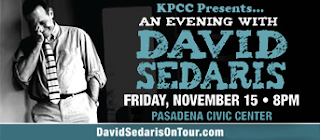
http://www.scpr.org/events/2013/11/15/1139/kpcc-presents-an-evening-with-david-sedaris/
KPCC FM, Pasadena (scpr.org) presents comedian David Sedaris

The Future: sutra, time travel, cartoon (video)

Amber Larson and Dhr. Seven, Pat Macpherson, Wisdom Quarterly translation based on Ven. Thanissaro, Anagata-bhayani Sutta, "Discourse on Future Dangers" (AN 5.78)
The future: where you and I will spend the rest of our lives...when cartoons have been rendered useless by the lolcats (Tom Tomorrow/thismodernworld.com)
 
"Meditators, five future dangers are enough, when considered, for one living in a remote setting -- heedful, ardent, and resolute -- to live for attaining the not-yet-attained, reaching the not-yet-reached, realizing the not-yet-realized. What five?


Mr. Peabody & Sherman use the Wabac (Way Back) to travel in time
 
1. "One reminds oneself: At present I am young, dark-haired, endowed with the blessings of youth, in the first stage of life. But a time will come when this body will be beset by old age. When one is overcome by old age and decay, it is not easy to practice the Buddha's teachings. It is not easy to reside in seclusion in peaceful forest or wilderness dwellings [beneficial for rapid success in Buddhist serenity and insight forms of meditation].

"Before this disagreeable, distressing, unwelcome thing happens, let me make an effort for attaining the not-yet-attained, reaching the not-yet-reached, realizing the not-yet-realized, so that -- endowed with this instruction (Dharma) -- I will live in peace even when old.
 
"This is the first future danger that is enough, when considered, for one -- heedful, ardent, and resolute -- to live for attaining the not-yet-attained, reaching the not-yet-reached, realizing the not-yet-realized.

"Free Birds" - Going back in time to get turkeys off the menu
 
2. "Furthermore, one reminds oneself: At present I am free of illness and discomfort, endowed with healthy digestion: not too cold, not too hot, moderate and agreeable. But a time will come when this body will be beset by illness. When one is overcome by illness, it is not easy to practice the Buddha's teachings. It is not easy to reside in seclusion in peaceful forest or wilderness dwellings.

"Before this disagreeable, distressing, unwelcome thing happens, let me make an effort for attaining the not-yet-attained, reaching the not-yet-reached, realizing the not-yet-realized, so that -- endowed with this instruction -- I will live in peace even when sick.
 
"This is the second future danger that is enough, when considered, for one -- heedful, ardent, and resolute -- to live for attaining the not-yet-attained, reaching the not-yet-reached, realizing the not-yet-realized.

Original Mr. Peabody Dog and Boy Sherman (1959), "Rapunzel"
 
3. "Furthermore, one reminds oneself: At present food is plentiful, and alms are easy to come by. It is easy to maintain oneself by gleanings and patronage. But a time will come when there is famine: Food will be scarce, alms hard to come by, and it will not be easy to maintain oneself by gleanings and patronage. When there is famine, people will congregate where food is plentiful. There they will live packed and crowded together. When one is living packed and crowded together, it is not easy to practice the Buddha's teachings. It is not easy to reside in seclusion in peaceful forest or wilderness dwellings.

"Before this disagreeable, distressing, unwelcome thing happens, let me make an effort for attaining the not-yet-attained, reaching the not-yet-reached, realizing the not-yet-realized, so that -- endowed with this instruction -- I will live in peace even when there is famine.
 
"This is the third future danger that is enough, when considered, for one -- heedful, ardent, and resolute -- to live for attaining the not-yet-attained, reaching the not-yet-reached, realizing the not-yet-realized.

Family Guy/original "Back to the Future" blend

4. "Furthermore, one reminds oneself: At present people are living in harmony, on friendly terms, without quarreling, like milk and water, looking at one another with eyes of affection. But a time will come when there is danger due to an invasion by savage outsiders. Taking power, they will surround the countryside. When there is danger, people will congregate where it is safe. There they will live packed and crowded together. When one is living packed and crowded together, it is not easy to practice the Buddha's teachings. It is not easy to reside in seclusion in peaceful forest or wilderness dwellings.

"Before this disagreeable, distressing, unwelcome thing happens, let me make an effort for attaining the not-yet-attained, reaching the not-yet-reached, realizing the not-yet-realized, so that -- endowed with this instruction -- I will live in peace even when there is danger.
 
"This is the fourth future danger that is enough, when considered, for one -- heedful, ardent, and resolute -- to live for attaining the not-yet-attained, reaching the not-yet-reached, realizing the not-yet-realized.

Traffic? The first "movie" (30 secs) ever filmed in Los Angeles, 1899
  
5. "Furthermore, one reminds oneself: At present the community (Sangha) -- harmonious, on friendly terms, without quarreling -- lives in comfort with a communal recitation [of the guidelines of the path-to-liberation]. But a time will come when the community is split. When the community is split, it is not easy to practice the Buddha's teachings. It is not easy to reside in seclusion in peaceful forest or wilderness dwellings.
 
"Before this disagreeable, displeasing, unwelcome thing happens, let me make an effort for attaining the not-yet-attained, reaching the not-yet-reached, realizing the not-yet-realized, so that -- endowed with this instruction -- I will live in peace even when the community is split.
 
"This is the fifth future danger that is enough, when considered, for one -- heedful, ardent, and resolute -- to live for attaining the not-yet-attained, reaching the not-yet-reached, realizing the not-yet-realized.
 
"These are the five future dangers that are enough, when considered, for one -- heedful, ardent, and resolute -- to live for attaining the not-yet-attained, reaching the not-yet-reached, realizing the not-yet-realized."

Literal time travel

 
Time travel may already be a functional reality
(C2C/DiscloseTruthTV) "Time travel is possible and already being done" according to attorney Andrew Basiago from the US government's Project Pegasus (DARPA/CIA). Basiago and his father served in the secret program. He blows the whistle on the current state of the cover up and surveillance technology being deployed. This includes chronovision, a natural quantum-access time-visualization technology to see events recapitulated in time through a TV-like box, suggesting that "time" -- along with various alternative timelines -- is constantly occurring rather than dead and gone. Events leave a cyclical residual signal that can be amplified, as was discovered during investigations of Gregorian chant harmonics, as well as incipient signals of future events. These fading signals, like ripples in a pond, can be amplified in the lab -- and this has already been done. Elite physicists, like Fermi of Fermilab fame, were well aware of this discovery and its theoretical, experimental, as well as practical implications. One device, Basiago explains, "generates a hologram of a past or future event...by driving an electromagnetic signal through an octagonal, an eight-sided array of bismuth crystals." Time travelers like Basiago were trained in its use. Basiago last saw these technologies in 1972, when he left the program. However, he is convinced that chronovision has been implemented by the US intelligence community to aid in its widespread spying programs.
Who is Andrew D. Basiago? His father was a project principal, and he became a project participant. He a is a lawyer, writer, 21st century visionary, and future presidential candidate (Barry Obama was also involved in Project Pegasus and Mars travel). He is an emerging figure in the Disclosure Movement leading a campaign to lobby the US government to tell the truth and disclose its involvement in various mind bending controversies. Beyond mindboggling time travel, near instant travel to Mars to see the life forms living there, and "quantum access" to past and future events. He has been identified as the first of two major planetary whistleblowers predicted by ALTA, the Web Bot project that analyzes the content of the Web to discern future trends.