Showing posts with label chinese. Show all posts

Wednesday, 30 July 2014

"Monkey Mind" in Meditation

Michael Carr; CC Liu, Pat Macpherson, Seth Auberon, Wisdom Quarterly (Wiki edit)
What's monkey mind? Hold on a second, I'll look on Wisdom Quarterly (Huffington Post).
.
Obsessed with sexy distractions (Uhohbro).
Monkey mind (or mind monkey) comes from the Chinese word xinyuan and the Sino-Japanese shin'en (心猿), literally, "heart-/mind-monkey").

It is a Buddhist term meaning "restless, unsettled, capricious, whimsical, fanciful, inconstant, confused, indecisive, uncontrollable." In addition to Buddhist writings -- including Chinese Chan and Japanese Zen (two Mahayana sects giving their pronunciations of the Pali term jhan'a and the Sanskrit dhyan'a), Consciousness-Only, Pure Land, and Shingon -- this "monkey mind" psychological metaphor was adopted in Taoism, Neo-Confucianism, poetry, drama, and literature.

"Mind-monkey" occurs in two reversible four-character idioms with yima or iba (意馬), literally, "thought-/will-horse," most frequently used in Chinese xinyuanyima (心猿意馬) and Japanese ibashin'en (意馬心猿).

The "Monkey King" Sun Wukong in the Journey to the West personifies the mind-monkey. Note that much of the following summarizes Michael Carr ("'Mind-Monkey' Metaphors in Chinese and Japanese Dictionaries," International Journal of Lexicography 1993, 6.3:149-180). 

Linguistic and cultural background
Mind monkey piggy backs on horse idea (Tang Dynasty)
"Mind-monkey" (心猿) is an animal metaphor. Some figures of speech are cross-linguistically common, verging upon being linguistic universals.

Many languages use "monkey" or "ape" words to mean "mimic," for instance, Italian scimmiottare "to mock, to mimic" and scimmia "monkey, ape," Japanese sarumane (猿真似), literally, "monkey imitation," "copycat, superficial imitation," and the English monkey see, monkey do or to ape. Other animal metaphors have culture-specific meanings. Compare English chickenhearted as "cowardly, timid," "easily frightened" and Chinese jixin (雞心), literally, "chicken heart," "heart-shaped, cordate."
 
The four morphological elements of Chinese xinyuanyima or Japanese shin'en'iba are xin or shin (心) "heart, mind", yi or i (意) "thought," yuan or en (猿) "monkey," and ma or ba (馬) "horse."

The 心 "heart, mind" and 意 "idea, will"
Mr. Simian! - No, I just meant a pony ride on the "will horse," not us horsing around!
.
The psychological components of the "mind-monkey will-horse" metaphor are Chinese xin or Sino-Japanese shin or kokoro () "heart, mind, feelings, affections, center" and yi or i () "thought, idea, opinion, sentiment, will, wish, meaning."

This Chinese character 心 was graphically simplified from an original pictogram of a heart and 意 "thought, think" is an ideogram combining 心 under yin () "sound, tone, voice" denoting "sound in the mind, thought, idea."
 
In Chinese Buddhism and Japanese Buddhism, xin/shin (心) "heart, mind" generally translates Sanskrit citta "mind, process of mind, state of mind, consciousness" and yi/i (意) translates Sanskrit manas "the mental organ, deliberation."
 
Some Buddhist authors have used 心 and 意 interchangeably for "mind, cognition, thought." Compare these Digital Dictionary of Buddhism glosses:
  • 心 "Spirit, motive, sense. The mind as the seat of intelligence, mentality, idea. (Sanskrit citta)... Thought, intellect, feeling (Sanskrit mānasa)"
  • 意 "Thought, intellect (Sanskrit manas, Tibetan yid), the mind, (Sanskrit citta, Tibetan sems)."
For example, take the Buddhist word Chinese xin-yi-shi or Japanese shin-i-shiki (心意識), literally, "mind, thought, and cognition" that compounds three near-synonyms.
 
The Abhidharma theory uses this word as a general term for "mind, mentality." But Yogacara's theory of Eight Consciousnesses distinguishes xin/shin (心) "store consciousness," yi/i (意) "manas consciousness," and shi/shiki (識) "six object-contingent consciousnesses."
 
Xinyuanyima (心猿意馬), literally, "mind-monkey idea-horse," "distracted, indecisive, restless" is comparable with some other Chinese collocations:
  • xinmanyizu (心滿意足) "heart-full mind-complete," "perfectly content, fully satisfied."
  • xinhuiyilan (心灰意懶) "heart-ashes mind-sluggish," "disheartened, discouraged, hopeless" (or xinhuiyileng (心灰意冷) with leng "cold, frosty."
  • xinhuangyiluan (心慌意亂) "heart-flustered mind-disordered," "alarmed and hysterical, perturbed."
  • xinfanyiluan (心煩意亂) "heart-vexed mind-disordered," "terribly upset, confused and worried"...
"Mind-monkey" in English
Prozac (fluoride) calcifies the pineal gland
Monkey mind and mind monkey both occur in English usage, originally as translations of xinyuan or shin'en and later as culturally-independent images. Carr concludes:
Xinyuan-yima (心猿意馬) "monkey of the heart/mind and horse of the ideas/will" has been a successful metaphor. What began 1500 years ago as a Buddhist import evolved into a standard Chinese and Japanese literary phrase.
Rosenthal (1989:361) says a proverb's success "'depends on certain imponderables," particularly rhythm and phrasing. Of the two animals in this metaphor, the "monkey" phrase was stronger than the "horse" because xinyuan "mind-monkey" was occasionally used alone (e.g., Wuzhenpian) and it had more viable variants (e.g., qingyuan 情猿 "emotion-monkey" in Ci'en zhuan).
The "mental-monkey" choice of words aptly reflects restlessness, curiosity, and mimicry associated with this animal. Dudbridge (1970:168) explains how "the random, uncontrollable movements of the monkey symbolise the waywardness of the naive human mind before it achieves a composure which only Buddhist discipline can effect" (1993:166). More

    Tuesday, 8 April 2014

    Were Anasazi [Native Americans] Buddhists?

    Dhr. Seven (ed.), Wisdom Quarterly; Hendon Harris (chinesediscoveramerica.com)

    The most famous building in the entire Tibetan plateau, Potala Pueblo, Lhasa (HCC)
    Tibetan store (Aaron Berkovich/flickr)
    Were the Anasazi, who are known to many as the Native Americans of the Southwest, Buddhists? 
     
    Buddhism began in the sixth century BCE in India [although the Buddha was from neighboring Afghanistan -- the ancient northwestern frontier of Gandhara and to points west -- where the Dharma quickly took hold among his familial clan simultaneous with its spread in Magadha/modern Bihar, India].

    It soon spread to ancient Greece and parts of its empire in Central Asia [Bactria, Sogdiana, etc., where Alexander the Great left yet another "Alexandria" in Kandahar, Afghanistan, when it was part of the Hellenic Empire], the geopolitical Middle East, and some believe to Europe (Kalmykia) as far north as Scandinavia and even North America, which was partly ancient Mexico, a spread Rick Fields documented in How the Swans Came to the Lake: A Narrative History of Buddhism in America and Edward P. Vining's Inglorious Columbus, which recounts how a group of Afghan Buddhist monks led by Chinese Buddhist missionary Hwui Shan  "discovered" America and therefore interacted with the Native Americans long before the genocidal, Polish, Jewish Christopher Columbus].

    This is where the Native Anasazi (or Ancestral Puebloan people, such as the Hopi, Hisatsinom, and others) come in.
    One piece of evidence is the ancient Buddhist proclivity for carving building and shrines into mountains and creating distinctive rock formations. They are now found all over the world and bear a likeness to that favored by Vedic Hinduism/Buddhism. Buddhism ultimately reached China in the first century ACE, after it had made a grand impact on Greece bringing in many Eastern philosophical idea -- the atom (kalapa), democratic voting and rudimentary parliamentary rules of order (Sangha organization according to the Vinaya), and so on.
     
    The Anasazi culture mysteriously appeared in North America at an undetermined time and disappeared about 1300 ACE. Where did these incredibly advanced people come from? How and why did they just as mysteriously disappear? We know they were astronomers because we have found some of their observatories. We know they were road builders because we have found their roads. We know they were incredibly proficient at stone carving and masonry because we have found evidence of their work and architectural styles in the Four Corners area of the Southwest.
     
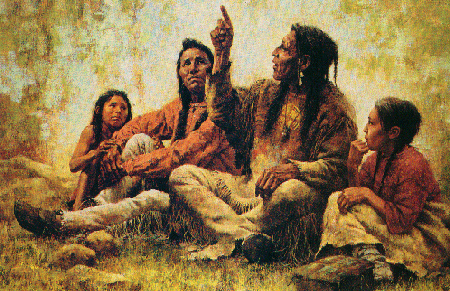
    Native American indigenous Apache, remnant Anasazi spirit dancers, 1887 (Native Skeptic)
     
    These architectural styles and art carved in stone provide the best evidence that the source of the Anasazi culture with its advanced knowledge and artistry was Vedic Asia.
     
    This is a provocative statement likely to offend a few scholars. However, if one takes the time to examine the art and architecture, compare examples from each culture side by side, it will provide clear evidence of their connection.
     
    Rock cliffs of the Grand Canyon, Arizona
    If one were to start by using the image search terms “Were the Anasazi people Buddhist?” one would find that the architectural styles of the Puebloan people (Anasazi) and Chinese Buddhists are so similar that they show up interchangeably on the image page clearly demonstrating that they used the same techniques for carving out rock caves. (See examples of rock caves carved high on the cliffs of Bandelier National Park, New Mexico. They bear an incredible likeness to Asian Buddhist caves). 

    Further search “Architecture-Pueblo complexes and Great Houses” or “Bandelier National Park Rock Cave Images” to see more). Compare these to the Caves of Dunhuang and the Longmen Caves in China or to the recently discovered Shangri-la Buddhist Caves of Nepal all of which are carved high up on rock faces.
     
    Luoyang Shaolin Buddhist temple (G-W-H)
    For evidence of IDENTICAL construction techniques used in ancient China and in ancient North America “zoom in” on these pictures of the rock-cut caves at Bandelier National Monument, USA and the Caves at Dunhuang, China.  Both locations, separated by the vast Pacific Ocean, show identical horizontal rows of small bored holes cut into the cliff faces perhaps to insert wooden pole frames for shade canopies for each location thousands of miles apart.
     
    Tibetan structures are like Puebloan dwellings of the Southwest. This American adobe complex was likely built between 1000-1450 AD near Taos, New Mexico, USA (wiki).
      
    Rock-cut remains, Bandelier, NM, USA
    Ancient Buddhists seem to have been fascinated by rocks shaped a particular way. Here is a very unusually shaped rock in Thailand and an almost identically shaped rock in the Bisti Badlands, New Mexico. 
     
    The Bisti Badlands are an interesting place in the Four Corners region, where the Anasazi people lived. However, the common opinion is that “The Canadian Goose Bisti,” “The Sleeping Lizard Bisti,” “The Flying Turtle Bisti,” and so on are simply random acts of erosion. A more plausible explanation is that these rock formations are ruins of a people exhibiting a Vedic cultural heritage because of at least three different types of rock formations there.
    1. Mushroom rocks like the ones found at Mushroom State Park, Kansas are found throughout these 45,000 acres of badlands. “Mushroom Rocks” are the chattra symbols of ancient Buddhism. Chattra is the Sanskrit word for “mushroom,” which is also the word for the Parasol, one of the Eight Auspicious Symbols of Buddhism. More

    Monday, 24 March 2014

    The Ghost Dance (Native American Buddhism)

    Hendon Harris, Wisdom Quarterly, Xochitl, CC Liu, Ashley Wells (eds.)
    Native Americans are the indigenouss people of what is now the USA (thedqtimes.com)
    Lama in ritual costume and American bison mask performs ghost dance at Taer Monastery in Xining, NW China, Qinghai Province, Feb. 5, 2012. The ghost dance is performed across Tibetan regions to ward off disasters and bring luck and fortune (Zhang Hongxiang/Xinhua).
      
    Tibetan ritual, California (Sacramento Bee)
    There is a link between the Native American "Ghost Dance" (Nanissáanah), which so frightened the Bureau of Indian Affairs (BIA) in the late 19th century, and the Tibetan Buddhist Ghost Dance tradition troubling China today.

    The basis for the Native American Ghost Dance, the sacred circle dance, is a traditional ritual used by many Native Americans since prehistoric times.
     
    Lakota chief (PRIR, 1899/W)
    A new form was first practiced among the Nevada Paiute in 1889. The practice swept throughout much of the Western United States, quickly reaching areas of California and Oklahoma.
     
    Psychologist Michael Katz, in his book Tibetan Dream Yoga, writes: "The last known enactments of the Ghost Dance were held in the 1950s among the Shoshoni. A contemporary Native American leader, Mary Thunder, upon seeing the [Tibetan] Vajra Dance performed, commented on the similarity of the two dances."
     
    The Ghost Dance is a spiritual ritual to regain the tribe's pre-invasion life (thedqtimes.com).
     
    When the Tibetan Ghost Dance was performed at Taer Monastery, Chinese media reported, "The ghost dance is performed across Tibetan regions to ward off disasters and bring luck and fortune."
      
    Buffalo in Tibet? (Eadweard Muybridge)
    "According to the prophet [of peace] Jack Wilson (Wovoka)'s teachings [which prophesied a peaceful end to white expansion, while preaching goals of clean, honest living and cross-cultural cooperation by Native Americans], proper practice of the dance would reunite the living with the spirits of the dead and bring peace, prosperity, and unity to native peoples throughout the region" (James Mooney, The Ghost Dance Religion and Wounded Knee, NY: Dover Publications, 1896).

    It is characterized by a revival of many traditional beliefs and by the fervent expectation that a time of perpetual bliss was immanent (thedqtimes.com).
     
    White postmortem photography (GG)
    The call to return to the Ghost Dance was a call... [to the Native people, to the First Nations, to resist British colonial imperialism, American expansionism, displacement, and genocide. The same holds true when Tibetan Buddhist dancers perform the same ritual, frightening Chinese officials who in Tibet are the imperial forces, expansionists, and perpetrators of displacement and a cultural genocide.]

    No dance means war (Siege of New Ulm)
    The Sioux variation on the Ghost Dance tended towards millenarianism, an innovation that distinguished the Sioux interpretation from Jack Wilson's original teachings. The Caddo Nation still practices the Ghost Dance today (Phil Cross, "Caddo Songs and Dances," Caddo Legacy from Caddo People).

    Moonlight Dance: Early "Indians" of India
    Ashley Wells (ed.), Wisdom Quarterly, Wikipedia edit
    When the Moon appears over the hills...
    Thabal Chongba is a popular ManipuriIndian folk dance associated with the Yaoshang festival. Manipuri Indians, or Meiteis, are the majority ethnic group of Manipur, India; they are made up of seven clans, who trace their written history back to 33 AD).
     
    They know our dances in ancient India? (SW)
    The literal meaning of thabal is "moonlight," and chongba means "dance" or "leap," thus "dancing in the moonlight" (Encyclopaedia of Indian Tribes, Shyam Singh Shashi, Anmol Publications, 1997). Traditionally conservative parents in Manipur, India, did not allow their daughters to go out and meet young men without their consent. Thabal Chongba therefore provided the only chance for girls to meet and talk to boys (Grapevine). In earlier times, this dance was performed in the moonlight accompanied by folk songs. The music is rhythmic beating of drums accompanied by other instruments....
     
    We need Native boy dancers (Hans Thoma)
    As soon as the Moon rises over the hills, the flute, the drums, and the cymbals start pouring out music. The boys and girls in a circle clutch each other's hands with rhythms of music slow and fast, high and low, upbeat and down. If the number is great, they may form two or three rows so everyone can participate. More
     
    "Native Chineseans" - Tibetans post-Chinese invasion, Potala Pueblo Palace, Lhasa (WQ)

      Sunday, 23 March 2014

      The Zen of Field Tripping ($10 tour)

      Roshi Jeff Albrizze, Wisdom Quarterly; The Buddhist Progress Society (hsilai.org)
      Hsi Lai Temple ("Going West" Monastery), Hacienda Heights, suburban Los Angeles, CA
      Hillside parking lot, main entrance, Hsi Lai (Jesse Kaplan/TheGuibordCenter.org)
        
      Courtyard with dining hall behind
      PasaDharma provides a place to practice Zen. With an idea of having no ideas but "just sitting," the trip often remains on the mat. However, on Saturday (March 29) the local sangha will take up mats and walk around the grounds of the largest Buddhist temple complex in the western hemisphere: Hsi Lai ("Going West") on a hill that separates the eastern suburbs of Los Angeles from Orange County. This is a field trip.

      Carpooling provided from Pasadena at 10:30 am. Those driving themselves are invited to meet at the temple at 11:00 am or join the carpool caravan going east to the temple. Chinese vegetarian lunch at 11:30 am. Tour starts at 1:30 and concludes at 3:00 pm.
      • Saturday March 29th, 2014
      • 3456 S. Glenmark Drive
      • Hacienda Heights, CA 91745
      What is Hsi Lai?
      WQ at Hsi Lai full moon observance
      This massive Taiwanese Mahayana Buddhist temple encompasses 15 acres and a floor area of 102,430 square feet. The temple's dynastic Ming (1268-1644 CE) and Ching (1644-1911 CE) architecture is reflected in its buildings, gardens, fountains, and statuary. Chinese speakers may regard Hsi Lai as "Coming to the West," signifying the dedication of the Buddha's Light Mountain (Fo Guang Shan) Buddhist Order to spread the teachings of the Buddha to the Western world. It is incluseve and provides Theravada as well as Mahayana teachings, having established the first Buddhist universities (University of the West) in the US. The founder, Ven. Master Hsing Yun, had previously established Fo Guang Shan, the largest monastery in Taiwan, which encompasses over 600 acres.

      Going West under a full moon (WQ)
      The temple was built to serve as a spiritual and cultural center for those interested in learning more about Buddhism and Taiwanese/Chinese cultural practices. This form of Mahayana came to be called "Humanistic Buddhism" aimed at creating a "Pure Land" on Earth. Built to fulfill these goals in the USA, the temple's objectives are to benefit society through charitable programs, nurture missionary activity through education, spread Dharma through rich cultural observances, and to edify people through traditional Buddhist practices.

      RSVP (Roshi Jeff Albrizze at 626.529.4074 or jeffalbrizze@hotmail.com) so an advanced count can be provided to the temple.
      CARPOOL: Meet at the Pasadena School District parking lot, 351 S. Hudson Ave., Pasadena, cross street East Del Mar Blvd.
      MEET: Main entrance outside first Buddha Hall at 11:00 am; the group will then proceed together to dining hall for lunch, followed by tour starting at the Information Center at 1:30 pm.
      DRESS: Out of respect dress comfortably but appropriately: avoid tank tops, shorts, or mini-skirts, smoking, and please avoid bringing meats of any kind or outside foods and beverages.
      DONATION: $9 (cash only) per person covers delicious all-you-care-to-eat buffet Chinese vegetarian lunch. Museum admission is an additional $1. There is also a temple gift shop with prayer beads (malas), Dharma books, statuettes, souvenirs, and art.

      Humanistic Buddhism & Leadership Online Certificate Program (uwest.edu)

      Thursday, 13 March 2014

      Native American Buddhism and Tibet

      Ashley Wells, Xochitl, Maya, Wisdom QuarterlyHendon Harris  ASK MAYA
      Pueblo/Gompa Lamayuru high in India's Himalayas, Ladakh (DietmarTemps.com)
        
      See that pueblo? - Yes, pa. - It's Tibetan. (CM)
      In response to Buddhism among the Pueblo Indians, USA, Hendon Harris (Chinese Discover America) writes: Thank you, Wisdom Quarterly, for your kind words regarding my work on Native Americans and Tibetan Buddhism. 

      The more research I do, the more I am convinced that Hwui Shan and his four fellow Buddhist clerics from Gandhara (Indo-Pakistan/Afghanistan) actually made it to North America (Fu Sang) in 458 CE as he reported.
      Native American (SuperG82/flickr)
      I understand your objection to my use of the [portmanteau] term "Vedic Buddhism." You are technically correct.

      The reason I have used those words together is to make a point. Buddhism began in a Vedic environment and as a result shares much in common even to this day with Hinduism and the other Dharmic religions of ancient India. 

      A proper understanding of the cultural connections between these religions, particularly in ancient times, is essential for understanding the mix of symbols and customs that show up today dating from ancient times here.

      Tibetan dancer, monk (CD)
      [Well, Hendon, it is certainly true that Buddhism/Jainism and Hinduism share many themes, symbols, motifs, and cultural roots, yoga being the result of the influence of shramanic religions (Buddhism and Jainism being the two most popular and long-lived) on Brahminical Vedantic "Hinduism" (all of the traditions of the Indus River area taken by the British who coined the term "Indus-ism" as one post-Indus Valley Civilization conglomerate no matter how different they are) -- taking it from temple priesthood and intermediaries between people and God(s) into a forest tradition and direct personal experience. May we suggest "Indian Buddhism" or "Buddhistic Hinduistic"?]

      Buddhism went "West" from Gandhara!
      The Native American Seven Step Seven Vow Wedding Ceremony is a Hindu tradition. Phallic symbols (lingam) are common to ancient India's Dharmic religions as are mandalas, mantras, and manjis (swastikas) [-- not to mention the very name "Indian" referring to both disparate populations]. I have to be able to explain the cross section of evidence.

      REPLY: Hendon, as for your central question -- "Did the Chinese discover America?" -- the answer is yes: Buddhism In America, Part 1Buddhism in Mexico before Christianity, Mexican Buddhists (BBC)... It is all laid out by Rick Fields in How the Swans Came to the Lake: A Narrative History of Buddhism in America (Shambhala.com), which could have been titled how Chinese Buddhist monks stumbled onto the American continent (Mesoamerica) a thousand years ago, centuries before Columbus brought conquest and Catholicism or the British sent pilgrims and capitalism. Who really discovered America? According to historians, the Chinese were here before Columbus.

      Chinese discover America (in 1421) long before Europeans

      Siberian Vajrayana Buddhist animist in teepee, Tsaatan wigwam, Mongolia (Hamid Sardar)

      Friday, 7 March 2014

      7-Day Kwan Yin Ceremony (March 9-16)

      Dhr. Seven, Ven. Abbess, D. Tan, Wisdom Quarterly; Ling Yen Mountain Temple, California
      Kwan Yin Bodhisattva, Kwannon, Avalokitesvara (Mig_T_One/flickr.com)
      In celebration of Guan Yin Bodhisattva’s BIRTHDAY as well as that of beloved Ven. Master Miao Lien, Ling Yen Mountain Temple is conducting two 7-Day Guan Yin Dharma Services.
      Kwan Yin Bodhisattva, Mu Ryang Sa Temple (WileyImages.com/flickr.com)

      Monday, 17 February 2014

      The legend of Goddess of Mercy Kwan Yin


      Linh Phuoc Pagoda ("Dragon Pagoda"), Da Lat, Vietnam
      Golden Buddha in Dragon Pagoda
      When first stepping into this area, one notices the cool atmosphere, which is in stark contrast to the blazing sun outside the compound. One can see the giant statue of Guan Yin Bodhisattva, the Buddhist "Goddess of Compassion." She is accompanied by many smaller statues and an interior of beautiful in-laid terracotta dragons (nagas) and porcelain mosaics.

      THE LEGEND OF QUAN YIN
      Goddess of Mercy
      Kwan Yin figurine (Holy Mountain Trading Co.)
      One of the "deities" most frequently seen on altars in China's temples is Kwan Yin (also Quan Yin, Kuanyin, Guanyin). In Sanskrit, her name is Padma-pâni, or "Born of the Lotus." Kwan Yin, alone among all Buddhist devas, is universally loved. She is the model of Chinese beauty.
       
      Regarded by the Chinese as the "Goddess of Mercy," she was originally male until the early part of the 12th century and has evolved since that time from her prototype, Avalokiteshvara, "the merciful lord who looks down [from on high]," an Indian enlightenment-being (bodhisattva), who chose to remain on Earth to bring relief to those suffering rather than enjoying for himself the ecstasies of complete-liberation (nirvana).
       
      One of the several stories surrounding Kwan Yin is that she was a human Buddhist who through great love and sacrifice during life had earned rebirth in [a paradise] after death.
       
      Avalokiteshvara
      However, like Avalokiteshvara, while standing before the gates of paradise, she hears a cry of anguish from the Earth below. Turning back, she renounces her reward of bliss but in its place finds immortality in the hearts of the suffering. In China she has many names; she is also known as "Great Mercy, Great Pity, Salvation from Misery, Salvation from Woe, Self-Abiding, Thousand Arms, Thousand Eyes," and so on. 
       
      In addition, she is often referred to as the Goddess of the Southern Sea -- the Indian Archipelago -- and has been compared to the Virgin Mary. She is one of the San Ta Shih, or the "Three Great Beings," renowned for their power over the animal kingdom or the forces of nature. These three bodhisattvas or P'u Sa as they are known in China, are Manjusri (Sanskrit) or Wên Shu, Samantabhadra or P'u Hsien, and Avalokiteshvara or Kwan Yin. More