Showing posts with label thinking. Show all posts

Wednesday, 30 July 2014

"Monkey Mind" in Meditation

Michael Carr; CC Liu, Pat Macpherson, Seth Auberon, Wisdom Quarterly (Wiki edit)
What's monkey mind? Hold on a second, I'll look on Wisdom Quarterly (Huffington Post).
.
Obsessed with sexy distractions (Uhohbro).
Monkey mind (or mind monkey) comes from the Chinese word xinyuan and the Sino-Japanese shin'en (心猿), literally, "heart-/mind-monkey").

It is a Buddhist term meaning "restless, unsettled, capricious, whimsical, fanciful, inconstant, confused, indecisive, uncontrollable." In addition to Buddhist writings -- including Chinese Chan and Japanese Zen (two Mahayana sects giving their pronunciations of the Pali term jhan'a and the Sanskrit dhyan'a), Consciousness-Only, Pure Land, and Shingon -- this "monkey mind" psychological metaphor was adopted in Taoism, Neo-Confucianism, poetry, drama, and literature.

"Mind-monkey" occurs in two reversible four-character idioms with yima or iba (意馬), literally, "thought-/will-horse," most frequently used in Chinese xinyuanyima (心猿意馬) and Japanese ibashin'en (意馬心猿).

The "Monkey King" Sun Wukong in the Journey to the West personifies the mind-monkey. Note that much of the following summarizes Michael Carr ("'Mind-Monkey' Metaphors in Chinese and Japanese Dictionaries," International Journal of Lexicography 1993, 6.3:149-180). 

Linguistic and cultural background
Mind monkey piggy backs on horse idea (Tang Dynasty)
"Mind-monkey" (心猿) is an animal metaphor. Some figures of speech are cross-linguistically common, verging upon being linguistic universals.

Many languages use "monkey" or "ape" words to mean "mimic," for instance, Italian scimmiottare "to mock, to mimic" and scimmia "monkey, ape," Japanese sarumane (猿真似), literally, "monkey imitation," "copycat, superficial imitation," and the English monkey see, monkey do or to ape. Other animal metaphors have culture-specific meanings. Compare English chickenhearted as "cowardly, timid," "easily frightened" and Chinese jixin (雞心), literally, "chicken heart," "heart-shaped, cordate."
 
The four morphological elements of Chinese xinyuanyima or Japanese shin'en'iba are xin or shin (心) "heart, mind", yi or i (意) "thought," yuan or en (猿) "monkey," and ma or ba (馬) "horse."

The 心 "heart, mind" and 意 "idea, will"
Mr. Simian! - No, I just meant a pony ride on the "will horse," not us horsing around!
.
The psychological components of the "mind-monkey will-horse" metaphor are Chinese xin or Sino-Japanese shin or kokoro () "heart, mind, feelings, affections, center" and yi or i () "thought, idea, opinion, sentiment, will, wish, meaning."

This Chinese character 心 was graphically simplified from an original pictogram of a heart and 意 "thought, think" is an ideogram combining 心 under yin () "sound, tone, voice" denoting "sound in the mind, thought, idea."
 
In Chinese Buddhism and Japanese Buddhism, xin/shin (心) "heart, mind" generally translates Sanskrit citta "mind, process of mind, state of mind, consciousness" and yi/i (意) translates Sanskrit manas "the mental organ, deliberation."
 
Some Buddhist authors have used 心 and 意 interchangeably for "mind, cognition, thought." Compare these Digital Dictionary of Buddhism glosses:
  • 心 "Spirit, motive, sense. The mind as the seat of intelligence, mentality, idea. (Sanskrit citta)... Thought, intellect, feeling (Sanskrit mānasa)"
  • 意 "Thought, intellect (Sanskrit manas, Tibetan yid), the mind, (Sanskrit citta, Tibetan sems)."
For example, take the Buddhist word Chinese xin-yi-shi or Japanese shin-i-shiki (心意識), literally, "mind, thought, and cognition" that compounds three near-synonyms.
 
The Abhidharma theory uses this word as a general term for "mind, mentality." But Yogacara's theory of Eight Consciousnesses distinguishes xin/shin (心) "store consciousness," yi/i (意) "manas consciousness," and shi/shiki (識) "six object-contingent consciousnesses."
 
Xinyuanyima (心猿意馬), literally, "mind-monkey idea-horse," "distracted, indecisive, restless" is comparable with some other Chinese collocations:
  • xinmanyizu (心滿意足) "heart-full mind-complete," "perfectly content, fully satisfied."
  • xinhuiyilan (心灰意懶) "heart-ashes mind-sluggish," "disheartened, discouraged, hopeless" (or xinhuiyileng (心灰意冷) with leng "cold, frosty."
  • xinhuangyiluan (心慌意亂) "heart-flustered mind-disordered," "alarmed and hysterical, perturbed."
  • xinfanyiluan (心煩意亂) "heart-vexed mind-disordered," "terribly upset, confused and worried"...
"Mind-monkey" in English
Prozac (fluoride) calcifies the pineal gland
Monkey mind and mind monkey both occur in English usage, originally as translations of xinyuan or shin'en and later as culturally-independent images. Carr concludes:
Xinyuan-yima (心猿意馬) "monkey of the heart/mind and horse of the ideas/will" has been a successful metaphor. What began 1500 years ago as a Buddhist import evolved into a standard Chinese and Japanese literary phrase.
Rosenthal (1989:361) says a proverb's success "'depends on certain imponderables," particularly rhythm and phrasing. Of the two animals in this metaphor, the "monkey" phrase was stronger than the "horse" because xinyuan "mind-monkey" was occasionally used alone (e.g., Wuzhenpian) and it had more viable variants (e.g., qingyuan 情猿 "emotion-monkey" in Ci'en zhuan).
The "mental-monkey" choice of words aptly reflects restlessness, curiosity, and mimicry associated with this animal. Dudbridge (1970:168) explains how "the random, uncontrollable movements of the monkey symbolise the waywardness of the naive human mind before it achieves a composure which only Buddhist discipline can effect" (1993:166). More

    Wednesday, 11 June 2014

    Psychology: "mindfulness" in science (audio)

    Amber Larson, Dhr. Seven, CC Liu, Crystal Quintero, Wisdom Quarterly; Ven. Nyanatiloka; Professor Ellen Langer (Harvard/ellenlanger.com), Krista Tippett (onbeing.org, 5-29-14)
    What could Sid or the Buddha teach Ziggy Freud on the psychotherapeutic couch?
    Note the Buddha heads behind Dr. Freud's chair. This is the original therapy couch (HW)
    Langer says keep it simple; notice things rather than practicing mindlessness (Kris Krug)
     
    Science of Mindlessness and Mindfulness
    Counter Clockwise
    Harvard University social psychologist Prof. Ellen Langer's unconventional studies have long suggested what brain science is now revealing: 

    Our "experiences" are formed by the words and ideas we attach to them, that is, the labels we add to our cognitions. Naming something "play" rather than "work" can mean the difference between delight and drudgery. 

    She is one of the early pioneers -- along with figures like Buddhist researcher Jon Kabat-Zinn and Herbert Benson -- drawing a connection between mindlessness and unhappiness and between mindfulness and health. 

    Going deeper
    "Mind" (citta) is a process, not a thing.
    Buddhism is not mere material "science" (the particle physics the Buddha talked about in terms of kalapas) but goes beyond materiality to mental- and mystical-experience, detailing processes that science has yet to acknowledge, detail, or come anywhere near explaining.
     
    The Buddha meant two distinct practices, mindfulness/clarity (sati-sampajañña) -- present time awareness that does not reach back into the past or project forward into the future -- and the fourfold setting up of mindfulness (satipatthana/vipassana) as a formal meditation practice that, on top of absorption, leads to insight and liberation of mind and heart.
     
    Buddha's Brain (Dr. Rick Hanson)
    Dr. Langer describes just the initial practice of "mindfulness," bare awareness, which is possible without formal meditation or yoga.

    She recommends the basic practice of “the simple act of actively noticing things.”
     
    This is bare awareness, which in a Buddhist context is practiced as "presence of mind" in the absence of the internal distractions that come from discursive elaboration (thinking about), mental proliferation (papañca), and interpretation/color-commenting based on our mental formations and fabrications (sankharas).
    Psychologists distinguish "top-down processing" (projecting, seeing what one thinks is there, going from the mind to the outside world) from "bottom-up processing" (going from what's actually there to the mind that perceives it and attempts to understand it free of prejudice).

    What is "mind"?
    This gray material goo is not "mind."
    MIND in Buddhism can refer to consciousness (viññāṇa), knowing (ñāna, one of the "psychic powers" or iddhis, a synonym of wisdom/paññā, the best and hightest being aññā), discrete mental processes (cittas), the "mind door" near the heart, perception (saññā), the ~50 mental formations (sankharas) led by volition/will (which is the basis of karma), or more comprehensively as the Four Aggregates (Sanskrit skandhas, Pali khandhas) apart from the first, namely, form or materiality (rūpa). More

    Thursday, 26 December 2013

    Dr. Moody: Everyone will believe in rebirth

    Everyone's "island" is different. So be an island (dipa) unto yourself! (SN 22:43)
     
    Near death experience (NDE) researcher Dr. Moody, M.D. has been studying and documenting the reality of rebirth, post mortem consciousness, and the existence of other dimensions. On Jan. 17-18, 2014 he is conducting a seminar and claimed on Coast to Coast that he will reveal a bombshell breakthrough in the scientific study of future and past lives. 

    Neverland, Nonsense, Afterlife, Living Wisely
    The story of Peter Pan has long been described as a metaphor for childhood and immortality.

    Dr. Moody's new and groundbreaking work Nonsense (following Life After Life) shows that Peter Pan's story may also be a metaphor for understanding how nonsense can be a key to creating new language and thinking regarding the afterlife.

    Understanding the afterlife offers us wisdom for living now. J.M. Barrie, author of Peter Pan, shared that Neverlands are found in the minds of children. Although they always seem to be more or less an island resembling one another, they are not the same from one child to the next.

    For example, John Darling “had a lagoon with flamingos flying over it,” while his little brother Michael “had a flamingo with lagoons flying over it.”  Like Dr. Moody describes in his research on Near Death Experiences... More
      
    The Power of Nonsense
    Beauty and the bullet, Mona mad for the MIC?
    "Nonsense wakes up the brain cells," according to Dr. Seuss. Science has brought humanity a long way during the last 400 years. We have cured [or at least developed profitable "treatments" for] innumerable diseases, mastered human flight, split the atom, and sent humans to the moon. So why do so many of our deepest mysteries remain beyond the reach of reason?

    I have discovered a hidden collective cognitive flaw that impairs our ability to think cogently about some very fundamental problems of science, philosophy, and religion.

    I am a psychiatrist and professor of philosophy and logic. During my almost 50-year career, I have examined a glitch that is practically built into the way we think. When Aristotle codified logic [for the Western world, having borrowed so much from India] 2,300 years ago, he left a gap, an area of incompleteness that compromises our ability to think rationally about important questions that do not fit easily into the literal frame of... More 

    Neverland 
    So how does one get to Neverland? Walt Disney popularized the directions to Neverland by giving the nonsensical directions, “Second star to right, straight on til morning.”  In the novel, however, Barrie said the directions were “second to right, straight on til morning.”

    This is a great metaphor both for both entering the dream world and dying. One second to the right is the difference between being awake (alive) and being on our way in flight in dreams (death) until we wake up in the morning (make our passage to the new afterlife realm).
      
    THE SEMINAR
    Prof. Moody is a medical doctor and author
    The program will guide participants through a process that awakens an important but forgotten power of the mind. The purpose is to enhance critical, analytical, and creative thinking in a rapid, observable way with three main objectives:
    1. Increase critical thinking skills. Democracy depends on citizens' ability to think and debate logically. So this program teaches participants how to think more logically with entertaining exercises that enhance critical thinking skills.
    2. Open new possibilities for advances in numerous fields including science, psychology, and advertising. There are direct applications in many fields, widening the scope of the mind in a way that is useful in any profession.
    3. To enable us to study mystical states of consciousness including near-death experiences in an entirely new way. A study is in progress using the information in this program to understand the language of dying patients in more depth, which will help improve our care of the terminally ill. More

    Tuesday, 12 November 2013

    Is Eckhart Tolle Buddhist? (video)

    Ashley Wells, CC Liu, Wisdom Quarterly; video (Learning the Secret)

    Be here now, sati-sampajjana (P-A)
    Sitting on a park bench, not listening to Jethro Tull but talking with Eckhart Tolle (pronounced eK-heart TOLL-lay), after his own independent "awakening" to the power of NOW. There is this moment, the present moment, and it is always only this moment. So live now. The mind will complicate things. Pain will encourage suffering, but suffering is optional and mind-made. How can we live in the now?

    Presence -- even if being only in the company of someone speaking from presence (mindfulness, presence of mind, alert, constantly aware that it is only the now, what the Buddha referred to as sati-sampajjanna or "mindfulness and clear comprehension) -- keeps us powerful and in the now.

    Tolle seems to have realized, at least intellectually, that there is no self, no permanent "I" to identify with thoughts, feelings, perceptions, and so on. If he has had this realization to the profound level of a stream enterer, one who has entered upon the first stage of what the historical Buddha described as "enlightenment" (bodhi), glimpsing nirvana, certain to make an end of rebirth and all suffering within seven lives, that is doubtful or at least unclear. He does not make that claim. But his realization, however it happened and however he phrases it (since, by his own admission, Tolle is only ever saying the same thing, making the same point in a hundred different ways. See Even the Sun Will Die, a Sounds True double CD interview with Tami Simon), puts him in line with Buddhism. See Minute 28:55, where Tolle begins to talk about the Buddha and the conception of "emptiness" or "spaciousness" (shunyata), what he claims Jesus called "the fullness of life." And he often speaks highly of the Buddha and Buddha's teachings (Dharma).

    He may only have come to a Vedantic conception of reality, the "Timeless or Eternal Truth" (Sanatan Dharma, as Hinduism refers to itself). The Buddha was aware of this perspective, which lives on very strongly in many Mahayana Buddhist conceptions. But the historical Buddha went beyond, to talk about things never heard by the Brahmin priests and ancient Vedic "seers" (rishis) thought to have composed the very ancient Vedas ("Knowledge Books" of the Indus Valley Civilization preserved as India's sacred texts). The Buddha rejected the authority of the Vedas and became not a teacher aligned with the Brahmins, but a Shraman (shramana movement) teacher, the iconoclastic tradition of "wandering ascetics" rejecting the Vedas and independent of Brahmin temple priests, engaged in ritual and memorizing Vedic verses).

    The Power of (the bench) Now
    Under a tree: girlfriend, Eckhart, and filmmaker
    Eckhart Tolle's profound yet simple teachings have already helped countless people throughout the world find inner peace and greater fulfillment in life.

    At the core of his teachings lies the transformation of consciousness, a spiritual awakening that he sees as the next step in human evolution that leaves behind suffering (i.e., mentally-produced pain).
     
    An essential aspect of this awakening consists in transcending our ego-based state of consciousness. This is a prerequisite not only for personal happiness but also for the ending of collective violence on the planet.

    Eckhart Tolle is a much sought-after public speaker who teaches and travels extensively. Many of his talks, weekend intensives, and retreats are published as CDs and DVDs. Most of the teachings are given in English, but occasionally he also gives teaches in German and Spanish. 

    He is a pioneer in using technology to disseminate his teachings. At EckhartTolleTV.com, he gives monthly talks, live meditations, and answers questions from viewers. In addition to The Power of Now and A New Earth, he has written a book designed for meditative (contemplative) reading entitled Stillness Speaks. And a book consisting of selections from The Power of Now is also available, entitled Practicing the Power of Now.
    • There is a lot of money to be made selling what we have difficulty finding as simple as we are told it is. Billionaire media mogul Oprah (oprah.com) pushes and capitalizes on Tolle, too: "I keep Eckhart's book at my bedside. I think it's essential spiritual teaching. It's one of the most valuable books I've ever read."
    Final commentary
    Many ask, "How can I achieve what you have clearly achieved?" To that Tolle has no answer, except to say that he sees it happening more and more, presumably spontaneously and only to a select few. This leaves us to wonder if he thinks no one can hasten the unfoldment, make faster progress, advance the process along, blossom more quickly the way the Buddha taught followers to blossom.
     
    Eckhart Tolle may be a Buddhist at heart, or very close to liberating-insight, but he is not one publicly so. He speaks highly of the Buddha and speaks highly of the Dalai Lama (Minute 44:00), as if the Dalai Lama were an example of enlightenment, which the Dalai Lama very clearly says he is not. And given the way Tolle defines "self" (Minute 1:55) -- whether as presence, a watcher, the wider space in which things happen, the spaciousness in which experience unfolds, or as consciousness itself -- these are all very Hindu/Eastern philosophical conclusions that fall short of what a "stream enterer" realizes in order to make the breakthrough into what the historical Buddha defined as just the first stage of "enlightenment." As Mahayana-Buddhist as all his beautiful teachings may sound at times, it is not in line with the core Mahayana teaching of the Heart Sutra, namely that what is taken as "self" is actually devoid of self, is empty (shunyata). This is the epitome of the perfection of wisdom that liberates Kwan Yin/Avalokitateshvara, the protagonist in the great sutra and climactic mantra known in Sanskrit as the Prajna Paramita.
     
    Hinduism points and says, "Thou art that." It is the twin teaching along with, "Thou art not that." Yet, constantly seeking identification with anything, the realization never dawns (on the Five Aggregates) that things arise dependently originated, not from an eternal "self" or "ego," not from an independent doer, watcher, or experiencer behind the experience. Without this monumental realization, one clings to one or more of the Five Aggregates of Clinging and calls it "self." Ego is bound in ignorance (avidya), bound by the Wheel of Rebirth and Suffering (samsara); ego is not released (moksha) by the ultimate (nirvana).

    Tuesday, 22 October 2013

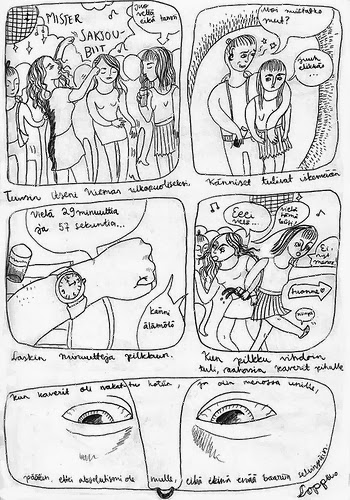
    My cartoon ART is your perception

    Amber Larson, Seven, CC Liu, Wisdom Quarterly; Arkiharha (Scandinavian comic artist Saara, 18, Weekday-Illusion and Arkiharha.Sarjakuvablogit.com)
    What artist would ruin her art by telling anyone what it actually meant? It's as personal to me as it is to you...unless Maroon 5 discovers you on Flickr. Then it's as personal as Adam's agent says Following interpretations not that of the artist! (Arkiharha/flickr)
    The artist Arkiharha, Saara, writes in Finnish.
    What is "art" but a statement, one transcending language? A flag should bear no words. Words, on the one hand, formalize ideas. Images, on the other hand, allow for free-form associations, eidetic, ripe connotations, sly symbolic suggestions, eerie emaciated thinking full of emotions...

    See. See me. Who do you really see?
    It's a different use of cognition, exploiting this or that hemisphere of the brain, if that theory of a difference holds any weight. We use both sides all of the time!

    What it means to the artist is interesting, but what it means to the viewer is almost all that actually matters. 

    I'm a fat American on the Web. I search startpage.com and kuh-ching. I find it! My dream dating site for seniors -- Carbon Dating. Ooh, look at these elder honeys. What should I write? Hi, my is Joe Blow, and I've got lots of cash... This is funnier than the Finnish version.
     
    Cry or don't cry. It's better not to cry, crybaby.
    This is why artists tend to avoid defining their works. Why add a definitive interpretation that might wipe out other equally valid interpretations? It's "Zen."

    Why ask me what I mean when we could all be asking, "What does it mean to me?"? Questions are only for those who question.

    Is there any meaning in the ravings of artists and lunatics?

    Is there any sense in the assertions of critics and passive lovers of art? I mean, what does "Pussy Riot" mean exactly? Nadia can explain, but people will think something else.
    Even "Buddhist art" -- which often symbolizes a narrative or lesson more than existing for its own sake or for devotional abuses -- is what it is to the viewer more than the maker. To be sure, most makers have something in mind. 
     
    But in the end, it's the art that meets the eye, the beauty that beholds it more than the beauty beheld by the eye that counts.
     
    Despicable Me for all to see

    I know! I'll become an "artist"! Then I can really live!
    I saw a dead steer in the sun, worm oozing from its eye. I cried. My tears watered the desert. I took a death cross, set it in the sun, smoked, and let the worms win.
    Girls night out! But I met a guy. It's every gal for herself! Look at the time. Where is she? Let's forget our pact and leave without her! You look different in the morning.