Showing posts with label psychology. Show all posts

Monday, 30 June 2014

Twins and Suicide; My Shink; N. Korea (audio)

Wisdom Quarterly; Glynn Washington, Nancy Lopez (SnapJudgment.org, #514)


Twin sisters Christa and Cara careen after tragedy
Christa Parravani and her twin sister, Cara Parravani, did everything they could to set themselves apart. They wore different styles of clothes, pursued different careers, listened to different music. But when tragedy struck and Christa found herself without her other half, the lengths she went to to get close to her sister were beyond incredible. Christa is a writer and photographer. For more on her life before and after her twin sister, check out her memoir Her.

Baby Steps (Agoraphobia): When trapped inside a jail of our own making, the only liberator up to the task is a fellow prisoner. Joshua Walters is a performer who explores language, creativity, and madness (Producer: Mark Ristich/Sound Design: Leon Morimoto).
    Two Bowls (North Korea): From the "Risk" storytelling podcast comes a story by Christine Lee of love and sustenance in North Korea (Producer: Kevin Allison of Risk)
    • (Skuggi Snaps/flickr.com)
      Not being on or the other ...import/export, or business but to continue the Buddhist missionary work for the existing Japanese American community...
    • Clues and Answers ...the dim cool room in which my grandma sat was filled with Buddhist artifacts. Teak dressers, and framed kimonos.  In the middle of...
    • Creatures of Habit I have two tattoos and counting. I am a budding Buddhist. My spirit animal is Bill Cosby. I’m a writer and anti-hipster....
    • It's not about the bike ... (for 20 minutes) until I regained my Yogic and Buddhist composure. Question: So what did I learn from this experience? 
    • Not AGAIN! So there I was a peaceful little Buddhist boy. I prefer the term W.A.S.A.B.I or "White Anglo Saxon Buddhist Individual" getting ready for my new school. I mentioned offhandedly that... 
    • Killer Camera ...the village where I stayed there was a new house blessing. Buddhist priests had a ceremony and most of the village was there for a...

    Tuesday, 17 June 2014

    I'm in love! (love addiction)

    Danger, drama: Lana Del Rey wants the whole world to love her (New York Times)

    Evolution of the parasite: Tapeworm, Flea, Leech, Vampire Bat, Banker...Love Addict
    How To Break the Pattern of Love Addiction
    Reinvent Yourself: future focus
    Part 2. Might as well face it if you're "addicted" to love. Love does not cure all, not even close.
     
    Rachel Uchitel, an alleged Tiger Woods' mistress, spoke openly about her addiction to love because of her participation in Dr. Drew Pinksy's "Celebrity Rehab." For many people this may be the first time they ever heard about love addiction, so here's a popular post about the topic from last year:
     
    First things first. Take this brief quiz to see if you are likely a "love addict."
    When is love an addiction?
    1. Did you once think that if only someone loved you in that "special way" you would be happy for the rest of your life?
    2. Were you/Are you pre-occupied with the notions of love as expressed in music, movies and fiction?
    3. Have you ever tried to talk yourself into loving someone you weren't particularly fond of because you needed the love NOW?
    4. Have you felt the need to prop up or do a total makeover on your partner early on in your relationship rather than admit that he/she wasn't right for you and end it?
    5. Have you stayed in a bad relationship or repeatedly returned to an ex-partner because you couldn't stand to be alone?
    6. When you are in a committed relationship do you wonder if you chose the RIGHT one or fantasize about a lover from your past, thinking you should have kept him or her and then you would be happier?
    7. Have you used the words "soul mate" in reference to how love should be? ...

    Not crazy in love, getting paid
    No need to score or rate yourself. If you suspect you are a love addict -- don't feel too badly about it. I was a member of the love addicts club for a good portion of my life as well. I too was in love with love.

    I have built my career on this issue, working with ordinary people who are lost when it comes to finding and sustaining a healthy relationship, stuck in a cycle of pain and disappointment in others and themselves.

    They believe that either they just can't find the right one or that the early infatuation waned and they are no longer "in love." Some jump from one relationship to another in search of that wonderful feeling they once had.
     
    Others stay, despite feeling dissatisfied, harboring secret thoughts of leaving, cultivating emotional affairs, or cheating from time to time, having no clue about the real problem.
     
    To be clear, addiction can be defined in a general way as a compulsive (repeated action without choice) and chronic (ongoing over time) pattern of using a substance or behavior for soothing, comforting, and/or arousal. It is used as a means of medicating uncomfortable feelings. "Addicts" typically continue use of their behavior or drug of choice despite negative consequences.
     
    Sex addiction is a compulsive pattern of pursuing sexual arousal independent of emotional attachments. [While this seems common and promoted among American males, it gets so out of control -- for example with online porn addiction -- as to be devastating; attend an SAA meeting and find out how bad if you doubt that such a condition can even exist.]
     
    Love addiction [more common and promoted among American females, so much so that we may consider it "typical" gendered behavior] is a little harder to define simply because by nature we are all "addicted" to love -- meaning we want it, seek it, and have a hard time not thinking about it. More

    Tuesday, 22 April 2014

    Me, Myself, and Why: Science of Self (video)

    Pat Macpherson, CC Liu (eds.), Wisdom Quarterly; author Jennifer Ouellette (Scientific American's "Cocktail Party Physics"), host Sonali Kohlhatkar (UprisingRadio.org)
    Eat cr*p! Do it for yourself! - Eat kindly. Do it for yourself and others.
     
    The colors, look at all the colors
    Scientists are celebrating the success of a new experiment to make precision changes to the DNA of scientifically-tortured mice to cure a human liver disease. 

    The DNA “edits,” as they are calling them, are the latest in a series of genetic studies that are part of a scientific push stemming from the Human Genome Project and related gene sequencing surveys.

    We are taught in high school biology that genes are inherited from parents and determine, to a limited extent, our physical, physiological, and even psychological traits. (Epigenetics would differ from this point of view but has yet to become widely known). Humans share an overwhelmingly large proportion of our genes with one another. 

    What I do I do for science (JF).
    What then creates the stunning diversity we observe among humans? Karma, which is a psychological basis of our subsequent physiology? Chance, which is how science used to explain everything, which is no explanation at all? Do our genes direct our behaviors and our disposition to diseases? What determinant wins in the age-old question, Is it nature or nurture?
     
    Attempting to ask and answer these questions is Scientific American science writer and journalist Jennifer Ouellette, who does not drink much but dropped acid (the entheogen LSD) in her subjective quest for objective science. LISTEN

    Radical radio host and future TV star Sonali Kolhatkar is a scientist or was. Last week she gave this TedX address at Moorpark College in the Valley: "My Journey from Astrophysicist to Radio Host, or How I Found Meaning in My Life"

    Me, Myself, and Why
    Me, Myself, and Why
    Her new book is Me, Myself, and Why: Searching for the Science of Self. Her previous book is [a horror story] called The Calculus Diaries. She has written for the Wall Street Journal, Washington Post, Discover, Salon.com, and Nature. Her science and culture blog is "Cocktail Party Physics," an odd name since Ouellette like us is nearly a teetotaler, who explains: 
     
    As diverse as people appear to be, all of our genes and brains are nearly identical. Me, Myself, and Why dives into the miniscule ranges of variation to understand just what sets us apart. Drawing on cutting-edge research in genetics, neuroscience, and psychology -- enlivened with a signature sense of humor -- the book explores the mysteries of human identity and behavior. 

    Readers ride along on a surprising journey of self-discovery as Ouellette has her genome sequenced, her brain mapped, her personality typed, and even samples a popular 1960s hallucinogen, which more importantly is an entheogen, under very controlled and scientific conditions.

    Bringing together everything from Mendel’s famous pea plant experiments and mutations in The X-Men to our taste for cilantro (coriander) and our relationships with virtual avatars, Ouellette takes us on an endlessly thrilling and illuminating trip into the science of ourselves. More

    Wednesday, 12 February 2014

    Plasticity: Power of Affirmations, Aphrodisiacs

    “What we are today comes from our thoughts of yesterday, and our present thoughts build our life tomorrow: our life is the creation of our mind.” - THE BUDDHA
      
    Think affirmations are New-Agey and trite? I mean, really, as if, “I am the very source of abundance and love itself” taped on the mirror were going to pay that credit card bill in the drawer? 

    I’m going to suggest that we rethink and try on the possibility that affirmations may be at the cutting edge of neuroscience and its sexy sister, PNI, or psycho-neuro-immunology.
     
    See inside free (layoga.com)
    And while an affirmation in and of itself may not be enough to pay bills, practicing affirmations can reshape our brains and thus cause us to incorporate behavioral changes, which can help us do everything from having more successful relationships to better managing our finances.

    “Plasticity” refers to the brain’s ability to reconfigure itself, to establish and to dissolve connections between its different parts. Consider the phrase, “Neurons that fire together wire together” [video]. What exactly does it mean? More

    Aphrodisiacs: Encouraging Love and Vigor
    Arun Deva (layoga.com, Feb. 2014, p. 26)

    http://www.layoga-digital.com/layoga/february_2014#pg66
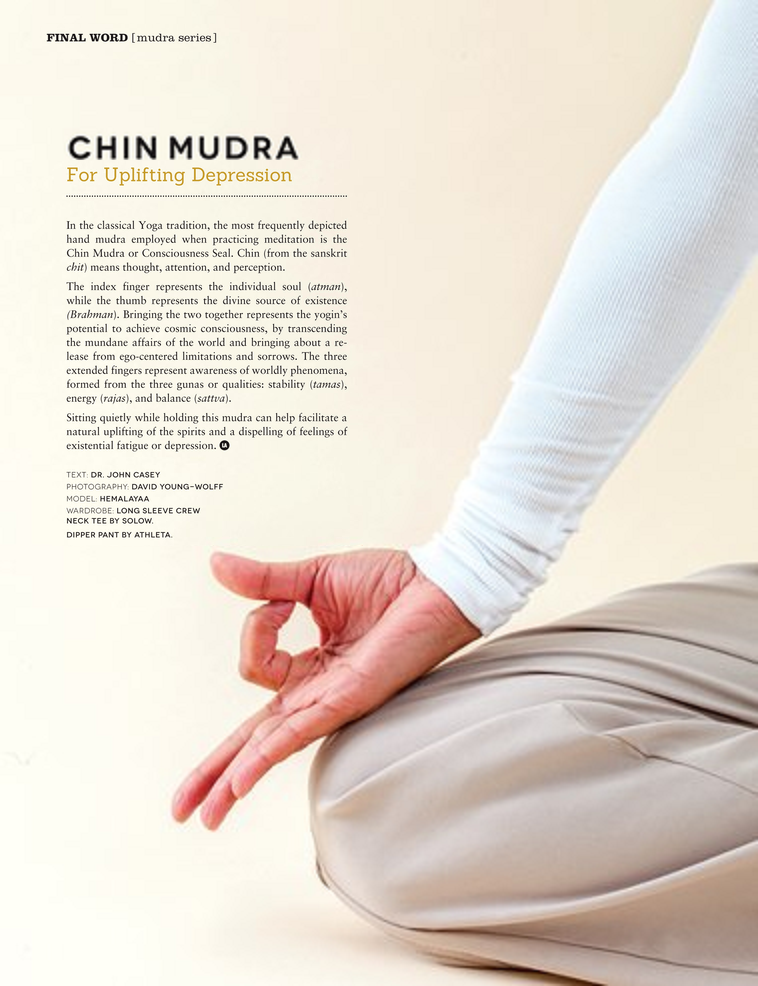
    Depression help (chin mudra)
    We are all fascinated with aphrodisiacs -- the substances or activities that help build our strength and staying power in the bedroom as well as our overall vitality.

    In Ayurveda, the study and use of these is significant. The Sanskrit term for aphrodisiacs is vajikarana, which means "that which imparts the strength of a horse."

    Aphrodisiacs are applicable whatever one’s personal situation. Reproductive fluid, called shukra, circulates throughout the body and is responsible for courage, activity, love, delight, and vigor, according to the ancient Indian medical texts, the Sushruta Samhita and the Charaka Samhita. More

    Also in this issue: massage oils, yogi food, meditation, depression help (mudra), Deepak Chopra, astrology, India.Arie, yogis feeding the homeless, Events Calendar, "Lights, Camera, Yoga!"

    Tuesday, 11 February 2014

    Mindfulness: Business and Behavioral Sciences


    Innovation and creativity are understood as necessary skills for thriving in a dynamic economy, but what is often left out is the role of transforming the mind itself -- as the Buddha recommended.

    Today's overwhelming challenges require leaders to move beyond "being effective" to fundamentally change themselves and how they see and relate to the world. How can individuals and organizations let go of ego and transform mindsets to evoke creativity, productivity, and innovation?

    In this edition of Southern California Public Radio's Drucker Business Forum series SCPR hears about a new model for creative and productive leaders, a model in which innovation is actually a complete mentality, not a business-led process.

    Nick Udall, Ph.D., is CEO of nowhere (now-here.com) and chair of the World Economic Forum's Global Agenda Council on New Models of Leadership, puts it this way: leaders have to "stop taking up space and start making and holding space" to help their organizations deal with facing the unknown.  They must turn the notion of leadership on its head and move beyond their own egos. Udall sits down with Drucker School Assistant Professor of Practice Jeremy Hunter, Ph.D. (Claremont Graduate University, co-author chapter "Making the Mindful Leader: Cultivating Skills for Facing Adaptive Challenges" in the new The Wiley-Blackwell Handbook of the Psychology of Leadership, Change, and Organizational Development.  They will explore how transforming the way leaders and groups relate, learn, and organize can lead to new patterns of thought and innovative action.

    This insightful conversation will draw on their personal and organizational skills to show how awareness, perception, consciousness, and mindfulness can lead to more purposeful, sustainable, innovative -- and successful -- organizations.
     
    Nick Udall works with CEOs and executive leaders of global businesses to develop breakthrough strategies and build cultures of innovation; Chair of the World Economic Forum's Global Agenda Council on New Models of Leadership. His new book, Riding the Creative Rollercoaster: How Leaders Evoke Creativity, Productivity and Innovation, is out this month.

    Tuesday, 29 October 2013

    Our True Ghost Story (video)

    Pat Macpherson, Pfc. Sandoval, Seven, Ashley Wells, Wisdom Quarterly HALLOWEEN TEAM

    (Dave Symes) Now, kids, obey the nice police. They're only here to protect you from expressing yourselves and saying things you might regret later. This is just like the Battle at Kruger:

    (Jason Schlosberg) Now, water buffs, obey the nice lions.
    They're only here to eat you alive.

    Gary Holt, Tom, Kerry King, Paul (LAW)
    One strange (i.e., paranormal) thing did happen at the Slayer concert! It sounds silly to recount it given that one might discuss the societal or interpersonal freak show that most any concert in Hollywood becomes.

    Standing, watching the show from the pit -- a sweaty, chaotic mass of humanity pressing in with everyone blocking the view by throwing up "Hang Ten" hand signs -- it was mesmerizing to watch it for a few seconds from the vantage point of a well placed little screen.

    The person in front was videotaping through a good quality cellphone with a good size screen. He was holding it up above the fray, so by looking up one had a good vantage point. He was focusing it on Kerry King during a quick guitar solo. We very clearly saw Jeff Hanneman playing guitar with his unmistakeable long blond hair.
     
    Not having previously thought much about who else was now playing guitar on tour with Slayer, we were standing stage right in front of the deafening speakers, 20 feet or so away from the stage where the crush of fans is not all-consuming.

    Kerry King (right) and Jeff Hanneman (Jesse Davis biography-tribute video, see below)
    Hey, Jeff, I've been waiting. - Just one more solo, Mara! (namedtranslation.co.uk)
     
    Now when the camera came down, we saw Kerry King playing guitar on our right. We rushed forward to figure out who was stage left. Were there five people up there? No. The Hanneman-replacement (Gary Holt) was on his own side of the stage, and he doesn't look anything like Hanneman. We searched and searched the stage from various angles in case someone had fallen back obstructed by the stacks playing rhythm guitar in addition to the duo, who were not interacting but just keeping to their sides.

    When the camera and arm came down, it had clearly been pointing at a bald, head-tattooed Kerry King, not a long-haired blond guitarist. They look nothing alike. We assumed that who had been in the frame must have just stepped aside, but no. The sheen of Hanneman's hair magnified and amplified, glowing as luminescent pixels on the screen, left an even greater impression, in jarring contrast to King's baldness.
    It is due to karma -- actions willed, carried out, and accumulated -- that one lives.

    Flesh eating bacteria destroy a limb (wiki)
    Then it dawned on us whose image had been on that camera screen -- that was DEAD Jeff Hanneman! (Hanneman died this year as a result of  liver failure due to years of drug and alcohol abuse and perhaps demons after a mysterious spider bite that led to him contracting a crippling case of necrotizing fasciitis, "flesh-eating disease," which almost led to the amputation of his right arm). His story is told here:

    Jeff Hanneman (1964-2013) memorial tribute by Jesse Davis

    Did the image appear as a transient interaction between an electronic device and our eyes, the camera capturing and transducing a haint, making visible for a moment what the unaided eye cannot normally see? Or was their a documented intersection of planes: Did Hanneman's image appear on the digital video that person's camera was taking? There was no one on stage who looked anything like Hanneman, certainly no one wielding a guitar. We'll have to go through our messy, poorly lit photos and footage in search of paranormal artifacts.
    Edgar Cayce, Sleeping Prophet
    But if the person who was filming finds Hanneman on it, please contact us! (Leave a comment in the Comments section with a way to contact you). Up the street at the Magic Castle, private members conduct a seance trying to contact the Great Houdini. It's been almost a century, and they have not reported any success. Here along Sunset Blvd., where a bicyclist once died right in front of the Palladium just before a Slayer show, having been driving without a helmet and being side swiped by a slow moving semi truck (a head is no match for asphalt), a deceased band member steps in, occupies, possesses his erstwhile friend and musical partner for a moment of Hollywood glory on stage together again. 

    This really happened, as hokey as it may sound. But "see is believing," and we know what we saw. Without digital evidence there is no sense in others believing. So readers can take comfort in that. Halloween is just a few days away. The Moon is round. And The Veil is thinning in this hemisphere, just as it was a few months ago for Obon in Asia on the other side of the planet. This thinning between the dimensions, the Planes of Existence (as outlined in Buddhist cosmology), allows for the interaction of the worlds here on Earth. We coexist with animals and space-devas ("shining ones") and space-others [asuras, nagas, gandharvas: celestial titans/Annunaki (as explained by Michael "Forbidden Archeologist" Cremo), reptilians/Draconians, and angelic messenger-musicians].

    Saturday, 26 October 2013

    Spirituality: 10 things to make you happier

    Narada Thera (trans), Dhr. Seven, Amber Larson, Wisdom Quarterly, Great Mangala Sutta, "Discourse on Blessings" (Sn 2.4; Khp 5) from Everyman's Ethics (BPS Wheel 14)
    "Those who abide in this way ever remain invincible and established in happiness."
     
    Deva full of splendor visits the forest grove
    SAVATTHI, ancient India - Thus have I heard. Once upon a time a being of light, who illuminated the entire Jeta Grove around Anathapindika's monastery where the Buddha was staying, came to ask a question. 
     
    The night was far spent, and this deva of surpassing splendor came before the Exalted One, saluted him, and respectfully stood to one side. He addressed the Exalted One in verse:
     
    "Many devas and humans, yearning after good, have pondered happiness. [Commentary: mangala, or "blessings," means what is conducive to happiness and prosperity.] Tell me, what leads to the greatest blessing!"

    (Treasures of Wisdom/earth-spirit/flickr.com)
    [The Buddha answered the deva's question in 10 ways:] 1. "Not to associate with fools, to associate with the wise, to honor those worthy of honor — this is the greatest blessing.
     
    2. To reside in a suitable place [not too noisy, crowded, or distracting, where good people are bent on the performance of the Ten Meritorious Deeds*, and where the Dharma exists as a living principle], to have made merit [profitable karma, good deeds] beforehand, and to set oneself in the right course [making the resolve to abandon immorality for virtue, doubt for confidence, selfishness for generosity] — this is the greatest blessing.
    • *10 Wholesome Actions (kusala-kammapatha) in thought, word, deed: freeing the mind/heart of greed, anger, wrong views; avoiding speech that is untruthful, slanderous, abusive, or frivolous; avoiding killing, stealing, sexual misconduct.
    3. To have much learning, to be skilled [in harmless crafts], well-trained in discipline [self-discipline in thought, word, and deed. Commentary: there are two kinds of discipline — that of the householder, which is abstaining from ten unwholesome actions and that of the monastic, which is the non-transgression of the offenses enumerated in the Path to Liberation (patimokkha, the monastic code)], and to be of good speech [speaking what is opportune, truthful, friendly, profitable, and uttered with thoughts of loving-kindness] — this is the greatest blessing.

    4. To support mother and father, to cherish spouse and children, and to be engaged in a harmless livelihood — this is the greatest blessing.
     
    5. To be generous in giving, to be upright in conduct, to help one's relatives, and to be blameless in action — this is the greatest blessing.
     
    6. To be averse to any more unwholesomeness and to abstain from it, to refrain from intoxicants, and to be steadfast in virtue — this is the greatest blessing.
     
    7. To be respectful, humble, contented, grateful, and to listen to the Dharma on suitable occasions [such as when one is harassed by unwholesome thoughts] — this is the greatest blessing.
     
    8. To be patient and behaved, to associate with inspiring teachers [ascetics], and to have uplifting discussions on suitable occasions — this is the greatest blessing.
     
    9. Self-restraint [suppressing greed and aversion by guarding the senses, abandoning indolence by rousing energy], a wholesome and beneficial life, the perception of the Four Noble Truths [which represent Buddhism in a nutshell], and the realization of nirvana — this is the greatest blessing.
     
    10. A heart/mind undisturbed by good and ill fortune [loka-dhamma: "worldly things," conditions connected with this world, such as these eight: gain and loss, honor and dishonor, praise and blame, pain and joy], from sorrow freed, from defilements cleansed, from fear liberated — this is the greatest blessing.
    • Each of these three expressions refers to the mind of a fully enlightened individual: sorrowless, stainless (free of lust, hate, delusion), security from the bonds of sensual cravings, rebirth, wrong views, and ignorance.
    Those who abide in this way ever remain invincible and established in happiness. These are life's greatest blessings."

    Friday, 25 October 2013

    Science: 10 things to make you happier

    Edited by Wisdom Quarterly based on (Buffer, Aug. 6, 2013) via Higher Perspective and Shawn Achor (The Happiness Advantage)
    Smile! (baconbabble.com)
    The smiling Buddha (atmajyoti.org)
    Happiness is interesting. It may not be the end of suffering, but sometimes it's all we have. It can pleasantly divert us as eustress in a world-of-thought that seems distressing.
     
    There is rapture, bliss, joy (piti), but "happiness" (sukha) provides a nice counterbalance to overt forms of dukkha (misery). We may all have different ideas about what "happiness" is and how to get it, so we would be far better off on a quest for nirvana (the end of all disappointment).

    But, instead, happiness is all we get. Naturally, we get obsessed with it. Most of us would like to be happier. What does science, our great secular "religion" with its white-lab-coat-clad priestly caste, have to say about it? Here are 10 things. 

    1. EXERCISE more: 7 minutes might be enough.
    A seven-minute workout? Says who? The New York Times reports... No time? Maybe there is time. Exercise has a profound effect on happiness and well-being.
     
    It’s been proven to be an effective treatment for overcoming depression. In a study cited by Shawn Achor in The Happiness Advantage, three groups of patients were treated for depression with either medication, exercise, or a combination of the two. The results were that although all three groups experienced similar improvements in their happiness levels to begin with, the follow up assessments proved to be radically different:
     
    The groups were then tested six months later to assess their relapse rate. Of those who had taken the medication alone, 38 percent had slipped back into depression. Those in the combination group were doing only slightly better, with a 31 percent relapse rate. The biggest improvement came from the exercise group: Their relapse rate was only 9 percent! [Exercise beats allopathic medications].
     

    Everyone benefits from exercise. It can help us relax, increase brain power, and improve body image, with or without weight loss.
     
    A study in the Journal of Health Psychology found that people who exercised felt better about their bodies, even when they saw no physical changes:
     
    Body weight, body shape, and body image were assessed in 16 males and 18 females before and after both six times 40 minutes exercise and six times 40 minutes reading. For both, body weight and body shape did not change. However, various aspects of body image improved with exercise.
     
    Exercising makes us happier, according to Leo Widrich. What does it do to our brains? It releases proteins and endorphins that make us feel happier:

    make yourself happier - exercise 

    2. SLEEP more: It makes us less sensitive to negative emotions.
    Surrender to sleep; it does a bodymind good.
    Sleep helps bodies recover from the day as they repair themselves, which helps us focus and be more productive. It’s also important for happiness.
     
    In NutureShock, Po Bronson and Ashley Merryman explain how sleep affects our positivity:

    Negative stimuli get processed by the amygdala [a part of the brain]; positive or neutral memories gets processed by the hippocampus [another part of the brain]. Sleep-deprivation hits the hippocampus harder than the amygdala. The result is the sleep-deprived fail to recall pleasant memories yet can recall gloomy memories just fine.

    In one experiment by Walker, sleep-deprived college students tried to memorize a list of words. They could remember 81% of words with a negative connotation, such as “cancer.” But they could remember only 31% of words with a positive or neutral connotation, such as “sunshine” or “basket.”
    The BPS Research Digest explores another study that proves sleep affects our sensitivity to negative emotions. Using a facial recognition task over the course of a day, the researchers studied how sensitive participants were to positive and negative emotions. Those who worked through the afternoon without taking a nap became more sensitive late in the day to negative emotions like fear and anger.
     
    Using a face recognition task, here we demonstrate an amplified reactivity to anger and fear emotions across the day, without sleep. However, an intervening nap blocked and even reversed this negative emotional reactivity to anger and fear while conversely enhancing ratings of positive (happy) expressions.
     
    Of course, how well (and how long) one sleeps will probably affect how one feels on waking up, which can make a difference to one's whole day. This graph showing how brain activity decreases offers great insight into how important enough sleep is for productivity and happiness:
     
    make yourself happier 
     
    Another study tested how employees’ moods when they started work in the morning affected their work day.Researchers found that employees’ moods when they clocked in tended to affect how they felt the rest of the day. Early mood was linked to their perceptions of customers and to how they reacted to customers’ moods. And most importantly to managers, employee mood had a clear impact on performance, including both how much work employees did and how well they did it.
    3. MOVE closer to work: A short commute is worth more than a big house.
    Is your wife home? - Yeah, she's in there.
    Our commute to the office can have a surprisingly powerful impact on our happiness. The fact that we tend to do this twice a day five days a week makes it unsurprising that its effect would build up over time and make us less and less happy.According to The Art of Manliness, having a long commute is something we often fail to realize will affect us so dramatically:
     
    …while many voluntary conditions don’t affect our happiness in the long term because we acclimate to them, people never get accustomed to their daily slog to work because sometimes the traffic is awful and sometimes it’s not. Or as Harvard psychologist Daniel Gilbert puts it, “Driving in traffic is a different kind of hell every day.”

    We tend to try to compensate for this by having a bigger house or a better job, but these compensations don’t work:
     
    Two Swiss economists who studied the effect of commuting on happiness found that such factors could not make up for the misery created by a long commute.
     
    4. TIME with friends and family: Don’t regret it on your deathbed.
    But those Kennedys keep dying all the time.
    Staying in touch with friends and family is one of the Top 5 regrets of the Dying. It can make us happier right now.
     
    Social time is highly valuable when it comes to improving our happiness, even for introverts. Several studies have found that time spent with friends and family makes a big difference to how happy we generally feel. Harvard happiness expert Daniel Gilbert explains it:
     
    We are happy when we have family, we are happy when we have friends, and almost all the other things we think make us happy are actually just ways of getting more family and friends.
     
    George Vaillant is the director of a 72-year study of the lives of 268 men.In an interview in the March 2008 Newsletter to the Grant Study subjects Vaillant was asked, “What have you learned from the Grant Study men?” Vaillant said: “That the only thing that really matters in life are your relationships to other people.”

    He shared insights of the study with Joshua Wolf Shenk at The Atlantic on how the men’s social connections made a difference to their overall happiness:
     
    The men’s relationships at age 47, he found, predicted late-life adjustment better than any other variable, except defenses. Good sibling relationships seem especially powerful: 93 percent of the men who were thriving at age 65 had been close to a brother or sister when younger.

    Rebeccah, Erika, Isaac, Johnny, and Brennen (Spencer Finnley/BasileiaClothing.com)
      
    In fact, a study published in the Journal of Socio-Economics states than our relationships are worth more than $100,000:
     
    Using the British Household Panel Survey, I find that an increase in the level of social involvements is worth up to an extra £85,000 a year in terms of life satisfaction. Actual changes in income, on the other hand, buy very little happiness.
     
    Actual changes in income buy very little happiness. So we could increase our annual income by hundreds of thousands of dollars and still not be as happy as if we increased the strength of our social relationships.The Terman Study, covered in The Longevity Project, found that relationships and how we help others were important factors in living long, happy lives:
     
    We figured that if a Terman participant sincerely felt that he or she had friends and relatives to count on when having a hard time then that person would be healthier. Those who felt very loved and cared for, we predicted, would live the longest.
     
    Surprise: our prediction was wrong… Beyond social network size, the clearest benefit of social relationships came from helping others. Those who helped their friends and neighbors, advising and caring for others, tended to live to old age.
    5. GO outside: Happiness is maximized at 13.9°C [57.02°F].
    Get outside into the relative warmth.
    In The Happiness Advantage, Shawn Achor recommends spending time in the fresh air to improve happiness:

    Making time to go outside on a nice day also delivers a huge advantage; one study found that spending 20 minutes outside in good weather not only boosted positive mood, but broadened thinking and improved working memory…

    This is pretty good news for those worried about fitting new habits into already-busy schedules. Twenty minutes is a short enough time to spend outside that could easily fit it into a commute or lunch break.
     
    A UK study from the University of Sussex also found that being outdoors made people happier:

    Being outdoors, near the sea, on a warm, sunny weekend afternoon is the perfect spot for most. In fact, participants were found to be substantially happier outdoors in all natural environments than they were in urban environments.

    The American Meteorological Society published research in 2011 that found current temperature has a bigger effect on our happiness than variables like wind speed and humidity, or even the average temperature over the course of a day. It also found that happiness is maximized at 13.9°C. 

    6. HELP others: 100 hours a year is the magic number.
    Each one teach one according to ability.
    One of the most counterintuitive pieces of advice to make ourselves feel happier is to help others. In fact, 100 hours per year (just two hours per week) is the optimal time to dedicate to helping others in order to enrich our lives. 
     
    Going back to Shawn Achor’s book, he says this about helping others:

    …when researchers interviewed more than 150 people about their recent purchases, they found that money spent on activities -- such as concerts and group dinners out -- brought far more pleasure than material purchases like shoes, televisions, or expensive watches. Spending money on other people, called “prosocial spending,” also boosts happiness.

    The Journal of Happiness Studies published a study that explored this topic:

    Friends vs. partners (Spencer Finnley/flickr)
    Participants recalled a previous purchase made for either themselves or someone else and then reported their happiness. Afterward, participants chose whether to spend a monetary windfall on themselves or someone else.
     
    Participants assigned to recall a purchase made for someone else reported feeling significantly happier immediately after this recollection; most importantly, the happier participants felt, the more likely they were to choose to spend a windfall on someone else in the near future.

    Spending money on other people makes us happier than buying stuff for ourselves. What about spending time on other people? A study of volunteering in Germany explored how volunteers were affected when their opportunities to help others were taken away:

    Shortly after the fall of the Berlin Wall but before the German reunion, the first wave of data of the GSOEP was collected in East Germany. Volunteering was still widespread. Due to the shock of the reunion, a large portion of the infrastructure of volunteering (e.g., sports clubs associated with firms) collapsed and people randomly lost their opportunities for volunteering. Based on a comparison of the change in subjective well-being of these people and of people from the control group who had no change in their volunteer status, the hypothesis is supported that volunteering is rewarding in terms of higher life satisfaction.

    In his book Flourish: A Visionary New Understanding of Happiness and Well-being, University of Pennsylvania Professor Martin Seligman explains that helping others can improve our own lives:

    …we scientists have found that doing a kindness produces the single most reliable momentary increase in well-being of any exercise we have tested.

    7. SMILE: It can alleviate pain.
    Turn the frown upside down, Smiley.
    Smiling itself can make us feel better, but it’s more effective when we back it up with positive thoughts, according to this study:

    A new study led by a Michigan State University business scholar suggests customer-service workers who fake smile throughout the day worsen their mood and withdraw from work, affecting productivity. But workers who smile as a result of cultivating positive thoughts -- such as a tropical vacation or a child’s recital -- improve their mood and withdraw less.

    Of course, it’s important to practice “real smiles” where we use your eye sockets as well as our cheeks and mouths. It’s very easy to spot the difference:
     
    make yourself happier smiling
    A is a fake forced smile, whereas B includes the eye sockets as is more convincing
     
    According to UK site PsyBlogsmiling can improve our attention and help us perform better on cognitive tasks:

    Smiling makes us feel good which also increases our attentional flexibility and our ability to think holistically. When this idea was tested (Johnson, et al., 2010), the results showed that participants who smiled performed better on attentional tasks that required seeing the whole forest rather than just the trees.
     
    A smile is also a good way to alleviate some of the pain we feel in troubling circumstances:
     
    Smiling is one way to reduce the distress caused by an upsetting situation. Psychologists call this the facial feedback hypothesis. Even forcing a smile when we don’t feel like it is enough to lift our mood slightly (this is one example of embodied cognition).
    8. PLAN a trip: But don’t take one.
    Not warm enough? Plan a trip to the tropics.
    As opposed to actually taking a holiday, it seems that planning a vacation or just a break from work can improve our happiness. A study published in the journal Applied Research in Quality of Life showed that the highest spike in happiness came during the planning stage of a vacation as employees enjoyed the sense of anticipation:

    In the study, the effect of vacation anticipation boosted happiness for eight weeks. After the vacation, happiness quickly dropped back to baseline levels for most people.

    Author Shawn Achor has some information on this point as well:

    One study found that people who just thought about watching their favorite movie actually raised their endorphin levels by 27 percent.If [one] can’t take the time for a vacation right now, or even a night out with friends, put something on the calendar -- even if it’s a month or a year down the road. Then whenever you need a boost of happiness, remind yourself about it. 

    9. MEDITATE: Re-wire the brain for happiness
    Meditation for Dummies available
    Meditation is often touted as an important habit for improving focus, clarity and attention span, as well as helping to keep you calm. It turns out it’s also useful for improving your happiness:

    In one study, a research team from Massachusetts General Hospital looked at the brain scans of 16 people before and after they participated in an eight-week course in mindfulness meditation. The study, published in the January issue of Psychiatry Research: Neuroimaging, concluded that after completing the course, parts of the participants’ brains associated with compassion and self-awareness grew, and parts associated with stress shrank.
     
    Meditation literally clears the mind and calms us down. It’s often proved to be the single most effective way to live a happier live. This graphic may best explain why:

    calming-mind-brain-waves make yourself happier
     
    According to Shawn Achor, meditation can actually make us happier in the long-term:
     
    Studies show that in the minutes right after meditating, we experience feelings of calm and contentment, as well as heightened awareness and empathy. Research even shows that regular meditation can permanently rewire the brain to raise levels of happiness.
     
    The fact that we can actually alter our brain structure through mediation is most surprising and somewhat reassuring that however we feel and think today isn’t permanent.
     
    10. GRATITUDE pays: It increases happiness and life satisfaction
    It's not just for Hallmark, Inc. anymore. This seemingly simple strategy makes a huge difference to our outlook and happiness levels. There are lots of ways to practice gratitude, from keeping a journal of things we are grateful for, to sharing three good things that happen each day with a friend or partner, to going out of our way to show thanks when others help us.
      
    In an experiment where some participants took note of things they were grateful for each day, their moods improved just from this simple practice:
      
    The gratitude-outlook groups exhibited heightened well-being across several, though not all, of the outcome measures across the three studies, relative to the comparison groups. The effect on positive affect [emotion] appeared to be the most robust finding. Results suggest that a conscious focus on blessings [good fortune] may have emotional and interpersonal benefits.
     
    The Journal of Happiness published a study that used letters of gratitude to test how being grateful can affect our levels of happiness:
     
    Participants included 219 men and women who wrote three letters of gratitude over a three-week period. Results indicated that writing letters of gratitude increased participants’ happiness and life satisfaction, while decreasing depressive symptoms.

    We were born to mature. Ripening means being alive (Martine Franck/magnumphotos.com).
     
    10+ Quick last fact: Maturing (which, yes, means getting older) will make us happier.
    The joyful nuns of Plum Village (Quest4pce)
    As a final amazing point, as we get older, particularly past middle age, we tend to grow happier naturally. There’s still some debate over why this happens, but scientists have got a few ideas:

    Researchers, including the authors of the study, have found that older people shown pictures of faces or situations tend to focus on and better remember the happier ones and less so the negative ones. 
     
    Other studies have discovered that as we age, we seek out situations that will lift their moods. For instance, we prune social circles of friends or acquaintances who bring us down. Still other research finds that older adults learn to LET GO of loss and disappointment over unachieved goals, and hew their goals toward greater well being.
     
    Cooper (hellocode.co)
    So if we thought getting old would make us miserable, rest assured that it’s likely we’ll develop a more positive outlook than we likely have now. The end. Original version posted on Buffer by .