Showing posts with label self. Show all posts
Showing posts with label self. Show all posts
Friday, 8 August 2014
Is it "racism"? Selfies and symbolism (photos)
This summary is not available. Please
click here to view the post.

Tuesday, 17 June 2014
The Affection Sutra
Ashley Wells, Dhr. Seven, Wisdom Quarterly; "Discourse on Affection" (Pema Sutta, AN 4.200)
 |
| Gazing at the massive Buddha at Thimphu in Bhutan (Nikolas Schrader) |
"Meditators, four things are born. What are the four? [More] affection is born of affection. Aversion is born of affection. Affection is born of aversion. And aversion is born of aversion.
What?
"How is affection born of affection? An individual is [considered] pleasing, appealing, and charming. Others treat that person as pleasing, appealing, and charming, and someone thinks, 'This individual is pleasing, appealing, and charming to me [too. After all,] others treat this individual this way.' One gives rise to affection. This is how affection is born of affection [popularity].
"How is aversion born of affection? An individual is pleasing, appealing, and charming to someone. Yet others treat that individual as displeasing, unappealing, and not charming, and one thinks, 'This individual is pleasing, appealing, and charming to me, yet others treat this individual as displeasing, unappealing, and not charming.' One gives rise to aversion for them. This is how aversion is born of affection.
 |
| I'm not an attention hog. My meditation and yoga are really cooking (Hilaria Baldwin) |
"How is affection born of aversion? An individual is displeasing, unappealing, and not charming to someone. And others treat that individual as displeasing, unappealing, and not charming, and one thinks, 'This individual is displeasing, unappealing, and not charming to me, and others treat this individual as displeasing, unappealing, and not charming.' One gives rise to affection for them. This is how affection is born of aversion.
"How is aversion born of aversion? An individual is displeasing, unappealing, and not charming to someone, yet others treat that individual as pleasing, appealing, and charming, and one thinks, 'This individual is displeasing, unappealing, and not charming to me, yet others treat this individual as pleasing, appealing, and charming.' One gives rise to aversion for them. This is how aversion is born of aversion.
"Meditators, these are four things that are born.
"Now, when a meditator, withdrawn from sensuality, withdrawn from unskillful states, enters and remains in the first meditative absorption (jhana) -- with rapture and bliss born of withdrawal, accompanied by initial and sustained attention -- then any affection born of affection does not arise. Any aversion born of affection... any affection born of aversion... any aversion born of aversion does not arise.
"When a meditator... enters and remains in the second meditative absorption... enters and remains in the third meditative absorption... enters and remains in the fourth meditative absorption, then any affection born of affection does not arise. Any aversion born of affection... any affection born of aversion... any aversion born of aversion does not arise.
"When a meditator, by abandoning mental defilements, enters and remains in the defilement-free release of the heart and release by wisdom, having known and verified them for oneself right here and now, then any affection born of affection is abandoned, its root destroyed, made like a palmyra stump [a tree that does not regrow when topped off], deprived of supporting conditions, not destined for rearising. Any aversion born of affection... any affection born of aversion... any aversion born of aversion is abandoned, its root destroyed, made like a palmyra stump, deprived of supporting conditions, not destined for rearising.
"This is said to be a meditator who does not draw in, does not push away, does not smolder, does not flare up, and does not burn [again].
Self
 |
| 1,000 alabaster Buddha statues (LarryE251/flickr.com) |
"How does a meditator pull in? One assumes FORM to be THE SELF, or the self as possessing form, or form as in the self, or the self as in form. One assumes FEELING to be the self, or the self as possessing feeling, or feeling as in the self, or the self as in feeling. One assumes PERCEPTION to be the self, or the self as possessing perception, or perception as in the self, or the self as in perception. One assumes FORMATIONS to be the self, or the self as possessing formations, or formations as in the self, or the self as in formations. One assumes CONSCIOUSNESS [as happens in Hinduism and therefore in Mahayana Buddhism] to be the self, or the self as possessing consciousness, or consciousness as in the self, or the self as in consciousness. This is how a meditator pulls in.
 |
| Kwan Yin meditation (buddhism.about.com) |
"How does one not pull in? A meditator does not assume form to be the self, or the self as possessing form, or form as in the self, or the self as in form. One does not assume feeling to be the self... does not assume perception to be the self... does not assume formations to be the self... does not assume consciousness to be the self, or the self as possessing consciousness, or consciousness as in the self, or the self as in consciousness. This is how one does not pull in.
"How does a meditator push away? A meditator returns insult to one who has given insult, returns anger to one who is angry, quarrels with one who is quarreling. This is how one pushes away.
"How does one not push away? A meditator does not return insult to one who insults, does not return anger to one who is angry, does not quarrel with one who is quarreling. This is how one does not push away.
"How does one smolder? One may reason, There being 'I am,' there comes to be 'I am here,' there comes to be 'I am like this'... 'I am otherwise'... 'I am bad'... 'I am good'... 'I might be'... 'I might be here'... 'I might be like this'... 'I might be otherwise'... 'May I be'... 'May I be here'... 'May I be like this'... 'May I be otherwise'... 'I will be'... 'I will be here'... 'I will be like this'... 'I will be otherwise.'
"How does one not smolder? One knows, There not being 'I am,' there does not come to be 'I am here,' there does not come to be 'I am like this'... 'I am otherwise'... 'I am bad'... 'I am good'... 'I might be'... 'I might be here'... 'I might be like this'... 'I might be otherwise'... 'May I be'... 'May I be here'... 'May I be like this'... 'May I be otherwise'... 'I will be'... 'I will be here'... 'I will be like this'... 'I will be otherwise.'
"How does one flare up? One reasons, There being 'I am because of this (or by means of this),' there comes to be 'I am here because of this,' there comes to be 'I am like this because of this'... 'I am otherwise because of this'... 'I am bad because of this'... 'I am good because of this'... 'I might be because of this'... 'I might be here because of this'... 'I might be like this because of this'... 'I might be otherwise because of this'... 'May I be because of this'... 'May I be here because of this'... 'May I be like this because of this'... 'May I be otherwise because of this'... 'I will be because of this'... 'I will be here because of this'... 'I will be like this because of this'... 'I will be otherwise because of this.'
"How does one not flare up? One knows, There not being 'I am because of this (or by means of this),' there does not come to be 'I am here because of this,' there does not come to be 'I am like this because of this'... 'I am otherwise because of this'... 'I am bad because of this'... 'I am good because of this'... 'I might be because of this'... 'I might be here because of this'... 'I might be like this because of this'... 'I might be otherwise because of this'... 'May I be because of this'... 'May I be here because of this'... 'May I be like this because of this'... 'May I be otherwise because of this'... 'I will be because of this'... 'I will be here because of this'... 'I will be like this because of this'... 'I will be otherwise because of this.'
"How does one burn? A meditator's conceit (mana) of 'I am' is not abandoned, its root destroyed, made like a palmyra stump, deprived of supporting conditions, not destined for rearising. This is how one burns.
"How does one not burn? A meditator's conceit of 'I am' is abandoned, its root destroyed, made like a palmyra stump, deprived of the conditions of development, not destined for future arising. This is how one does not burn."
Wednesday, 12 February 2014
Plasticity: Power of Affirmations, Aphrodisiacs
Dearbhla Kelly (durgayoga, layoga.com); Seven, Wisdom Quarterly

“What we are today comes from our thoughts of yesterday, and our present thoughts build our life tomorrow: our life is the creation of our mind.” - THE BUDDHA
Think affirmations are New-Agey and trite? I mean, really, as if, “I am the very source of abundance and love itself” taped on the mirror were going to pay that credit card bill in the drawer?
I’m going to suggest that we rethink and try on the possibility that affirmations may be at the cutting edge of neuroscience and its sexy sister, PNI, or psycho-neuro-immunology.
 |
| See inside free (layoga.com) |
“Plasticity” refers to the brain’s ability to reconfigure itself, to establish and to dissolve connections between its different parts. Consider the phrase, “Neurons that fire together wire together” [video]. What exactly does it mean? More
Aphrodisiacs: Encouraging Love and Vigor
Arun Deva (layoga.com, Feb. 2014, p. 26)

We are all fascinated with aphrodisiacs -- the substances or activities that help build our strength and staying power in the bedroom as well as our overall vitality.
In Ayurveda, the study and use of these is significant. The Sanskrit term for aphrodisiacs is vajikarana, which means "that which imparts the strength of a horse."
Aphrodisiacs are applicable whatever one’s personal situation. Reproductive fluid, called shukra, circulates throughout the body and is responsible for courage, activity, love, delight, and vigor, according to the ancient Indian medical texts, the Sushruta Samhita and the Charaka Samhita. More
Also in this issue: massage oils, yogi food, meditation, depression help (mudra), Deepak Chopra, astrology, India.Arie, yogis feeding the homeless, Events Calendar, "Lights, Camera, Yoga!"
Aphrodisiacs: Encouraging Love and Vigor
Arun Deva (layoga.com, Feb. 2014, p. 26)
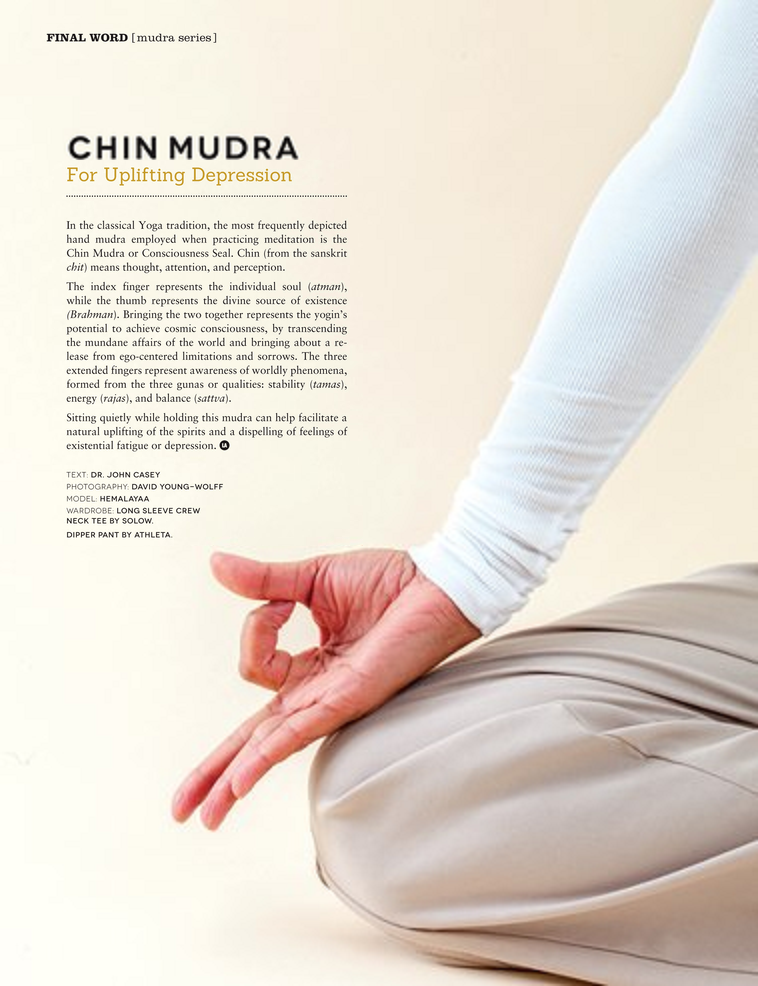 |
| Depression help (chin mudra) |
In Ayurveda, the study and use of these is significant. The Sanskrit term for aphrodisiacs is vajikarana, which means "that which imparts the strength of a horse."
Aphrodisiacs are applicable whatever one’s personal situation. Reproductive fluid, called shukra, circulates throughout the body and is responsible for courage, activity, love, delight, and vigor, according to the ancient Indian medical texts, the Sushruta Samhita and the Charaka Samhita. More
Also in this issue: massage oils, yogi food, meditation, depression help (mudra), Deepak Chopra, astrology, India.Arie, yogis feeding the homeless, Events Calendar, "Lights, Camera, Yoga!"
Thursday, 26 December 2013
"An Island to Oneself" (sutra)
Maurice O'Connell Walshe, Attadipa Sutta (SN 22.43); Dhr. Seven (ed.), Wisdom Quarterly
 |
| An island on a river at sunset with sudden bursts of lightning (Gary Story/plus.google.com) |
 |
| Sitting is intensive but not the only way |
"Meditators, be islands unto yourselves [Note 1], be your own [guide], having no other; let the Dharma be an island and a [guide] for you, having no other. Those who are islands unto themselves... should investigate to the very heart of things [2]:
"'What is the source of sorrow, lamentation, pain, grief, and despair? How do they arise?' [What is their origin?]
 |
| Buddha on island of Sri Lanka (NH53) |
"But seeing [3] the body's impermanence, its change-ability, its waning [4], its ceasing, he says 'formerly as now, all bodies were impermanent and unsatisfactory, and subject to change.' Thus, seeing this as it really is, with liberating insight, one abandons all sorrow, lamentation, pain, grief, and despair. One is not worried at their abandonment but, without worry, lives at ease. And thus living at ease one is said to be 'assured of deliverance [5].'" [Similarly with feelings, perceptions, mental formations, and consciousness].
NOTES: 1. Atta-dipa. Dipa means both "island" (Sanskrit dvipa) and "lamp" (Sanskrit dipa), but the meaning "island" is well-established here. The "self" referred to is of course the unmetaphysical pronoun "oneself" (cf. SN 3.8, n. 1).
2. It is necessary to withdraw, to be "an island to unto oneself," at least for a time (as any meditator knows), not for any "selfish" reasons but precisely in order to make this profound introspective investigation. Otherwise, in another sense, Buddhists would of course agree with John Donne that "No man is an island."
3. As Woodward remarks in [Book of the Kindred Sayings, a translation of the Samyutta Nikaya, Vol. III, PTS, 1924], one would expect to find here the words which he inserts in the text: "The well-taught [noble] disciple," as in many passages. If one, in fact, sees these things and reflects as said in the text, one will cease to be [an ordinary] "worldling."
4. Waning (viraga) is elsewhere also translated as "dispassion" (SN 12.16, n. 2).
5. Tadanganibbuto means rather more than Woodward's "one who is rid of all that."
- See island admonition in the Buddha's final sutra: DN 16.
Thursday, 21 November 2013
The Discourse on Right View (sutra)
Dhr. Seven and Amber Larson, Wisdom Quarterly, "Discourse on Right View" (Samma-ditthi Sutta, MN 9), based on translation by Ñanamoli Thera and Bhikkhu Bodhi
 |
| Young Buddhist novices, Lamayuru monastery, Ladakh, India (Dietmar Temps/flickr) |
Birth
 |
| Novice, Burma (UrsulasWeeklyWanders.com) |
24. Saying, "Good, friend," the monastics delighted and rejoiced in Sariputra's words. [The Buddha declared Ven. Sariputra his chief male disciple "foremost in wisdom," just as he declared Ven. Khema his chief female disciple foremost in wisdom.] Then they asked him a further question: "But, friend, might there be another way in which a noble disciple is one of right view... and has arrived at this true Dharma?" -- "There might be, friends.
25. "When, friends, a noble disciple understands birth, the origin of birth, the cessation of birth, and the way leading to the cessation of birth, in that way a person is one of right view... and has arrived at this true Dharma.
 |
| Buddha in Phutthamonton (Gift of Light/flickr) |
26. "And what is birth, what is the origin of birth, what is the cessation of birth, what is the way leading to the cessation of birth? The birth of beings into the various orders of beings, their coming to birth, precipitation [in a womb], generation, manifestation of the aggregates, obtaining the bases for contact -- this is called birth. With the arising of being, there is the arising of birth. With the cessation of being, there is the cessation of birth. The way leading to the cessation of birth is this Noble Eightfold Path -- that is:
- right view
- right intention
- right speech
- right action
- right livelihood
- right effort
- right mindfulness
- right concentration
27. "When a noble disciple has thus understood birth, the origin of birth, the cessation of birth, and the way leading to the cessation of birth... that person here and now makes an end of suffering (reaches nirvana). In that way, too, a noble disciple is one of right view... and has arrived at this true Dharma."
Becoming
 |
| Wheel of Sense Worlds (greencollarrap.com) |
28. Saying, "Good, friend," the monastics delighted and rejoiced in Sariputra's words. Then they asked him a further question: "But, friend, might there be another way in which a noble disciple is one of right view... and has arrived at this true Dharma?" -- "There might be, friends.
29. "When, friends, a noble disciple understands becoming (bhava), the origin of becoming, the cessation of becoming, and the way leading to the cessation of becoming, in that way a person is one of right view... and has arrived at this true Dharma.
30. "And what is becoming, what is the origin of becoming, what is the cessation of becoming, what is the way leading to the cessation of becoming? There are these three kinds of becoming:
- sense-sphere becoming
- fine-material becoming
- immaterial becoming.
With the arising of clinging, there is the arising of becoming. With the cessation of clinging, there is the cessation of becoming. The way leading to the cessation of becoming is this Noble Eightfold Path -- that is, right view... right concentration.
31. "When a noble disciple has thus understood becoming, the origin of becoming, the cessation of becoming, and the way leading to the cessation of becoming... that person here and now makes an end of suffering. In that way, too, a noble disciple is one of right view... and has arrived at this true Dharma."
Clinging
 |
| 31 Planes reduced to Six States (lokas) |
32. Saying, "Good, friend," the monastics delighted and rejoiced in Sariputra's words. Then they asked him a further question: "But, friend, might there be another way in which a noble disciple is one of right view... and has arrived at this true Dharma?" -- "There might be, friends.
33. "When, friends, a noble disciple understands clinging, the origin of clinging, the cessation of clinging, and the way leading to the cessation of clinging, in that way that person is one of right view... and has arrived at this true Dharma.
34. "And what is clinging, what is the origin of clinging, what is the cessation of clinging, what is the way leading to the cessation of clinging? There are these four kinds of clinging:
- clinging to sensual pleasures
- clinging to views [opinions]
- clinging to rituals and observances
- clinging to a doctrine of self (atman).
35. "When a noble disciple has thus understood clinging, the origin of clinging, the cessation of clinging, and the way leading to the cessation of clinging... that person here and now makes an end of suffering. In that way, too, a noble disciple is one of right view... and has arrived at this true Dharma."
Craving
 |
| Cosmology (creative-harmonics.org) |
36. Saying, "Good, friend," the monastics delighted and rejoiced in Sariputra's words. Then they asked him a further question: "But, friend, might there be another way in which a noble disciple is one of right view... and has arrived at this true Dharma?" -- "There might be, friends.
37. "When, friends, a noble disciple understands craving, the origin of craving, the cessation of craving, and the way leading to the cessation of craving, in that way that person is one of right view... and has arrived at this true Dharma.
38. "And what is craving, what is the origin of craving, what is the cessation of craving, what is the way leading to the cessation of craving? There are these six classes of craving:
- craving for sights (forms)
- craving for sounds
- craving for fragrances
- craving for flavors
- craving for tangibles
- craving for mind-objects.
"With the arising of sensation (vedana, basic feeling not emotion), there is the arising of craving. With the cessation of sensation, there is the cessation of craving. The way leading to the cessation of craving is this Noble Eightfold Path -- that is, right view... right concentration.
39. "When a noble disciple has thus understood craving, the origin of craving, the cessation of craving, and the way leading to the cessation of craving... that person here and now makes an end of suffering. In that way, too, a noble disciple is one of right view... and has arrived at this true Dharma."
Sensation
 |
| Novice, Thiksey Monastery (Dietmar Temps) |
40. Saying, "Good, friend," the monastics delighted and rejoiced in Sariputra's words. Then they asked him a further question: "But, friend, might there be another way in which a noble disciple is one of right view... and has arrived at this true Dharma?" — "There might be, friends.
41. "When, friends, a noble disciple understands sensation, the origin of sensation, the cessation of sensation, and the way leading to the cessation of sensation, in that way that person is one of right view... and has arrived at this true Dharma.
42. "And what is sensation, what is the origin of sensation, what is the cessation of sensation, what is the way leading to the cessation ofsensation ? There are these six classes of sensation:
- sensation born of eye-contact
- sensation born of ear-contact
- sensation born of nose-contact
- sensation born of tongue-contact
- sensation born of body-contact
- sensation born of mind-contact.
With the arising of contact, there is the arising of sensation. With the cessation of contact, there is the cessation ofsensation . The way leading to the cessation of sensation is this Noble Eightfold Path -- that is, right view... right concentration.
43. "When a noble disciple has thus understood sensation, the origin of sensation, the cessation of sensation, and the way leading to the cessation of sensation... that person here and now makes an end of suffering. In that way, too, a noble disciple is one of right view... and has arrived at this true Dharma." More
Saturday, 14 September 2013
Entangled in Darkness, Seeking the Light
Dhr. Seven and CC Liu, Wisdom Quarterly; Deborah King


Deborah King is a friend of Wisdom Quarterly and was once a regular feature with her online Hay House radio show and frequent appearances around the country.
She has just come out with a new book Entangled in Darkness, Seeking the Light and was recently interviewed by GAIAM TV's Lisa Garr, hostess of Pacifica Radio's Los Angeles affiliate, KPFK FM, on TheAwareShow.com).
Entangled in Darkness: How to Find the Light
Lisa Garr (theawareshow.com)
Master healer and urban shaman, [and sexual abuse survivor], Deborah King (DeborahKingCenter.com), was a successful attorney in her 20s when a diagnosis of cancer sent her on a search for truth.
 |
| Deborah King |
It radically changed her life. Unwilling to undergo invasive (and harmful) surgery, she turned to alternative medicine. She had an amazing remission at the hands of a healer. Leaving the corporate arena for the mysterious world of healers, sages, and shamans, King mastered ancient and modern healing systems, ultimately developing a powerful healing technique of her own.

Her latest book, Entangled in Darkness: Seeking the Light, explores the purpose of the age-old battle between light and dark that is waged within us.
INTERVIEW (9-12-13) The Aware Show’s special guest this week is spiritual teacher, health-and-wellness expert, and New York Times best-selling author Dr. Deborah King. Take an excursion into the inner sanctum of the "soul," our deepest sense of self, to help us understand why we are here.
What is the purpose of the age-old battle between light and dark? It is being waged within us all. She will help deepen our insight into how and why we might be entangled in darkness and provide us with practical tools to infuse our lives with light. King talks about techniques to clear negative energies, dark entities, cordings, and intentional and unintentional attacks. More
INTERVIEW (9-12-13) The Aware Show’s special guest this week is spiritual teacher, health-and-wellness expert, and New York Times best-selling author Dr. Deborah King. Take an excursion into the inner sanctum of the "soul," our deepest sense of self, to help us understand why we are here.
What is the purpose of the age-old battle between light and dark? It is being waged within us all. She will help deepen our insight into how and why we might be entangled in darkness and provide us with practical tools to infuse our lives with light. King talks about techniques to clear negative energies, dark entities, cordings, and intentional and unintentional attacks. More
Subscribe to:
Comments (Atom)