Showing posts with label cognition. Show all posts

Thursday, 15 May 2014

What is "art"? (cartoons, illusions...)

Amber Larson, CC Liu, and Dhr. Seven, Wisdom Quarterly; the artist Saara (Arkiharha)
Saara (Arkiharha) pondering art and free expression in Finland (Weekday-Illusion)
 
The fun Finnish cartoonist, devi, and graphic artist noticed our coverage. Saara is an obscure but prolific talent. We love her work, which can be found at many outlets like such as Arkiharha and such as Weekday-Illusion (our nod to awkward beauty pageant contestant Miss South Carolina).
 
She is expressing herself in her work and in a letter to us:
 
"Susse" (Saara/Arkiharha/flickr)
"Wow, it's crazy to find a post full of my pictures and comics! Nice analysis, too. Maybe I kinda succeeded to pass on my thoughts in a visual way, because you get the idea from most of them -- even when they are written in Finnish!"
 
See Wisdom Quarterly coverage here: My cartoon ART is your perception

REPLY: Saara, send in art you are eager for the world to see, like your beautiful sketches of the Buddha. We would be overjoyed to feature more.
 
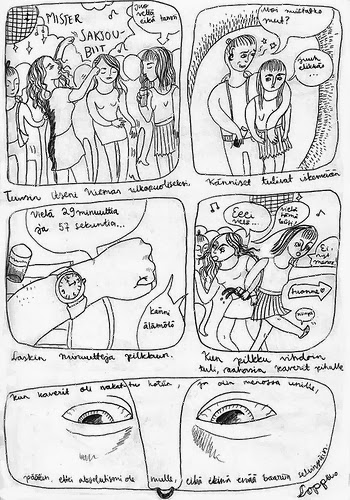
Comic vignettes as art "Kuva" (Saara/Arkiharha/flickr)
If you have "class" you know a bottle of "fine" wine and classical string instruments like a Stratavarious are the only things to sip or listen to. But you're wrong. Science says you're wrong. So surely when you add that only oil on canvas can be art and not no people pleasing cartoony comics, you're wrong, too. Don't tell us. We like classical. Tell it to science:
 
The way to get people to better enjoy craapy fermented grape juice that sells for thousands of dollars is to say it sells for more. Just a better bottle and a price change, or serving it with an elegant story of its venerable origins, its pedigree, is enough to make it "taste" better. How classy of study participants.

Can comics and webcam colors be called art?
fMRI scans prove bad alcohol actually tastes better when it's two-buck-chuck krup is said to be something more expensive and classy. Expensive wine tastes better. Let's call it "neuromarketing." Marketers have known about this effect for years regarding other foods. Before they started loading fruit juices with added flavorants (cynically called "natural flavors" not because they're natural but because they synthetically mimic something "natural" rather than something artificial) and artificial colorants.

My doggy, my doggy...oh, you've come back! "Sarjis 12.8"  (Saara/Arkiharha/flickr)
 
Vegan Food Fest, Los Angeles
Flavorless red colors make things taste better. Blindfolded we might not be able to tell a difference or say which drink is what fruit. We use color as a clue, and it works. The flavor of dull tasting juice is brightened just by brightening its color. Such is the illusion we live in and the hypnotic states we fall into every other moment.

If we would meditate, we could emerge and be dehypnotized.

Hungry ghost, psychic ("Bobb")
But we love our illusions, delusions, and dreams. And we would directly-personally-verifiably find that we are (w)holistic beings, not mind (intangible processes)/body (senses) possessing spirits like it seems.
 
Today a study is making headlines saying that an old Stradavarius violin sounds no better than a modern one. In fact, if one believes this study, the modern one sounds better. More musicians prefer it. (But maybe they are voting for the one they think is the Strad which is the one they fear the study would find inferior?)

The Distortions
It's all how we look at the world we are creating each and every without realizing what we're choosing. Art can sensitize and teach us as we clear our mental perception of the distortions/perversions (Wisdom Quarterly). "Hiljattain päivitetty" (Saara/Arkiharha).

Audio Test: Can we tell the difference between expensive and overpriced instruments?

Monday, 30 December 2013

The genius of Da Vinci and the Tao (audio)

Wisdom Quarterly; Dr. Fritjof Capra, Mitch Jeserich (Letters and Politics, Dec. 30, 2013)

Fritjof Capra's new book Learning from Leonardo: Decoding the Notebooks of a Genius presents an in-depth discussion of the main branches of Da Vinci's scientific work. What was it?

Da Vinci pioneered fluid dynamics [the Tao being the way, the flow, the path of least resistance], geology, botany, anatomy, mechanics, aerodynamics, [ecology, eco-designing, war and weapons engineering, vegetarianism, pacifism, art most famously painting the "Mona Lisa" but, notably, not the social sciences or any political or economic phenomena].

Most of his astonishing discoveries and achievements in these fields are virtually unknown to the general public. Dr. Capra's thesis is that, at the most fundamental level, Da Vinci always sought to understand the nature of life. This has often escaped earlier commentators, because until recently the nature of life was defined by biologists only in terms of cells and molecules, to which Da Vinci had no access.
 
Popes were more like Roman emperors
THE POPE of Da Vinci's day, in tune with the corrupt Holy Roman Catholic Church he led, was absorbed with mistresses, children, and imperial wars. He was not concerned with Da Vinci's heretical ideas, like his view of the "soul." Da Vinci thought it akin to cognitive psychology's view of cognition [or the Buddha's detailed analysis of citta, the process of consciousness, as an interdependent process]. Galileo, a century later, would face a much different pope and inquisitive Church that allowed no deviation from its dogma.
 
Mona Lisa and Leo (gregoryherpe.fr)
 
The enigmatic Leo Lisa (lewets)
But today, a new systemic understanding of life is emerging at the forefront of science -- an understanding in terms of metabolic processes and their patterns of organization. And those are precisely the phenomena which Da Vinci explored throughout his life. The book has been published in three editions in three languages.
Fritjof Capra, Ph.D., physicist and systems theorist, is a founding director of the Center for Ecoliteracy in Berkeley, California. Dr. Capra is the author of several international bestsellers, including The Tao of Physics (1975), The Web of Life (1996), The Hidden Connections (2002), and The Science of Leonardo (2007). He coauthored Green Politics (1984), Belonging to the Universe (1991), and EcoManagement (1993), and coedited Steering Business Toward Sustainability (1995). His most recent book, Learning from Leonardo, was published in Italy and Brazil in 2012 and will be published in the United States in 2013. He is currently working on a multidisciplinary textbook, The Systems View of Life, coauthored by Pier Luigi Luisi and to be published by Cambridge University Press. See bibliography for book details.

Tuesday, 22 October 2013

My cartoon ART is your perception

Amber Larson, Seven, CC Liu, Wisdom Quarterly; Arkiharha (Scandinavian comic artist Saara, 18, Weekday-Illusion and Arkiharha.Sarjakuvablogit.com)
What artist would ruin her art by telling anyone what it actually meant? It's as personal to me as it is to you...unless Maroon 5 discovers you on Flickr. Then it's as personal as Adam's agent says Following interpretations not that of the artist! (Arkiharha/flickr)
The artist Arkiharha, Saara, writes in Finnish.
What is "art" but a statement, one transcending language? A flag should bear no words. Words, on the one hand, formalize ideas. Images, on the other hand, allow for free-form associations, eidetic, ripe connotations, sly symbolic suggestions, eerie emaciated thinking full of emotions...

See. See me. Who do you really see?
It's a different use of cognition, exploiting this or that hemisphere of the brain, if that theory of a difference holds any weight. We use both sides all of the time!

What it means to the artist is interesting, but what it means to the viewer is almost all that actually matters. 

I'm a fat American on the Web. I search startpage.com and kuh-ching. I find it! My dream dating site for seniors -- Carbon Dating. Ooh, look at these elder honeys. What should I write? Hi, my is Joe Blow, and I've got lots of cash... This is funnier than the Finnish version.
 
Cry or don't cry. It's better not to cry, crybaby.
This is why artists tend to avoid defining their works. Why add a definitive interpretation that might wipe out other equally valid interpretations? It's "Zen."

Why ask me what I mean when we could all be asking, "What does it mean to me?"? Questions are only for those who question.

Is there any meaning in the ravings of artists and lunatics?

Is there any sense in the assertions of critics and passive lovers of art? I mean, what does "Pussy Riot" mean exactly? Nadia can explain, but people will think something else.
Even "Buddhist art" -- which often symbolizes a narrative or lesson more than existing for its own sake or for devotional abuses -- is what it is to the viewer more than the maker. To be sure, most makers have something in mind. 
 
But in the end, it's the art that meets the eye, the beauty that beholds it more than the beauty beheld by the eye that counts.
 
Despicable Me for all to see

I know! I'll become an "artist"! Then I can really live!
I saw a dead steer in the sun, worm oozing from its eye. I cried. My tears watered the desert. I took a death cross, set it in the sun, smoked, and let the worms win.
Girls night out! But I met a guy. It's every gal for herself! Look at the time. Where is she? Let's forget our pact and leave without her! You look different in the morning.