Showing posts with label Afghan. Show all posts

Thursday, 21 August 2014

The Buddha to his family: Money and Happiness

Dhr. Seven and Amber Larson (ed.), Wisdom Quarterly based on initial translation by Ven. Thanissaro (Geoffrey DeGraff), Sakka Sutra: "To the Shakyans" (AN 10.46); Wiki; Sirimunasiha
Golden face of Afghan Buddha excavated from 2,600-year-old Mes Aynak ("Copper Well") temple complex, one of the first and possibly the largest monastic complexes in the world.
Bamiyan, Afghanistan (ancient Sakka, Scythia), at the Himalayan foothills of the Hindu Kush, was a wealthy East-West crossroads on the Silk Route beyond India into Central Asia (wiki).
 
On one occasion the Blessed One [the Buddha] was staying near Kapilavatthu [Kapilavastu, likely in the region of modern Bamiyan and Kabul (Kapil?), Afghanistan, beyond the ancient northwest frontier of India] at the Banyan Park.
 
First anthropomorphic images of the Buddha
Then many Shakyan lay followers, on the lunar observance day (uposatha), went to see the Blessed One, bowed, and sat respectfully to one side. As they were sitting there, the Blessed One said to them, "Shakyans, do you observe the eightfold lunar observance?"
 
"Sometimes we do, venerable sir, and sometimes we do not." 
  • [The weekly lunar observance days (full moon, new moon, first and last quarter moons), call uposatha days, are a time of intensive effort and rededication to the Buddha's Dharma. Its eight factors or limbs (anga) are the Eight Precepts observed for that day and night.]
"It is no gain for you, Shakyans. It is ill-gotten, that in this life so threatened by grief, in this life so threatened by death, you only sometimes observe the eight-factored lunar observance and sometimes do not.
 
"What do you think, Shakyans. Suppose a person, by some profession or other, without encountering an unprofitable (akusalam, unskillful, wasted) day, were to earn half a gold coin.
  • [See Wisdom Quarterly discussion of the gold, silver, and copper kahapana below.]
The first Buddhas were Indo-Greco (Boonlieng/flickr)
"Would that person deserve to be called a capable person, full of initiative?"
 
"Yes, venerable sir."
 
"Suppose a person, by some profession or other, without encountering an unprofitable day, were to earn a whole coin... two coins... three... four... five... six... seven... eight... nine... ten... 20...30 ... 40... 50... 100 coins. Would that person deserve to be called a capable person, full of initiative?"
 
"Yes, venerable sir."
 
"Now what do you think: Earning 100 or 1,000 coins a day, and saving up one's gains, and living for 100 years, would a person arrive at a great mass of wealth?"
 
"Yes, venerable sir."
  
Massive Bamiyan Buddha, Kapilavastu (grand-bazaar)
"Now what do you think: Would that person, because of that wealth, on account of that wealth, with that wealth as the cause, live enjoying unalloyed bliss for a day, a night, half a day, or half a night?"
 
"No, venerable sir. And why is that? Sensual pleasures are inconstant (unstable, undependable, fickle, impermanent), hollow, false, deceptive by nature."

"Now, Shakyans, there is the case where a disciple of mine, spending ten years practicing as I have instructed, would live enjoying unalloyed bliss for 100 years, 100 centuries, 100 millennia.
  • [One reason for this is jhana (meditative absorption) and its astounding karmic aftereffects. It is on account of attaining to one of the eight jhanas, re-entering it frequently, or mastering it completely that one, going no further to cultivate liberating insight in this life, is reborn in superior planes of existence, heavens (worlds in space or other dimensions), with lifespans that last aeons. See Large Chart in 31 Planes of Existence.]
"And that person would be a once-returner, a non-returner, or at the very least a stream-winner.
  
Kapilavastu? Sakastan (SCMP.com)
"Let alone ten years, there is the case where a disciple of mine, spending nine years... eight years... seven... six... five... four... three... two years... one year practicing as I have instructed, would live enjoying unalloyed bliss for 100 years, 100 centuries, 100 millennia. And that person would be a once-returner, a non-returner, or at the very least a stream-winner.
  • [In a more famous sutra (MN 10), the Buddha uses this cascading description of time to emphasize that while it might take as many as seven years to reach enlightenment, it might actually only take as few as seven days of mindful application (on a foundation of powerful concentration). See the Greater Four Foundations of Mindfulness Discourse.]
Gandhara-style Buddha, Bactria (Boonlieng/flickr)
"Let alone one year, there is the case where a disciple of mine, spending ten months... nine months... eight months... seven... six... five... four... three... two months... one month... half a month practicing as I have instructed, would live enjoying unalloyed bliss for 100 years, 100 centuries, 100 millennia. And that person would be a once-returner, a non-returner, or at the very least a stream-winner.
 
"Let alone half a month, there is the case where a disciple of mine, spending ten days and nights... nine days and nights... eight... seven... six... five... four... three... two days and nights... one day and night [this expression "one day and night" suggests one uposatha day] practicing as I have instructed, would live enjoying unalloyed bliss for 100 years, 100 centuries, 100 millennia. And that person would be a once-returner, a non-returner, or at the very least a stream-winner.
 
Did the Shakyans listen and benefit?
"It is no gain for you, Shakyans. It is ill-gotten, that in this life so threatened by grief, in this life so threatened by death, you only sometimes observe the eightfold lunar observance and sometimes do not."
 
"Then from this day forward, venerable sir, we will observe the eightfold lunar observance!"
 
Gold kahapanas, ancient coins used in Central Asia (Afghanistan), India, Sri Lanka (Siri)
.
Later kahapana with the Buddha
  • NOTES: India did not have anthropomorphic (human-like) representations of the Buddha or the "gods" (devas, brahmas) until Buddhists outside of India -- in Hellenized Afghanistan, Gandhara, and Central Asia (Bactria, Scythia, Sodgdia, etc.) -- made the first images.
  • Isn't it interesting that maps of the area in ancient times show a Sakastan right in the vicinity of modern Afghanistan? And isn't it more interesting that the main "god" (deva) of earthly relevance in Buddhism and of the Buddha's time -- the "King of the Gods/Devas" -- is called Sakka?
  • Greco-Buddhist art (Bimaran casket)
  • This discourse, "Sutra to the Shakyans" (Sakka Sutta) is not called the Sakya or Shakya Sutra but the Sakka Sutta, suggesting that they were called the Sakkas -- Scythians, one of any far wandering "tribes" (family clans) relying on horses (like Siddhartha's famed white pony Kanthaka), rich with gold from controlling commerce and land along the Silk Route of traveling merchants taking riches between East and West? See discussion in Pali Encyclopedia.
  • See also AN 3.70; AN 8.43; Ud 2.10; MN 10
Ancient Money (the kahapana)
Wisdom Quarterly English translation from German-Wiki
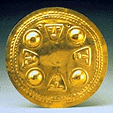
Modern minor excavation at Mes Aynak, Afghanistan shows gold and jewellery treasure. This hoard was dated from 500 AD to 700 AD (Kadir Salamviking)
 
Kahapana was the name of an ancient Indian coin. It was either copper, silver, or gold. Its shape was round or rectangular. In Sanskrit it was called purana, in English "elding." Kahapanas are mentioned in early Buddhist literature, where their role was as a means of payment on the Indian subcontinent of antiquity. It is also in evidence in excavations. More

Set of kalandas of corresponding weight -Type I -Chank over Vase or Pot (Sirimunasiha).

Friday, 4 July 2014

Why is America really called "America"?

Seth Auberon, Pat Macpherson, Pfc. Sandoval, Wisdom Quarterly; "The Naming of America: Fragments We've Shored Against Ourselves" by Johnathan Cohen (uhmc.sunysb.edu)
USA is #1 at ideals but not soccer, human rights, peacemaking... (Dan Kitwood/Getty Images)
Where are all the fireworks and star-spangled spectacles? (losangeles.cbslocal.com)
Local MTV feeder, KROQ FM (CBS, Inc.) reveals best places in LA/OC to watch fireworks
 
Navajo flag representing Native Americans
USA - It's [Declaration of] Independence Day, the 4th of July, so it's time to decry war and conquest and to celebrate rebellion.

England sent out invaders with lots of technology, took over most of the known world, including this ancient naga territory of America -- which is NOT named after Amerigo Vespucci or any old European map. Then we rebelled, absorbed people from all over the world, mostly from Africa, where are forebears stole them from, and mixed with the indigenous people we did not kill off.
 
This country belongs to the 99% (occupy.com)
It's odd that place names are kept the same when invaders can easily change them on a whim, as they do in many places to remind them of home. Whatever the reason, whatever its name, the English, Spanish, French, Vikings -- and earlier the Afghans/Chinese (judging from the body of written records and anthropological evidence), Egyptians (judging from the pyramids and the trace amounts of "New World" cocaine in ancient Egyptian mummies), the Khmer (judging from the megalithic architecture and strange demise of various pre-Mexican Mesoamerican empires mimicking the history of the Southeast Asian Empire of Angkor in present-day Cambodia), and Africans or Australian aborigines (judging from the fossil record). But the story is even stranger, and it is certainly connected one way or another to the very ancient earthling nagas.
How it's done in formerly Buddhist Kyrgyzstan, Independence Day, Bishkek (Cyrille Gibot)
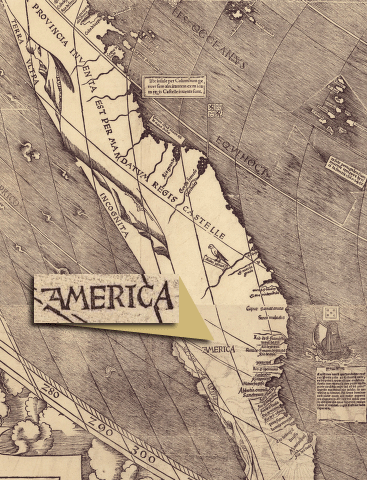
Click here to see entire map.
The name America (applied to present-day Brazil) appeared for what is believed the first time on Martin Waldseemüller's 1507 world map, known as the Baptismal Certificate of the New World and also America's Birth Certificate. More
América, no invoco tu nombre en vano
["America, I don't invoke your name in vain"]
-Pablo Neruda, Canto General
The Naming of America
Johnathan Cohen (edited by Wisdom Quarterly)
"America" (gabelli-us.com)
AMERICA, we [incorrectly] learn as schoolchildren, was named in honor of Amerigo Vespucci, for his discovery of the mainland of the New World. We tend not to question this [deceptive] lesson about the naming of America.
 
By the time we are adults it lingers vaguely in most of us, along with images of wave-tossed caravels and forests peopled with naked cannibals. Not surprisingly, the notion that America was named for Vespucci has long been universally accepted, so much so that a lineal descendant, America Vespucci, came to New Orleans in 1839 and asked for a land grant "in recognition of her name and parentage."
 
Since the late 19th century, however, conflicting ideas about the truth of the derivation have been set forth with profound cultural and political implications. To question the origin of America's name is to question the nature of not only our history lessons but our very identity as Americans.
 
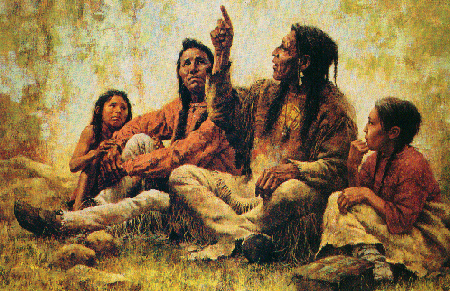
Traditional history lessons about the discovery of America also raise questions about the meaning of discovery itself. It is now universally recognized that neither Vespucci nor Columbus "discovered" America. They were of course preceded by the pre-historic Asian forebears of Native Americans, who migrated across some ice-bridge in the Bering Straits or over the stepping stones of the Aleutian Islands.
 
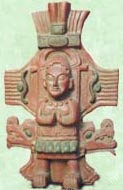
Kukulcán, Mayan god of the wind.
A black African discovery of America, it has been argued, took place around 3,000 years ago and influenced the development of Mayan, Aztec, and Inca civilizations [judging from facial features of the large stone monuments and other records].
 
The records of Scandinavian expeditions to America are found in sagas -- their historic cores encrusted with additions made by every storyteller who had ever repeated them. The Icelandic Saga of Eric the Red, the settler of Greenland, which tells how Eric's son Leif came to Vinland, was first written down in the second half of the 13th century, 250 years after Leif found a western land full of "wheatfields and vines"; from this history emerged a fanciful theory in 1930 that the origin of "America" is Scandinavian: Amt meaning "district" plus Eric, to form Amteric, or the Land of (Leif) Eric.
 
Other Norsemen went out to the land Leif had discovered; in fact, contemporary advocates of the Norse connection claim that from around the beginning of the 11th century, North Atlantic sailors called this place Ommerike (oh-MEH-ric-eh), an Old Norse word meaning "farthest outland."
 
(This theory is currently being promoted by white supremacists of the so-called Christian Party, who are intent on preserving the nation's Nordic character, and who argue that the Norse Ommerike derives from the Gothic Amalric which, according to them, means "Kingdom of Heaven.")
 
But most non-Scandinavians were ignorant of these sailors' bold exploits until the 17th century, and what they actually found was not seriously discussed by European geographers until the 18th century.
 
Further, other discoveries of America have been credited to the Irish, who had sailed to a land they called Iargalon, the land beyond the sunset, and to the Phoenicians, who purportedly came here before the Norse.
 
The 1497 voyage by John Cabot to the Labrador coast of Newfoundland constitutes yet another discovery of the American mainland, which led to an early 20th-century account of the naming of America, recently revived, that claims the New World was named after an Englishman (Welshman, actually) called Richard Amerike.
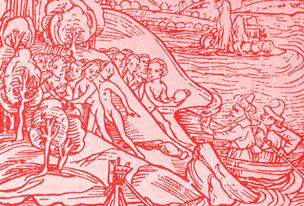
 
From Map of the Discoveries of Columbus, Christopher Columbus/Carolus Verardus, 1493. 
Yet, despite the issue of who discovered America, we are still confronted with the awesome fact that it was the voyages of Columbus, and not earlier ones, that changed the course of world history.

Indeed, as Tzvetan Todorov, author of The Conquest of America (1984; tr. Richard Howard), has argued,
 
"The conquest of America...heralds and establishes our present identity; even if every date that permits us to separate any two periods is arbitrary, none is more suitable, in order to mark the beginning of the modern era, than the year 1492, the year Columbus crosses the Atlantic Ocean."
 
Columbus clearly made a monumental discovery in showing Europe how to sail across the Atlantic; Vespucci's great contribution was to tell Europe that the land Columbus had found was not Asia but a New World (and that a western route to Asia involved yet another ocean beyond it). 
 
[What about the name?]
The naming of America, then, becomes essential to a full understanding of our history and cultural values -- ourselves -- especially when considered in terms of the range of theories about the origin of the name. 

The Maya Connection

The most explosive, haunting, almost credible etymology -- the so-called Amerrique theory, which was first advanced in 1875 -- reappeared in the late 1970s in an essay by Guyanan novelist Jan Carew, titled "The Caribbean Writer and Exile."

Here Carew focuses on the identity struggle of Caribbeans who are "subject to successive waves of cultural alienation from birth -- a process that has its origins embedded in a mosaic of cultural fragments -- Amerindian, African, European, Asian."
He adds that "the European fragment is brought into sharper focus than the others, but it remains a fragment." It is in his discussion of this European fragment that he turns to the early historical accounts written by "European colonizers, about their apocalyptic intrusion into the Amerindian domains" -- histories which, he argues, are largely fictions "characterized, with few exceptions, by romantic evasions of truth and voluminous omissions."

Carew moves from the "fictions" of Columbus to those of Vespucci with these striking words: "Alberigo Vespucci, and I deliberately use his authentic Christian name, a Florentine dilettante and rascal, corrected Columbus's error [thinking he had found the Orient]...Vespucci, having sailed to the American mainland... More

Thursday, 26 June 2014

‘Fasting Buddha’ damaged during cleaning

Amber Larson (ed.), Wisdom Quarterly; Shoaib Ahmed (dawn.com, June 26, 2014)
The Ascetic Siddhartha or "Fasting Buddha," Lahore Museum (file, dawn.com)
 
LAHORE, Pakistan - The jewel of Lahore Museum, the Fasting Buddha sculpture, carries a fresh scar, the legacy of an amateur attempt at "repairing" one of its arms after an accident during cleaning.
 
The Buddha had two fingers on its right hand missing and an old crack on its left arm. The crack was opened up a couple of years ago while the staff was cleaning it, Dawn.com was told by an art lover and conservationist on Wednesday.
 
Just use this epoxy. - Really? (dawn.com)
Later investigations confirmed the "accident," and the subsequent careless repairing by staff at the museum's lab, their restoration effort failing to go beyond the application of a common adhesive that did more to damage it than to restore it. The incident happened in the Gandhara Gallery on April 4, 2012, museum sources revealed.

They say the statue was “repaired” by staff in the museum’s lab like an ordinary object instead of implementing modern scientific methods of conservation.

Gandhara Gallery Chief Muhammad Mujeeb told Dawn.com on Wednesday that the conservation laboratory staff had filled the crack in with simple epoxy. More  

Tuesday, 17 June 2014

"The Last Magazine" - corporate media (video)

Amber Larson, Seth Auberon, Wisdom Quarterly; Amy Goodman, Aaron Mate (democracynow)


A conscience will cost you in the Army
June 17th marks the first anniversary of the [assassination] of investigative journalist Michael Hastings. Just 33 years old, Hastings died in a [mysterious] car crash at a time when he was considered of one of the country’s most daring young reporters.
 
His dispatches from Iraq and Afghanistan unveiled the hidden realities of war. His 2010 Rolling Stone article on General Stanley McChrystal, the U.S. commander in Afghanistan, sparked a political controversy after McChrystal and his aides were quoted making disparaging remarks about top administration officials.

The article exposed longstanding government discord over the U.S. War on Afghanistan’s direction and led to McChrystal’s firing. One year after his death, Hastings’ reporting has made waves once again.
 
In 2012, Hastings wrote a major investigation for Rolling Stone on the American prisoner of war, Army Sergeant Bowe Bergdhal. At the time, Hastings thought it was the most important story of his career. 
 
But it has only recently earned widespread attention after Bergdahl’s release in an exchange for five "Taliban" members sparked a political firestorm. In his report, Hastings revealed Berghdal was profoundly disillusioned with the War on Afghanistan and may have walked away from his base (as he and others regularly did) as a result. With Berghdal still silent as he recovers from five years in Taliban captivity and torture, Hastings’ article remains the definitive account of the young soldier’s story.

Today another major work from Michael Hastings is upon us: The Last Magazine, a posthumous novel and scathing satire of the corporate news media based on Hastings’ time at Newsweek. Democracy Now! are joined by Hastings’ widow, Elise Jordan, who brought the book to life after coming across the manuscript following her husband’s death. More

Tuesday, 8 April 2014

Were Anasazi [Native Americans] Buddhists?

Dhr. Seven (ed.), Wisdom Quarterly; Hendon Harris (chinesediscoveramerica.com)

The most famous building in the entire Tibetan plateau, Potala Pueblo, Lhasa (HCC)
Tibetan store (Aaron Berkovich/flickr)
Were the Anasazi, who are known to many as the Native Americans of the Southwest, Buddhists? 
 
Buddhism began in the sixth century BCE in India [although the Buddha was from neighboring Afghanistan -- the ancient northwestern frontier of Gandhara and to points west -- where the Dharma quickly took hold among his familial clan simultaneous with its spread in Magadha/modern Bihar, India].

It soon spread to ancient Greece and parts of its empire in Central Asia [Bactria, Sogdiana, etc., where Alexander the Great left yet another "Alexandria" in Kandahar, Afghanistan, when it was part of the Hellenic Empire], the geopolitical Middle East, and some believe to Europe (Kalmykia) as far north as Scandinavia and even North America, which was partly ancient Mexico, a spread Rick Fields documented in How the Swans Came to the Lake: A Narrative History of Buddhism in America and Edward P. Vining's Inglorious Columbus, which recounts how a group of Afghan Buddhist monks led by Chinese Buddhist missionary Hwui Shan  "discovered" America and therefore interacted with the Native Americans long before the genocidal, Polish, Jewish Christopher Columbus].

This is where the Native Anasazi (or Ancestral Puebloan people, such as the Hopi, Hisatsinom, and others) come in.
One piece of evidence is the ancient Buddhist proclivity for carving building and shrines into mountains and creating distinctive rock formations. They are now found all over the world and bear a likeness to that favored by Vedic Hinduism/Buddhism. Buddhism ultimately reached China in the first century ACE, after it had made a grand impact on Greece bringing in many Eastern philosophical idea -- the atom (kalapa), democratic voting and rudimentary parliamentary rules of order (Sangha organization according to the Vinaya), and so on.
 
The Anasazi culture mysteriously appeared in North America at an undetermined time and disappeared about 1300 ACE. Where did these incredibly advanced people come from? How and why did they just as mysteriously disappear? We know they were astronomers because we have found some of their observatories. We know they were road builders because we have found their roads. We know they were incredibly proficient at stone carving and masonry because we have found evidence of their work and architectural styles in the Four Corners area of the Southwest.
 
Native American indigenous Apache, remnant Anasazi spirit dancers, 1887 (Native Skeptic)
 
These architectural styles and art carved in stone provide the best evidence that the source of the Anasazi culture with its advanced knowledge and artistry was Vedic Asia.
 
This is a provocative statement likely to offend a few scholars. However, if one takes the time to examine the art and architecture, compare examples from each culture side by side, it will provide clear evidence of their connection.
 
Rock cliffs of the Grand Canyon, Arizona
If one were to start by using the image search terms “Were the Anasazi people Buddhist?” one would find that the architectural styles of the Puebloan people (Anasazi) and Chinese Buddhists are so similar that they show up interchangeably on the image page clearly demonstrating that they used the same techniques for carving out rock caves. (See examples of rock caves carved high on the cliffs of Bandelier National Park, New Mexico. They bear an incredible likeness to Asian Buddhist caves). 

Further search “Architecture-Pueblo complexes and Great Houses” or “Bandelier National Park Rock Cave Images” to see more). Compare these to the Caves of Dunhuang and the Longmen Caves in China or to the recently discovered Shangri-la Buddhist Caves of Nepal all of which are carved high up on rock faces.
 
Luoyang Shaolin Buddhist temple (G-W-H)
For evidence of IDENTICAL construction techniques used in ancient China and in ancient North America “zoom in” on these pictures of the rock-cut caves at Bandelier National Monument, USA and the Caves at Dunhuang, China.  Both locations, separated by the vast Pacific Ocean, show identical horizontal rows of small bored holes cut into the cliff faces perhaps to insert wooden pole frames for shade canopies for each location thousands of miles apart.
 
Tibetan structures are like Puebloan dwellings of the Southwest. This American adobe complex was likely built between 1000-1450 AD near Taos, New Mexico, USA (wiki).
  
Rock-cut remains, Bandelier, NM, USA
Ancient Buddhists seem to have been fascinated by rocks shaped a particular way. Here is a very unusually shaped rock in Thailand and an almost identically shaped rock in the Bisti Badlands, New Mexico. 
 
The Bisti Badlands are an interesting place in the Four Corners region, where the Anasazi people lived. However, the common opinion is that “The Canadian Goose Bisti,” “The Sleeping Lizard Bisti,” “The Flying Turtle Bisti,” and so on are simply random acts of erosion. A more plausible explanation is that these rock formations are ruins of a people exhibiting a Vedic cultural heritage because of at least three different types of rock formations there.
  1. Mushroom rocks like the ones found at Mushroom State Park, Kansas are found throughout these 45,000 acres of badlands. “Mushroom Rocks” are the chattra symbols of ancient Buddhism. Chattra is the Sanskrit word for “mushroom,” which is also the word for the Parasol, one of the Eight Auspicious Symbols of Buddhism. More

Monday, 7 April 2014

Buddhism in America before Columbus (video)

Amber Larson, Dhr. Seven, CC Liu, Wisdom Quarterly; All History Buff (History Channel)
Polish Jew Christopher Columbus came to infect, rape, and enslave for Europe (AMN)
   
Long before Christians and Conquistadors
The Chinese made a map of the world
It's 455 and the Aztecs live in America as the Chinese begin to make their way to the "New World."

This was long before Chris(to) Columbus' merchant mission. In fact, no less than a dozen cultures have tales of these adventures woven into their histories, but they are noticeably absent in American history books. This documentary explores the possibility that Chinese Buddhists, Japanese, Polynesians, Norse, Welsh, Irish, Ancient Hebrews, and Solutreans [DNA evidence of Africans arriving 50,000 years ago not included] all made it to the Americas much earlier than the mass murderer Columbus. 

Afghan Buddhist monks discovered America shows American historian in 1885 (archive.org)
 
Tibetans (China) brought pueblos to Natives
In 455 AD Buddhist missionaries -- Chinese Hwui Shen and Afghan Buddhist monks -- brought the world-religion of Buddhism to the Native Americans 1,037 years before Columbus, the Conquistadors and Cortes, and European Christian-Catholic missionaries in general.
 
Buddhist missionaries made it to Mexico via California (when California was part of Mexico) according to surviving records (see Minute 8:20). The Chumash (Native Americans from Los Angeles, the Channel islands, and Santa Barbara along the coast of Southern California) were even visited by the Polynesians (Min. 34:20). What hard evidence, apart from written histories, is there for all this?
 
Avoiding European invasion and genocid
Some maritime archaeological artifacts were found in our very own Los Angeles (Min. 11:20). By the time the Welsh set off for the New World, the magnificent Buddhist Khmer Empire of Cambodia was completing Angkor Wat (Min. 20:00), the greatest urban city of the time with a million suburban inhabitants made of stone in the jungle just like those in Mexico and Mesoamerica/Central America built by the Maya, Olmec, Toltec, Inca, and Aztec empires. 
 
But let's rebuild the ships, trace the routes, test the artifacts, and analyze blood evidence to finally learn the answer to one of the greatest mysteries of all time -- Who really discovered America?
Convert them like this, Columbus (Daily Mail)
Scholars now believe that Italian mass murderer Columbus was actually a Marrano, a "secret Jew," who feigned conversion to Catholicism. Historians say five clues to the explorer's faith can be found in his will. His famous voyage was funded not by the Queen of Spain, but by three prominent Jews -- and he first updated them on the progress of his quest. One new theory even suggests he may have been looking for a safe haven for Jews persecuted and driven out of Spain...

No, comments Lorenzo Damas: Search "Christopher Columbus History Turned Upside-Down by New Polish Biography." Historian Manuel Rosa has these links in his book “Kolumb: Historia Nieznana” (published May 8, 2012 in Poland), translated from the Spanish book “Colon: La Historia Nunca Contada. Jews weren't persecuted in Spain until later, and that will is a forgery.