Showing posts with label buddha statue found in afghanistan. Show all posts

Thursday, 21 August 2014

The Buddha to his family: Money and Happiness

Dhr. Seven and Amber Larson (ed.), Wisdom Quarterly based on initial translation by Ven. Thanissaro (Geoffrey DeGraff), Sakka Sutra: "To the Shakyans" (AN 10.46); Wiki; Sirimunasiha
Golden face of Afghan Buddha excavated from 2,600-year-old Mes Aynak ("Copper Well") temple complex, one of the first and possibly the largest monastic complexes in the world.
Bamiyan, Afghanistan (ancient Sakka, Scythia), at the Himalayan foothills of the Hindu Kush, was a wealthy East-West crossroads on the Silk Route beyond India into Central Asia (wiki).
 
On one occasion the Blessed One [the Buddha] was staying near Kapilavatthu [Kapilavastu, likely in the region of modern Bamiyan and Kabul (Kapil?), Afghanistan, beyond the ancient northwest frontier of India] at the Banyan Park.
 
First anthropomorphic images of the Buddha
Then many Shakyan lay followers, on the lunar observance day (uposatha), went to see the Blessed One, bowed, and sat respectfully to one side. As they were sitting there, the Blessed One said to them, "Shakyans, do you observe the eightfold lunar observance?"
 
"Sometimes we do, venerable sir, and sometimes we do not." 
  • [The weekly lunar observance days (full moon, new moon, first and last quarter moons), call uposatha days, are a time of intensive effort and rededication to the Buddha's Dharma. Its eight factors or limbs (anga) are the Eight Precepts observed for that day and night.]
"It is no gain for you, Shakyans. It is ill-gotten, that in this life so threatened by grief, in this life so threatened by death, you only sometimes observe the eight-factored lunar observance and sometimes do not.
 
"What do you think, Shakyans. Suppose a person, by some profession or other, without encountering an unprofitable (akusalam, unskillful, wasted) day, were to earn half a gold coin.
  • [See Wisdom Quarterly discussion of the gold, silver, and copper kahapana below.]
The first Buddhas were Indo-Greco (Boonlieng/flickr)
"Would that person deserve to be called a capable person, full of initiative?"
 
"Yes, venerable sir."
 
"Suppose a person, by some profession or other, without encountering an unprofitable day, were to earn a whole coin... two coins... three... four... five... six... seven... eight... nine... ten... 20...30 ... 40... 50... 100 coins. Would that person deserve to be called a capable person, full of initiative?"
 
"Yes, venerable sir."
 
"Now what do you think: Earning 100 or 1,000 coins a day, and saving up one's gains, and living for 100 years, would a person arrive at a great mass of wealth?"
 
"Yes, venerable sir."
  
Massive Bamiyan Buddha, Kapilavastu (grand-bazaar)
"Now what do you think: Would that person, because of that wealth, on account of that wealth, with that wealth as the cause, live enjoying unalloyed bliss for a day, a night, half a day, or half a night?"
 
"No, venerable sir. And why is that? Sensual pleasures are inconstant (unstable, undependable, fickle, impermanent), hollow, false, deceptive by nature."

"Now, Shakyans, there is the case where a disciple of mine, spending ten years practicing as I have instructed, would live enjoying unalloyed bliss for 100 years, 100 centuries, 100 millennia.
  • [One reason for this is jhana (meditative absorption) and its astounding karmic aftereffects. It is on account of attaining to one of the eight jhanas, re-entering it frequently, or mastering it completely that one, going no further to cultivate liberating insight in this life, is reborn in superior planes of existence, heavens (worlds in space or other dimensions), with lifespans that last aeons. See Large Chart in 31 Planes of Existence.]
"And that person would be a once-returner, a non-returner, or at the very least a stream-winner.
  
Kapilavastu? Sakastan (SCMP.com)
"Let alone ten years, there is the case where a disciple of mine, spending nine years... eight years... seven... six... five... four... three... two years... one year practicing as I have instructed, would live enjoying unalloyed bliss for 100 years, 100 centuries, 100 millennia. And that person would be a once-returner, a non-returner, or at the very least a stream-winner.
  • [In a more famous sutra (MN 10), the Buddha uses this cascading description of time to emphasize that while it might take as many as seven years to reach enlightenment, it might actually only take as few as seven days of mindful application (on a foundation of powerful concentration). See the Greater Four Foundations of Mindfulness Discourse.]
Gandhara-style Buddha, Bactria (Boonlieng/flickr)
"Let alone one year, there is the case where a disciple of mine, spending ten months... nine months... eight months... seven... six... five... four... three... two months... one month... half a month practicing as I have instructed, would live enjoying unalloyed bliss for 100 years, 100 centuries, 100 millennia. And that person would be a once-returner, a non-returner, or at the very least a stream-winner.
 
"Let alone half a month, there is the case where a disciple of mine, spending ten days and nights... nine days and nights... eight... seven... six... five... four... three... two days and nights... one day and night [this expression "one day and night" suggests one uposatha day] practicing as I have instructed, would live enjoying unalloyed bliss for 100 years, 100 centuries, 100 millennia. And that person would be a once-returner, a non-returner, or at the very least a stream-winner.
 
Did the Shakyans listen and benefit?
"It is no gain for you, Shakyans. It is ill-gotten, that in this life so threatened by grief, in this life so threatened by death, you only sometimes observe the eightfold lunar observance and sometimes do not."
 
"Then from this day forward, venerable sir, we will observe the eightfold lunar observance!"
 
Gold kahapanas, ancient coins used in Central Asia (Afghanistan), India, Sri Lanka (Siri)
.
Later kahapana with the Buddha
  • NOTES: India did not have anthropomorphic (human-like) representations of the Buddha or the "gods" (devas, brahmas) until Buddhists outside of India -- in Hellenized Afghanistan, Gandhara, and Central Asia (Bactria, Scythia, Sodgdia, etc.) -- made the first images.
  • Isn't it interesting that maps of the area in ancient times show a Sakastan right in the vicinity of modern Afghanistan? And isn't it more interesting that the main "god" (deva) of earthly relevance in Buddhism and of the Buddha's time -- the "King of the Gods/Devas" -- is called Sakka?
  • Greco-Buddhist art (Bimaran casket)
  • This discourse, "Sutra to the Shakyans" (Sakka Sutta) is not called the Sakya or Shakya Sutra but the Sakka Sutta, suggesting that they were called the Sakkas -- Scythians, one of any far wandering "tribes" (family clans) relying on horses (like Siddhartha's famed white pony Kanthaka), rich with gold from controlling commerce and land along the Silk Route of traveling merchants taking riches between East and West? See discussion in Pali Encyclopedia.
  • See also AN 3.70; AN 8.43; Ud 2.10; MN 10
Ancient Money (the kahapana)
Wisdom Quarterly English translation from German-Wiki
Modern minor excavation at Mes Aynak, Afghanistan shows gold and jewellery treasure. This hoard was dated from 500 AD to 700 AD (Kadir Salamviking)
 
Kahapana was the name of an ancient Indian coin. It was either copper, silver, or gold. Its shape was round or rectangular. In Sanskrit it was called purana, in English "elding." Kahapanas are mentioned in early Buddhist literature, where their role was as a means of payment on the Indian subcontinent of antiquity. It is also in evidence in excavations. More

Set of kalandas of corresponding weight -Type I -Chank over Vase or Pot (Sirimunasiha).

Saturday, 3 May 2014

Afghan landslides kill 2,100 (video)

Wisdom Quarterly; Reuters; AP; Hashmat Kaktash, Shashank Bengali (latimes.com)
 
Landslides bury thousands (Ahmad Zubair/AP)
The United Nations said at least 350 people had been killed in Badakhshan, a rugged province between Tajikistan and Pakistan [formerly Gandhara, India]. Shah Waliullah Adeeb, the provincial governor, said about 2,500 people were trapped under the landslides, which occurred Friday afternoon after several days of heavy rain.

Afghan Greco Indian (Gandhara) Buddhas
It was one of the worst natural disasters in recent memory in Afghanistan, where spring rainfall and snowmelt make the mountainous northeast susceptible to flash floods and mudslides. U.N. officials said more Afghans had been killed in natural disasters in the last seven days than in all of 2013.
 
Say no to war (codepink.org)
A search-and-rescue effort was underway and eight people had been found, according to Afghan news agencies. Afghan soldiers and police who reached the village were hampered by the scale of the landslides, Adeeb said.
 
World's greatest Buddhist temple site
"We found that it's impossible to rescue those people even...with machinery. They are covered in about 20 meters of dirt," he said in a telephone interview.
 
The first landslide crushed about 300 homes, he said, and when several hundred people arrived to try to rescue those buried, they were hit by a second slide.
 
President Obama said the United States was ready to assist with the rescue effort [presumably by signing secret executive orders to send in swarms of deadly armed drones to euthanize Afghans during rescue efforts, thereby putting them out of our misery and allowing JSOC to continue our U.S. war of aggression and occupation]. More

Condoleezza Rice latest graduation speaker to back out amid protests
War? Landslide? Who cares? We're rich.
Bush Administration unindicted co-conspirator and war criminal Condi Rice's choice not to speak at Rutgers Univ. makes her just the latest public figure embroiled in a commencement spat.
 
The reality of life in Afghanistan after illegal US invasion and occupation (RAWA.org)

Sunday, 2 March 2014

Is a bigger Buddha better? (video)

Amber Larson, Maya, CC Liu, Wisdom Quarterly; Fareed Zakaria, Global Public Square (CNN)
The Buddha, Statue of Liberty (USA), The Motherland Calls (Russia), Redeemer (Brazil) [W]

Is bigger better?
Mountaintop Tian Tan Buddha, Lantau Island, Hong Kong (rmonty119/flickr)
  
Smaller Afghan Buddha
China is home to the world's fastest train, longest bridge, largest freestanding building, longest wall, and is the biggest source of tourists in the world. In China, bigger is definitely better -- even when it comes to the Buddha.
 
Massive Buddha statues have been built around the country over the past few decades. The 160-foot Buddha in the video towers over crowds like another 300-foot Buddha in eastern China. 
 
Is Liberty a freed slave? (USS)
In 2002, the tallest statue in the world -- the 500-foot Spring Temple Buddha -- was unveiled in China. It is almost 200 feet taller than the Statue of Liberty!

[Scholar Dr. Joy DeGruy points out that the Statue of Liberty in New York harbor is shackled by broken ankle chains signifying our history of enslaving Africans and others, yet nearly no American knows it because the truth is kept hidden by the Nat'l Park Service].
 
India's future biggest Buddha? (Maitreya)
So why is Buddha on steroids? One word: tourists. Last year, this Buddha reportedly brought in 3.8 million visitors and $200 million. Not every large statue has been met with appreciation though. Two giant Buddhas in their birthday suits recently unveiled in Eastern China were taken down after an uproar. More

In 1886, the Statue of Liberty was a symbol of democracy and Enlightenment ideals. It was also a celebration of the Union's Civil War victory and our [official] abolition of slavery. Edouard de Laboulaye first proposed the idea of a great monument as a gift from France. He was a firm supporter of Pres. Lincoln's fight for abolition. For he saw it as a way to eliminate immorality and a means of protesting repressive tendencies in France. More

Monday, 3 February 2014

Buddhism and Time Travel (sutra)

Dhr. Seven, Amber Dorrian, CC Liu, Wisdom Quarterly (SPECULATION)
A Buddha figure encased in one of many inexplicable bell-shaped stupas, Borobudur, Indonesia, the largest Buddhist site in world (Wisdom Quarterly)
 
We know of no sutra directly bearing on the subject of time travel, although space travel to the akasha deva loka ("space world of shining ones") is frequently met with in both directions, Sakka to Earth and the Buddha and monastics to many "celestial" worlds [like the Buddha, Maha Moggallana, and other disciples going into near Earth orbit and battling a reptilian or naga named Nandopananda). But there is one oddity we never stop pointing out: 
 
During WW II the Germans developed a time travel "bell" (Die Glocke), which just happens to look exactly like the strange hollow stupas, reliquary mounds or "bells" housing Buddha figures at the largest Buddhist site in the world -- Borobudur, Central Java, Indonesia -- with its massive, pyramid-like platforms. The structure is the size of a mountain in what is now an Islamic.
 
What was the purpose of this mega structure?
So marvelous and inexplicable to the Muslims was this site that they tried to destroy it but could not. Nor could they build anything to rival it; they simply did not have the technology. Instead, they buried it in a massive pile of mud. More than a century later, when the British archeologists were surveying the site, one realized that there was no way there could be a "mountain" there. He had his workers dig, and he is credited with rediscovering a Buddhist temple complex larger than the massive pieces in Bamiyan, Afghanistan (although the unexcavated Mes Aynak site may rival Borobudur, but if Chinese mining interests have their way, it will be destroyed first) and Angkor Wat, Cambodia.

Hitler out for a propaganda photo op
The Germans were given off-planet instructions on how to construct a transporter, which they dubbed "The Bell" (Die Glocke), and tested it. They sent it into the future and retrieved, weather beaten a short time later. What else they did is kept top secret by the OSI, CIA, NASA, and other American organizations which inherited and protected German scientists after the war, such as Robert Oppenheimer and Nazi Wernher von Braun.

Chortans (AlexSaurel/flickr)
It is interesting that from Central Asia (Afghanistan, to India (Ajanta, Ellora, Sanchi) to Sri Lanka to Western China (Yulin, Kizil, Mogao, Dunhuang in Gansu, Bingling), Buddhism is characterized by temples and monastic cave complexes built into solid rock and cliff sides with a technology we do not understand to this day. It can be credited to visitors from space (akasha devas), much in the way that those advanced humanoid beings erected super-antiquated monolithic sites all over the world: Egypt, Stonehenge, Avebury, Petra (Jordan), Adam's Calendar (Africa), Antarctica, Sumer (Babylon), and mounds all across the USA as well as the mystery Egyptian caverns/Buddhist temples of the Grand Canyon.
The Light Being in Space
Wisdom Quarterly translation based on Ven. Thanissaro (Rohitassa Sutta, AN 4.45; SN 2.26

Space or akasha deva loka (Wiki)
Once the Blessed One [the Buddha, who was known as the Teacher of Devas and Humans] was staying near Savatthi, in Jeta's Grove, at Anathapindika's monastery. Then the male deva Rohitassa, late at night, with his splendid radiance lighting up the entire grove, went to the Blessed One, bowed, respectfully stood to one side, and asked:

"Venerable sir, is it possible by traveling to know or see or reach the far end of the universe where one does not undergo rebirth, aging, dying, passing away, or reappearing?"
 
"I tell you, friend, that it is not possible by traveling to know or see or reach the far end of the universe where one does not undergo rebirth, aging, dying, passing away, or reappearing."
 
Future Buddha, Ladakh (Sahil Vohra/flickr)
"It is amazing, venerable sir, it is awe-inspiring, how well this has been said by the Blessed One! ...Once I was a seer (Indian rishi, yogi) named Rohitassa, a disciple of [the Guru] Bhoja, a powerful sky-walker. My speed was as fast as that of a strong archer -- well-trained, a practiced hand, a practiced sharp-shooter -- shooting a light arrow across the shadow of a palm tree. [This is a common idiom to illustrate extreme speed in ancient India, the time it would take a shot arrow to pass the shadow of a tree.] My stride stretched as far as the East Sea is from the West [the width of India]. To me, endowed with such speed, such a stride, there arose the desire: 'I will go traveling to the end of the universe.'

"I with a 100 year life, a 100 year span spent 100 years traveling. And apart from the time spent eating, drinking, savoring, urinating, defecating, and sleeping to ward off weariness. But without reaching the end of the universe, I died along the way. So it is amazing, venerable sir, it is awesome, how well this has been said by the Blessed One!"
 
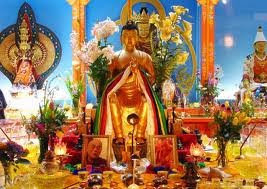
Golden Buddhist altar (BuddhistTrainTour)
[The Buddha replied:] "I tell you, friend, that it is not possible by traveling to know or see or reach the far end of the universe... But at the same time, I tell you that there is no making an end of disappointment and suffering without reaching the end of the universe (world). It is just within this fathom-long body, with its perception and intellect, that I declare that:
  1. there is the universe (world), 
  2. the origination of the universe,
  3. the cessation of the universe, and
  4. the path of practice leading to the cessation of the universe." [This is another wording of the ennobling Four Noble Truths.]
"It is not to be reached by traveling [in space]. AND it is not without reaching the end of the universe that there is release from disappointment and suffering. 
 
"So truly the wise one, an expert with regard to the cosmos, a knower of the end of the cosmos, having fulfilled the holy life, calmed, knowing the cosmos' end, doesn't long for this cosmos or for any other." (See also AN 9.38).