Showing posts with label forbidden archeology. Show all posts

Friday, 8 August 2014

The Great Pyramid of Titicaca, Bolivia

Crystal Quintero, Xochitl, Pat Macpherson, Wisdom Quarterly;  "Lost Temples: Mystery of the Akapana Pyramid" (NationalGeographic.com, NatGeo)
Lake Titicaca, Bolivia, with Andes mountains in the distance (Anthony Lacoste)


LAKE TITICACA, Bolivia - Titicaca (in the hispanicized spelling) or Titiqaqa is a lake in the Andes on the border of Peru and Bolivia. By volume of water, it is the largest lake in South America. Lake Maracaibo has a larger surface area, but it is considered to be a large brackish bay due to its direct connection with the sea. Titicaca is often called the highest navigable lake in the world, with a surface elevation of 12,507 feet (3,812 m)... Bolivia has a mystery beyond the lake, that of Akapana. Scientists decode the life-giving riddle of Bolivia's great Akapana pyramid.

Tuesday, 1 April 2014

The rock-cut temples of Buddhism

Dhr. Seven, Amber Larson, CC Liu, Wisdom Quarterly
Bezeklik ancient Buddhist rock-cut temple monastery complex (chinatouronline.com)
Tiger's Nest Buddhist Monastery perched on cliff, Bhutan (MichaelFoleyPhotography/flickr)
Rock-cut Buddha, Luoyang Shaolin Temple, taken during the "Kung Fu and Buddhism Tour by Cycle" through China in 2013 (Great-wall-hikers/flickr.com)
 
Kwan Yin, Yungang (G-W-H)
It is characteristic of Buddhism that temples were built by carving them directly into mountains out of bare stone -- a feature known as rock-cut architecture, particularly in ancient India.
 
This was accomplished in some advanced way that cannot be explained today, for it was a time when there were presumably no lasers, power drills, grinders, sanders, or diamond-tipped chisels.
 
Mountain-sized Buddhas, Bamiyan
The first were in Afghanistan beginning at the time of the Buddha. His family was apparently living in the area, the northwestern frontier of greater "India" (Bharat) beyond Gandhara.

There are stunning examples in the spectacular Afghan archeological sites of Bamiyan and Mes Aynak, the jaw-dropping caves of Ellora and Sanchi in Buddhist India, and China's Bezeklik and Yungang grottoes.... Of course, one cannot lose sight of the official "largest" Buddhist sites in Borobudur, Java, Indonesia and the rock-cut marvels of the Cambodian jungles at Angkor Wat and "lost medieval cities" (livescience.com) such as Mahendraparvata discovered in 2013. We are assured by the enlightened and psychic Buddhist master Ven. Jumnien that more such stone sites remain in the jungle to be found.

Giant and Buddhist missionaries Datong, Yungang Grottoes (Great-wall-hikers/flickr.com)
Magnificent rock-cut architectural finds: stupa at Mes Aynak, Afghanistan (ranajitpal.com)
"Copper Well" (Mes Aynak), Afghanistan mineral mine treasures (AP)
 
World's largest Buddhas, Bamiyan, Afghanistan
The real Kapilavastu, the Buddha's hometown, was close to modern Kabul (Kapil). For the ancient country's capital, seat of the Shakyan janapada (the "foothold" of the Shakya clan's territory) may have been Bamiyan, a site famed not only for rock-cut caves and monastic dwellings but also the most massive Buddha statues in the world.

Bojjannakonda cave (Adityamadhav83/AP)
It was rich because it was on the Silk Road between India to the east and Central Asia to the west. Right from its inception Buddhism traveled the route west into ancient Greece and onto China. It is said that one of the first things the newly enlightened Buddha did was send out 60 enlightened missionaries in all directions; they were wandering ascetics spreading the "good news" of liberation from all suffering.
 
Cliffside Bamiyan Valley, Afghanistan, overlooking adobe "pueblos" in the distance (wiki)


Much of desert western China features magnificent rock-cut Buddhist architecture which is little known today. Islam supplanted the Dharma and obscured its Buddhist past. Much of the architecture is now in a part of the Great Walled Empire (China), known as the restive Uighur Autonomous Region. Like Buddhist Tibetans from the Tibetan Autonomous Region, Muslim Uygurs want nothing to do with colonial communist/capitalist Han Buddhist Chinese rule.

Buried treasures at Mes Aynak (Andy Miller)
At 2,600 years, the oldest Buddhist temple complex yet discovered and largest -- with a central area of one square mile -- is at Mes Aynak ("Copper Well"). 

However, most of it is still underground as an archeological site never to be excavated if China (through its Chinese Metallurgy Company) has its way. China will be the next empire to invade Afghanistan, according to Afghans, after the ancient Greeks with Alexander, the British, the Soviets, and the Americans.
  • Scientific research in "forbidden archeology" suggests that technologically advanced tools were in the possession of someone as explained by Micheal Cremo, David Hatcher Childress, and others.
Buddha Grottoes, China (Great-wall-hikers)
While characteristic of Buddhist sites, rock-cut technology did not remain exclusive to the East, having made its way to Petra and widely practiced in Cappadocia, (Anatolia, Asia Minor) Turkey, particularly in the soft stone of Derinkuyu. But no other religious movement did so much to generate and exploit this practice -- we would guess with help from above, namely, the akasha deva loka (space deva world).

https://www.flickr.com/photos/great-wall-hikers/


Buddhism spread from Afghanistan
Dazzling new finds from Mes Aynak and Tepe Naranj near Kabul
Ranajit Pal, Ph.D. (ranajitpal.com)
Mes Aynak vihara, Trapusa (Brent E. Huffman)
"The discoveries cover more than 1,000 hectares and have unearthed [Buddhist] temples, monasteries, and about 1,000 statues, which cannot be compared with finds from any location in Nepal.

Smaller Buddha, Bamiyan
"The site is about 20 km from the Indian border (pre-partition) and was probably within ancient ‘India.’ The RigVeda names many rivers and tribes of Afghanistan, which shows that it was a part of Vedic India.

"The new discoveries unmistakably indicate that Buddhism spread from Afghanistan and northwest India, not eastern India or Nepal. The discoveries at Bamiyan, Mes Aynak, and [Greco-Buddhist] Hadda highlight the primacy of Afghanistan and Gandhara in early Buddhist history."
Gold-covered statues of "Copper Well" (Mes Aynak) archeological site, Afghanistan

Wednesday, 26 March 2014

Native Buddhist artifacts, Grand Canyon (video)

xDhr. Seven, Pat Macpherson (eds.), Wisdom Quarterly; David Hatcher Childress (davidhatcherchildress.com), host George Noory (coasttocoastam.com); Karen Slaughter
Lightning bolt illuminates the Grand Canyon (news.yahoo.com, May 14, 2013)

Ancient Mesoamerican site, modern Mexico, panoramic view from pyramids (Tula)

 
Egypt in the Grand Canyon
Lost Cities: Ancient Mysteries of the Southwest
archeologist and author David Hatcher Childress discussed his research into Buddhist, Hindu (Vedic), and Egyptian artifacts found in the Grand Canyon, USA.

Did Egyptians visit North America thousands of years ago? Childress reveals his investigation into the history of the Olmecs in the south (Mesoamerica) -- with a great pyramid at La Venta, Mexico -- and the amazing technologies they possessed.

"The more and more I've looked into it over the years, what I've concluded is that, Yes, there is something to it," Childress says of the famous 1909 American media story: At that time a Smithsonian-sponsored expedition into the Grand Canyon found and collected Egyptian and Buddhist artifacts. 

Ancient bald Olmec sitting pose
Childress is off to the American Southwest, traversing the region's deserts, mountains, and forests investigating archeological mysteries. He starts in northern Mexico and searches for the lost mines of the Aztecs and continues north to west Texas, delving into the mysteries of Big Bend, including mysterious Phoenician tablets discovered there and the strange lights of Marfa. He continues northward into New Mexico, where he stumbles upon a hollow mountain with gold bars hidden inside! In Arizona he investigates tales of Egyptian catacombs in the Grand Canyon... In Nevada and California Childress checks out mummified giants and weird tunnels in Death Valley, plus he searches the Mohave Desert for the mysterious remains of ancient dwellers alongside lakes that dried up tens of thousands of years ago...
 
Noble disciple Sayalay Susila, Grand Canyon
He shares one confounding piece of evidence to mainstream history which claims that Native Americans did not practice mummification. "The Thing," a Southwestern roadside attraction, shows that mummies were found in the "New" World.

Mythical meditator (Las Limas)
This odd mummy of a woman and child together was "privately purchased in 1910," according to his sources. Childress theorized that it "may well be one of the artifacts from the caves." Speculating on why this information has been shrouded in secrecy, Childress speculated that "today, history is politically correct, not what happened, but what they want to have happened."
 
He refutes the mainstream belief that ancient peoples were fairly isolated, asserting that "Oceans were highways, not barriers." To support this idea, he points out that the Egyptians, Romans, and Phoenicians had ships bigger than those used by Columbus.

By the third hour of the interview, Childress got into his work exploring the ancient and mysterious Olmec culture of ancient Mexico, which was only discovered in the 1940s. He points out that the Olmecs were a unique looking people who may have been responsible for many works ascribed to the Mayans (Maya), such as very precise and famous cosmic calendar, which share a Buddhist/Vedic view of time measured in epochs and aeons.

Naga guides Olmec pilot (Delange)
Regarding fantastic ancient technologies, Childress discussed the discovery of an old Indian book about the ancient spacecraft, which are called vimanas in ancient India. The Olmecs described metal crafts using mercury as fuel. [This form of propulsion, which is based on manipulating gravity by swirling the mercury within the craft, was detailed in Popular Mechanics and elsewhere decades ago.] More
 
Sitchin with massive Olmec head (cae2k.com)

Tuesday, 25 March 2014

Secret underground worlds (video)

Pat Macpherson, Dhr. Seven, Wisdom Quarterly; David Wilcock, Giorgio Tsoukalos, David Hatcher Childress (C2C), Linda Moulton Howe... (History.com)

(History Channel) documentary: ANCIENT MAN MADE TUNNELS: Underground Civilizations

Buddhist stone carved caves of Ellora, India
The first stop is Turkey's underground city of Derinkkuyu in Cappadocia. Then onto the origins of U.S. DUMBS (Deep Underground Military Bases) in the American Southwest (and elsewhere), built by aliens and once inhabited by various Puebloan and other Native peoples or "Indians." See Minute 9:45 for the Native Americans and civilizations in the Southwestern United States: Navajo, Zuni, Pueblo, Hopi, and Apache tribes. These First Nations people all share a common creation "myth" of emerging from the ground rather than coming across the Bering Straits and down from Alaska as modern anthropologist try to explain. By their own account, they got help from the "Snake People" (nagas) and "Ant People" -- subterranean humanoid dwellers.

Wednesday, 26 February 2014

Graham Hancock: amazing discoveries (video)

Graham Hancock (News, Feb. 24, 2014); Pat Macpherson, Wisdom Quarterly

11,000-year-old settlement found under Baltic Sea
Evidence of a Stone Age settlement that may have been swallowed whole by the Baltic Sea has resurfaced near Sweden, revealing a collection of well-preserved artifacts left by nomads some 11,000 years ago.

Dubbed by the local press “Sweden's Atlantis” after the fabled island which, according to the Greek philosopher Plato, sank around 9600 B.C. in the Atlantic Ocean, the newly discovered site was in fact some sort of dump in which nomadic Swedes discarded objects, according to a report by the Swedish daily The Local. More


(Knowledge Center) Sunken Civilizations: Secrets of Underwater Lost Cities Underwater

Grainy digital images presented as evidence of structures constructed on the 400C surface of Mercury
First it was the face on Mars. Then it was the Nazis on the Moon. Now is it buildings on the surface of Mercury? One UFO expert is convinced NASA photos show a city on the red-hot planet’s surface.
 
UFO Sightings Daily author Scott Waring is set to sell more books after revealing what he claims are recently built structures “without breaks or fissures and clean with no dirt of dust blanketing them over time, which tells me…they are occupied.” More

Source of Stonehenge bluestone rocks identified 
Scientists have found the exact source of Stonehenge's smaller bluestones, new research suggests.

The stones' rock composition revealed they come from a nearby outcropping, located about 1.8 miles (3 km) away from the site originally proposed as the source of such rocks nearly a century ago. The discovery of the rock's origin, in turn, could help archaeologists one day unlock the mystery of how the stones got to Stonehenge. More

"Microbial Pompeii": 1,000-year-old plaque preserves bacteria, microscopic particles of food
A "microbial Pompeii" has been discovered, preserved on the teeth of skeletons which are around 1,000 years old. A research team discovered that the ancient human oral cavity carries numerous opportunistic pathogens and that periodontal disease is caused by the same bacteria today as in the past, despite major changes in human diet and hygiene. More

Early Christians in Viking Denmark
Excavations at the Domskirke in Ribe, Denmark, began in 2008, and analysis of the results lend new insight into early Christianity, where this may have been one of the first places in the country where a small enclave of Christians worshipped and died.

Studies have now shown that there may have been Christian Vikings in Ribe around 865 A.D. Denmark officially became a Christian country around the year 965 A.D. when Harald Bluetooth announced his deed on the Jelling stone. More

People who believe HELL are less happy
Fire, brimstone, eternal-seeming suffering -- hell is not a pleasant concept. But research has pointed to the societal benefits of a belief in supernatural punishment, including higher economic growth in developing countries and less crime.

But there are also drawbacks, even in this life. A new study links believing in hell, and perhaps even thinking about it, with lower levels of happiness and satisfaction in life. More

A Guide to Psychoactive Plants in the Bible
Holy Anointing Oil (Leviticus 10:6) - Then took Mary a pound of ointment of spikenard, very costly, and anointed the feet of Jesus, and wiped his feet with her hair: and the house was filled with the odor of the ointment (Exodus 29:7). Then shalt thou take the anointing oil, and pour it upon his head and anoint himMore

After 400 years, mathematicians find new class of solid shapes
The work of the Greek polymath Plato has kept millions of people busy for millennia. A few among them have been mathematicians who have obsessed about Platonic solids, a class of geometric forms that are highly regular and are commonly found in nature. More

Hundreds of tiny satellites could soon deliver free [government-Google spying and] Internet worldwide
Developers say they are less than a year away from deploying prototype satellites that could someday soon broadcast free and universal Internet all over the globe from high in orbit.

The “Outernet” project being bankrolled by the Media Development Investment Fund (MDIF) of New York is currently in the midst of conducting technical assessment of the project. More


Monday, 3 February 2014

Buddhism and Time Travel (sutra)

Dhr. Seven, Amber Dorrian, CC Liu, Wisdom Quarterly (SPECULATION)
A Buddha figure encased in one of many inexplicable bell-shaped stupas, Borobudur, Indonesia, the largest Buddhist site in world (Wisdom Quarterly)
 
We know of no sutra directly bearing on the subject of time travel, although space travel to the akasha deva loka ("space world of shining ones") is frequently met with in both directions, Sakka to Earth and the Buddha and monastics to many "celestial" worlds [like the Buddha, Maha Moggallana, and other disciples going into near Earth orbit and battling a reptilian or naga named Nandopananda). But there is one oddity we never stop pointing out: 
 
During WW II the Germans developed a time travel "bell" (Die Glocke), which just happens to look exactly like the strange hollow stupas, reliquary mounds or "bells" housing Buddha figures at the largest Buddhist site in the world -- Borobudur, Central Java, Indonesia -- with its massive, pyramid-like platforms. The structure is the size of a mountain in what is now an Islamic.
 
What was the purpose of this mega structure?
So marvelous and inexplicable to the Muslims was this site that they tried to destroy it but could not. Nor could they build anything to rival it; they simply did not have the technology. Instead, they buried it in a massive pile of mud. More than a century later, when the British archeologists were surveying the site, one realized that there was no way there could be a "mountain" there. He had his workers dig, and he is credited with rediscovering a Buddhist temple complex larger than the massive pieces in Bamiyan, Afghanistan (although the unexcavated Mes Aynak site may rival Borobudur, but if Chinese mining interests have their way, it will be destroyed first) and Angkor Wat, Cambodia.

Hitler out for a propaganda photo op
The Germans were given off-planet instructions on how to construct a transporter, which they dubbed "The Bell" (Die Glocke), and tested it. They sent it into the future and retrieved, weather beaten a short time later. What else they did is kept top secret by the OSI, CIA, NASA, and other American organizations which inherited and protected German scientists after the war, such as Robert Oppenheimer and Nazi Wernher von Braun.

Chortans (AlexSaurel/flickr)
It is interesting that from Central Asia (Afghanistan, to India (Ajanta, Ellora, Sanchi) to Sri Lanka to Western China (Yulin, Kizil, Mogao, Dunhuang in Gansu, Bingling), Buddhism is characterized by temples and monastic cave complexes built into solid rock and cliff sides with a technology we do not understand to this day. It can be credited to visitors from space (akasha devas), much in the way that those advanced humanoid beings erected super-antiquated monolithic sites all over the world: Egypt, Stonehenge, Avebury, Petra (Jordan), Adam's Calendar (Africa), Antarctica, Sumer (Babylon), and mounds all across the USA as well as the mystery Egyptian caverns/Buddhist temples of the Grand Canyon.
The Light Being in Space
Wisdom Quarterly translation based on Ven. Thanissaro (Rohitassa Sutta, AN 4.45; SN 2.26

Space or akasha deva loka (Wiki)
Once the Blessed One [the Buddha, who was known as the Teacher of Devas and Humans] was staying near Savatthi, in Jeta's Grove, at Anathapindika's monastery. Then the male deva Rohitassa, late at night, with his splendid radiance lighting up the entire grove, went to the Blessed One, bowed, respectfully stood to one side, and asked:

"Venerable sir, is it possible by traveling to know or see or reach the far end of the universe where one does not undergo rebirth, aging, dying, passing away, or reappearing?"
 
"I tell you, friend, that it is not possible by traveling to know or see or reach the far end of the universe where one does not undergo rebirth, aging, dying, passing away, or reappearing."
 
Future Buddha, Ladakh (Sahil Vohra/flickr)
"It is amazing, venerable sir, it is awe-inspiring, how well this has been said by the Blessed One! ...Once I was a seer (Indian rishi, yogi) named Rohitassa, a disciple of [the Guru] Bhoja, a powerful sky-walker. My speed was as fast as that of a strong archer -- well-trained, a practiced hand, a practiced sharp-shooter -- shooting a light arrow across the shadow of a palm tree. [This is a common idiom to illustrate extreme speed in ancient India, the time it would take a shot arrow to pass the shadow of a tree.] My stride stretched as far as the East Sea is from the West [the width of India]. To me, endowed with such speed, such a stride, there arose the desire: 'I will go traveling to the end of the universe.'

"I with a 100 year life, a 100 year span spent 100 years traveling. And apart from the time spent eating, drinking, savoring, urinating, defecating, and sleeping to ward off weariness. But without reaching the end of the universe, I died along the way. So it is amazing, venerable sir, it is awesome, how well this has been said by the Blessed One!"
 
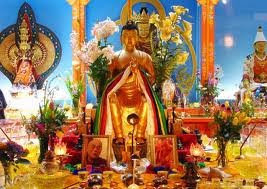
Golden Buddhist altar (BuddhistTrainTour)
[The Buddha replied:] "I tell you, friend, that it is not possible by traveling to know or see or reach the far end of the universe... But at the same time, I tell you that there is no making an end of disappointment and suffering without reaching the end of the universe (world). It is just within this fathom-long body, with its perception and intellect, that I declare that:
  1. there is the universe (world), 
  2. the origination of the universe,
  3. the cessation of the universe, and
  4. the path of practice leading to the cessation of the universe." [This is another wording of the ennobling Four Noble Truths.]
"It is not to be reached by traveling [in space]. AND it is not without reaching the end of the universe that there is release from disappointment and suffering. 
 
"So truly the wise one, an expert with regard to the cosmos, a knower of the end of the cosmos, having fulfilled the holy life, calmed, knowing the cosmos' end, doesn't long for this cosmos or for any other." (See also AN 9.38).