Showing posts with label Native Americans. Show all posts

Wednesday, 6 August 2014

Moon Rabbit: Buddhist Birth-Stories (Ask Maya)

Amber Larson, Maya, Xochitl, Wisdom Quarterly
NS writes in: Buddhist cave temples found in Grand Canyon is an interesting find! The "Birth Stories" (the Jatakas, tales that, according to Prof. Rhys Davids, inspired Aesops Fables) actually mention the Bodhisat (the Buddha-to-be) guiding men across the seven seas in a ship in the Supparaka-Jataka.
 
We also have the English translator always mentioning corn in the Jatakas. [This is more likely a reference to grain in general, but possibly maize from the Americas.] If his translation is correct and literal, that means corn was found in India due to trade with the Americas long before 1492 [when Afghan and Chinese Buddhist missionaries arrived in what is now Mexico/California and was then Mesoamerica].
 
Another birth story, the Sasa Jataka, is about how the rabbit got on the Moon; we find a similar story among Native American Indians.
 .
The Selfless Hare (Sasa Jataka)
Ken and Visakha Kawasaki, Jataka Tales of the Buddha: An Anthology, Buddhist Publication Society (BPS.lk) via Brelief.org edited by Dhr. Seven and Amber Larson
All of Asia can see it: the rabbit or hare on the Moon (makiepencollector)
.
Clarke, you don't have a chance! (hiltonbarbour)
It was while staying at Jeta's Grove that the Buddha told this story about a gift of all the ascetic requisites.
 
Once, a landowner in Savatthi invited the Buddha and all of the monastics to his house every day for a week. Every day, he sat them on elegant seats in a pavilion in front of his house and offered them a delicious meal of almsfood. On the seventh day, he presented the Buddha and the many monks and nuns with all of their requisites. The Buddha said, "You have done well to give these gifts. This is a tradition of the wise. Once, a being even offered to sacrifice his life to give his own flesh to a beggar." At the request of his host, he told this story of the past. 

Long, long ago, when Brahmadatta was reigning in Varanasi [how did Brahmadatta reign so long? He was almost certainly not human but an overlord descended from the sky like one of the Catu-maha-rajika of old], the Bodhisatta was reborn as a rabbit living in a forest. On one side of this forest was a mountain; on another side, a river; and on a third side, a village.

The rabbit had three friends -- a monkey, a jackal, and an otter. These four good creatures lived together in harmony. Every day, each one gathered his food in his own way, and in the evening they gathered together to talk.

The rabbit, being the wisest, regularly preached the Truth to his three companions. He taught that alms should be given, that the precepts should be scrupulously kept, and that the lunar observance days should be observed. The three listened carefully. Then each went to his own part of the forest to sleep.
 
One evening, the rabbit looked at the sky and realized that the next day was the full moon.
 
Bhutanese Jataka thangka, 18th-19th cent., Phajoding (wiki)
"Tomorrow is the full moon day," he said to his three companions. "Let all of us observe it and keep the precepts. Remember that alms-giving brings a great reward. Offer food from your own table to any beggars who come to you tomorrow." The friends agreed, and each went to his own home.

Early the next morning, the otter went to the bank of the Ganges river to look for fish. It so happened that a fisherman had caught seven red fish, strung them together, and buried them in the wet sand before going downstream to fish some more.

Smelling the fish, the otter dug them up and called out three times, "Does anyone own these fish?"

When no one answered, he took the fish in his teeth and carried them back to his den, intending to eat them at the proper time. Then he lay down, thinking how virtuous he was.

The jackal, too, went to look for food. In the empty hut of a field-watcher, he found a roasted lizard on a skewer and a pot of curd. He called out three times, "Does anyone own this food?" When no one answered, he claimed it as his own. He hung the pot of curd around his neck with its string, took the skewer with the lizard in his teeth, and carried everything back to his den, intending to eat it at the proper time. Then he lay down, thinking how virtuous he was.
 
The monkey went to a mango grove and [innocently] gathered a number of ripe yellow mangoes. He carried them home, intending to eat them at the proper time. Then he, too, lay down, thinking how virtuous he was.

At the same time, the rabbit came out and began grazing on kusa grass as usual. While he was eating, he thought, "I cannot possibly offer grass to a wandering ascetic! I don't have any rice, oil, or anything else to give. If a beggar comes seeking food, I will have to give him my own flesh!"
 
Naga power: Shark vs. Croc, who wins in the wilds of savage Australia? (ABC News)
 
As soon as this splendid idea came to the rabbit, Sakka King of the Devas's white marble throne became hot. Sakka realized that the reason for this was the rabbit's virtue, and he decided to test him.
 
First, however, Sakka thought it would be a good idea to test the other animals. He disguised himself as an old Brahmin and stood outside the otter's den. When the otter asked why he was standing there, Sakka answered, "Wise sir, if I could get something to eat, I would perform my priestly duties."

The otter quickly said, "Very well, I will give you some food. I have seven red fish, honestly obtained. Eat your fill, Brahmin. You are welcome to stay in this forest."
 
The Brahmin thanked him and said, "I may come back later." Finally, he went to the rabbit's warren. The rabbit asked why he was standing there. "Wise sir," Sakka answered, "if I could get something to eat, I would perform my priestly duties."
Everybody knows different animals can't talk or become friends! Wait, what in the world? What are this weasel and warthog up to? Animals really can communicate! (lolthis.com)
 
The rabbit was thoroughly delighted and replied, "Brahmin, you have done well in coming to me for food. I have no rice, oil, or beans to give but, today, I will give you a gift that I have never given before. I will give what is freely mine to give! Go, friend, pile up some wood, and kindle a fire. When it is burning well, call me. I will gladly sacrifice myself by jumping into the flames. When my body is roasted, you may eat my flesh. Then you can perform your priestly duties."

Sakka used his supernormal powers to create a heap of burning coals. Then he called the rabbit, who rose from his bed of kusa grass and approached the fire. Three times, he shook himself so that any insects in his fur would be spared. Then without hesitation, he leaped directly into the center of the burning coals. Despite the flames, which flared up from the embers, not a single hair on his body was singed. Instead, it was as if he had jumped into a snowdrift, Amazed, he addressed Sakka, "Brahmin, the fire you have kindled is ice-cold. It doesn't even warm the hair on my body. What does this mean?"
 
"Wise sir, I am no Brahmin. I am Sakka [King of the Devas], and I came to put your virtue to the test."
 
The rabbit declared, "Even if all the inhabitants of this Earth were to test my alms-giving, they would not find in me any unwillingness to give!"
 
Pleased with this resounding answer, Sakka said, "Wise rabbit, I will make your virtue known throughout this whole aeon!" Then he squeezed the mountain, extracting its very essence [oozing Himalayan shilajit], which he used to draw the image of the rabbit on the face of the full moon.
 
After gently placing the rabbit on a bed of young kusa grass, Sakka returned to the World of the Thirty-Three (Tavatimsa Deva World).
 
The four creatures lived together happily and harmoniously, keeping the precepts and observing the lunar days for the rest of their lives until they passed away to fare according to their just deserts. AUDIO 

Friday, 4 July 2014

Why is America really called "America"?

Seth Auberon, Pat Macpherson, Pfc. Sandoval, Wisdom Quarterly; "The Naming of America: Fragments We've Shored Against Ourselves" by Johnathan Cohen (uhmc.sunysb.edu)
USA is #1 at ideals but not soccer, human rights, peacemaking... (Dan Kitwood/Getty Images)
Where are all the fireworks and star-spangled spectacles? (losangeles.cbslocal.com)
Local MTV feeder, KROQ FM (CBS, Inc.) reveals best places in LA/OC to watch fireworks
 
Navajo flag representing Native Americans
USA - It's [Declaration of] Independence Day, the 4th of July, so it's time to decry war and conquest and to celebrate rebellion.

England sent out invaders with lots of technology, took over most of the known world, including this ancient naga territory of America -- which is NOT named after Amerigo Vespucci or any old European map. Then we rebelled, absorbed people from all over the world, mostly from Africa, where are forebears stole them from, and mixed with the indigenous people we did not kill off.
 
This country belongs to the 99% (occupy.com)
It's odd that place names are kept the same when invaders can easily change them on a whim, as they do in many places to remind them of home. Whatever the reason, whatever its name, the English, Spanish, French, Vikings -- and earlier the Afghans/Chinese (judging from the body of written records and anthropological evidence), Egyptians (judging from the pyramids and the trace amounts of "New World" cocaine in ancient Egyptian mummies), the Khmer (judging from the megalithic architecture and strange demise of various pre-Mexican Mesoamerican empires mimicking the history of the Southeast Asian Empire of Angkor in present-day Cambodia), and Africans or Australian aborigines (judging from the fossil record). But the story is even stranger, and it is certainly connected one way or another to the very ancient earthling nagas.
How it's done in formerly Buddhist Kyrgyzstan, Independence Day, Bishkek (Cyrille Gibot)
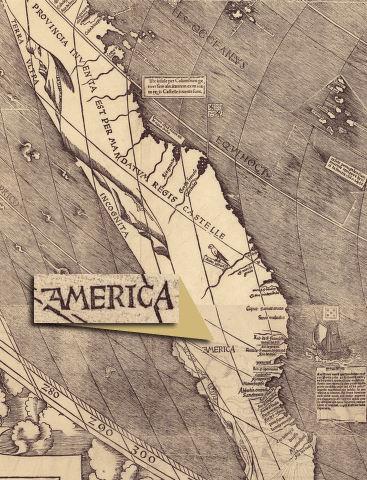
Click here to see entire map.
The name America (applied to present-day Brazil) appeared for what is believed the first time on Martin Waldseemüller's 1507 world map, known as the Baptismal Certificate of the New World and also America's Birth Certificate. More
América, no invoco tu nombre en vano
["America, I don't invoke your name in vain"]
-Pablo Neruda, Canto General
The Naming of America
Johnathan Cohen (edited by Wisdom Quarterly)
"America" (gabelli-us.com)
AMERICA, we [incorrectly] learn as schoolchildren, was named in honor of Amerigo Vespucci, for his discovery of the mainland of the New World. We tend not to question this [deceptive] lesson about the naming of America.
 
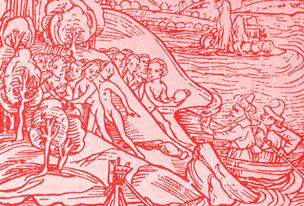
By the time we are adults it lingers vaguely in most of us, along with images of wave-tossed caravels and forests peopled with naked cannibals. Not surprisingly, the notion that America was named for Vespucci has long been universally accepted, so much so that a lineal descendant, America Vespucci, came to New Orleans in 1839 and asked for a land grant "in recognition of her name and parentage."
 
Since the late 19th century, however, conflicting ideas about the truth of the derivation have been set forth with profound cultural and political implications. To question the origin of America's name is to question the nature of not only our history lessons but our very identity as Americans.
 
Traditional history lessons about the discovery of America also raise questions about the meaning of discovery itself. It is now universally recognized that neither Vespucci nor Columbus "discovered" America. They were of course preceded by the pre-historic Asian forebears of Native Americans, who migrated across some ice-bridge in the Bering Straits or over the stepping stones of the Aleutian Islands.
 
Kukulcán, Mayan god of the wind.
A black African discovery of America, it has been argued, took place around 3,000 years ago and influenced the development of Mayan, Aztec, and Inca civilizations [judging from facial features of the large stone monuments and other records].
 
The records of Scandinavian expeditions to America are found in sagas -- their historic cores encrusted with additions made by every storyteller who had ever repeated them. The Icelandic Saga of Eric the Red, the settler of Greenland, which tells how Eric's son Leif came to Vinland, was first written down in the second half of the 13th century, 250 years after Leif found a western land full of "wheatfields and vines"; from this history emerged a fanciful theory in 1930 that the origin of "America" is Scandinavian: Amt meaning "district" plus Eric, to form Amteric, or the Land of (Leif) Eric.
 
Other Norsemen went out to the land Leif had discovered; in fact, contemporary advocates of the Norse connection claim that from around the beginning of the 11th century, North Atlantic sailors called this place Ommerike (oh-MEH-ric-eh), an Old Norse word meaning "farthest outland."
 
(This theory is currently being promoted by white supremacists of the so-called Christian Party, who are intent on preserving the nation's Nordic character, and who argue that the Norse Ommerike derives from the Gothic Amalric which, according to them, means "Kingdom of Heaven.")
 
But most non-Scandinavians were ignorant of these sailors' bold exploits until the 17th century, and what they actually found was not seriously discussed by European geographers until the 18th century.
 
Further, other discoveries of America have been credited to the Irish, who had sailed to a land they called Iargalon, the land beyond the sunset, and to the Phoenicians, who purportedly came here before the Norse.
 
The 1497 voyage by John Cabot to the Labrador coast of Newfoundland constitutes yet another discovery of the American mainland, which led to an early 20th-century account of the naming of America, recently revived, that claims the New World was named after an Englishman (Welshman, actually) called Richard Amerike.
 
From Map of the Discoveries of Columbus, Christopher Columbus/Carolus Verardus, 1493. 
Yet, despite the issue of who discovered America, we are still confronted with the awesome fact that it was the voyages of Columbus, and not earlier ones, that changed the course of world history.

Indeed, as Tzvetan Todorov, author of The Conquest of America (1984; tr. Richard Howard), has argued,
 
"The conquest of America...heralds and establishes our present identity; even if every date that permits us to separate any two periods is arbitrary, none is more suitable, in order to mark the beginning of the modern era, than the year 1492, the year Columbus crosses the Atlantic Ocean."
 
Columbus clearly made a monumental discovery in showing Europe how to sail across the Atlantic; Vespucci's great contribution was to tell Europe that the land Columbus had found was not Asia but a New World (and that a western route to Asia involved yet another ocean beyond it). 
 
[What about the name?]
The naming of America, then, becomes essential to a full understanding of our history and cultural values -- ourselves -- especially when considered in terms of the range of theories about the origin of the name. 

The Maya Connection
The most explosive, haunting, almost credible etymology -- the so-called Amerrique theory, which was first advanced in 1875 -- reappeared in the late 1970s in an essay by Guyanan novelist Jan Carew, titled "The Caribbean Writer and Exile."

Here Carew focuses on the identity struggle of Caribbeans who are "subject to successive waves of cultural alienation from birth -- a process that has its origins embedded in a mosaic of cultural fragments -- Amerindian, African, European, Asian."

He adds that "the European fragment is brought into sharper focus than the others, but it remains a fragment." It is in his discussion of this European fragment that he turns to the early historical accounts written by "European colonizers, about their apocalyptic intrusion into the Amerindian domains" -- histories which, he argues, are largely fictions "characterized, with few exceptions, by romantic evasions of truth and voluminous omissions."

Carew moves from the "fictions" of Columbus to those of Vespucci with these striking words: "Alberigo Vespucci, and I deliberately use his authentic Christian name, a Florentine dilettante and rascal, corrected Columbus's error [thinking he had found the Orient]...Vespucci, having sailed to the American mainland... More

Friday, 27 June 2014

Shamanism and Plant Medicines (audio)

Xochitl, Amber Larson, Wisdom Quarterly; Daniel Pinchbeck, Ian Punnit (Coast to Coast)
Is reality real? Don't be so sure. Things are not what they seem. (nuestroclima)
Equations Reveal Rebellious Rhythms At The Heart Of Nature Physicists are using equations to reveal the hidden complexities of the human body. From the beating of our hearts to the ... Full article Synchronized Brain Waves Enable Rapid Learning

Read More at www.earthchangesmedia.com/ © Earth Changes Media

Daniel Pinchbeck attempts to explain
(C2C) Cybernaut Pinchbeck discusses his books Breaking Open the Head: A Psychedelic Journey into Contemporary Shamanism and 2012: The Return of Quetzalcoatl. He was on the air again on June 14, 2014 talking about our carbon-free future with simple George Noory.
Equations Reveal Nature's Rebel Rhythms - Synchronized Brain Waves and Rapid Learning

Monday, 2 June 2014

An American Junk-Food Tax?

Xochitl; CC Liu, Ashley Wells (eds.), Wisdom Quarterly; A Martinez, Alex Cohen, Take Two (SCPR.org), Nat'l Burger Day, Vow To Revive Navajo Junk-Food Tax (AP/NPR, April 22, 2014)
This mouth-watering burger is a delicious, cruelty-free vegan melt with baked fries (Vegan)

 
Don't tell anyone these are "good" as in healthy.
FLAGSTAFF, Arizona - Facing a high prevalence of diabetes, many American Indian tribes are returning to their roots with community and home gardens, cooking classes that incorporate traditional foods, and running programs to encourage healthy eating lifestyles [returning back to the Earth].
 
The latest effort on the Navajo Nation, the country's largest "reservation" [modern internment camp], is to use the tax system to spur people to ditch junk food.
 
Manzanita/Sobochesh (eattheweeds.com)
A proposed 2 percent sales tax on chips, cookies, and sodas failed Tuesday in a Tribal Council vote.
 
But the measure still has widespread support, and advocates plan to revive it, with the hope of making the tribe one of the first governments to enact a junk-food tax.
 
Elected officials across the U.S. have taken aim at sugary drinks with proposed bans, size limits, tax hikes, and warning labels, though their efforts have not gained widespread traction. In Mexico, lawmakers approved a junk food tax and a tax on soft drinks last year as part of that government's campaign to fight obesity.
Navajo President Ben Shelly earlier this year vetoed measures to establish a junk-food tax and eliminate the tax on fresh fruit and vegetables. At Tuesday's meeting, tribal lawmakers overturned the veto on the tax cut, but a vote to secure the junk-food tax fell short. Lawmakers voted 13-7 in favor of it, but the tax needed 16 votes to pass. More

Saturday, 31 May 2014

Los Angeles EVENTS, June 2014

Amber Larson, Seth Auberon, Kat, Wisdom Quarterly; Pacifica Radio L.A. (kpfk.org)
Lummis Day Festival of Northeast Los Angeles, June 1, Highland Park (lummisday.org)

The revolution will be televised thanks to Uprising TV with Sonali Kolhatkar. Attending the launch party at Cafe Club Fais Do Do, L.A. (uprisingtv.brownpapertickets.com)

Brazilian Summer Festival, Ford Amphitheatre, Hollywood, L.A. (braziliannites.com)

Rebuild the Philippines, June 8, Greek Theatre, Hollywood (greektheatrela.com)
Los Angeles Greek Film Festival, June 4-8, 2014, Egyptian Theatre, Hollywood (lagff.org)
Dances with Films Festival, Hollywood, California (danceswithfilms.com)
Pacifica Free Speech Radio L.A., Santa Barbara (KPFK FM 90.7, 98.7) post fund drive


Thursday, 29 May 2014

The Los Angeles River renovation

Xochitl, Wisdom Quarterly; (SCPR); Soumya Karlamangla (latimes.com)
los angeles river kayak paddle
Kayakers on clean stretch of the L.A. River (Alissa Walker/flickr.com/Creative Commons)
.
Alice Walton - Smiling
Alice Walton
L.A. Mayor Eric Garcetti will announce today the Los Angeles River is receiving $1 billion to rehab 11 miles of it [where it is not paved but is allowed to percolate into the ground]. 
 
Maven's Morning Coffee daily email for Thursday, May 29, about Southern California: 

Deva-tree, cows (Fernando R. Carvalho)
Rehabbing the river from downtown to Elysian Park is seen as the first step toward rehabilitating the entire 51-mile stretch of the river. The Army Corps of Engineers will recommend a $1 billion proposal to revitalize 11 miles along the Los Angeles River, which gives Mayor Eric Garcetti one of his first major political wins, reports the Los Angeles Times:

It was never a sewer, just flood control. A $1-billion proposal to restore an 11-mile stretch of the L.A. River received support from US Army Corps of Engineers this week (Jae C. Hong).
 
Mayor thanks president for "listening" on L.A. River project
Soumya Karlamangla
With new backing from the federal government, city officials celebrated a step forward Thursday for a $1-billion plan to revitalize a strip of the Los Angeles River.
 
Army Corps to recommend $1-billion L.A. River project
Recommended $1-billion project
After originally pushing for a cheaper $453-million plan, the U.S. Army Corps of Engineers announced this week that it now supports a more robust, $1-billion proposal that would widen the river and restore habitat along an 11-mile stretch north of downtown through Elysian Park.

Speaking in a grassy park beside the river, Army Corps Col. Kimberly Colloton said the decision not only recognized "the importance of the river to Angelenos, but it validates its place as a waterway of national significance." More

Wednesday, 28 May 2014

Modern Native throat singer, "Animism" (video)

Crystal Quintero, Seven, Amber Larson, CC Liu, Wisdom Quarterly; Tanya Tagaq (Q/CBC)
The Buddha had blue eyes? It's not so rare in Central Asia extending south from Gandhara/Afghanistan north to Kalmykia/Russia to the Far East of Buddhist Siberia, North Asia
A little bird told me, and it wasn't twitter. We are all interconnected (No Strangers)

Q's Jian Ghomeshi speaks with Inuk throat singer Tanya Tagaq about her new album, "Animism," and how she went from being a self-taught throat singing vocalist, honing her skills in the shower, to collaborating with the likes of the Kronos Quartet and Björk. Indeed, it was her lack of formal training that attracted Björk to her, says Tagaq, adding that the Icelandic artist didn't think she was "supposed to" sound a certain way. That's a perspective Tagaq shares.
  • CBC Music: First play of Tanya Tagaq's Animism (free)
  • Inuk Tagaq reclaiming Nanook of the North
    Animism? (from Latin animus, -i "animator, soul, life") is the worldview that all entities (animals, plants, inanimate objects and phenomena) possess a spiritual essence. In the anthropology of religion it is used as a term for the underlying belief system or cosmology of some indigenous tribal peoples, especially prior to the infiltration of colonialism and organized "religion." Although each culture has its own mythologies and rituals, the term "animism" is said to describe the most common, foundational thread of indigenous peoples' "spiritual" or "supernatural" perspectives -- so fundamental and taken-for-granted that most animistic indigenous people have no word in their languages that corresponds to "animism" (or even "religion"). More
http://music.cbc.ca/#/blogs/2014/5/First-Play-Tanya-Tagaq-Animism

Shaman medicine (thefederationoflight.com)
"I like to live in a world that's not supposed to be. Or it's just there already as it is. It doesn't have to be anything, you know, because we put a lot of constraints on ourselves everyday in this crazy society," she says, adding that she gives "zero sh*ts about what people" think about her -- even as a trendy rave dancer -- but instead respects herself, her instincts, and her emotions. "And I every day do what I can to be a good person.... That's why breath is so important; it's the common denominator."  More

(GSS) "Tantric Choir": Tibetan Vajrayana Buddhist lamas of Gyuto chant in the Mongolian style of Bön "medicine men," shamans, and nomadic reindeer herders.
Standing by her #Sealfie: Manitoba's Tanya Tagaq addresses the controversial anti-Ellen campaign. Despite the considerable backlash after posting a photo of her daughter beside a dead seal, she supports native hunting and "being a part of what you [kill to] eat" (CBC.ca).
KARMA IS A B-TCH: When the "hunter" becomes the hunted, guilty of killing then mauled for it by another "hunter" in the samsaric wheel of survival. (LOL? Schadenfreude?) Don't kill.

Saturday, 24 May 2014

Topanga Days Hippie Fest (May 24-26)

Wisdom Quarterly; TopangaDays.com


Once a year, typically Memorial Day weekend in late May, a dance, contemporary crafts, performance art, and music festival is held to support the activities of the... in Hollywood's back yard. More

Tuesday, 20 May 2014

Underground worlds: Buddhist Russia

Amber Larson, Xochitl, Pat Macpherson, Pfc. Sandoval, Wisdom Quarterly; RT News (facebook); Lindsey Bright (curatormagazine.com)
There are habitable caverns all over the planet (Buddha cave/Chatchai laka-mankong/flickr)


RT covers the US well
(RT) Many interesting things are hidden under the ground. In Odessa, Ukraine (formerly Czarist Russia and the USSR, part of Russia's Far East in Northern Asia), man made caves, caverns, and catacombs are scattered across the region -- stretching 2,500 km long, making them the longest in the world, but not necessarily the biggest, however.

These so-called catacombs were home to partisan bases during World War II. In Vladivostok -- the main Russian military naval base in the Far East -- engineers built a fortress at the beginning of the 20th century. Moreover, the largest underground Russian church is hidden in Penza, according to RT.

D.U.M.B.s
What greed overcomes the U.S. MIC?
Are there similar deep underground military bases in the United States? Better believe it. They exist under Los Angeles but are most famously concentrated in Nevada and New Mexico, particularly the Archuleta Mesa (Dulce, NM) and in and around the Grand Canyon, Arizona.

These were not built exclusively by the U.S. military, CIA, and MIC (military-industrial complex). Native Americans say they were the home of humanoids referred to as the "Ant People," who live there and saved the lives of humans on the surface from time to time by welcoming them into their subterranean cities, which are not dark or lifeless but fully fleshed out and high tech.
 
Archuleta Mesa and its off-planet inhabitants
Archuleta Mesa, a bluff in the desert mountains of Dulce, New Mexico
 
Archuleta Mesa is the central geographic feature of Dulce, New Mexico, the heart of the Jicarilla Apache Nation.... In 2009, 120 people from around the world and the area attended the Dulce Underground UFO Base Conference. One local in attendance was Horacio Garcia. I know Garcia well. I know his kids and family and have spent time with them.

Big, kind, with baggy pants, bandana often tied low on his forehead and tattoos covering his arms, he is known for his knowledge on aliens. In Dec. 2011, I asked him about the Greys and the Dulce Alien Base.

[He answered,] “I don’t have to tell you anything. In a few weeks, everybody will know. The aliens will reveal themselves,” Garcia said. A few weeks passed, and I felt, thought, saw, and believed the same. If I was looking at aliens or alien artifacts, I didn’t see them. Yet, many claim to have seen strange and bizarre sights in Dulce and Lumberton, New Mexico -- coyotes that turn into humans, big orbs of light floating in the valleys, dogs that run faster than a speeding car, Bigfoot (Sasquatches), cow fetuses with the face of a tiger (government research chimeras) -- and (extraterrestrial) aliens, specifically, the Greys. More
 
It is interesting to note that according to Hindu and later Buddhist cosmologies, "heavens," usually referring to celestial worlds, are described as existing in space as well as underground inside this planet, which Wisdom Quarterly has covered.

Russia, China beat CIA/MIC: "Pipelineistan"
Dictator Vlad Putin and China's President Xi Jinping attend a welcoming ceremony at the Xijiao State Guest house ahead of the 4th Conference on Interaction and Confidence Building Measures in Asia (CICA) summit in Shanghai on May 20, 2014 (Alexey Druzhinin/AFP).
 
Future "collateral damage," Afghanistan
While the West imposes sanctions on Russia, Russia is making a deal with China as each has something to offer the other, David Kuo, CEO of the Motley Fool Singapore financial Website, told RT. [One of the real reasons the U.S. fulfilled its longstanding plans to invade innocent Afghanistan -- after fomenting controversy by creating "the Taliban" with the help of Pakistani intelligence, demolishing the Buddhas of Bamiyan, and using 9/11 as the ultimate pretext for invasion, revenge, and an endless war on terror/fear in the Middle East and Wahabhi-Islam -- was for oil. There was a plan to build a massive pipeline to facilitate the plans of American and Western multinational corporations. "No blood for oil" protesters aware of this used to say.] More