Showing posts with label USA. Show all posts

Tuesday, 19 August 2014

Violence and Disruption in Society (sutras)

Elizabeth J. Harris; Dhr. Seven, Amber Larson, Crystal Quintero (eds), Wisdom Quarterly
Police provoke peaceful protests to become violent as a pretext to violently clampdown.
Violence and Disruption in Society: A Study of the Early Buddhist Texts
U.S. state-sponsored violence over Japan
At 8:15 am Japanese time, on August 6th 1945, a U.S. plane purposely dropped a horrific bomb named "Little Boy" over the center of the city of Hiroshima with the intention of killing all the civilians living there.

The total number of human beings who were killed immediately and in the following months was probably close to 200,000. [The countless other earthlings harmed are not measured or recorded.]

Nagasaki Museum (latimes.com)
Propaganda was cultivated as a justification -- How could we do this and still come off looking like moral heroes and nonbarbarians? -- that this nuclear bomb and the one the U.S. military chose to drop on the city of Nagasaki ended the war quickly and saved American and Japanese lives. This is but a consequentialist theory to justify our horrific industrial-scale violence against innocent civilians.
 
Hirohsima-Nagasaki (kootation.com)
Others say the newly developed weapons had to be tested as a matter of necessity. Victims in Hiroshima and Nagasaki helped us usher in a new age. Our tendency toward conflict and violence can now wipe out the entire human habitat....

It is against the urgency of this background that the teachings of Buddhism about violence must be studied and interpreted. Excerpts such as the following have been extracted and used to sum up the Buddhist attitude to this issue:
All tremble at violence,
All fear death;
Comparing oneself with others
One should neither kill nor cause others to kill. (Dhp. v. 129)
Victory breeds hatred,
The defeated live in pain.
Happily the peaceful live,
Giving up victory and defeat.
(Dhp. v. 201)
These verses would seem to indicate a clearly defined Buddhist perspective. Yet such text extraction can lead to misrepresentation if not undergirded with a strong supporting framework. Furthermore, if Buddhism has a message for a violent world, it must do more than condemn violence. It must be able to interpret its nature, its roots, its hold on the world and the possibilities for its transformation. It must dialogue with other philosophies and ideologies such as utilitarianism [Note 1], scientific socialism, and the belief in a "just" or "holy" war.

For instance, utilitarianism still lives among those who believe that violence can be justified if more people will benefit than will be hurt, and the consequentialist theory is similar to this. Then there are those who hold that certain forms of injustice and exploitation can only be destroyed through violence and that history will justify its legitimacy.

The view that violent change is a historical inevitability is close to this. Buddhism must be able to comment on the stance which argues that if Hitler had been assassinated early in his career numerous deaths would have been avoided, or the claim that force is justified against a government which is using violence against its people under the pretext of law. If it cannot, it will stand accused of irrelevance.

"Violence" is that which harms, debases, dehumanizes, or brutalizes human beings, animals, or the natural world. The violent person is one who causes harm in speech or action, either directly or indirectly, or whose mind is filled with such thoughts [2].  These four questions provide the framework for this study:
(1) What different forms of violence do the Buddhist texts show knowledge of?
(2) Why do the texts condemn violence or call it into question?
(3) What do they see to be the roots of violence?
(4) Do the texts give any guidelines for the eradication of violence in the individual or in society?
1. Forms of Violence:
The Buddha's Awareness
Dhammikarama Burmese Buddhist Temple -- the first Buddhist temple to be built in Georgetown, Penang, Malaysia, 1803. It is filled with striking features and a rich past, a retreat for Buddhist devotees, serving as historical evidence of Burmese occupation (JMR).
.
The sutras of the Buddha, as they have been handed down, are replete with details about the contemporary realities of his time. They reveal much about the social context within which he moved and the faces of society with which he was familiar.
 
The Canki [pronounced "chunky"] Sutra shows a Brahmin overlord insisting that the Buddha is equal to him in birth, riches, and knowledge of the Vedas (the sacred knowledge books of India inherited from the more ancient Indus Valley Civilization). He continues:
Indeed, sirs, King Seniya Bimbisara of Magadha with his wife and children has gone to the recluse Gautama for [guidance] for life. Indeed, sirs, King Pasenadi of Kosala with his wife and children has gone to the [guidance] Gautama for refuge for life. Indeed, sirs, the Brahmin Pokkharasati with his wife and children has gone to the recluse Gautama for [guidance] for life [3].
Important here is the reference to kings. The texts show clearly that the Buddha -- himself a royal from the Shakya clan somewhere in the northwest frontier -- had an intimate knowledge of statecraft. Records of his conversations with King Pasenadi and King Bimbisara show him speaking in a language which those involved in government could understand.

King Pasenadi, for instance, comes through as a man torn between his duties as king, involving some degree of ruthlessness, and his concern for spiritual things. At one moment, he is seen preparing a Brahminical sacrifice in which many animals are to be slaughtered and menials beaten and, at another, speaking seriously with the Buddha about the dangers of wealth, power, and unskillful conduct [4].

What is significant is the level of knowledge shown by the Buddha about the pressures on a king such as Pasenadi. His use of similes and illustrations, for instance, appeals to Pasenadi's experience, including the central concern of all rulers at that time -- defense against aggression. At one point Pasenadi asks about the value of gifts and to whom a gift should be given for the gift to bear much fruit. The Buddha replies:
A gift bears much fruit if given to a virtuous person, not to a vicious person. As to that, sire, I also will ask you a question. Answer it as you think fit. What think you, sire? Suppose that you were at war, and that the contending armies were being mustered. And there were to arrive a noble youth, untrained, unskilled, unpracticed, undrilled, timid, trembling, affrighted, one who would run away -- would you keep that man? Would such a man be any good to you? [5]
The Buddha thus uses similes from Pasenadi's military world to indicate that virtue does not depend on birth but on qualities of character. In fact, in a number of texts, illustrations drawn from the context of the state, defense, and martial arts can be found. Not only does the Buddha make use of military metaphors, but the texts show that he [as a prince trained to one day assume throne as king of the Shakyas] had extensive knowledge of the strategies of war, punishment, and political patronage. 

The Mahadukkhakkhandha Sutra, for instance, uses graphic description to show that war and conflict spring from sensual desires:
And again, meditators, when sense pleasures are the cause... having taken sword and shield, having girded on bow and quiver, both sides mass for battle, and arrows are hurled, and knives are hurled, and swords are flashing. Those who wound with arrows and wound with knives and decapitate with their swords, these suffer dying then and pain like unto dying...
And again, meditators, when sense pleasures are the cause...having taken sword and shield, having girded on bow and quiver, they leap on to the newly daubed ramparts, and arrows are hurled, and knives are hurled, and swords are flashing. Those who wound with arrows and wound with knives and pour boiling cow-dung over them and crush them with the portcullis and decapitate them with their swords, these suffer dying then and pain like unto dying [6].
In the next part of the sutra, a variety of horrific punishments are described, and a keen awareness of their nature is revealed:
Kings, having arrested such a one, deal out various punishments: they lash him with whips, and they lash him with canes, and they lash him with rods, and they cut off his hand... his foot... his hand and foot... his ear... and they give him the "gruel-pot" punishment... the "shell-tonsure" punishment... "Rahu's mouth"... the "fire-garland"... the "flaming hand"... and so on [7].
In another sutra, two men are pointed out while the Buddha is talking to a headman, Pataliya. One of them is garlanded and well-groomed; the other is tightly bound, about to lose his head. We are told that the same deed has been committed by both. The difference is that the former has killed the foe of the king and has been rewarded for it, while the latter was the king's enemy [8] .

Hence it is stressed that the laws of the state are not impartial: they can mete out punishment or patronage according to the wish of the king and his cravings for revenge or security.
 
It cannot be argued that the Buddha was ignorant of the political realities of his day. He spurned frivolous talk about such things as affairs of state [9]. But he was neither indifferent to them nor uninformed.

On the contrary, his concern for the human predicament made him acutely aware of the potential for violence within the economic and political forces around him. The political milieu of rival republics and monarchies janapadas] in northern India forms a backdrop to his teaching, whether the rivalries between the kingdoms [of Kosala and Magadha or the struggles of the republics to maintain their traditions and their independence in the face of the rising monarchies [10].

However, the violence attached to politics and statecraft forms only one section of the picture which emerges from the texts. Violence is detected in the Brahmanical sacrificial system, in the austerities practiced by some wanderers, and in the climate of philosophical dispute among the many shramana groupings as well as in the area of social discrimination and the economic order.

Religion, to take this first, is seen as a cause of physical, verbal, and mental violence. The violence inflicted through sacrifices is described thus:
Now at that time a great sacrifice was arranged to be held for King Pasenadi, the Kosalan. Five hundred bulls, 500 bullocks, and as many heifers, goats, and rams were led to the pillar to be sacrificed. And they that were slaves and menials and craftsmen, hectored about by blows and by fear, made the preparations with tearful faces weeping [11].
In contrast, the shramana groupings within this period rejected sacrifice [to the gods]. Denying the authority of the Vedas and a realm of gods [brahmas, devas, nagas, asuras] to be manipulated, their emphasis was on renunciation, the gaining of insight, and philosophical debate.
 
Nevertheless, a form of violence was present. The austerities practiced by some of those who came to the Buddha were worse than any enemy might inflict as punishment. Prior to enlightenment Prince Siddhartha as a wandering ascetic practiced them. In the Maha-Saccaka [12] and the Maha-Sihanada [13] Sutras there is vivid description of the excesses undertaken. More
ENDNOTES
Abbreviations: DN...Digha Nikaya, MN...Majjhima Nikaya, SN...Samyutta Nikaya, AN...Anguttara Nikaya, Dhp...Dhammapada, Snp...Sutta Nipata.
 
Textual references have been taken from the Pali Text Society's editions of the Nikayas (Sutra Collections). Unless specified otherwise, English translations have been taken from the PTS versions, though some have been slightly altered.
 
1. Utilitarianism is a philosophy which claims that the ultimate end of action should be the creation of human happiness. Actions should be judged according to whether they promote the greatest happiness of the greatest number. The most important exponent of this philosophy was the nineteenth century British thinker John Stuart Mill. One of the weaknesses of utilitarianism is that it can be used to justify the violation of minority rights.
2. Reference may be made to many texts which stress that encouraging others to do harm is blameworthy. AN ii,215, for instance, speaks of the unworthy man and the more unworthy man, the latter being one who encourages others to do harmful actions such as killing living beings.
3. MN 95/ii,167.
4. The Kosala Samyutta (Samyutta Nikaya, Vol. 1) records the conversations which this king had with the Buddha. The examples mentioned have been taken from this section.
5. SN i,97.
6. MN 13/i,86-87.
7. MN 13/i,87.
8. SN iv,343.
9. In several sutras, the Buddha comes across groups of wanderers engaged in heated discussions about kings, robbers, armies, etc. (e.g., DN iii,37; MN ii,1). In contrast, the Buddha advised his disciples either to maintain noble silence or to speak about the Dharma.
10. See Romila Thapar, A History of India (Pelican Books UK, 1966), Chapter 3.
11. SN i,75.

Thursday, 7 August 2014

An honest man on ISRAEL: Noam Chomsky

Wisdom Quarterly; Noam Chomsky, Amy Goodman (democracynow.org, Aug. 7, 2014)


Hideous. Sadistic. Vicious. Murderous. That is how Noam Chomsky describes Israel’s 29-day offensive war on Gaza -- which as killed nearly 1,900 people and left almost 10,000 Gazan Palestinians injured.
 
Ilanpappe
Pappe: "Racist Apartheid State" with US help
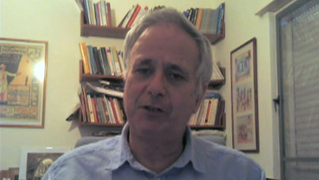
Chomsky has written extensively about the Israel conflict with Palestine for decades. After Israel’s Operation Cast Lead in 2008-2009, Chomsky co-authored the book Gaza in Crisis: Reflections on Israel’s War Against the Palestinians with Israeli scholar Ilan Pappé. (Exeter University Prof. Pappé is one of the leading voices on Israel, calling the U.S./Israel campaign against Palestine an "incremental genocide").
 
Gazadestruction
Israel claims "self-defense" in war crimes
Chomsky's other books on the Israel/Palestine conflict include Peace in the Middle East?: Reflections on Justice and Nationhood and The Fateful Triangle: The United States, Israel, and the Palestinians. Perhaps his most famous work is called Manufacturing Consent exposing American propaganda techniques.
 
Noam Chomsky is a world-renowned political dissident, linguist, and author, Institute Professor Emeritus at MIT (Massachusetts Institute of Technology), where he has taught for more than 50 years. More

Wednesday, 6 August 2014

America's Buddhist burial mound at Sedona

Crystal Quintero, Dhr. Seven, Wisdom Quarterly; photographers Pete/Karevil, Glen Carlin
Vajrayana Buddhist prayer flags flying over Boudhanath, Nepal (Pete/Karnevil/flickr)
 
Wisdom and Compassion
The dome at the base of Boudhanath Stupa ("Enlightenment Reliquary," a UNESCO World Heritage Site) outside Kathmandu, Nepal represents the entire world. When a person awakens (represented by the opening of the eyes of wisdom and compassion) from the illusory bonds of the world, that person has reached the state of enlightenment. Complete liberation (nirvana) awaits and is already visible when this is accomplished.


America needs a great Buddhist stupa!
Xochitl, Amber Larson, Dhr. Seven, Ashley Wells, Wisdom Quarterly
Sedona's Buddhist Stupa, Sedona, Arizona (Glen_Carlin/flickr.com/collage)
 
Flags over Sedona Stupa (Glen Carlin)
We have one! We have other smaller ones, too. Every Buddhist temple in America wants its own old-world reliquary, a white mound to entomb spiritual treasures.

Pagodas, dagabas, chortans, mandala-mounds, and so on all house priceless reliquary objects -- either minute amounts of the historical Buddha's funerary ashes or relics (strange physical byproducts of enlightenment manifesting as beautiful glass-like beads and other formations that survive or are produced during cremation) or the remains of arhats, honored teachers, and world rulers (chakravartins).

Then there's the great Tibetan stupa at SMC in Colorado, too (shambhalamountain.org)
  • Small side-chortan in Sedona
    Wait a minute. How in the world could there be so many of the Buddha's cremation ashes to supply all the world's stupas? It's ludicrous; it's like all that wood the Medieval Christians sold as authentic bits of Christ's own Roman cross. The answer is very simple. If we begin with one cup of actual cremation remains, then we can divide that, but as with any precious powder, it is watered down with a neutral substance: one part relic ashes with one million parts neutral ashes = 1,000,001 parts authentic Buddha ashes. Stranger still, "relics" multiply, so they are not limited to what was available the first day. Moreover, not only the Buddha's remains are used but those of many arhats. There are still arhats, still funeral pyres, cremation remains, and so long as the Dharma is practiced even by one person, there is a chance for more.
Amazing Anasazi (Hopi) ruins at Tuzigoot, Clarkdale, Arizona (americansouthwest.net)
 
Wooden Buddha (Glen Carlin)
City councils are very reluctant to approve of such building requests. There is a campaign to bring one to Los Angeles by the Los Angeles Buddhist Vihara.
 
But one already exists, built by Tibetan Buddhists in northern California. Across the USA there are small ones and plans, or at least dreams, for more.

Buddha profile (Glen Carlin)
However, there is at least one great one already: It is in our spiritual center where Native Americans recognized vortices of power and energy, Sedona, Arizona.

Wisdom Quarterly visited with Xochitl and Dr. Rei Rei to visit the Anasazi sites and this amazing hidden gem hidden on the west side of the American Southwest's most beautiful town.

To visit, choose the cooler months. Sedona is amazing year round, with winter snows the blanket the red rocks. It is one of the most picturesque landscapes in the world, a lower extension of the once Buddhist Grand Canyon. (How could the Grand Canyon ever have been Buddhist? It was).
Hovering above the massive stupa is a gorgeous wooden Buddha carving surrounded by many American offerings: trinkets, flowers, incense, glass beads, Native American jewelry, coins, notes, flags...adding to the splendor of the U.S. Southwest (Glen_Carlin/flickr.com).
Sedona, Arizona is "the most beautiful place on earth" (visitsedona.com)

Friday, 1 August 2014

Animals eating corpses due to ISRAEL (video)

Ashley Wells, Sheldon S., Pat Macpherson, Pfc. Sandoval, Dhr. Seven, Wisdom Quarterly; Amy Goodman, Juan Gonzalez, Aaron Mate, Nermeen Shaikh (DemocracyNow.org)

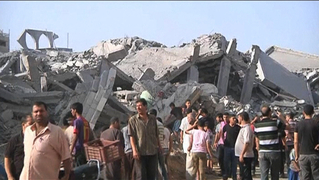
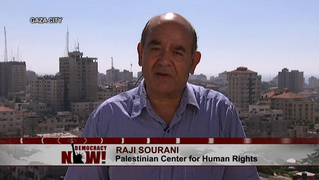
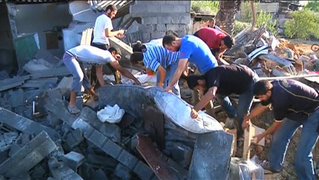
Rajisouraniaugust1An almost unthinkable thing is happening in Muslim/Christian Palestine. Dead civilians, children, and their scattered body parts are not being allowed to be collected. The result is that laying around in the sun and rubble, wild animals are moving in to devour them. The demons rejoice and unclean spirits feast (Buddhist yakshas, pretas, maras, asuras).
 
This is unthinkable because according to Muslim and Jewish tradition, it is vital that all parts of the physical body be interred for the future rearising (not rebirth so much as reincarnation, the coming to life again, the resurrection). Palestinians are horrified and rushing in when any phony, fragile ceasefire is announced only to be killed when Israel changes its mind or uses the pretext that Hamas restarted the asymmetrical warfare being waged on it.
Whereas Zoroastrians (Indian Parsis) or Tibetans might welcome a "sky burial," being eaten as carrion by vultures, the Middle East can hardly think of anything worse than being eaten by filthy beasts, a mark of the depravity of human cultural insensitivity. Their suffering and anguish seems to drive the "powers that be," the forces fueling, directing, encouraging, and re-arming Israel.
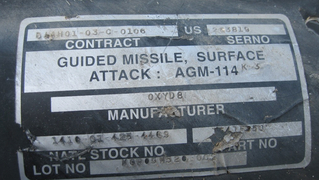
Israelis may carry out the atrocities, but it is certain that the CIA and other Western forces are pulling the strings and approving of the tactics -- drones, mass surveillance, spies, informants, home demolishing, bombing civilian infrastructure as was done illegally in Iraq in the early years of the internationally-illegal U.S. invasion, and so on. Then Israeli generals take it even to unapproved tactics -- shelling U.N. facilities, invading civilian camps (as was done infamously in Janine), immediately rearresting released prisoners, claiming to have lost a soldier to kidnapping then using this allegation as a pretext for collective punishment, the basis of threats to take the gloves off and go in with even greater force and brutality, to engage in ethnic cleansing, incremental genocide, and crimes against humanity all the while calling it "retaliation" and a "security" exercise and a tunnel exploration, tunnels built only to overcome an illegal strangulation of 1.8 million people called a "blockade."

S4-1
Amnesty Int'l: US should stop arming Israel amid "growing evidence of war crimes in Gaza"
 
There is a literal Preta Realm as well.
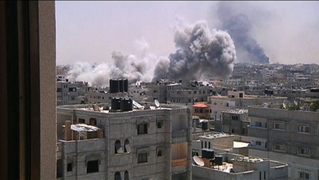
Indiscriminate shooting, aerial bombardment, attacks from the sea, and ground invasion of a densely populated metropolitan civilian area with no exit allowed. It is as if a WW II army went into a ghetto, surrounded it, cut off all escapes, then began killing residents blaming them for "remaining in a war zone." And the world is lied to told that it is a "conflict" between, one is led to assume, more or less equal sides, to foreign armies at odds, when nothing could be further from the truth.

The truth is the world's greatest military is funding, aiding, arming, and training the fourth most powerful military to kill civilians armed with homemade rockets, old rifles, and anything that comes to hand, who are granted an internationally-recognized right to defend themselves. But that defense is used as the excuse for offensive attacks and thousands of TONS of bombs being dropped on a city of helpless victims.

And we, the world, stand around looking at our feet saying, "I'm sure Israel has its reasons." The mainstream media is controlled, unarmed soldiers are sent all over the world to man the PR desks, and keep the propaganda machine churning out spin to protect the onslaught from scrutiny or intervention.
 
The Western world is silenced, the Arab world is stymied, and the poor Palestinians have to wonder why no one but God is hearing their cries and pleas. And even God seems to not be paying attention. People of conscience may say something, but people of the book only seem to be chanting encouragement to the killers in Israel to keep going.
Johnbrennan
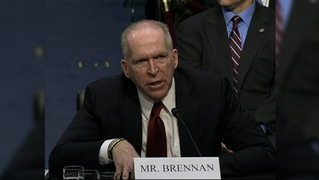
John Brennan faces calls to resign after CIA admits to spying on Senate torture probe
 

How Israel's PR controls the media (video)

Ashley Wells, Sheldon S., Dhr. Seven, CC Liu, Wisdom Quarterly; documentary directors and (mediaed.org, IMDB.com)
Why is the U.S. public unaware of the war crimes our government (military-industrial complex) and Israel are committing even though it's in the news all day long? Careful public relations, also known as well crafted propaganda. Jahlly and Ratzkoff explain in Peace, Propaganda & the Promised Land.

This video shows how the foreign policy interests of American political elites -- working in combination with Israeli public relations strategies -- influence U.S. news reporting about the Middle East conflict.

Combining American and British TV news clips with observations of analysts, journalists, and political activists, "Peace, Propaganda & the Promised Land" provides a brief historical overview, a striking media comparison, and an examination of factors that have distorted U.S. media coverage and, in turn, [controlled] American public opinion.
What will it take to get the U.S. public's attention about our and Israel's crimes? Topless FEMEN protesters conduct a "Slut Walk" in Tel Aviv, May 10, 2014 calling attention to religious sexism, patriarchy, militarism, and crimes against humanity.
 
Peace, Propaganda & the Promised Land:
U.S. Media on Israel-Palestine
Peace, Propaganda & the Promised Land provides a striking comparison of U.S. and international media coverage.
 
It focuses on the "crisis" [actually Israel's genocide, ethnic cleansing, and crimes against humanity] in the Middle East, zeroing in on distortions in U.S. coverage reinforce false perceptions of the Israeli-Palestinian problem.
 
I did what you said. - You'll get over it.
This pivotal documentary exposes how the foreign policy interests of American political elites -- big oil, a need to have an American military base in the region, and others -- work in combination with Israeli public relations (PR) strategies to exercise a powerful influence over how news from Israel is reported.

Through the voices of scholars, media critics, peace activists, religious figures, and Middle East experts, Peace, Propaganda & the Promised Land carefully analyzes and explains how -- through the use of language, framing and context -- the Israeli occupation of the West Bank and Gaza remains hidden in the news media, and Israeli colonization of the occupied territories appears to be a defensive move rather than an offensive one.

Jewish-Israeli occupiers demand Muslim-Arab blood: All the U.S. gets in its mainstream media are slanted, spun, pro-Israeli images, explanations, and crafted talking points (newser.com)
 
The documentary also explores the ways that U.S. journalists, for reasons ranging from intimidation to a lack of thorough investigation, have become complicit in carrying out Israel's PR campaign. At its core, the documentary raises questions about the ethics and role of journalism, and the relationship between media and politics.

Interviewees include Seth Ackerman, Mjr. Stav Adivi, Rabbi Arik Ascherman, Hanan Ashrawi, Noam Chomsky, Robert Fisk, Neve Gordon, Toufic Haddad, Sam Husseini, Hussein Ibish, Robert Jensen, Rabbi Michael Lerner, Karen Pfeifer, Alisa Solomon, and Gila Svirsky. More

Arresting and imprisoning children 10 and older: Why is this Palestinian kid dressed in "concentration camp" garb being manhandled by a heavily armed adult Israeli militant?

Friday, 11 July 2014

America's Amazing "Buddha Girl"

Mother Asokha with Dhr. Seven, Ashley Wells, CC Liu, Wisdom Quarterly
The amazing "Buddha Girl" -- Ratanayani -- at nuns' full-ordination ceremony for three Western Theravada Buddhists, Dharma Vijaya Temple, L.A. supported by Bhikkhu Bodhi, Wisdom Quarterly, Ruth Denison, Ven. Karunananda Theri, family, friends, Nov. 2012 (WQ)

Bible Belt South: Georgia borders North and South Carolina (aussiefitzy.com)
.
Bright Buddha banner (Georgie_girl/flickr)
DHARMA VIJAYA TEMPLE, Los Angeles - Wisdom Quarterly loves and supports "Buddha Boy," Nepal's Ram Bahadur Bomjon (aka Ven. Dharmasangha, formerly Ven. Palden Dorje).

Apsaras (Andreadaddi/flickr)
And late in 2012 we met an equally amazing American "Buddha Girl," the samaneri Ratanayani. She is a Cambodian-American (Theravada Buddhist) child in the U.S. who felt so strongly about ordaining as a nun and making known the Buddha's liberating teaching (Dharma) that she swayed her Georgia town to make accommodations and swayed her reluctant brother (photographed above in Buddhist robes next to her as he holds his breath with arms crossed) to come along with her on this monastic journey.
 
She is a samaneri (a female novice, "little ascetic," probationary "Buddhist nun-in-training"). She intends to become a bhikkhuni (fully ordained Theravada nun) in America's Bible Belt.

Angkor Thom (Ramsch_ursel/flickr)
We spoke to her mother, who told us the details and have been hit and miss about publishing the story without an extended sit down interview with the family.

Buddha Boy, a bodhisattva intent on training in the Ten Perfections to eventually become a supremely enlightened teaching buddha (samma-sam-buddha).

The venerable novice Ratanayani ("Jewel Vehicle") is a Cambodian-American Buddhist, the first "little nun" (samaneri) from Clayton County, Georgia, Southern United States of America.

Her family has many accomplishments to announce. For example, on November 5, 2013 the novice and her brother, Jadetha Samanera, were set to receive the first proclamation from Commissioner Jeff Turner of Clayton County, Georgia. This award was the first ever issued by a commissioner to any Buddhist monastic in Georgia's history.

The award was presented in the town center with reporters from local papers in attendance. We will offer more "Buddha Girl" coverage but first, What is a Buddhist "novice"?
10 Questions of a Novice
Samanera Pañha, "The Novice's Questions" (Ven. Piyadassi, edited by Wisdom Quarterly)
  1. What is one? All beings subsist on nutriment [Footnote 1].
  2. What is two? Name and form [2].
  3. What is three? The three types of
    feeling (sensations) [3].
  4. What is four? The Four Noble Truths [4].
  5. What is five? The Five Aggregates of Clinging [5].
  6. What is six? The six internal sense bases [6].
  7. What is seven? The Seven Factors of Enlightenment [7].
  8. What is eight? The Noble Eightfold Path.[8].
  9. What is nine? The nine abodes for beings [9].
  10. What is ten? Endowed with ten qualities, one is called an arhat (a fully enlightened person) [10].
FAME: depressed, drunk, sickly Selena (W)
FOOTNOTES: 1. "There are these four nutriments for the establishing of beings who have taken rebirth or for the support of those in search of a plane to be reborn. What are the four? Physical food, gross or subtle; contact as the second, intention [a representative mental formation] the third, and consciousness the fourth" (SN 12.64).
2. Mental and physical phenomena.
3. Pleasant, painful, and neutral (neither pleasant nor painful).
4. Disappointment (suffering), the origination of disappointment, the cessation of disappointment, the path of practice leading to the cessation of disappointment.
5. Form, feeling, perception, mental formations, and consciousness.
6. Eye, ear, nose, tongue, body, and mind.
7. Mindfulness, keen investigation of mental phenomena (dhammas), energy (persistence), rapture (joy), serenity (calm), concentration (collectedness), equanimity (non-bias).
8. Right view, right intention, right speech, right action, right livelihood, right effort, right mindfulness, and right concentration.
9. Seven stations of consciousness and two spheres. There are beings with diversity of diverse form (body) and diverse perceptions, such as human beings, some devas, and some beings in the lower realms; this is the first station of consciousness. There are beings of diverse form and singular perceptions, such as the devas of Brahma's Retinue generated by the first meditative absorption (jhana); this is the second station of consciousness. There are beings of singularity (not undiversified) form yet diverse perceptions, such as the Radiant Devas; this is the third station of consciousness. There are beings with singular form and singular perceptions, such as the Effulgent Streaming Devas; this is the fourth station of consciousness. There are beings who, with the complete transcending of perceptions of [physical] form, with the disappearance of perceptions of resistance, and not attending to perceptions of diversity, [perceiving] 'Space is boundless' arrive at the base of consciousness of Boundless Space; this is the fifth station of consciousness. There are beings who, with the complete transcending of the base of Boundless Space, [perceiving] 'Consciousness is boundless' arrive at the base Boundless Consciousness; this is the sixth station of consciousness. There are beings who, with the complete transcending of the base Boundless Consciousness [perceiving,] 'There is nothing [or no-thing],' arrive at the base of Nothingness (the Void); this is the seventh station of consciousness. The base of non-percipient beings and, second, the base of Neither-perception-nor non-perception; these are the two spheres (Maha-nidana Suttanta, DN 15).
10. "The right view of one beyond training (asekha), the right intention (non greed, non harming, non wrath) of one beyond training, the right speech of one beyond training, the right action of one beyond training, the right livelihood of one beyond training, the right effort of one beyond training, the right mindfulness of one beyond training, the right concentration of one beyond training, the right wisdom of one beyond training, the right release (liberation) of one beyond training" (AN 10.112)