Showing posts with label south. Show all posts

Friday, 8 August 2014

The Great Pyramid of Titicaca, Bolivia

Crystal Quintero, Xochitl, Pat Macpherson, Wisdom Quarterly;  "Lost Temples: Mystery of the Akapana Pyramid" (NationalGeographic.com, NatGeo)
Lake Titicaca, Bolivia, with Andes mountains in the distance (Anthony Lacoste)


LAKE TITICACA, Bolivia - Titicaca (in the hispanicized spelling) or Titiqaqa is a lake in the Andes on the border of Peru and Bolivia. By volume of water, it is the largest lake in South America. Lake Maracaibo has a larger surface area, but it is considered to be a large brackish bay due to its direct connection with the sea. Titicaca is often called the highest navigable lake in the world, with a surface elevation of 12,507 feet (3,812 m)... Bolivia has a mystery beyond the lake, that of Akapana. Scientists decode the life-giving riddle of Bolivia's great Akapana pyramid.

Wednesday, 6 August 2014

America's Buddhist burial mound at Sedona

Crystal Quintero, Dhr. Seven, Wisdom Quarterly; photographers Pete/Karevil, Glen Carlin
Vajrayana Buddhist prayer flags flying over Boudhanath, Nepal (Pete/Karnevil/flickr)
 
Wisdom and Compassion
The dome at the base of Boudhanath Stupa ("Enlightenment Reliquary," a UNESCO World Heritage Site) outside Kathmandu, Nepal represents the entire world. When a person awakens (represented by the opening of the eyes of wisdom and compassion) from the illusory bonds of the world, that person has reached the state of enlightenment. Complete liberation (nirvana) awaits and is already visible when this is accomplished.


America needs a great Buddhist stupa!
Xochitl, Amber Larson, Dhr. Seven, Ashley Wells, Wisdom Quarterly
Sedona's Buddhist Stupa, Sedona, Arizona (Glen_Carlin/flickr.com/collage)
 
Flags over Sedona Stupa (Glen Carlin)
We have one! We have other smaller ones, too. Every Buddhist temple in America wants its own old-world reliquary, a white mound to entomb spiritual treasures.

Pagodas, dagabas, chortans, mandala-mounds, and so on all house priceless reliquary objects -- either minute amounts of the historical Buddha's funerary ashes or relics (strange physical byproducts of enlightenment manifesting as beautiful glass-like beads and other formations that survive or are produced during cremation) or the remains of arhats, honored teachers, and world rulers (chakravartins).

Then there's the great Tibetan stupa at SMC in Colorado, too (shambhalamountain.org)
  • Small side-chortan in Sedona
    Wait a minute. How in the world could there be so many of the Buddha's cremation ashes to supply all the world's stupas? It's ludicrous; it's like all that wood the Medieval Christians sold as authentic bits of Christ's own Roman cross. The answer is very simple. If we begin with one cup of actual cremation remains, then we can divide that, but as with any precious powder, it is watered down with a neutral substance: one part relic ashes with one million parts neutral ashes = 1,000,001 parts authentic Buddha ashes. Stranger still, "relics" multiply, so they are not limited to what was available the first day. Moreover, not only the Buddha's remains are used but those of many arhats. There are still arhats, still funeral pyres, cremation remains, and so long as the Dharma is practiced even by one person, there is a chance for more.
Amazing Anasazi (Hopi) ruins at Tuzigoot, Clarkdale, Arizona (americansouthwest.net)
 
Wooden Buddha (Glen Carlin)
City councils are very reluctant to approve of such building requests. There is a campaign to bring one to Los Angeles by the Los Angeles Buddhist Vihara.
 
But one already exists, built by Tibetan Buddhists in northern California. Across the USA there are small ones and plans, or at least dreams, for more.

Buddha profile (Glen Carlin)
However, there is at least one great one already: It is in our spiritual center where Native Americans recognized vortices of power and energy, Sedona, Arizona.

Wisdom Quarterly visited with Xochitl and Dr. Rei Rei to visit the Anasazi sites and this amazing hidden gem hidden on the west side of the American Southwest's most beautiful town.

To visit, choose the cooler months. Sedona is amazing year round, with winter snows the blanket the red rocks. It is one of the most picturesque landscapes in the world, a lower extension of the once Buddhist Grand Canyon. (How could the Grand Canyon ever have been Buddhist? It was).
Hovering above the massive stupa is a gorgeous wooden Buddha carving surrounded by many American offerings: trinkets, flowers, incense, glass beads, Native American jewelry, coins, notes, flags...adding to the splendor of the U.S. Southwest (Glen_Carlin/flickr.com).
Sedona, Arizona is "the most beautiful place on earth" (visitsedona.com)

Saturday, 21 June 2014

Litha 2014: Pagans welcome Summer Solstice

summer solstice

The summer solstice arrives in the northern hemisphere on June 21 at 6:51 am EDT, bringing us the longest day in the year -- which means lots of extra sunlight for festivities. The day is also considered to be sacred by many pagans and Wiccans around the world who celebrate the solstice among their other yearly holidays.
Some refer to the summer solstice as "Litha," a term that may derive from 8th century monk Bede's The Reckoning of Time. Bede names "Litha" as the Latin name for both June and July in ancient times.
 
summer solstice
The summer solstice is one of four solar holidays, along with the autumnal equinox, the winter solstice and the vernal equinox. The other major pagan holidays are Samhain, Yule, Imbolc, Beltane, and Lughnasadh.
 
summer solstice
 
Observers celebrate the solstice in myriad ways, including festivals, parades, bonfires, feasts and more. As one member of the Amesbury and Stonehenge Druids explains, "What you're celebrating on a mystical level is that you're looking at light at its strongest. It represents things like the triumph of the king, the power of light over darkness, and just life -- life at its fullest."
 
summer solstice
 
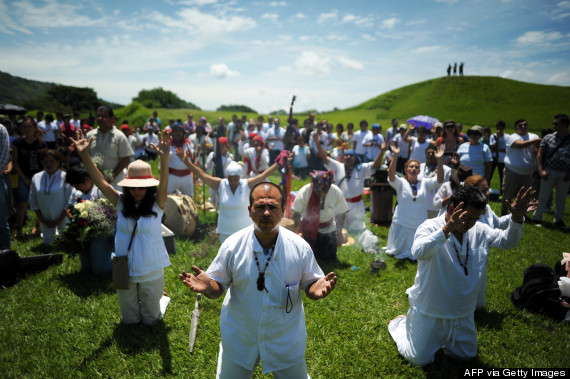
Celebrations for the summer solstice take place around the world, and not all are pagan-affiliated. One of the biggest pagan celebrations occurs at Stonehenge in England, but others take place among indigenous Latin and South American communities, and in Russia, Spain, and other countries.
 
summer solstice
 
As the official first day of summer, the solstice is a time of celebration. Cities around the world will mark the day with spiritual and secular celebrations, like this yoga festival in New York's Times Square, expected to draw thousands for some mid-city, summer realignment. More (PHOTOS)

Wednesday, 18 June 2014

I'm a Mexican-American Buddhist

Crystal Quintero, Pfc. Sandoval; Amber Larson, Seven (eds.), Wisdom Quarterly; LA Times
Mexican-Americans and other Latinos wandering around the City of Angels (latimes.com)

Latino celebs like Chicana Selena Gomez on the streets of L.A. (PeopleEnEspanol.com)
Los Angeles' favorite soccer/futbol team, like its favorite cuisine, comes from Mexico (AP)
 
It's all about directly experiencing the Truth
Q: If you were a "Mexican Buddhist," wouldn't you live in L.A.?

A: I guess that's true. I don't live in Latin America. I must be a Mexican-American Buddhist because I live in Los Angeles.

Buddhist temples here are very welcoming to people who speak Spanish or Spanglish. They try to be very accommodating to explain the Dharma or offer meditation instruction.

La Virgen de Guadalupe as Latin Guan Yin
Beyond Chino Hills, far to the east near the massive Hindu mandir which is larger than the Malibu forest mandir, there is a large Thai Buddhist temple that tried to get a permit from the city to build a golden stupa. The city said it was too big. So they cut it down to size and set it in the parking lot. That temple has a little guest house dedicated to Native Americans, who were once the locals before colonization and incorporation. When one asks the monks why it's there, they explain that it's out of reverence for the people who originally settled that land.

Ancient Mexico in Mesoamerica was partially usurped to form the United States. Mesoamerica included North and Central America, including California, where the people remember the Mayan, Aztec, Toltec, and Olmec empires (wiki)
 
Reality check: El Pueblo de L.A.
Going West (Hsi Lai) temple-complex in Hacienda Heights on the border with Orange County is very welcoming, too. They are a Taiwanese Mahayana missionary movement, so one expects it. One does not expect to be so warmly treated in about 100 much smaller temples that dot Latin neighborhoods all over L.A. County.

Q: And what Dharma message do you like best?

Jessica Alba, mom, Beverly Hills
A: The message of independent thinking. The Dharma is not about faith or priestly authority. It is about free inquiry and a sangha, a community, that includes the people who practice the Path. The Kalama Sutra tells us so, as do so many teachings of the Buddha.

Like the original Protestant movement opposing corrupt Catholic institutions, Buddhism says we don't need an intermediary between us and the Truth, us and reality, us and enlightenment (seeing things as they really are), seeing the end-of-suffering (nirvana).

Ricky Ricardo (Desi Arnaz) loves Lucy
We don't need idols, Gods, or heroes. They're all well and good. What we need is practice and insight. And that's up to us. No one gets anywhere without help, but no one can help us so much that they are doing it for us. No one can do it for us. I think Mexican-Americans can really relate to this. Maybe all Americans in our diversity can, like disaffected Presbyterians and languishing Lutherans [Editor: Like my dad, you mean?] What did people want but a direct experience of sacred knowledge, liberating enlightenment, of the divine, of the entheogenic (godhood-within) experience.

Speaking of diversity, before there was America there was Mexico. And Mexico was the place for diversity. It still is! The Los Angeles Times recently (hardcopy June 13, online June 12, 2014) had a front page story titled "Mestizo Nation: Mexican DNA reveals a staggering range of diversity"! Mestizo means "mixed" (miscegenation, which was illegal in the U.S. until the 1950s, but has been and is now one of the most popular things Anglos and Latinos do, like Sofia Vergara and "Al Bundy" on Modern Family as the new Lucy and her Hispanic hubby).

Afghan, Chinese Buddhist missionaries to Cali
"Mexico," it seems, gets its name from one Indian tribe, the Mexica or Mēxihcatls, who were Aztecs. Mexicans again became the majority group in sunny California in 2013, but now we're Mexican-Americans, and many of us are interested in Buddhism. After all, what few know is that Buddhism arrived in Mexico and California LONG before Europeans, Columbus, or Christianity.
 
Writers, artists, and historians have long pondered what it means to be Mexican. Now science has offered its answer, and it could change how medicine uses racial and ethnic categories to assess disease risk, testing, and treatment.

Why do Christians blame rape victims?

Christian university student/rape victim told to look for her sin as the cause (RawStory)
 
Catholic Church [get] out of my body (FEMEN)
According to an investigative report from Al Jazeera America, rape victims searching for help at Bob Jones [Christian] University in Greenville, South Carolina, were told to repent and seek out their own “root sin” that caused them to be raped.
 
Within the past year BJU has opened its own investigation into sexual abuse and rape, and now former students who were victimized are coming forward to tell their stories about life on a campus where they were shamed and told to keep their stories to themselves.
 
Rape, abuse, incest (rainn.org)
Coming from a conservative Mennonite family, Katie Landry, who at age 19 had never even held hands with a boy, was raped multiple times by her supervisor at her summer job. Two years later, haunted by the attacks, and attending Bob Jones University, she sought help from then dean of students, Jim Berg.
 
BJU rape survivor Katie Landry (AJA)
According to Landry,  Berg asked whether she’d been drinking or smoking pot and if she had been “impure.” He then brought up her “root sin.”
 
“He goes, ‘Well, there’s always a sin under other sin. There’s a root sin,’” Landry explained. “And he said, ‘We have to find the sin in your life that caused your rape.’ And I just ran.”
 
“He just confirmed my worst nightmare,” she added. “It was something I had done. It was something about me. It was my fault.”

Christian conservatives: Rape? Were you asking for it? That's what ya get for having sex!
 
Republicans: Military-rape? Man up, soldier!
Landry eventually withdrew from the school and didn’t tell anyone else for five more years.
 
In interviews with Al Jazeera, other victims of abuse related how Biblical scripture was used to lay blame for the rapes on their own sins and that their trauma was a sign that they were fighting God and would never be at peace until they forgave their rapists.
 
Called the “Fortress of Fundamentalism, ” Bob Jones University’s philosophical approach to almost all mental problems, beyond medical issues, is that they are the result of sin.
  • [Rationalist, materialist, left-leaning readers may not like to hear it but: Unskillful karma from past lives does cause one many troubles in many ways in other lives. To blame oneself for what was done in previous lives, however, leads to a lot of confusion about identity, justice, root causes and conditions of anything. We are not in the past. The present does not contain all of the causes, but it usually does contain triggers, and we can do something about guiding our attention and intention now. The working out of karma is very mysterious and impossibly complicated. Make merit to counteract it.]
Even R.J. has more compassion
In a 1996 book, Becoming an Effective Christian Counselor, written by former BJU Dean of Education Walter Fremont and his wife, counselors are instructed to emphasize that the blame lies with the abuser.

However, the authors also state that being sexually assaulted is not an excuse for “sinful feelings” of discontentment, hate, fear, and especially, bitterness, calling unresolved anger “rebellion and bitterness against God.”
  • [That's true. That's right. Those things are our karma, our action in response to someone else's grave misdeeds. Each being is the owner of one's own karma. Rapists have the karma of rape, which does NOT necessarily manifest as being raped although it can. It manifests in many terrible and unwelcome ways now and in many future lives. But are we performing the mental-karma of resentment, hate, fear, anger, sadness, and so on? Although most of us cannot normally exercise control over our emotions and reactions, we can gain such control. We can be mindful and not react to what comes up. If we fail to be mindful then react to what typically comes up for victims, we sink ourselves worse than the initial injury.]
Every 2 minutes in the U.S. (codepinkla.org)
Previously Al Jazeera America reported on a BJU student named identified only as Lydia, who had been raped off campus and, seeking help, reported it to the school authorities only to eventually be expelled for dwelling upon it and questioning the schools handling of the incident. [Such indifference by the school is abominable!] More

Wednesday, 21 May 2014

Singapore haze; Indonesia forest slash-n-burn

Ashley Wells, Wisdom Quarterly; Rujun Shen from Singapore (Reuters.com, 5-21-14)
Smoke haze obscures building under construction, Singapore March 2014 (Tim Wimborne)
  
Singapore braces for worst smoke "haze" as Indonesia slashes-and-burns forests
Singapore is approaching its yearly "haze" [dense air pollution] season, when smoke from forest clearing in Indonesia chokes the air, with this year likely to be worse than 2013's record pollution thanks to lack of action in Jakarta and an expected El Nino weather pattern.

The prosperous city-state, which prides itself on its clean air, was shrouded in heavy smog from slash-and-burn clearances on the neighbouring Indonesian island of Sumatra last June which sent its air pollution index to a record high.

Is America better than Asia about polluting?
One year on, and an election-distracted government in Indonesia has still not ratified the Association of Southeast Asian Nations (ASEAN) 2002 Agreement on Transboundary Haze Pollution, and fires continue to burn in Sumatra.

That is despite outrage in Singapore as well as environmental groups putting pressure on Jakarta. Fires are used to clear land on plantations and can burn for weeks because of peat deposits below the surface.

There is also a growing likelihood of an El Nino weather pattern this year, meaning Singapore, as well as parts of Indonesia and Malaysia, could be set for months of intense haze with a knock-on effect on health and business, especially tourism. More

Friday, 16 May 2014

Balinese Buddhism in Bali, Indonesia

Ven. S. Dhammika (DM/BuddhaNet); Amber Larson, Dhr. Seven (eds.), Wisdom Quarterly
The spirituality and unique character of religions in Indonesia (destination-asia.com)

Pura Tanah Temple, Bali, Indonesia  (Jos Dielis/dielis/flickr.com)
 
Buddha, Bali (Robert Scales/flickr)
Much attention has been given to how far west Buddhism extended in ancient times. 
 
The most westerly Buddhist monument [not that that marks how far it got, only how far it made such an impression that monuments were erected to it] that can be is the foundations of a large stupa [Buddhist burial mound and sacred reliquary] in the south east corner of the ancient citadel of Khiva in Turkmenistan [Central Asia, formerly Russia].

Small communities of Buddhists may have existed beyond this. But if they did, they would have been insignificant [too insignificant to erect permanent stone religious structures], isolated, and exceptional. We can say therefore that the outer edge of [early] Buddhism in the west was what is now eastern Iran [the seat of the Solar Dynasty mentioned in Rhys Davids' translation in "The Story of the Lineage" from Buddhist Birth-Stories: Jataka].

Undersea Bali, Buddha statues in the coral reef, Indonesia (Robert Scales/flickr.com)
 
But how far to the east did Buddhism spread its gentle and civilizing influence? [Did it get] to the outer islands of Indonesia, to Australia, or perhaps beyond? 
 
The Buddhist hero Satusoma (buddhanet.net)
In the 1920's a superb bronze bust of the Buddha was found on Sulawesi, one of the larger islands that make up Indonesia [a massive stretch of islands between India and Australia]. This is the eastern most point that any Buddhist antiquity has ever been found. 
 
There is, though, no evidence of an enduring Buddhist presence either on Sulawesi or beyond it -- no ruined temples or monasteries [hidden in the dense jungles as keep being discovered in Cambodia], no inscriptions, or references to it in the historical records. 
 
However, only a few hundred miles southwest of Sulawesi is the small island of Bali, where archeological, epigraphical, and literary evidence shows that Buddhism existed alongside Hinduism for about 700 years.
 
Buddha under the sea, Bali, Indonesia (Robert Scales)
Indian merchants first arrived in Bali in about 200 BCE, and it was probably these people who introduced Buddhism and Hinduism.
 
A Balinese work of uncertain date called the Naga-rakrtagama by a Buddhist monk lists all of the Buddhist temples in Bali, 26 altogether, and mentions that in 1275 King Kretanagara underwent a Tantric Buddhist initiation to protect his kingdom from an expected invasion by Kublai Khan.

Kublai Khan conquers Asia and goes overseas to keep going (pic2fly.com)

 
Trade routes to Indonesia and back
The island's history is scant until 1343, when it was conquered by and absorbed into the Majapahit Empire of Java-Sumatra. Hinduism and Buddhism both received state patronage, although the type of Buddhism that prevailed gradually became indistinguishable from Hinduism [such is the case around the world for Mahayana Buddhism].

A Javanese Buddhist work from about the 12th century contains this telling verse: "The one substance is called two, that is, the Buddha and Shiva. [Tantra is a merging of Shakti and Shiva, conflating Hinduism and Mahayana Buddhism, particularly esoteric Vajrayana] They say they are different, but how can they be divided? Despite differences there is oneness."

Sanur, Bali (MickJim/flickr)
Clearly at the time these words were being composed, some Buddhists were struggling to maintain the uniqueness of the Dharma, while others were stressing its similarity with Hinduism [which metamorphosed to be much more similar to Buddhism under the Buddha's radical influence bringing the Vedas back to life and on the Brahmins of his day].

Eventually in both Java and Bali the integrators prevailed. Incidentally, the phrase "Despite differences there is oneness" (Bhineka tunggal ika) has been taken as the motto for the Republic of Indonesia. With the collapse of Mahapahit [Hindu empire] in 1515 and the ascendancy of Islam, Java's old intellectual and religious elite, including the last surviving Buddhist monastics and scholars, sought refuge in Bali.

My Trip to Bali
Traveling round the world (destination360.com)
In January 2004 I fulfilled a long-standing wish to visit the island that Nehru eulogized as "The Morning of the World." I planned to visit all the sights that other tourists like to see, but my main intention was to search out the traces of Buddhism and find out something about Bali's small [surviving] Buddhist community. My first stop was the Bali Museum in Dempasar, the capital of the island. More