Showing posts with label violence. Show all posts

Tuesday, 19 August 2014

Violence (Dhammapada verses)

Acharya Buddharakkhita (trans.), Dhr. Seven, Amber Larson, Crystal Quintero (eds), Wisdom Quarterly, Dandavagga: "Violence," Dhammapada 10 (Dhp X) PREV-NEXT
The Buddha, sunrise over Borobudur, Java, Indonesia (Ulambert/flickr.com)
 
The Dhammapada
Dhammapada Verse 129. All tremble at violence; all fear death. Putting oneself in the place of another, one should not kill nor cause another to kill.
 
130. All tremble at violence; life is dear to all. Putting oneself in the place of another, one should not kill nor cause another to kill.
 
131. One who, while seeking happiness, oppresses with violence other beings who also desire happiness, will not attain happiness hereafter.
 
132. One who, while seeking happiness, does not oppress with violence other beings who also desire happiness, will find happiness hereafter.
 
133. Speak not harshly to anyone, for those thus spoken to might retort. Indeed, angry speech hurts, and one may be overtaken by retaliation.
 
134. If, like a broken gong, one silences oneself, one has approached nirvana, for vindictiveness is no longer in one.
 
135. Just as a cowherd drives the cattle to pasture with a staff, so do old age and death drive the life force of beings (from existence to existence in samsara).
 
Reflecting on the world, on the causes of violence and peace (Ulambert/flickr.com)
.
136. When the fool commits unskillful deeds, the fool does not realize (their harmful nature). The witless person is tormented by those very deeds, like one burned by fire.
 
137. One who inflicts violence on those who are unarmed, and offends those who are inoffensive, will soon come upon one of these ten states:
 
138-140. Sharp pain, or disaster, bodily injury, serious illness, or derangement of mind, trouble from the government, or grave charges, loss of relatives, or loss of wealth, or houses destroyed by ravaging fire; upon dissolution of the body that ignorant person is reborn in hell.
 
Indian ascetics in Nepal (galuzzi.it)
141. Neither [engaging in ascetic extremes of mortification like] going about naked, nor wearing matted locks, nor wallowing in filth, nor fasting, nor lying on the ground, nor smearing oneself with pyre-ashes and dust, nor sitting on heels (in penance) can purify a person who has not overcome doubt (skepticism).
 
142. Even though one be well-attired, yet if one is poised, calm, controlled, and established in the pure life, having set aside violence towards all beings -- one, truly, is a holy person (sadhu), a renunciate, a monastic (samana, wandering ascetic).
 
143. Only rarely is there a person in this world who, restrained by modesty, avoids reproach, as a thoroughbred horse avoids the goad (whip).
 
144. Like a thoroughbred horse touched by the goad, be strenuous, be filled with spiritual yearning (to strive). By confidence and virtue, by effort and meditation, by investigation of the truth, by being rich in knowledge and purity, and by being mindful, destroy this unlimited suffering (of samsara).
 
145. Irrigators regulate the waters, fletchers straighten arrow shafts, carpenters shape wood, and the good control themselves.

Violence and Disruption in Society (sutras)

Elizabeth J. Harris; Dhr. Seven, Amber Larson, Crystal Quintero (eds), Wisdom Quarterly
Police provoke peaceful protests to become violent as a pretext to violently clampdown.
Violence and Disruption in Society: A Study of the Early Buddhist Texts
U.S. state-sponsored violence over Japan
At 8:15 am Japanese time, on August 6th 1945, a U.S. plane purposely dropped a horrific bomb named "Little Boy" over the center of the city of Hiroshima with the intention of killing all the civilians living there.

The total number of human beings who were killed immediately and in the following months was probably close to 200,000. [The countless other earthlings harmed are not measured or recorded.]

Nagasaki Museum (latimes.com)
Propaganda was cultivated as a justification -- How could we do this and still come off looking like moral heroes and nonbarbarians? -- that this nuclear bomb and the one the U.S. military chose to drop on the city of Nagasaki ended the war quickly and saved American and Japanese lives. This is but a consequentialist theory to justify our horrific industrial-scale violence against innocent civilians.
 
Hirohsima-Nagasaki (kootation.com)
Others say the newly developed weapons had to be tested as a matter of necessity. Victims in Hiroshima and Nagasaki helped us usher in a new age. Our tendency toward conflict and violence can now wipe out the entire human habitat....

It is against the urgency of this background that the teachings of Buddhism about violence must be studied and interpreted. Excerpts such as the following have been extracted and used to sum up the Buddhist attitude to this issue:
All tremble at violence,
All fear death;
Comparing oneself with others
One should neither kill nor cause others to kill. (Dhp. v. 129)
Victory breeds hatred,
The defeated live in pain.
Happily the peaceful live,
Giving up victory and defeat.
(Dhp. v. 201)
These verses would seem to indicate a clearly defined Buddhist perspective. Yet such text extraction can lead to misrepresentation if not undergirded with a strong supporting framework. Furthermore, if Buddhism has a message for a violent world, it must do more than condemn violence. It must be able to interpret its nature, its roots, its hold on the world and the possibilities for its transformation. It must dialogue with other philosophies and ideologies such as utilitarianism [Note 1], scientific socialism, and the belief in a "just" or "holy" war.

For instance, utilitarianism still lives among those who believe that violence can be justified if more people will benefit than will be hurt, and the consequentialist theory is similar to this. Then there are those who hold that certain forms of injustice and exploitation can only be destroyed through violence and that history will justify its legitimacy.

The view that violent change is a historical inevitability is close to this. Buddhism must be able to comment on the stance which argues that if Hitler had been assassinated early in his career numerous deaths would have been avoided, or the claim that force is justified against a government which is using violence against its people under the pretext of law. If it cannot, it will stand accused of irrelevance.

"Violence" is that which harms, debases, dehumanizes, or brutalizes human beings, animals, or the natural world. The violent person is one who causes harm in speech or action, either directly or indirectly, or whose mind is filled with such thoughts [2].  These four questions provide the framework for this study:
(1) What different forms of violence do the Buddhist texts show knowledge of?
(2) Why do the texts condemn violence or call it into question?
(3) What do they see to be the roots of violence?
(4) Do the texts give any guidelines for the eradication of violence in the individual or in society?
1. Forms of Violence:
The Buddha's Awareness
Dhammikarama Burmese Buddhist Temple -- the first Buddhist temple to be built in Georgetown, Penang, Malaysia, 1803. It is filled with striking features and a rich past, a retreat for Buddhist devotees, serving as historical evidence of Burmese occupation (JMR).
.
The sutras of the Buddha, as they have been handed down, are replete with details about the contemporary realities of his time. They reveal much about the social context within which he moved and the faces of society with which he was familiar.
 
The Canki [pronounced "chunky"] Sutra shows a Brahmin overlord insisting that the Buddha is equal to him in birth, riches, and knowledge of the Vedas (the sacred knowledge books of India inherited from the more ancient Indus Valley Civilization). He continues:
Indeed, sirs, King Seniya Bimbisara of Magadha with his wife and children has gone to the recluse Gautama for [guidance] for life. Indeed, sirs, King Pasenadi of Kosala with his wife and children has gone to the [guidance] Gautama for refuge for life. Indeed, sirs, the Brahmin Pokkharasati with his wife and children has gone to the recluse Gautama for [guidance] for life [3].
Important here is the reference to kings. The texts show clearly that the Buddha -- himself a royal from the Shakya clan somewhere in the northwest frontier -- had an intimate knowledge of statecraft. Records of his conversations with King Pasenadi and King Bimbisara show him speaking in a language which those involved in government could understand.

King Pasenadi, for instance, comes through as a man torn between his duties as king, involving some degree of ruthlessness, and his concern for spiritual things. At one moment, he is seen preparing a Brahminical sacrifice in which many animals are to be slaughtered and menials beaten and, at another, speaking seriously with the Buddha about the dangers of wealth, power, and unskillful conduct [4].

What is significant is the level of knowledge shown by the Buddha about the pressures on a king such as Pasenadi. His use of similes and illustrations, for instance, appeals to Pasenadi's experience, including the central concern of all rulers at that time -- defense against aggression. At one point Pasenadi asks about the value of gifts and to whom a gift should be given for the gift to bear much fruit. The Buddha replies:
A gift bears much fruit if given to a virtuous person, not to a vicious person. As to that, sire, I also will ask you a question. Answer it as you think fit. What think you, sire? Suppose that you were at war, and that the contending armies were being mustered. And there were to arrive a noble youth, untrained, unskilled, unpracticed, undrilled, timid, trembling, affrighted, one who would run away -- would you keep that man? Would such a man be any good to you? [5]
The Buddha thus uses similes from Pasenadi's military world to indicate that virtue does not depend on birth but on qualities of character. In fact, in a number of texts, illustrations drawn from the context of the state, defense, and martial arts can be found. Not only does the Buddha make use of military metaphors, but the texts show that he [as a prince trained to one day assume throne as king of the Shakyas] had extensive knowledge of the strategies of war, punishment, and political patronage. 

The Mahadukkhakkhandha Sutra, for instance, uses graphic description to show that war and conflict spring from sensual desires:
And again, meditators, when sense pleasures are the cause... having taken sword and shield, having girded on bow and quiver, both sides mass for battle, and arrows are hurled, and knives are hurled, and swords are flashing. Those who wound with arrows and wound with knives and decapitate with their swords, these suffer dying then and pain like unto dying...
And again, meditators, when sense pleasures are the cause...having taken sword and shield, having girded on bow and quiver, they leap on to the newly daubed ramparts, and arrows are hurled, and knives are hurled, and swords are flashing. Those who wound with arrows and wound with knives and pour boiling cow-dung over them and crush them with the portcullis and decapitate them with their swords, these suffer dying then and pain like unto dying [6].
In the next part of the sutra, a variety of horrific punishments are described, and a keen awareness of their nature is revealed:
Kings, having arrested such a one, deal out various punishments: they lash him with whips, and they lash him with canes, and they lash him with rods, and they cut off his hand... his foot... his hand and foot... his ear... and they give him the "gruel-pot" punishment... the "shell-tonsure" punishment... "Rahu's mouth"... the "fire-garland"... the "flaming hand"... and so on [7].
In another sutra, two men are pointed out while the Buddha is talking to a headman, Pataliya. One of them is garlanded and well-groomed; the other is tightly bound, about to lose his head. We are told that the same deed has been committed by both. The difference is that the former has killed the foe of the king and has been rewarded for it, while the latter was the king's enemy [8] .

Hence it is stressed that the laws of the state are not impartial: they can mete out punishment or patronage according to the wish of the king and his cravings for revenge or security.
 
It cannot be argued that the Buddha was ignorant of the political realities of his day. He spurned frivolous talk about such things as affairs of state [9]. But he was neither indifferent to them nor uninformed.

On the contrary, his concern for the human predicament made him acutely aware of the potential for violence within the economic and political forces around him. The political milieu of rival republics and monarchies janapadas] in northern India forms a backdrop to his teaching, whether the rivalries between the kingdoms [of Kosala and Magadha or the struggles of the republics to maintain their traditions and their independence in the face of the rising monarchies [10].

However, the violence attached to politics and statecraft forms only one section of the picture which emerges from the texts. Violence is detected in the Brahmanical sacrificial system, in the austerities practiced by some wanderers, and in the climate of philosophical dispute among the many shramana groupings as well as in the area of social discrimination and the economic order.

Religion, to take this first, is seen as a cause of physical, verbal, and mental violence. The violence inflicted through sacrifices is described thus:
Now at that time a great sacrifice was arranged to be held for King Pasenadi, the Kosalan. Five hundred bulls, 500 bullocks, and as many heifers, goats, and rams were led to the pillar to be sacrificed. And they that were slaves and menials and craftsmen, hectored about by blows and by fear, made the preparations with tearful faces weeping [11].
In contrast, the shramana groupings within this period rejected sacrifice [to the gods]. Denying the authority of the Vedas and a realm of gods [brahmas, devas, nagas, asuras] to be manipulated, their emphasis was on renunciation, the gaining of insight, and philosophical debate.
 
Nevertheless, a form of violence was present. The austerities practiced by some of those who came to the Buddha were worse than any enemy might inflict as punishment. Prior to enlightenment Prince Siddhartha as a wandering ascetic practiced them. In the Maha-Saccaka [12] and the Maha-Sihanada [13] Sutras there is vivid description of the excesses undertaken. More
ENDNOTES
Abbreviations: DN...Digha Nikaya, MN...Majjhima Nikaya, SN...Samyutta Nikaya, AN...Anguttara Nikaya, Dhp...Dhammapada, Snp...Sutta Nipata.
 
Textual references have been taken from the Pali Text Society's editions of the Nikayas (Sutra Collections). Unless specified otherwise, English translations have been taken from the PTS versions, though some have been slightly altered.
 
1. Utilitarianism is a philosophy which claims that the ultimate end of action should be the creation of human happiness. Actions should be judged according to whether they promote the greatest happiness of the greatest number. The most important exponent of this philosophy was the nineteenth century British thinker John Stuart Mill. One of the weaknesses of utilitarianism is that it can be used to justify the violation of minority rights.
2. Reference may be made to many texts which stress that encouraging others to do harm is blameworthy. AN ii,215, for instance, speaks of the unworthy man and the more unworthy man, the latter being one who encourages others to do harmful actions such as killing living beings.
3. MN 95/ii,167.
4. The Kosala Samyutta (Samyutta Nikaya, Vol. 1) records the conversations which this king had with the Buddha. The examples mentioned have been taken from this section.
5. SN i,97.
6. MN 13/i,86-87.
7. MN 13/i,87.
8. SN iv,343.
9. In several sutras, the Buddha comes across groups of wanderers engaged in heated discussions about kings, robbers, armies, etc. (e.g., DN iii,37; MN ii,1). In contrast, the Buddha advised his disciples either to maintain noble silence or to speak about the Dharma.
10. See Romila Thapar, A History of India (Pelican Books UK, 1966), Chapter 3.
11. SN i,75.

How many black boys have to die? (Berkeley)

CC Liu, Crystal Quintero (eds.), Wisdom Quarterly; Assistant Director Stephen Menendian, Haas Institute for a Fair and Inclusive Society (berkeley.edu, August. 14, 2014)
UC Berkeley campus tower overlooking San Francisco and Bay Bridge (berkeleyside.com)
 
How Many Black Boys Have to Die? Berkeley Faculty weigh in
Stephen Menendian
Menendian
Although the “facts” are still coming out [and the police cover up is well underway], we can add Michael Brown of Ferguson, Missouri to the list of young black men and boys killed by overzealous police or armed civilians:
 
Trayvon Martin, Eric Garner, Sean Bell, Amadou Diallo, Oscar Grant, Jordan Davis, and so many more, including young women like Renisha McBride.
 
The ultimate tragedy is that each of these deaths seems to have done little to prevent the next [senseless police killing]. As I wrote two years ago, each death reopens a conversation on race framed to ask all of the wrong questions.
 
I predicted that “until we start asking the right questions, I fear there will be more Trayvon Martins.”
 
This list reminds us that these deaths are not isolated incidents, but part of a larger pattern -- a picture we can only make out if we step back for a broader view. A series of similar incidents occurred across the nation in the late 1960s, triggering the “urban disturbances” that were the focus of the famous “Kerner Commission” Report on Civil Disorders.”
 
The report is as startling in its description and analysis of events that parallel today as it is in the relevance of the recommendations it advanced.
 
The Commission was established for the specific purpose of investigating the causes of the late 1960s riots, and the Report is a comprehensive analysis of both the specific incidents at issue and the more general conditions that led to the combustible environment.


Policing
Consider the chapter dedicated to the issue of policing and the community, described as a “primary cause” of the “disorders” surveyed in the Report. The Report observed that “[t]he patrolman comes to see the city through a windshield and hear about it over a police radio. To him, the area increasingly comes to consist only of law breakers. To the ghetto resident, the policeman comes increasingly to be only an enforcer.”
 
The Kerner Commission Report expressed concern that many police neither reside nor grew up in these environments, widening the gulf between police and the communities they serve.
 
This remains the case today, with no more vivid an illustration that Ferguson, Missouri. Ferguson is a predominantly black community, and yet just three of the fifty-three police officers on the municipal force are African-American.
 
Consider, especially, the remarks of the 1968 authors of the Report when they assert that the incidents it documented were not “the crude acts of an earlier time,” alluding to explicitly racist police behavior, but that police misconduct -- whether described as brutality, harassment, or merely verbal abuse and discourtesy -- was a motivating factor that contributed to the civil disorders of that decade.
 
Protests in Ferguson, MO after an unarmed black teenager, Michael Brown, was shot and killed by Ferguson police. Photo credit: Southern Poverty Law Center
Line of peaceful protesters in Ferguson, MO, after an unarmed black teenager, Michael Brown, was shot to death by Ferguson police (Southern Poverty Law Center).
 
In the context of the era of stop-and-frisk (83 percent stopped were black or Hispanic), and the criminalization of poverty, it’s worth considering the applicability Commission’s observation, nearly 50 years later, that “Negroes firmly believe that police brutality and harassment occur repeatedly in Negro neighborhoods.”
 
The explanation for what’s happening is not a secret, but it doesn’t seem to have seeped into the broader consciousness.
 
In his 2005 book Blink, Malcolm Gladwell deconstructed the shooting of the unarmed Amadou Diallo in New York City, and explained the critical causal force, implicit or unconscious bias, as measured by the implicit association test.
 
Most Americans, even those who embrace egalitarian norms, harbor unconscious negative associations with black bodies. It is on account of these pervasive and yet unconscious, culturally embedded associations that black boys are not only automatically viewed with suspicion, but as criminals, regardless of who they are. The Internet meme #iftheygunnedmedown not only illustrates the portrayal of black men and boys, but the perception as well.
 
We need to begin by addressing the pervasiveness of these unconscious biases, first by acknowledging them, and secondly by working to reduce them or ameliorate their impact. Police academies and law enforcement agencies not only need more diverse staff, but they need implicit bias training for officers. They need to measure, track and address implicit bias, enhance officer supervision and create accountability measures.
 
Only efforts like these can repair and strengthen the relationship between law enforcement and communities of color that will ultimately prevent the senseless deaths of boys like Michael Brown and more, I fear, to come. More (comments)

Sunday, 10 August 2014

Could I be EVIL? (TED Talks)

This episode, TED speakers uncover surprising realities about violence.
Gunshot to the face or head right through the windshield? (Sascha Burkard/iStockphoto)
 
The Violence Within Us
Violence and brutality are grim realities of life. In one hour, four TED speakers explore the sinister side of our dim human nature -- and ask whether we're all capable of violence.
 
"Pray to the Moon when it's round. Death with you shall then abound..." sings Slayer (from "Hell Awaits"), one of the most popular bands for U.S. militants, along with all things porn, songs serial killers might whistle while engaged in their doings.

(Slayer) See Minute 4:15. Slayer and rap music were PMRC targets

U.S. tanks come equipped with CD players and premium music systems. Why? American soliders like to enjoy some music to kill by. "Driven by the instinct of centuries of horror/ Implanted along the brain of the sickening parasite/ Linked together by one trait/ The hell-filled need to kill, kill, kill, kill, KILL" (Slayer, "At Dawn They Sleep"). But the No. 1 song on the military hit parade is "Bodies" by Drowning Pool: "Let the bodies hit the floor"! What is more "evil" (Pali papa) than industrial-scale killing?

Philip Zimbardo explains his infamous Stanford Prison experiment at a TED conference.
Psychology Prof. Phil Zimbardo on his Stanford Prison Experiment
Jim Fallon's work analyzing the brains of psychopaths lead to a surprising personal discovery.
AUDIO: What does the [brain] of a killer look like? (Jim Fallon)
  
TED Censorship?


(RT, June 2014) Graham Hancock breaks the set on TED CENSORSHIP, Lost Civilizations, and War on Consciousness: Abby Martin interviews author Graham Hancock about the mysteries of ancient civilizations, hidden societies of the past, and censorship by TED Talks and the difficulty of getting new ideas accepted by mainstream archaeologists and historians.
 
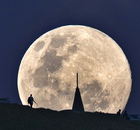
The Super Full Moon Tonight
The perigee moon, or supermoon rises over Mount Eden in Auckland, New Zealand on Sunday morning.
Moon over Auckland (TG)
 Supermoon lights up skies around the world – in pictures. The perigee Moon, or Supermoon, rises over Mount Eden in Auckland, New Zealand, on Sunday morning. A dramatic Supermoon is set to accompany this year's Perseid meteor shower, one of the most anticipated events on the skywatcher's calendar. Given a dark, clear sky in a normal year, it is common to see more than 100 of the meteors an hour during the second week in August. But this year the Perseids have a bright shining rival. On Sunday, two days before the meteor shower reaches its peak, the Moon will become full. Coincidentally, it will also have reached the point in its orbit that is closest to the Earth, known as perigee. The Supermoon will be up to 14% bigger and 30% brighter than other full moons during the year. On one level, this is bad news, according to Dr. Bill Cooke from NASA's meteoroid environment office. "Lunar glare wipes out the black, velvety backdrop required to see faint meteors, and sharply reduces counts." More

Friday, 1 August 2014

Love? It's Ultraviolence! (sutra)

Ashley Wells, Crystal Quintero, Amber Larson, Seven, Wisdom Quarterly; Lana Del Rey; Korn

Lana-of-the-King, when did he stop treating you like a princess?
(BBC, June 28, 2014) Devi Lana Del Rey performs "Ultraviolence" at Glastonbury 2014. For more exclusive videos and photos from the show, go to BBC.co.uk/glastonbury.
 
(Psst, Lana, the Lorde says your music sucks and is bad for girls to listen to, like, a bad influence keeping them waiting for some "Prince Charming"). 

"He used to call me DN/ That stood for Deadly Nightshade/ Cause I was filled with poison/ But blessed with beauty and rage/ Jim told me that./ He hit me, and it felt like a kiss./ Jim brought me back/ Reminded me of when we were kids/ With his Ultraviolence Ultraviolence Ultraviolence Ultraviolence/ I can hear sirens, sirens/ He hit me, and it felt like a kiss/ I can hear violins, violins/ Give me all of that Ultraviolence/ He used to call me poison/ Like I was poison ivy/ I could have died right there/ Cause he was right beside me/ Jim raised me up/ He hurt me, but it felt like true love/ Jim taught me that/ Loving him was never enough/

(Clockwork Orange) England, Germany, USA, Israel, the "West"
loves killing on an industrial scale. It's ultra-violence.

Zombies: abused learn to abuse.
We could go back to New York/ Loving you was really hard/ We could go back to Woodstock/ Where they don't know who we are/ Heaven is on Earth/ I would do anything for you, babe/ Blessed is this union/ Crying tears of gold like lemonade/ I love you the first time/ I love you the last time/ Yo soy la princesa, comprende mis white lies/ Cause I'm your jazz singer/ And you're my cult leader/ I love you forever/ I love you forever/ With his Ultraviolence (Lay me down tonight)/ Ultraviolence (In my linen and curls)/ Ultraviolence (Lay me down tonight)/ Ultraviolence (Riviera Girls)/ I can hear sirens, sirens/ He hit me, and it felt like a kiss/ I can hear violins, violins/ Give me all of that Ultraviolence...

(Korn/"Thoughtless") Thumbing through the pages of my fantasies/ Pushing all the mercy down, down, down/ I wanna see you try to take a swing at me/ Come on, gonna put you on the ground, ground, ground/ Why are you trying to make fun of me?/ You think it's funny?/ What the 'uck do you think it's doing to me?/ You take your turn lashing out at me/ I want you crying with your dirty a-s in front of me/ All of my hate cannot be found/ I will not be drowned by your thoughtless scheming/ So you can try to tear me down/ Beat me to the ground/ I will see you screaming/ Thumbing through the pages of my fantasies/ I'm above you, smiling at you, drown, drown, drown/ I wanna kill and 'ape you the way you 'aped me/ And I'll pull the trigger/ And you're down, down, down// All of my friends are gone, they died (Gonna take you down)/ They all screamed and cried (Gonna take you down)/ I've got my body, got my body back against the wall/ I've got my body, got my body back against the wall/ Gonna take you down...

(Evanesence/"Thoughtless" live at Rock am Ring (Germany)

Maybe in the future women won't stand or fall for it? So long as the mainstream media defines our "feminist" or "progressive" views, the status quo is likely to remain largely unchanged. The TV is not our friend. We have to think and question and search for answers. They rarely come prepackaged with nice bows on top.

(Diamante) Hey, Jim, you got a kiss for me? I'll "Bite Your Kiss"!

Sutra: The Abusive Brahmin Husband
Acharya Buddharakkhita edited by Wisdom Quarterly from Positive Response: How to Meet Evil With Good, Akkosa Sutta (SN VII.2)
Hey, you bald-pated offspring of..!
Thus have I heard. Once the Buddha was staying in a sylvan grove nestled in the foothills surrounding Magadha's capital city of Rajagaha (modern Rajgir). This royal pleasure garden just outside of the gated city, known as the Bamboo Grove (Veluvana), was offered to the Buddha by his great patron, King Bimbisara, who was delighted to have such a remarkable sage nearby.

The king built a monastic residence just outside of the gate -- equipping it with a large number of meditation huts, where at least 1,250 monastics stayed and countless more lay devotees, spending their time in meditation, hearing the Dharma, and intense spiritual endeavor. The Bamboo Grove was neither too far nor too near the city, but at just the right distance from it for the large number of devotees who flocked there every morning and evening to pay homage to the Enlightened One.

Practicing leads to mind/heart's freedom!
A certain Brahmin (India's high caste, priestly class, social elites) belonging to the Bharadvaja clan had a great prejudice against the Buddha since he thought a member of the nobility (warrior caste, kshatriya) had claimed to be a saint.

Yet as it happened, the Brahmin's wife was a great devotee of the Buddha. On a certain festival day when everybody, including his wife, had gone to the Bamboo Grove hermitage to hear a discourse (sutra), the Brahmin, coming to know of it, became furious.

Fuming with rage, he rushed to the Bamboo Grove to give both his wife and the Buddha a piece of his mind. He forced his way through the crowd and began shouting foul abuse. He headed straight to where the Buddha was seated. People were aghast. Even the presence of the king, nobles, and ministers did not deter the enraged Brahmin from reviling the Buddha to his face.

When the Buddha remained completely undisturbed, radiating powerful feelings/thoughts of loving-kindness, the Brahmin stopped abusing him. But he was still aggrieved.

Then the Buddha asked him in a kind and gentle voice full of friendliness: "Friend, if somebody visits you, and you offer food which that person declines, who gets that food?"

"If the visitor does not accept what I offer, I will get it back because I offered it."

Then the Buddha came to his point: "If I do not accept your abuse, to whom will it return?"

The Brahmin was so moved by the tremendous implication of this analogy that he fell at the feet of the Buddha and sought to be ordained as a Buddhist monk. Soon after his ordination, depending on the Buddha's instruction for his path-of-practice, the Brahmin attained full enlightenment. The Buddha had transformed him by his positive approach. More

Thursday, 5 June 2014

Seattle Campus Shooting, 6 Shot (video)

Amber Larson, Pat Macpherson, CC Liu, Seth Auberon, Wisdom Quarterly; KIRO 7; LAT
Was it proving his masculinity or subjugating her femininity, what drives a mass shooter?
Police State coming: Seattle versus World Trade Organization (freedomsphoenix.com)
Five percent or more of police are predators, according to a former San Diego police chief. How many more are sociopaths? When ununiformed criminals are induced, coached, and triggered, mayhem ensues. Police are deployed. We are locked down. Whole cities are put under martial law. The police rush in with orders to shoot anyone they see for our "protection." That's the plan. With protection like that, who needs a "lone gunman"/MC? The planners! (Occupy, Battle-of-Seattle, fromthevaultradio.org).


Multiple people were left wounded after a shooting this afternoon at Seattle Pacific University. The Seattle PD warned that they are dealing with conflicting reports, but confirmed at least three people were injured and transported to a local hospital. Other news outlets are reporting as many as six victims were hospitalized. Although there were reports that two people were arrested, police now say they only have one suspect in custody. According to the AP, police say they have stopped searching for a second gunman, who was described as a white male wearing a long-sleeved blue shirt. According to KIRO 7, the suspect's car was registered to the parent of a Seattle Pacific University student. Students told reporters they initially thought the gunshots were a science experiment until the school went into lockdown.

1 man dies, 5 others injured in Seattle college shooting

  
See wounded suspect and video below.
A man in his 20s died and at least three others were hospitalized after a shooting inside an engineering building on the campus of Seattle Pacific University [SPU, a Christian school] on Thursday [June 5, 2014] afternoon [about 3:00 pm], authorities said.

Map of vicinity (Paul Duginski/latimes.com)
A suspect was in custody. Seattle police had initially sought a second suspect [who was part of the false flag operation before they were keyed in and told to say there was only one shooter, the lone gunman, and we venture to guess it will be a white young man on antidepressants with a history of loving guns and not talking to his neighbors with a connection to psychiatric studies either through the military, the university, or Hollywood], but later said the person in custody was the only shooter.  
 
As many as six people were injured, according to the Seattle Fire Department. One woman suffered life-threatening injuries. Two men suffered minor injuries and were in stable condition.

Seattle Pacific Univ. Alert announces planned prayer vigil tonight at 7:00 pm (spu.edu)
 
Many students reported that the gunshots -- heard throughout the building -- sounded like a science experiment, maybe a helium balloon popping.

But when a student in Room 136 in Otto Miller Hall went into the hallway to doublecheck, she quickly came back and offered a terse statement, "I think someone got shot," according to Blake Oliveira, who was inside the classroom... More

(World Breaking News)

1 Dead, 3 Wounded In Shooting at Seattle College Campus
One person has died in the campus shooting at Seattle Pacific University, according to Susan Gregg, a spokeswoman for Harborview Medical Center. [Original story published at 8:11 pm ET and labelled June 6 world time] A gunman opened fired Thursday [June 5 local time] at Seattle Pacific [Christian] University, wounding four people before faculty and staff disarmed him, the Seattle Police Department said. The gunman was reloading when the staff stopped him, police reported on the department's official Twitter account. The accused shooter, whose identity was not immediately released, is in custody, and no outstanding suspects are being sought, police said At least two people -- one man and one woman -- suffered life-threatening injuries, police said. Another man and woman were in stable condition, they said. The shooting began inside Otto Miller Hall, which houses the university's science, math and engineering departments. Witness Briana Clarke told CNN affiliate KOMO she was in Otto Miller Hall when she heard shots and then saw students running. "I first heard two muffled shots that I thought were two helium balloons," she said. Then she said she saw between five and seven students who appeared to be injured. The school was locked down during the shooting, and it was lifted after police cleared all the buildings on the campus. "I'm in my office with four students with the blinds closed. We're sitting on the floor with the door locked, very scared," university counselor Karen Altus told KOMO. Seattle Pacific is a Christian university with a student population of 4,270. It is located in Seattle's Queen Anne neighborhood.

(ABC 7 Eyewitness News) Breaking news, Seattle Pacific University school shooting with multiple suspects converted into "a lone gunman" now in custody.

Why does she stay? "Trauma bonding" (TED)

Ashley Wells, CC Liu, Wisdom Quarterly; Leslie Morgan Steiner, TEDxRainier, 2013
 
Why domestic violence victims don't leave
TEDLeslie Morgan Steiner was in "crazy love" -- that is, madly in love with a man who routinely abused her, held a gun to her head, and threatened her life. Steiner, who graduated from Harvard and Morton Business School, tells the dark story of her relationship, correcting misconceptions many of us hold about victims of domestic violence. And she explains how we can all help break the silence.

"Every two minutes in the U.S. a woman is sexually assaulted." CODEPINK provides a space for women of all ages and backgrounds to come together to advance the movement for peace and justice. The CODEPINK community encourages creativity, humor, and the arts.
 
TED Talks is a daily video podcast of the best talks and performances from the TED Conference, where the world's leading thinkers and doers give the talk of their lives in 18 minutes (or less). Look for talks on Technology, Entertainment, and Design -- plus science, business, global issues, the arts, medicine, and much more. Find closed captions and translated subtitles in many languages at ted.com/translate.

Thursday, 29 May 2014

Unbelievable rapes in India; police participate

Teen gets three years in gang rape, murder of Indian woman: a protester in India chants slogans as she braces herself against the spray fired from police water canons during a protest sparked by the gang rape of student. This is the first verdict in a case that has sparked international outrage over the brutal crime (Daniel Berehulak/Getty Images/NPR).

Young girls hold banners during a demonstration Thursday in Lucknow, India, after police arrested several men for allegedly gang raping and murdering two teenage children, sisters, then hanging their bodies from a tree. At least one of the perpetrators was a policeman (Azam Husain/Barcroft Media/Landov).
.
Slutwalk, London (Garry Knight)
NPR's Julie McCarthy reports today on another alleged gang rape and murder in India -- this one involving two teenage sisters from the lowest Hindu [slave or "untouchable"] caste, whose bodies were found hanging from a mango tree.
 
McCarthy says the two girls, ages 14 and 15, were killed in a village about 140 miles east of India's capital New Delhi.
 
What U.S. child rapists look like, incest, too
"They reportedly had gone to a field to relieve themselves but never returned," McCarthy says. "Like hundreds of millions of Indians, they lacked a bathroom at home."

The girls' family belong to the Dalit caste, formerly known as "untouchables," the lowest rung of India's ancient [social stratification-by-birth] system of societal hierarchy.

What Indian rapists look like. Men convicted in notorious case to be sentenced (npr.org)
.
Men say no to rape of their female relatives
The Press Trust of India says charges have been filed against seven people, including two police constables. Local media report that one of the policemen allegedly participated in the attack. The other is said to have refused to listen to relatives who reported the two girls missing.
 
Prison guard and homosexual rapist
The Associated Press says: "Hundreds of angry villagers stayed next to the tree throughout Wednesday, silently protesting the police response. Indian TV footage showed the villagers sitting under the girls' bodies as they swung in the wind, and preventing authorities from taking them down until the suspects were arrested."
 
Human Rights campaigners say Dalit women are frequently the target of attacks, and this incident is yet another in a series of violent rapes against Indian women in recent years that have united India in anger.

FEMEN says no to rape, no to patriarchy!
Last year, four men were sentenced in the highest-profile of the cases -- one involving a young woman on a bus who was gang raped [in front of her boyfriend who was beaten unconscious] and later died from injuries she sustained in the [violent sexual] assault. More (MORE)