Showing posts with label bhikkhu bodhi. Show all posts

Thursday, 24 July 2014

Understanding Maitreya Buddha

CC Liu, Maya, Crystal Quintero, Wisdom Quarterly; Bhikkhu Bodhi (BAUS) ASK MAYA

Question: Recently K.K. Shrivastava contacted Wisdom Quarterly with an appetizing offer, asking if we would be willing to probe his claim about Maitreya Buddha. That would having go through 20 pages of text containing plainly written and easily verifiable facts supporting his mysterious contention.
Answer: We would love to, particularly because the future Buddha is widely misunderstood and been made much of and possibly distorted in the service of a universalist-Buddhist message, a "greater vehicle" (maha yana) for all to cross over on going from this painful and fraught samsara to that secure and joyful nirvana -- without perceiving any duality (because of Hindu-Advaita influence on this school) in the process.

Gandhara Maitreya Buddha (asianart.org)
Dear K.K. Shrivastava, please send us (or help us locate) your scholarship, and you can start with the abstract or brief summary. 

While we wait -- and while others realize the dual offer is also open to them to write for Wisdom Quarterly or ask us any question -- we should explore the original story of Maitreya/Metteyya ("friend," from the Sanskrit maitri/Pali metta, a proper name referring to loving-kindness, loving-friendliness, altruistic help).

Because the historical Buddha had mentioned 24 supremely enlightened teaching buddhas in the past, and many other nonteaching (pacceka) buddhas
 
Arahants, Bodhisattvas, and Buddhas
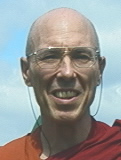
Bhikkhu Bodhi
I. Competing Buddhist Ideals The arhat ideal [enlightenment for all] and the bodhisattva ideal [enlightenment for none as everybody is already enlightened, and everyone should become a martyr and messianic/maitreyanic "savior" saving an infinite number of living beings first] are often considered the respective guiding ideals of [a simplistic understanding of] Theravāda Buddhism and Mahāyāna Buddhism.

This assumption is not entirely correct, for the Theravāda tradition has absorbed the bodhisattva ideal [and many Mahayanists in the past and now would indeed strive for the stages of enlightenment] into its framework and thus recognizes the validity of both arhatship and buddhahood as objects of aspiration.

It would therefore be more accurate to say that the arhat ideal and the bodhisattva ideal are the respective guiding ideals of Early Buddhism [Sarvastivada and the Hinayana schools, of which Theravada is not one but gets called one because of its age and its keeping with early ideals and teachings] and Mahāyāna Buddhism.

"Early Buddhism" is not the same thing as Theravāda Buddhism that exists in the countries of South and Southeast Asia. It refers to the type of Buddhism embodied in the archaic Nikāyas [collection, division, volume, assemblages of sacred texts] of Theravāda Buddhism and in the corresponding texts of other schools of Indian Buddhism that did not survive the general destruction of Buddhism in India.
 
It is important to recognize that these ideals, in the forms that they have come down to us, originate from different bodies of literature stemming from different periods in the historical development of Buddhism.

If we fail to take this fact into account and simply compare these two ideals as described in Buddhist canonical texts, we might assume that the two were originally expounded by the historical Buddha himself. Then we might suppose that the Buddha -- living and teaching in the Gangetic plain in the fifth century B.C. -- offered his followers a choice between them, as if to say: "This is the arhat ideal, which has such and such features, and that is the bodhisattva ideal, which has such and such features. Choose whichever one you like."
  • There is also a third model of Buddhist spiritual life, that of the pacceka-buddha (Sanskrit pratyeka), which is similar in many respects to the disciple arhat, except that the disciple arhat attains enlightenment under the guidance of a teaching buddha, and other gains enlightenment without any outside guidance [after an incredibly long time and a great deal of effort and uncertainty with no ability to teach the Path to others]. Otherwise, the combination of qualities that constitute this type is essentially the same. In the literature of the Buddhist systems, we often read of three types of fully enlightened ones -- disciples ("hearers," Pali sāvakas), nonteaching (pacceka) buddhas, and supremely or perfectly enlightened teachers (sammā sam buddhas, Sanstrit śrāvakas, pratyeka-buddhas, and samyak sam buddhas). And of the three vehicles (yānas) that lead to these attainments.
The Mahāyāna sūtras, such as the "Great Perfection of Wisdom" (Mahā Prajñā-Pāramitā Sūtra) and the Lotus Sūtra (Saddharmapuṇḍarīka Sūtra), give the impression that the Buddha did teach both ideals. Such sūtras, however, are certainly not archaic. To the contrary, they are relatively late attempts to schematize the different types of Buddhist practice that had evolved over a period of roughly 400 years after the Buddha's final nirvāṇa.
 
The most archaic Buddhist texts -- the Pali [an exclusively Buddhist language] Nikāyas and their counterparts from other early schools (some of which have been preserved in the Chinese Āgamas and the Tibetan Kanjur) -- depict the ideal for the Buddhist disciple as the arhat.

The Mahāyāna sūtras, composed a few centuries later in a Buddhist hybrid Sanskrit, depict the ideal for the Mahāyāna follower as the bodhisattva. Now some people argue that because the arhat is the ideal of Early Buddhism, while the bodhisattva is the ideal of later Mahāyāna Buddhism, the Mahāyāna must be a more advanced or highly developed type of Buddhism, a more ultimate teaching compared to the simpler, more basic teaching of the Nikāyas.

That is indeed an attitude common among [average or unlearned] Mahāyānists, which I will call "Mahāyāna elitism." An opposing attitude common among conservative advocates of the Nikāyas rejects all later developments in the history of Buddhist thought as deviation and distortion, a fall away from the "pristine purity" of the ancient teaching. I call this attitude "Nikāya purism."
 
Taking the arhat ideal alone as valid, Nikāya purists reject the bodhisattva ideal, sometimes forcefully and even aggressively.
 
I have been seeking a point of view that can do justice to both perspectives, that of the Nikāyas and the early Mahāyāna sūtras, a point of view that can accommodate their respective strengths without falling into a soft and easy syncretism, without blotting out conceptual dissonances between them, without abandoning faithfulness to the historical records -- yet one which also recognizes that these records are by no means crystal clear and are unlikely to be free of bias.

This task is difficult. It is much simpler to adopt either a standpoint of "Nikāya purism" or one of "Mahāyāna elitism" and hold to it without flinching. The problem with these two standpoints, however, is that both are obliged to neglect facts that are discomforting to their respective points of view.
 
Although I am ordained as [an American] Theravāda Buddhist monk, in this paper I am not going to be defending the opinions of any particular school of Buddhism or trying to uphold a sectarian point of view. For six years, I have lived in Chinese Mahāyāna monasteries, and my understanding of Buddhism has been particularly enriched by my contact with the teachings of the Chinese scholar-monk Master Yinshun (1906-2005) and his most senior living pupil, Master Renjun, the founder of Bodhi Monastery in New Jersey. My first purpose is to draw out from the texts what the texts say explicitly, and also what they imply, about these two competing ideals of the Buddhist life. More

Saturday, 19 July 2014

Bodhisattva in the trenches: Bhikkhu Bodhi

In a planned monthly series of profiles about socially engaged Buddhists, The Jizo Chronicle featured [Wisdom Quarterly's Dharma teacher] Bhikkhu Bodhi. Having first met the venerable American Theravada scholar-monk and prolific translator when he came to the 2007 Buddhist Peace Delegation in Washington, D.C., where he gave a stirring speech the night before we marched.

He linked the teachings of the historical Buddha with the imperative to work for peace in the world and to end the imperial American war in Iraq.
 
In 2010 our paths crossed again in San Francisco, where I joined in a walk along the Bay (photo above) along with his colleagues from the Buddhist charity Buddhist Global Relief (BGR) and other Dharma friends including Alan Senauke and Katie Loncke.
 
The honor of spending time with an accomplished scholar with a heartfelt commitment to alleviating suffering is a joy. It is hoped that readers will also enjoy getting to know Ven. Bodhi better through this interview. Make sure to check out the annual Walk to Feed the Hungry happenings around the country organized by BGR to meet him in person. There are many ways to be involved.
_____________
Jizo Chronicle: Where do you call home?
Bhikkhu Bodhi: Technically, a monk is a “homeless person” so, in compliance with this tradition, I would have to say that I have no home. But as a matter of practical convenience, for the past four years I have been residing at Chuang Yen Monastery (BAUS.org) in Carmel, New York, a woodlands area in the beautiful and quiet Hudson River Valley. 

At the monastery, I live in Tai Hsu Hall (named after the famous Chinese Buddhist monastic reformer of the early 20th century), which is separate from the other monastic residences and thus serves me virtually as a hermitage on the premises of the monastery.

JC: What are you reading right now?
BB: I read simultaneously along several tracks. For my Buddhist reading, I have been reading, in Chinese, the Mahasam-Nipata Sutra, a collection of Mahayana sutras preserved in the Chinese Tripitaka. I’ve also been looking at the Pali commentary to the Sutta Nipata, though hardly reading it in a sustained way.
 
For edification in social and cultural matters, I just recently finished reading Democracy Incorporated: Managed Democracy and the Specter of Inverted Totalitarianism. This is a brilliant analysis of the predicament of modern American democracy by Professor Emeritus Sheldon S. Wolin at Princeton University.

JC: Who inspires you – Buddhist teachers, activists, writers, artists…
BB: [The] greatest inspiration in my life as a Buddhist monk has been the person who served as my mentor during my [30] years in Sri Lanka, the German elder Ven. Nyanaponika Thera (1901-1994). It was his clear comprehension of the intersection between the ancient Buddhist teachings of the Pali canon and the compelling needs of our time that gave me the perspective and sense of direction that has guided my own development as a Buddhist monk and teacher.
 
Over the past ten years, since my return to the U.S. and my affiliation with Chinese [Mahayana] Buddhists, I have been greatly inspired by three modern Chinese Buddhist masters who are hardly among American Buddhists (hardly surprising when their works are virtually untranslated).

One is Ven. Tai Hsu, mentioned above; the second is his student, Ven. Yin Shun (1906-2005), widely regarded as the foremost Chinese scholar-monk of the past century; and the third is Ven. Jen Chun (1919-2011), a senior student of Ven. Yin Shun and the founder of Bodhi Monastery in New Jersey, where I lived for four years.

All three of these teachers emphasized what Yin Shun called “Buddhism for the human realm,” an approach that advocates a fusion of the “world-transcending” aspect of the Dharma with its capacity for world transformation and the ennoblement of human life in our concrete existential situation.

Incidentally, I recently read an essay in which Thich Nhat Hanh is cited as calling Yin Shun “the Buddhist teacher whom I most revere.” I cannot testify to its accuracy, but [Ven.] Nhat Hanh’s “Engaged Buddhism” seems to be a free rendering of Yin Shun’s renjian fojiao refracted through French existentialism.
 
Apart from Buddhist thinkers, the persons I have come in recent years to admire most are those engaged in the struggle for a more just and compassionate world. [Dr.] Martin Luther King’s speeches and writings have impressed me with their powerful currents of deep spiritual faith and social conscience; King has acquired accelerating a relevance, especially as the militarism and social injustices that he decried long ago have become so badly exacerbated over the past decade.

I also greatly admire Bill McKibben for his courage in leading the campaign against the ravages of climate change.
Perhaps it was through my practice of the meditations on loving-kindness and compassion that I felt “a call of conscience,” a sense that our Buddhist practice should enable us to share the sufferings of those weighed down by grinding poverty…
JC: What social issue is close to your heart right now?
BB: There are two issues, intimately interwoven, that are close to my heart right now. The one with which I am most directly involved is global hunger and chronic malnutrition, which afflicts close to a billion people around the world and claims 10 million lives a year, 60% of them children.

It was to tackle this problem that, together with some of my friends and students, I established Buddhist Global Relief [in 2008]. In these three years we have already launched over 20 projects that provide food relief and educational aid to people in poor communities in countries ranging from Vietnam and Cambodia to Mali, Niger, and Haiti, and also in the U.S.
 
But food availability is closely connected with climate change. If the Earth’s climate changes at its current rate, the consequences will include a drastic reduction in the world’s resources of food and water. The result will be mass starvation, political chaos, terrifying violence, and regional wars. Hence my concern with alleviating global hunger also spills over into a concern with preventing runaway climate change.

JC: How does your Dharma practice inform your involvement on that issue?
BB: During my early years as a monk, I hardly paid any attention to social issues. My focus was almost entirely on my Dharma studies and personal spiritual development. In recent years, however, I came to feel increasingly a sense of responsibility for the fate of the world
 
The conviction came to me that a predominantly personal and private approach to spiritual development is sadly inadequate as a response to the crushing misery that afflicts billions of ordinary nameless people around the world.

Perhaps it was through my practice of the meditations on loving-kindness and compassion[metta and karuna bhavana] that I felt “a call of conscience,” a sense that our Buddhist practice should enable us to share the sufferings of those weighed down by grinding poverty, compelled by an unjust system to endure constant hunger, fear, and the threat of disabling illnesses without adequate medical services.

As this conviction gained momentum in my mind, and I met people with similar sentiments, this led to the creation of Buddhist Global Relief in mid-2008.
 
JC: If you could invite people to join you in taking one action on that issue, what would it be?
BB: It is hard to limit my invitation to one issue. I should mention, though, that Buddhist Global Relief will be holding its second annual “Walk to Feed the Hungry” on September 10th, in at least three places: New York City (Riverside Park), Michigan (Kensington Park), and the Bay Area of California.
 
For details, please check our website: buddhistglobalrelief.org. I invite those who live in these areas to join us on this walk. (I will be walking in Michigan); if this is not possible, please consult our website and, through First Giving, consider sponsoring those who will be walking. All donations go to support our [listed] projects.
 
JC: What else would you like people to know about you?
BB: I should mention that I also translate Buddhist texts from Pali into English. A couple of months ago I completed a translation of the Anguttara Nikaya [a collection of sutras called the "Numerical Discourses"], which has been submitted to Wisdom Publications and will be published in 2012.
 
I donated a substantial portion of the royalties from my earlier publications to create, through Wisdom, a Nikayas ["Sutra Basket Divisions"] Fund. The intention is to donate sets of the English translations of the four nikayas to monasteries and libraries in the disadvantaged countries of Buddhist Asia, Eastern Europe, and elsewhere where the costs would be formidable. More

Tuesday, 8 July 2014

Who is the American monk Bhikkhu Bodhi?

Editorial staff, Wisdom Quarterly; Bodhimonastery.org; Chaung Yen Monastery (BAUS.org)

http://bodhimonastery.org/religion/teachersVen. Bhikkhu Bodhi

Bhikkhu Bodhi is an American Theravada Buddhist monk. He was born in Brooklyn, New York, in 1944, obtained a BA in philosophy from Brooklyn College (1966), and a Ph.D. in philosophy from Claremont Graduate School (1972) in California.
 
He was drawn to Buddhism in his early 20s, so after completing his studies he traveled to the ancient Buddhist island of Sri Lanka off the southern tip of India, where he received monastic ordination as a novice (samanera) in 1972 and full ordination (upasampada) in 1973, both under Ven. Ananda Maitreya, the leading Sri Lankan scholar-monk of recent times.
 
He was appointed editor of the Buddhist Publication Society in 1984 and as its president in 1988.

Middle Length Discourses of the Buddha
He has more important publications to his credit than any other living Buddhist scholar, either as author, translator, or editor, including The Middle Length Discourses of the Buddha (a translation of the Majjhima Nikaya co-translated with Ven. Bhikkhu Nanamoli (1995) and an excellent anthology titled In the Buddha’s Words (2005).
 
In May 2000 he gave the keynote address at the United Nations on its first official commemoration of the day of the Buddha’s birth, great enlightenment, and final-nirvana (Vesak). He returned to the U.S. from many years in Asia in 2002 and currently resides in upstate New York at the Buddhist Association of the United States' Chuang Yen Monastery (BAUS) and teaches there and at Bodhi Monastery in New Jersey. He is currently the chairman of Yin Shun Foundation. More

Friday, 4 July 2014

What is Nirvana? Complete freedom!

Bhikkhu Bodhi (beyondthenet.net); Ashley Wells, Dhr. Seven (eds.), Wisdom Quarterly

The Buddha says that he teaches only two things, disappointment (dukkha, suffering) and the end-of-disappointment (nirvana).

That is, he only finds two kinds of questions important. "What is suffering?" and "How do we achieve the end of suffering?"
In the First Noble Truth the Buddha deals with the problem of disappointment. But this truth is the first word, not the final word, of the Buddha's Teaching, the Dharma.
It is the starting point. Here the Buddha begins by talking about the unpleasant, the miserable, which many of us might feel is hopeless or pessimistic.
    Yoga Rave (artoflivingla.org)
  • "Hey cheer up, Buddha, and party with us -- not that you would know anything about 'partying' having spent 29 years as a prince living in three massive party palaces full of dancing girls, fabulous food and drink, musicians, minstrels, and the surfeit of princely trappings. It was a right royal rave in your private kingdom somewhere between Egypt and India. Never mind about that then. Hey, Buddha, teach us! We want to be free! We want to be liberated from this lack-of-fulfillment, this misery without end. Show us the way!"
The Buddha begins with suffering because Buddhism is designed to bring about an end to ALL suffering. The Dharma, the Teaching, leads those who practice it to liberation.

Hey, A, please no Buddha selfies (AK)
In order to get us there, the Buddha gives a reason for seeking freedom. For example, if a person does not know that the roof is on fire, one lives in that house enjoying oneself, playing, joking, and laughing. To get someone to come out, that person must first become aware that the house is burning, a dangerous smoldering mass soon to collapse and engulf everyone inside.

In the same way, the Buddha announces that our lives are burning. They are burning with rebirth, old age (decay), sickness, and death -- full of loss, separation, weeping, doing anything we can to never think about it, to divert ourselves with addictive sensual delights which we lose, which are hard to come by, and which we are often willing to kill for, to steal, to engage in misconduct, to lie, and to become intoxicated to get. We find temporary relief through them but never gain release.
 
Meditation Barbie: breatharian Amatue
Our hearts/minds are aflame with greed (craving), hatred (fear and aversion), and delusion (confusion). It is only when we become aware of these perils that we have any chance of beginning to seek a way to release and freedom.
In the Second Noble Truth, the Enlightened One points out that we can do something about one of the causes of suffering and thereby undo all suffering. This weak link we can undermine is our craving, which we have been depending on for relief like drug addicts do their drug of choice.

Novices full of devotion (Dietmar Temps)
It is our insatiable desire for a world of sights, sounds, fragrances, flavors, touch sensations, and ideas. Since one of the causes of disappointment is craving (along with aversion and delusion, spelling out as the key in the 12 links of the dependent origination of suffering), the key to reaching the end of disappointment is to undermine this very painful craving.

In the Third Noble Truth the Buddha, therefore, explains nirvana (nibbana) as the extinction of craving because it results in enlightenment and the end of suffering. [To break the chain of dependently arisen suffering only takes breaking one link, and the Buddha saw that it was here with this link, this obsessive craving, that we could make a complete end of suffering].

In the Fourth Noble Truth, the Buddha explains how, namely, the Noble Eightfold Path.

Ven. Bhikkhu Bodhi, what is Nirvana? What is the end-of-all-suffering? (Angelina K)

Tuesday, 24 June 2014

Starving for meaning in New York

Ashley Wells, Amber Larson, Wisdom Quarterly; Bhikkhu Bodhi (Buddhist Global Relief)
New York City: Reaching Youth Starved for Meaning (buddhistglobalrelief)


.
Bhante
The Reciprocity Foundation was established in 2006 to address the plight of homeless youth in New York City.
 
[Two years ago] in 2012, when they found that the homeless students were arriving hungry and unable to focus, the RF team started a vegetarian meal program  called “Starved for Meaning.” 
 
We won't stand for sexism, racism (FEMEN)
Meals, prepared collectively and served “family-style,” with a moment of gratitude before the meal, fulfilled the students’ hunger for community, dialogue, and meaning.

 
Last year, with the help of Buddhist Global Relief funds, the number of meals doubled and there was an increase in the number of youth coming to the center for food.
 
Bombarded with propaganda from the NY Times
In a questionnaire about the program, 100 percent of the youth said that their life improved as a result of the meals, they felt a greater sense of belonging, and they felt more optimistic about their life.

[This is June 2014 and] over the next year, BGR funding will help the Reciprocity Foundation increase the capacity of the vegetarian meal program for homeless youth in NYC and expand the food program to reach young people living on the streets. This and the next in the Bronx are annually renewable projects:

Engaged Buddhism: Buddhist Global Relief Charity (BuddhistGlobalRelief.wordpress.com)
URI_Greenhouse 1
New York City: Community Garden Plots in the Bronx (Fiscal BGR Projects)
 
Occupy Wall Street (Carolyn Cole/latimes.com)
The Urban Community Food Project (UCFP) was started in 2011 as an initiative of the Urban Rebuilding Initiative. Its mission is to build a sustainable food system throughout New York in order to fight poverty and resultant food insecurity.
 
UCFP’s farms are located in the 16th Congressional District of the US, an area that has the lowest median income and the highest rates of unemployment and [police state mass] incarceration in the nation. UCFP works with at-risk youth, young adults, and formerly incarcerated men in local neighborhoods to convert urban spaces into food production sites. The food grown on these sites is donated to neighborhood food pantries and homeless shelters. The BGR grant will help UCFP fulfill its goals for 2014-15, which include:
  1. Developing four inner-city farms that will produce 5,000 pounds of produce for local food pantries and soup kitchens;
  2. introducing a new fitness program called “good food and fitness go hand in hand”; and
  3. offering regular workshops on sustainability, urban farming, green technology, and civic action.
Without a Doubt – It’s Time to Get to Work on Climate Change
Ayya

Monday, 23 June 2014

Maybe a relationship will end all my problems?

Ashley Wells, Seven, Amber Larson, Wisdom Quarterly; alt-J; Bhikkhu Bodhi; Method PUA
Sex? alt-J Breezeblock: "Please don't go, I love you so!" Reverse makes no sense! See it forward:
Looking for a diversion, an emotional distraction, a personal relationship to fill the void on Paris' "Bridge of Love Locks" over the Seine ("sane"), a popular tourist attraction (kunm.org)

.
Oops! - Captain Chaos, you've done it again!
Our teacher Bhikkhu Bodhi once wrote in "The Quest for Meaning" that, just as Nature does not tolerate a vacuum, humans will not tolerate a loss of meaning.

Then to escape the plunge into an abyss of meaninglessness, we grab for anything to immerse ourselves in distractions.

Answer to all my problems: Jeremy!
What do we do? Bhikkhu Bodhi says, We pursue pleasure and power, seek wealth and status, surround ourselves with contraptions, invest our hopes in personal relationships to conceal our inner poverty.

We use our absorption in whatever distractions we can find to help us cope with our psychological VOID. But then this stifles a deeper, more insistent need -- our longing for freedom and peace that does not depend upon anything external.

What if I were to love myself? No!
We don't need a religion, a relationship, or a Revolver (like the Beatles who claimed "happiness is a warm gun").  But we need something!

Maybe "thing" is not the right word for what we need. If we had accomplishments, we'd feel better. We may not need them, but they wouldn't hurt. Maybe we need capabilities. We may not need them (or we may already have them uncovered and untapped), but they wouldn't hurt.

Breaking up is sad not because who we were with was so great, but because we know we're never going to be able to get someone this good again. At least that's what we think in our loss. Maybe what we need is to become Pick Up Artists (PUA) with style, a little substance, and a lot of sex -- but not all crazy like Method or that killer.
 
No, I think LOVE would work, somebody else's love. I have nothing higher to live for! Just like this video, which tells the story of a passionate relationship backwards and forwards:
 
Our Relationship in Forward
Vesak 2014 with Bhikkhu Bodhi at Bodhi Monastery, New Jersey (bodhimonastery.org)

Buddhism makes it into the White House

Amber Larson (ed.), Wisdom Quarterly; Danny Fisher; /Zenpeacemakers
Bring up Tibet and China! The Dalai Lama would have, but he's so nice. (phayul.com)
Bhikkhu Bodhi and Danny Fisher in Washington, D.C. to visit White House (ZPS)

 
Danny Fisher's visit to the White House in the historic first Dharmic Religious Leaders' Conference 
Co-hosted by the White House Office of Public Engagement and White House Office of Faith-Based and Neighborhood Partnerships with Hindu American Seva Charities, the conference brought together a large group of religious and institutional leaders from Buddhist, Hindu, Sikh, and Jain communities to discuss service with various government departments and agencies.

I gotta go meet with some Buddhists NOW.
[In 2012] I had an interesting weekend: I was in Washington, D.C., at the White House as a participant in the historic first Dharmic Religious and Faith Leaders Conference: Community Building in the 21st Century with Strengthened Dharmic Faith-Based Infrastructures.
 
The conference brought together a large group of religious and institutional leaders from Buddhist, Hindu, Sikh, and Jain communities to discuss service with various government departments and agencies. [Did the Conference find signs of the Dharma already at 1600 Pennsylvania Avenue?]

Michelle's Way [in the White House]: Lessons in Buddhism from the First Lady
(Huff Post); Pat Macpherson and Crystal Quintero, Wisdom Quarterly
2009-04-09-0mkids.jpg
Michelle loves all the children! (HuffingtonPost.com)
Tonight, for the first time in history, our First Lady will attend a Passover Seder in the White House with her two daughters, as the president honors the Jewish people. For the last week she has been electrifying Europe with her warmth and her fearlessness in showing that she cares. She is adored wherever she goes for one simple reason: She brings hope. The hope that the world can be a caring and compassionate place, and the hope anyone of any color or background can fulfill their dreams.

[That was 2009, the heady days before the world found out that Michelle's husband, B.S. Obama, was following in the footsteps of Dick Cheney, George Bush II, George Bush I, Donald Rumsfeld, Colin Powell, Condoleezza Rice, John Ashcroft, World Banker Paul Wolfowitz, and other alleged war criminals.]

It brought tears to our eyes when the children at the school Michelle Obama visited in London jumped up and down and hugged and hugged her, and she hugged them back. We could see in their faces that, because of her, they too felt they had a chance. Her charisma and confidence make others feel comfortable in her presence. Deb, being English, was delighted to finally see someone arm in arm with the Queen!
 
A generous heart, kind speech, and a life of service and compassion are the things that renew humanity.
-The Buddha

2009-04-09-0garden.jpg
Greening the White House lawn (HP)
When we read this quote we thought the Buddha could have been saying this about Michelle Obama! She is setting an extraordinary example by doing things her own way and being true to herself.
 
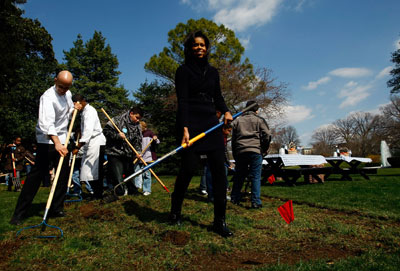
From having bare arms [which is what arms are for, hugging not war], to serving lunch to the homeless [in a planned photo op that serves as an example to us...to get an official photographer to follow us around until we do something nice then send it out with a press release] in a soup kitchen, to planting a vegetable garden [hooray for organic Nature] at the White House, she is making us take a fresh look at the role of the First Lady and at our own prejudices and opinions about what we think is right and wrong [right and left, black and white, implicitly-racist and what is just a function of white-privilege].
 
A person who gives freely is loved by all. It's hard to understand, but it is in giving that we gain strength. But there is a proper time and a proper way to give, and the person who understands this is strong and wise. By giving with a feeling of reverence for life, envy and anger are banished. A path to happiness is found. Like one who plants a sapling and in due course receives back shade, flowers, and fruit, so the results of giving bring joy. Through continuous acts of kindness the heart is strengthened by compassion and giving.
- the Buddha
 
[For more awesome, freely translated "quotes" without citations, echoes of the Universalist Mahayana/Hindu school of Buddhism beloved by many and by disaffected Jewish people in particular, see here.]
Danny and Dharma in the White House
Anti-Tar Sands/Keystone XL protest at WH
Among others, we met with representatives of the Department of Education, Department of State, Department of Homeland Security, and the Office of Faith-Based and Neighborhood Partnerships.

We also heard from and dialogued with a large group of interesting speakers, including Joshua Stanton, founding co-editor of the Journal of Inter-Religious Dialogueco-director of Religious Freedom USA, and co-editor of O.N. Scripture - The Torah; former U.S Senator Harris Wofford; and Rev. Suzan Johnson Cook, U.S. Ambassador-at-Large for International Religious Freedom.
 
Overall, I concur...that the gathering was hugely important symbolically: to see Buddhists, Hindus, Sikhs, and Jains gathered together at the White House to spend a day in dialogue with the government about service and community-building felt like a huge step forward in terms of addressing the lack of attention to and representation of Dharmic religious practitioners in Washington.

The Buddhist Delegation (with White House and Seva Charities representatives), D.C., April 20, 2012. Author is in the back row, second from the left (Phil Rosenberg/SGI-USA).
 
(In Religion Dispatches in 2009 I talked about the lack of a Buddhist representative on the White House’s Advisory Council on Faith-Based and Neighborhood Partnerships. See article).
 
The conference agenda [felt] a little overstuffed to me. And things were done in relatively broad strokes. I think we might have benefited more from smaller groups and more precise focus on unique issues in particular communities, with some attention to broader concerns. But it was certainly a great start. And I thought Joshua Stanton did a really nice job of illustrating the effect the conference had on one person outside these communities looking in. See his piece at State of Formation.

Burmese Democracy Leader, The Lady, Daw Aung San Suu Kyi at White House (AFP)
 
The Buddhist Delegation (BGR)
In addition, here is the official press release about the conference, as well as a substantial post at Hindu American Seva Charities’ official blog.
 
[UPDATE: Ven. Bhikkhu Bodhi, the American Theravada scholar-monk, offers his take at Buddhist Global Relief.] And I have pictures to share at DannyFisher.org.
 
What a thrill to be in the White House, a joy to see old friends and make new ones, and participate in something so important. Many thanks to the White House Office, Hindu American Seva Charities, and my friend Bill Aiken at Soka Gakkai International-USA. I’m humbled and at your service.

First-Ever White House Conference of Dharmic Faiths
Bhikkhu Bodhi (BuddhistGlobalRelief)
Bhikkhu Bodhi and monks (BGR)
Until recently conferences on interfaith cooperation in the U.S. have almost always centered on the Abrahamic religions of Judaism, Christianity, and Islam. Yet, over the past 40 years America has become a much more diversified and pluralistic society.

WH celebrates many Jewish holidays (AP)
The relaxing of restrictions on immigration, followed by the post-war upheavals in Southeast Asia in the 1970s, has dramatically transformed our population.
 
Large numbers of Americans now have religious roots that go back, not to the deserts of Judea and Arabia, but to the plains, mountains, and villages of ancient India.
 
Buddhist flags on Lantau (m.gin/flickr)
For convenience, these are  grouped together under the designation “the Dharmic faiths.” They include Buddhists, Hindus, Jains, and Sikhs, and their national origins range from Pakistan to Japan, from Burma to Vietnam, and from Mongolia to Sri Lanka. Not all are immigrants. At least one whole generation of people of Asian descent has been born and raised in America and think of themselves principally as Americans following a Dharmic religion. More