Amber Larson (ed.), Wisdom Quarterly; Danny Fisher; Bearing Witness/Zenpeacemakers
 |
| Bring up Tibet and China! The Dalai Lama would have, but he's so nice. (phayul.com) |
 |
| Bhikkhu Bodhi and Danny Fisher in Washington, D.C. to visit White House (ZPS) |
Danny Fisher's visit to the White House in the historic first Dharmic Religious Leaders' Conference
Co-hosted by the White House Office of Public Engagement and White House Office of Faith-Based and Neighborhood Partnerships with Hindu American Seva Charities, the conference brought together a large group of religious and institutional leaders from Buddhist, Hindu, Sikh, and Jain communities to discuss service with various government departments and agencies.
Co-hosted by the White House Office of Public Engagement and White House Office of Faith-Based and Neighborhood Partnerships with Hindu American Seva Charities, the conference brought together a large group of religious and institutional leaders from Buddhist, Hindu, Sikh, and Jain communities to discuss service with various government departments and agencies.
 |
| I gotta go meet with some Buddhists NOW. |
[In 2012] I had an interesting weekend: I was in Washington, D.C., at the White House as a participant in the historic first Dharmic Religious and Faith Leaders Conference: Community Building in the 21st Century with Strengthened Dharmic Faith-Based Infrastructures.
The conference brought together a large group of religious and institutional leaders from Buddhist, Hindu, Sikh, and Jain communities to discuss service with various government departments and agencies. [Did the Conference find signs of the Dharma already at 1600 Pennsylvania Avenue?]
Michelle's Way [in the White House]: Lessons in Buddhism from the First Lady
Ed and Deb Shapiro (Huff Post); Pat Macpherson and Crystal Quintero, Wisdom Quarterly
Tonight, for the first time in history, our First Lady will attend a Passover Seder in the White House with her two daughters, as the president honors the Jewish people. For the last week she has been electrifying Europe with her warmth and her fearlessness in showing that she cares. She is adored wherever she goes for one simple reason: She brings hope. The hope that the world can be a caring and compassionate place, and the hope anyone of any color or background can fulfill their dreams.
[That was 2009, the heady days before the world found out that Michelle's husband, B.S. Obama, was following in the footsteps of Dick Cheney, George Bush II, George Bush I, Donald Rumsfeld, Colin Powell, Condoleezza Rice, John Ashcroft, World Banker Paul Wolfowitz, and other alleged war criminals.]
It brought tears to our eyes when the children at the school Michelle Obama visited in London jumped up and down and hugged and hugged her, and she hugged them back. We could see in their faces that, because of her, they too felt they had a chance. Her charisma and confidence make others feel comfortable in her presence. Deb, being English, was delighted to finally see someone arm in arm with the Queen!
When we read this quote we thought the Buddha could have been saying this about Michelle Obama! She is setting an extraordinary example by doing things her own way and being true to herself.
From having bare arms [which is what arms are for, hugging not war], to serving lunch to the homeless [in a planned photo op that serves as an example to us...to get an official photographer to follow us around until we do something nice then send it out with a press release] in a soup kitchen, to planting a vegetable garden [hooray for organic Nature] at the White House, she is making us take a fresh look at the role of the First Lady and at our own prejudices and opinions about what we think is right and wrong [right and left, black and white, implicitly-racist and what is just a function of white-privilege].
Michelle's Way [in the White House]: Lessons in Buddhism from the First Lady
Ed and Deb Shapiro (Huff Post); Pat Macpherson and Crystal Quintero, Wisdom Quarterly
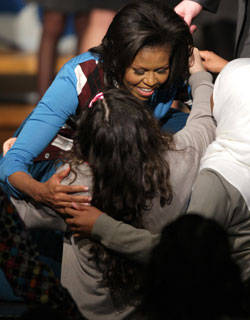 |
| Michelle loves all the children! (HuffingtonPost.com) |
[That was 2009, the heady days before the world found out that Michelle's husband, B.S. Obama, was following in the footsteps of Dick Cheney, George Bush II, George Bush I, Donald Rumsfeld, Colin Powell, Condoleezza Rice, John Ashcroft, World Banker Paul Wolfowitz, and other alleged war criminals.]
It brought tears to our eyes when the children at the school Michelle Obama visited in London jumped up and down and hugged and hugged her, and she hugged them back. We could see in their faces that, because of her, they too felt they had a chance. Her charisma and confidence make others feel comfortable in her presence. Deb, being English, was delighted to finally see someone arm in arm with the Queen!
A generous heart, kind speech, and a life of service and compassion are the things that renew humanity.
-The Buddha
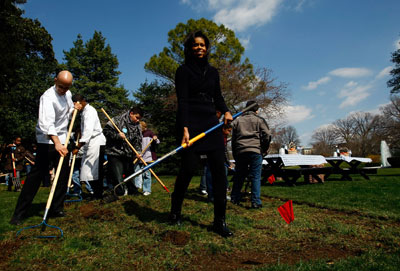 |
| Greening the White House lawn (HP) |
From having bare arms [which is what arms are for, hugging not war], to serving lunch to the homeless [in a planned photo op that serves as an example to us...to get an official photographer to follow us around until we do something nice then send it out with a press release] in a soup kitchen, to planting a vegetable garden [hooray for organic Nature] at the White House, she is making us take a fresh look at the role of the First Lady and at our own prejudices and opinions about what we think is right and wrong [right and left, black and white, implicitly-racist and what is just a function of white-privilege].
A person who gives freely is loved by all. It's hard to understand, but it is in giving that we gain strength. But there is a proper time and a proper way to give, and the person who understands this is strong and wise. By giving with a feeling of reverence for life, envy and anger are banished. A path to happiness is found. Like one who plants a sapling and in due course receives back shade, flowers, and fruit, so the results of giving bring joy. Through continuous acts of kindness the heart is strengthened by compassion and giving.
- the Buddha
[For more awesome, freely translated "quotes" without citations, echoes of the Universalist Mahayana/Hindu school of Buddhism beloved by many and by disaffected Jewish people in particular, see here.]
- Dick Cheney sticks it to Colon Powell; Rumsfeld get award
- VIDEO: Relatives Cheney and Obama on waging war on Iraq
- VIDEO: Saying NO to our U.S. war criminals! (Code Pink)
- Hospital program coaches parents to deal with toxic stress
 |
| Anti-Tar Sands/Keystone XL protest at WH |
Among others, we met with representatives of the Department of Education, Department of State, Department of Homeland Security, and the Office of Faith-Based and Neighborhood Partnerships.
We also heard from and dialogued with a large group of interesting speakers, including Joshua Stanton, founding co-editor of the Journal of Inter-Religious Dialogue, co-director of Religious Freedom USA, and co-editor of O.N. Scripture - The Torah; former U.S Senator Harris Wofford; and Rev. Suzan Johnson Cook, U.S. Ambassador-at-Large for International Religious Freedom.
We also heard from and dialogued with a large group of interesting speakers, including Joshua Stanton, founding co-editor of the Journal of Inter-Religious Dialogue, co-director of Religious Freedom USA, and co-editor of O.N. Scripture - The Torah; former U.S Senator Harris Wofford; and Rev. Suzan Johnson Cook, U.S. Ambassador-at-Large for International Religious Freedom.
Overall, I concur...that the gathering was hugely important symbolically: to see Buddhists, Hindus, Sikhs, and Jains gathered together at the White House to spend a day in dialogue with the government about service and community-building felt like a huge step forward in terms of addressing the lack of attention to and representation of Dharmic religious practitioners in Washington.
 |
| The Buddhist Delegation (with White House and Seva Charities representatives), D.C., April 20, 2012. Author is in the back row, second from the left (Phil Rosenberg/SGI-USA). |
(In Religion Dispatches in 2009 I talked about the lack of a Buddhist representative on the White House’s Advisory Council on Faith-Based and Neighborhood Partnerships. See article).
The conference agenda [felt] a little overstuffed to me. And things were done in relatively broad strokes. I think we might have benefited more from smaller groups and more precise focus on unique issues in particular communities, with some attention to broader concerns. But it was certainly a great start. And I thought Joshua Stanton did a really nice job of illustrating the effect the conference had on one person outside these communities looking in. See his piece at State of Formation.
 |
| Burmese Democracy Leader, The Lady, Daw Aung San Suu Kyi at White House (AFP) |
 |
| The Buddhist Delegation (BGR) |
In addition, here is the official press release about the conference, as well as a substantial post at Hindu American Seva Charities’ official blog.
[UPDATE: Ven. Bhikkhu Bodhi, the American Theravada scholar-monk, offers his take at Buddhist Global Relief.] And I have pictures to share at DannyFisher.org.
What a thrill to be in the White House, a joy to see old friends and make new ones, and participate in something so important. Many thanks to the White House Office, Hindu American Seva Charities, and my friend Bill Aiken at Soka Gakkai International-USA. I’m humbled and at your service.
First-Ever White House Conference of Dharmic Faiths
Bhikkhu Bodhi (BuddhistGlobalRelief)
 |
| Bhikkhu Bodhi and monks (BGR) |
Until recently conferences on interfaith cooperation in the U.S. have almost always centered on the Abrahamic religions of Judaism, Christianity, and Islam. Yet, over the past 40 years America has become a much more diversified and pluralistic society.
 |
| WH celebrates many Jewish holidays (AP) |
The relaxing of restrictions on immigration, followed by the post-war upheavals in Southeast Asia in the 1970s, has dramatically transformed our population.
Large numbers of Americans now have religious roots that go back, not to the deserts of Judea and Arabia, but to the plains, mountains, and villages of ancient India.
 |
| Buddhist flags on Lantau (m.gin/flickr) |
For convenience, these are grouped together under the designation “the Dharmic faiths.” They include Buddhists, Hindus, Jains, and Sikhs, and their national origins range from Pakistan to Japan, from Burma to Vietnam, and from Mongolia to Sri Lanka. Not all are immigrants. At least one whole generation of people of Asian descent has been born and raised in America and think of themselves principally as Americans following a Dharmic religion. More


