Sunday, 24 November 2013

TED: Doubt versus Belief (audio)

Seth Auberon, Ashley Wells, Wisdom Quarterly; NPR/TED Staff (NPR.org, 11-24-13); SCPR.org


Believers and Doubters
Why do some of us believe in something greater than ourselves, while others of us do not? Can our doubts bring our beliefs into sharper focus? Or what is the difference between belief and faith? TED speakers, courtesy of Guy Raz and National Public Radio, offer personal perspectives on belief from all ends of the spectrum, from ardent atheists to the devout faithful.

Devil vs. Super Devil ("Family Guy")
First, the daughter of the Christian televangelist Billy Graham, Anne Graham Lotz, speaking for her elderly father on the difference between (rational) belief and (emotional) faith. Lesley Hazleton asks, Is doubt essential to faith? Former Catholic and SNL comedienne Julia Sweeny explores the journey, How does a person go from believer to atheist? Then Alain de Botton asks, What can atheism learn from religion? Finally, Indian Hindu intellectual Devdutt Pattanaik wants to know, Are there any universal beliefs and truths? LISTEN
Kimberly Reed (themoth.org, 11-12-13)
A high school quarterback leaves Montana as a promising son and returns years later to reveal a shocking secret; a boy from Sierra Leone describes his transformation from innocent child to cold-hearted soldier; a teenage girl discovers how to control her errant parrot; and a construction worker discovers the up-side of his girlfriend’s one-year prison sentence. LISTEN

Storytelling with a Beat
(SnapJudgment.org) American life is much richer and diverse than we usually get to hear on NPR. Host Glynn Washington is doing something, bringing us Snap Judgment's amazing array of stories with extras only available to the podcast audience and the story-behind-the-stories on Facebook.
 
This American Life
(512: House Rules, 11-22-13) Where we live is important. It can dictate the quality of the schools and hospitals we have access to, as well as things we will experience -- like cancer rates, unemployment statistics, or whether the city repairs roads in our neighborhood. On this week's show, stories about "destiny by geography." Much of this story is told to Nancy Updike by ProPublica reporter Nikole Hannah-Jones, whose series on the Fair Housing laws in modern America -- with more stories, research, and interviews — is here.
 
More comedy, more stories:

Saturday, 23 November 2013

Buddhism and Social Action

Amber Larson, Ashley Wells, Wisdom Quarterly; Ken Jones, "Buddhism and Social Action: An Exploration" (Paul Ingram, editor, Buddhist Society's journal The Middle Way (Vol. 54, No. 2)
WARNING: Graphic self-immolation! A harmful and condemnable act of suicide conflating Hindu and Mahayana Buddhist concepts praising martyrdom in the name of "protest" -- bringing attention to U.S. War on Vietnam abuses by a Zen Buddhist monk. This harmful idea currently modern Tibetan monastic extremists.

1.1 Buddhism and the new global society
Protester (Time/Ted Soqui/Shepard Fairey)
It is the manifest suffering (dukkha, disappointment, lack of fulfillment, unsatisfactoriness, misery) and folly (moha, delusion, wrong view, avijja ignorance) in the world that invokes humane and compassionate social action in its many different forms.

For Buddhists this situation raises fundamental and controversial questions. And here, also, Buddhism has implications of some significance for Christians, humanists, and other non-Buddhists. By "social action" we mean the many different kinds of action intended to benefit humankind.
 
These range from simple individual acts of charity, teaching, and training, organized kinds of service, "right livelihood" (nonharmful survival) in and outside the helping professions, and through various kinds of community development as well as to political activity in working for a better society.

(Nati) Burmese Theravada monks lead Saffron Revolution against dictator
 
Occupy L.A. activist (WQ)
Buddhism is a pragmatic teaching that starts from certain fundamental propositions about how we experience the world and how we act in it. It teaches that it is possible to transcend this sorrow-laden world of our experience and is concerned first and last with ways of achieving that transcendence.

What finally leads to such transcendence is what we call wisdom (paññā or prajna). The enormous literature of Buddhism is not a literature of revelation and authority. Instead, it uses ethics and meditation, philosophy and science, art and poetry to point a way to this wisdom.
 
Similarly, Buddhist writing on social action, unlike secular writings, makes finite proposals which must ultimately refer to this wisdom, but which also are arguable in terms of our common experience.
 
In the East, Buddhism developed different "schools" or "traditions," serving the experiences of different cultures, ranging from Theravada Sri Lanka through Vajrayana Tibet and Mongolia to Zen Japan. Buddhism may thus appear variously as sublime humanism, magical mysticism, poetic paradox, and much else.

"Anonymous" NSA/CIA spy
These modes of expression, however, all converge upon the fundamental teaching, the "perennial Buddhism." Drawing upon the different Asian traditions to present the teachings in an attempt to relate them to our modern industrial Western society.
 
From the evidence of the Buddha's discourses, or sutras in the "Long Discourses" (Digha Nikaya), it is clear that early Buddhists were very much concerned with the creation of social conditions favorable to the individual cultivation of Buddhist values. 

An outstanding example of this, in later times, is the remarkable "welfare state" created by the Buddhist emperor, Asoka (B.C.E. 274-236). Ven. Walpola Rahula stated the situation -- perhaps at its strongest -- when he wrote:

"Buddhism arose in India as a spiritual force against social injustices, against degrading. superstitious rites, ceremonies, and sacrifices; it denounced the tyranny of the caste system and advocated the equality of all [people]; it emancipated woman and gave her complete spiritual freedom."
- Ven. Rahula (1978)

Lula, Freedom's daughter (occupyla.org)
Buddhist scriptures indicate the general direction of Buddhist social thinking, and to that extent they are suggestive for our own times. Nevertheless it would be pedantic, and in some cases absurd, to apply directly to modern industrial society social prescriptions detailed to meet the needs of social order which flourished 2[6] centuries ago.
 
The Buddhist householder of the "Advice to Householders Discourse" (Sigalovada Sutta, DN 31) experienced a different way of life from that of a computer consultant in Tokyo or an unemployed black youth in Liverpool [England].

And the conditions which might favor their cultivation of the Middle Way must be secured by correspondingly different -- and more complex -- social, economic, and political strategies.
 
It is therefore essential to attempt to distinguish between perennial Buddhism on the one hand and, on the other hand, the specific social prescriptions attributed to the historical Buddha which related the basic, perennial teaching to the specific conditions of his day.

(Blazing Wisdom) Buddhism: Philosophy, Religion, or Science of Mind

We believe that it is unscholarly to transfer the scriptural social teaching uncritically and with careful qualification to modern societies, or to proclaim that the Buddha was a democrat and an internationalist. The modern terms "democracy" and "internationalism" did not exist in the sense in which we understand them in the emergent feudal society in which the Buddha lived.

Buddhism is ill-served in the long run by such special pleading. On the other hand, it is arguable that there are democratic and internationalist implications in the basic Buddhist teachings.
 
Wat Maha Leap, Cambodia (BokehCambodia/flickr)
In the past 200 years society in the West has undergone a more fundamental transformation than at any period since Neolithic times, whether in terms of technology or the world of ideas. And now in the East, while this complex revolution is undercutting traditional Buddhism, it is also stimulating Asian Buddhism; in the West it is creating problems and perceptions to which Buddhism seems particularly relevant.
 
Throughout its history Buddhism has been successfully reinterpreted in accordance with different cultures, while at the same time preserving its inner truths. In this way has Buddhism spread and survived.
 
The historic task of Buddhists, both East and West, in the 21st century is to interpret perennial Buddhism in terms of the needs of industrial humans in the social conditions of their time and to demonstrate its acute and urgent relevance to the ills of society.

(PS) Zucotti Park: Buddhist monk visits Occupy Wall St. protests
 
To this great and difficult enterprise Buddhists will bring their traditional boldness and humility. For certainly this is no time for clinging to dogma and defensiveness. More

The nun Khema, Foremost in Wisdom (sutra)

Dhr. Seven and Amber Larson, CC Liu, Wisdom Quarterly translation based on Ven. Thanissaro (aka Geoffrey DeGraff, Abbot of Wat Metta), Khema Sutta (SN 44.1)
Venerable Khema, the Buddha's chief female disciple (-William/flickr.com)
 
First Buddhist Women (Susan Murcott)
On one occasion the Blessed One was residing near the city of Savatthi at Jeta's Grove in the millionaire's monastery. At that time the nun Khema [the Buddha's chief female disciple, "foremost in wisdom"], wandering on tour among the Kosalan peopple, had taken up her residence between Savatthi and Saketa at Toranavatthu

Then King Pasenadi Kosala, while traveling from Saketa to Savatthi, took up a one-night residence between Savatthi and Saketa at Toranavatthu. He addressed a certain man, "Come, now, my good man. Find out if in Toranavatthu there is any Brahmin [priest] or wandering ascetic (shraman) I might visit today."
 
"As you wish, sire," the man replied. Having roamed all over Toranavatthu, he did not see any. However, he did see the nun Khema. And seeing her he went to King Pasenadi Kosala and reported: "Sire, in Toranavatthu there is no Brahmin or wandering ascetic of the sort your majesty might visit. But there is a [Buddhist] nun named Khema, a disciple of the Blessed One, worthy and rightly self-awakened.

Khema "foremost in wisdom"
"And of this lady this commendable report has spread: 'She is wise, competent, intelligent, learned, a fluent speaker, admirable in her ingenuity.' Let your majesty visit her."
 
King Pasenadi Kosala went to the nun Khema. When he arrived, he bowed and sat respectfully to one side. Sitting there he said: "Now then, lady, does the Tathagata [the "Wayfarer," the Buddha] exist after death?"
 
"This, great king, has not been declared by the Blessed One: 'The Tathagata exists after death.'"
 
"Well then, lady, does the Tathagata not exist after death?"
 
"Great king, this too has not been declared by the Blessed One: 'The Tathagata does not exist after death.'"
 
"Then does the Tathagata both exist and not exist after death?"

"This also has not been declared by the Blessed One: 'The Tathagata both exists and does not exist after death.'"
 
"Well then, does the Tathagata neither exist nor not exist after death?"
 
"This, too, has not been declared by the Blessed One: 'The Tathagata neither exists nor does not exist after death.'"
 
"Now, lady, when asked if the Tathagata exists after death, you [answer no to each of the four exhaustive options]. Now, what is the cause, what is the reason, why that has not been declared by the Blessed One?"
 
Khema, Buddha, and Uppalavanna? (BreenJones)
"Very well, then, great king, I will question you in return about this very same matter. Answer as you see fit. What do you think, great king: Do you have an accountant or actuary or mathematician who can count the grains of sand in the river Ganges as 'so many grains of sand,' or 'so many hundreds of grains of sand,' or 'so many thousands of grains of sand,' or 'so many hundreds of thousands of grains of sand'?"
 
"No, lady."
 
"Then do you have an accountant or calculator or mathematician who can count the water in the great ocean as 'so many buckets of water,' or 'so many hundreds of buckets of water,' or 'so many thousands of buckets of water,' or 'so many hundreds of thousands of buckets of water'?"
 
"No, lady. But why is that? The great ocean is deep, boundless, hard to fathom!"
 
"Even so, great king, any physical form by which one describing the Tathagata would describe him -- that the Tathagata has abandoned, its root destroyed, made like a palmyra stump, deprived of the conditions of development, not destined for future rearising. Freed from the classification of form, great king, the Tathagata is deep, boundless, hard to fathom, like the ocean. 

Modern Theravada "ten precept nun" dressed in white in Burma (As1974/flickr.com)
 
"'The Tathagata exists after death' does not apply. 'The Tathagata does not exist after death does not apply. 'The Tathagata both exists and does not exist after death' does not apply. 'The Tathagata neither exists nor does not exist after death' does not apply.
 
"Any feeling... Any perception... Any mental formation...

"Any consciousness [form, feeling, perception, formation, and consciousness are the Five Aggregates of Clinging unenlightened beings cling to and regard as self] by which one describing the Tathagata would describe him -- that the Tathagata has abandoned, its root destroyed, made like a palmyra stump, deprived of the conditions of development, not destined for future rearising. 

"Freed from the classification of consciousness, great king, the Tathagata is deep, boundless, hard to fathom, like the ocean. 'The Tathagata exists after death' does not apply. 'The Tathagata does not exist after death' does not apply. 'The Tathagata both exists and does not exist after death' does not apply. 'The Tathagata neither exists nor does not exist after death' does not apply."
  • The Commentary and Sub-commentary try to go further than this discourse and to describe the Liberated One's indescribability. To paraphrase: He is freed from the classification of form [and the other aggregates] because for him there will be no rearising [rebirth] of form and so on in the future, after passing into final nirvana. In addition, he is deep in terms of the depth of his character and the depth of his qualities. As for any description in terms of "a being" which might be used in relation to someone with such deep qualities, when one sees the inapplicability of the description "being," owing to the (future) non-rearising of the Five Aggregates of Clinging, one sees that none of the four statements with regard to the Tathagata are invalid after passing into final nirvana. [Wayfarer is an early English translation of the term Tathagata, which means "welcome one" and "well gone one," sometimes translated in Mahayana Buddhism as "Thus Come One." He is gone-and-going, after having arisen and arrived. He is a welcome teacher of freedom destined for complete freedom.] This explanation, which borrows from Sister Vajira's verse in SN 5.10, misses an important point raised in SN 22.36 and SN 23.2. In SN 22.36 the Buddha states that one is measured and classified by what one is obsessed with or clinging to. If one is not obsessed with anything and no longer clinging even unconsciously, then one is not measured or classified by it in the here and now. In SN 23.2 the Buddha points out that the term "being" or "becoming" (bhava) applies only where there is craving and passion [rooted in ignorance/unenlightenment and therefore leading to the future rearising of a rebirth-linking consciousness, which entails rebirth in samsara yet again for the umpteenth time]. The Tathagata, freed from craving and passion, is indescribable in the present, even though he obviously still functions in the present. SN 22.86 elaborates on this point in great detail. Another problem raised by the Commentary's explanation for this brief discourse is how it would define the Tathagata's qualities and character, for what are they composed of aside from the aggregates.
Then King Pasenadi Kosala, delighting in and approving of the nun Khema's words, got up from his seat, bowed, and -- respectfully keeping her to his right -- departed.
 
Asking the Buddha
A great Indian king (maha raja) meets the Buddha.
At another time he went to the Blessed One. When he arrived, he bowed, and sat respectfully to one side. Sitting there [he asked the Buddha the same four questions asked of the nun Khema, and he received precisely the same responses and analogies. Then he exclaimed:]
 
"Amazing, venerable sir! It is astounding how the meaning and phrasing of the teacher and disciple agree, coincide, and do not diverge from one another with regard to the supreme teaching! 
 
Recently, venerable sir, I visited the nun Khema. And when I arrived I asked her regarding this matter, and she answered me with the same words, the very same phrasing as the Blessed One. Amazing, venerable sir! It is astounding how the meaning and phrasing of the teacher and disciple agree, coincide, and do not diverge from one another with regard to the supreme teaching!
 
"Now, venerable sir, we must go. Our duties are many, and many are our responsibilities."
 
"Then do as you see fit, great king."
 
So King Pasenadi Kosala, delighting in and approving of the Blessed One's words, got up from his seat, bowed, -- respectfully keeping the Blessed One to his right -- departed.

Friday, 22 November 2013

Climate chaos in Warsaw, Poland (video)

Ashley Wells, Pat Macpherson, Wisdom Quarterly; DemocracyNow.org, 19, 11-22-13
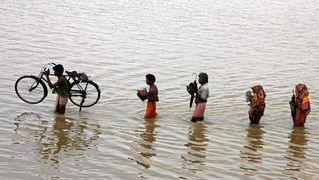
Flooding in Thailand was one dramatic byproduct of climate chaos (latimes.com)
 
Environmentalists walk out of U.N. talks
Pollution
"Carbon trading" is a false solution!
WARSAW - Negotiations at the U.N. climate summit COP 19 have entered their final scheduled day. Deep divisions remain between rich and poorer nations. Negotiators from nearly 200 countries have been meeting for the past two weeks trying to lay the foundation for a new global climate treaty to be agreed on at talks scheduled for Paris in two years. Yesterday, more than 800 members of various environmental groups disgusted with the lack of progress staged an unprecedented walk out of the talks.
US says NO to reparations for damage
Questioned by Democracy Now! host Amy Goodman hours later, the U.S. special envoy for climate change and lead climate negotiator, Todd Stern, rejected calls for reparations to poor countries damaged by the carbon [methane, and other] emissions of the world’s biggest polluters.

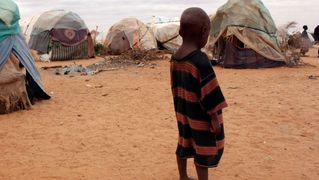
Somalia3What is the state of the talks? Guests Martin Khor, executive director of the South Centre, and Nitin Sethi, senior assistant editor at The Hindu discuss it. Sethi was responsible for leaking U.S. briefing papers on the climate negotiations before the summit began, revealing how U.S. negotiators at the climate talks are opposing efforts to help developing countries adapt to climate change.

Flood-india
US: We're not paying them damages!
According to the internal memo, the U.S. delegation is worried the talks in Warsaw will "focus increasingly on blame and liability" and that poor nations will be "seeking redress for climate damages from sea level rise, droughts, powerful storms, and other adverse impacts." More

"Xmas Without China" (film)

Mary's Christmas Museum for an inclusive Xtmas (Kevin Dooley/flickr.com)


Chinese immigrant Tom Xia challenges his American neighbors, the Joneses, to one Christmas season without using anything made in China!

"Xmas Without China" is a feature documentary set around the Christmas holiday in Arcadia, California, a Pasadena-adjacent neighborhood in the San Gabriel Valley that used to be predominantly Anglo, but is now half Asian.
 
Tom Xia, a Chinese-American immigrant, challenges his neighbors, the Jones family, to spend the entire month leading up to the commercial holiday season with no Chinese products in their homes and without purchasing any Chinese products for the holidays.

"Black Friday" is coming. Where will you be?
 
(Kevin Dooley/flickr.com)
Fed up with food and toy recalls, the Joneses take up the challenge. But the tables turn when Tim Jones provokes Tom about who he is and why he's so proud of China. As the Joneses struggle to figure out how to have a simpler Christmas in a time when "We don't make anything anymore." They also begin to think about just how related they are to China. 
 
xmas-without-china-banner-200x225Fed up with the mudslinging between the two countries, Tom finds himself on an unlikely journey to break down stereotypes between China and America. He find his own place between these worlds.
 
We shot the first half of the film, and in the wonderful way of documentary, we discovered that Tom's challenge brings us a fascinating story of the unusual relationship between two families who are each trying to adapt to the enormous changes that are defining our world today. More

A Guide to Void-Gazing Meditation

Editors, Wisdom Quarterly; (voices.yahoo.com)
The boundless sky or akasha includes space (bbc.co.uk)


Deep in meditation (wiki)
This is a variation on a Tibetan meditation known as "Sky-Gazing." It is named this because the practice involves gazing in a relaxed way at the sky as one meditates. This meditation is essentially the same and can be used indoors or wherever even if the sky is not immediately visible.

Begin by taking a seat with back erect, hands resting on lap. Alternatively, lie down comfortably, but not so comfortably that sleep comes on. Close the eyes, and take a few calming breaths as eyes settle gently behind the eyelids, gazing gently ahead. To relax even further, repeat silently the seed mantra, Emaho (ay-mah-ho). It is Tibetan for "wondrous!" and is the core-teaching of Tibetan meditation. Experience the wonder of being alive, sitting there in immersed in our original Buddha nature.
 
Gazing at Occupy LA (WQ)
Imagine staring out into a vast emptiness, a deep dark void where nothing exists. When this can be imagined easily, begin to breathe in and out as deeply as possible while remaining relaxed. The focus should be on the out-breath, imagining that with each exhalation one is breathing essence out into that void, becoming one with its spacious luminosity. No ego exists here. Feel yourself expanding beyond any corporeal confines, filling that void. More

    Fairies, Hybrids, Mysteries (Fortean TV)

    Pfc. Sandoval, Ashley Wells, Wisdom Quarterly; Rev. Lionel Fanthorpe (Fortean TV)
    Fairies (devas) and dragons (nagas) go hand in hand in world's mythologies (mobile9.com)
    (GIA) Let's go in search of faeries (devas, elves), Bigfoot (Yeti, yakshi, ogre), the dead (pretas), and mosquitoes with Father Fanthorpe on the UK series Fortean TV.
      
    Strange phenomena (FT)
    This documentary examines upright walking Oliver the humanzee (human-chimp hybrid), once touted in America as a living "baby Bigfoot." It also looks at a visit from the recently dead by an embodied apparition. Moreover, we follow Maria Dann who goes in search of fairies until she finds them -- mischievous goblins and elves, elementals, playful light beings or "shining ones," woodland denizens collectively called devas in Buddhism.