Showing posts with label Sigala. Show all posts

Sunday, 27 April 2014

Buddha in Berkeley: economics revolution

CC Liu, Dhr. Seven, Amber Larson (eds.), Wisdom Quarterly; UC Berkeley; Kathleen Maclay; (californiagoldenblogs.com, 3-19-14) via the Tipitaka Network
The new U.S. greenbacks with their high tech anti-counterfeiting measures (latimes.com)
Advances being made at the world's most prominent public university: Cal Berkeley
That's Berkeley

Golden Scholars: UC Berkeley researchers control cell migration, revolutionize economics with Buddha
Offerings, Thiksey Gompa (Aswin/flickr)
This is the start of a new series focusing on the academic discoveries at UC Berkeley. Getting things started with the non-magic magic of Berkeley is Prof. Brown teaching economics with the Buddha, and others using Oski to help advance tissue engineering and wound healing.
 
California Golden Blogs (CGB)'s new series highlights the research and academic work being done at UC Berkeley. One of the things to love best about this place is its ability to succeed in the world of athletics and academics, so spending more time sharing the amazing work being done by UC academicians and athletes makes sense.
 
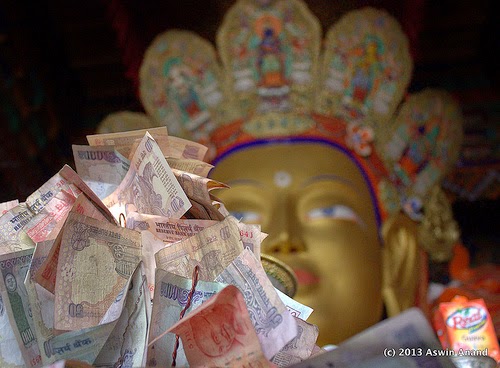
Budai (Hotei) and a wad of Asian bills
Coincidentally, the university just released a video on Twitter to promote this balance of success (see above). 

It features prominent Berkeley researchers -- including Jay Keasling, Homayoon Kazerooni, and Robert Reich -- whose work will be discussed later in the series.
 
Some stories that capture Berkeley's spirit include economics professor Clair Brown, who's looking to change the way the world views spending money and focus instead on reducing suffering and helping others

To accomplish this, she's helping spread the word and advocate for Buddhist economics. More


Buddhist Economics: oxymoron or idea whose time has come? Kathleen Maclay (Media Relations, 3-13-14) 
“How would Buddha teach Econ. 1?”
BERKELEY, California - UC Berkeley economist Prof. Clair Brown acknowledges that “Buddhist economics” may seem like an oxymoron.
 
Nevertheless, she’s teaching a sophomore seminar on the topic this semester -- the campus’s second such offering over the past year.
 
What's the future of money, Bits or Buddha?
Brown said she created the one-unit Buddhist Economics course after students in her Introductory Economics (Econ 1) class expressed frustration with the relentless Madison Avenue message that more is better, economic growth paves the path to a better life, and “retail therapy” is a quick trip to nirvana [ultimate bliss].

It's sustainable, it's all sustainable!
Nicholas Austin -- an economics major from Laguna Beach, Orange County, California, and a student this spring in Brown’s Buddhist Economics class -- said he was hungry for some fresh ideas about economics after seeing so many students in the field pursue finance careers and “moving money rather than creating a product that will help the world.” More

Wednesday, 23 April 2014

Native Americans on gay marriage, junk food...

Xochitl; CC Liu, Ashley Wells, (eds.) Wisdom Quarterly; NPR.org; Take Two (SCPR.org)
Cleaning, restoring, and hiking Hahamongna, sacred Tongva land, Native Los Angeles

Navajo Nation rainbow flag (dbking/flickr.com/npr.org)

How some Natives dealt with homosexuality
LGBTQ (transgendersociety.yolasite.com)
It may be that gay marriage is not accepted by traditional Native Americans, like California's Chumash (ranging from Malibu to San Luis Obispo). They nevertheless found a progressive and inclusive solution to gender-bending, transsexuality, and homosexuality: "Two-spirit people."

San Francisco march (indybay.org)
Two-spirit is a modern umbrella term used by some indigenous North Americans for gender-variant individuals within their communities.
 
Non-Native anthropologists have historically used the term berdaches (almost exactly like the analogous Afghan/Pashtun bacheh) for individuals who fulfill one of many mixed gender roles in First Nations and Native American tribes.
The complex social psychology of sex and the social construction of gender among Native Americans and ancient Asians can teach us a great deal to allay our unconscious sexism (GJ)
  
Ancient Afghans and Chinese in America
But this term has more recently fallen out of favor (in Afghanistan as well). Third and fourth gender roles historically embodied by two-spirit people include performing work and cross dressing, that is, wearing clothing associated with the other gender
 
Some tribes consider there to be at least four gender identities: (1) feminine men, (2) masculine men, (3) feminine women, and (4) masculine women. The presence of male two-spirits "was a fundamental institution among most tribal peoples" (Brian Joseph Gilley, Becoming Two-Spirit: Gay Identity and Social Acceptance in Indian Country, 2008). According to Will Roscoe, male and female two-spirits have been "documented in over 130 North America tribes, in every region of the continent" (Will Roscoe, The Zuni Man-Woman, p.5, 1991).
 
Transsexual and transgender Native Americans existed, and were even accepted and assimilated, before Western contact (Transgender Society/de Batz, Illinois,1735)
.
Banning Native American Gay Marriage
Tell Me More (npr.org)
But we need gay marriage or they win!
The Navajo Nation has has prohibited same-sex marriage since 2005, when the Dine Marriage Law was passed. Now, critics are challenging that ban.  As the largest reservation in the U.S., the Navajo Nation straddles the borders of three states: New Mexico, Arizona, and Utah. Utah has been embroiled in its own same-sex marriage battle recently (the state halted gay marriages Monday).  But these state laws do not affect the Navajo Nation ban. Michel Martin, the excellent host of NPR's nightly Tell Me More, recently sat down with Deswood Tome, a special adviser to the president of the Navajo Nation and activist Alray Nelson of the Coalition for Navajo Equality. LISTEN

Impact of The Long Walk felt 150 years later
Laurel Morales, Fronteras Desk (Take Two, Jan. 24, 2014)
The Long Walk for Navajos and Apaches (Bosque Redondo Memorial/Shonto Begay)
 
Navajo Artist Shonto Begay says, “I could feel and hear the cries of the people the trail the heat the cold. I had to be deep deep inside that to try to bring out the echoes of the cries on the trail.”

January marked the 150th anniversary of what Navajo and Mescalero Apache people call "The Long Walk," similar to the forced death-march known as the "Trail of Tears."

Native American (SuperG82/flickr)
In 1864 the U.S. Army forced the Navajo and Apache to walk 400 miles from their assigned reservation in northeastern Arizona to the edge of the Pecos River in eastern New Mexico. As expected thousands died during that long, arduous journey.

These days, so many Navajos like musician Clarence Clearwater have moved off the reservation for work.

Clearwater performs on the Grand Canyon Railway -- the lone Indian among dozens of cowboys and train robbers entertaining tourists.
 
“I always tell people I’m there to temper the cowboys,” Clearwater said. “I’m there to give people the knowledge that there was more of the West than just cowboys.”
 
Clearwater retraced his great-great-great-grandfather’s footsteps 50 years ago for The Long Walk’s 100th anniversary. Along the way he learned a song about going home. LISTEN
  • A history of discrimination denying affirmative action
Native American Junk-Food Tax?
"Advocates Vow To Revive Navajo Junk-Food Tax" (AP/NPR, April 22, 2014)
This mouth-watering burger is a delicious vegan melt with baked fries (Vegan)

 
Don't tell anyone they're good as in healthy.
FLAGSTAFF, Arizona - Facing a high prevalence of diabetes, many American Indian tribes are returning to their roots with community and home gardens, cooking classes that incorporate traditional foods, and running programs to encourage healthy lifestyles.
 
The latest effort on the Navajo Nation, the country's largest reservation, is to use the tax system to spur people to ditch junk food.
 
Sobochesh berries (eattheweeds.com)
A proposed 2 percent sales tax on chips, cookies and sodas failed Tuesday in a Tribal Council vote. But the measure still has widespread support, and advocates plan to revive it, with the hope of making the tribe one of the first governments to enact a junk-food tax.
 
Elected officials across the U.S. have taken aim at sugary drinks with proposed bans, size limits, tax hikes and warning labels, though their efforts have not gained widespread traction. In Mexico, lawmakers approved a junk food tax and a tax on soft drinks last year as part of that government's campaign to fight obesity.
 
Navajo President Ben Shelly earlier this year vetoed measures to establish a junk-food tax and eliminate the tax on fresh fruit and vegetables. At Tuesday's meeting, tribal lawmakers overturned the veto on the tax cut, but a vote to secure the junk-food tax fell short. Lawmakers voted 13-7 in favor of it, but the tax needed 16 votes to pass. More

Saturday, 23 November 2013

Buddhism and Social Action

Amber Larson, Ashley Wells, Wisdom Quarterly; Ken Jones, "Buddhism and Social Action: An Exploration" (Paul Ingram, editor, Buddhist Society's journal The Middle Way (Vol. 54, No. 2)
WARNING: Graphic self-immolation! A harmful and condemnable act of suicide conflating Hindu and Mahayana Buddhist concepts praising martyrdom in the name of "protest" -- bringing attention to U.S. War on Vietnam abuses by a Zen Buddhist monk. This harmful idea currently modern Tibetan monastic extremists.

1.1 Buddhism and the new global society
Protester (Time/Ted Soqui/Shepard Fairey)
It is the manifest suffering (dukkha, disappointment, lack of fulfillment, unsatisfactoriness, misery) and folly (moha, delusion, wrong view, avijja ignorance) in the world that invokes humane and compassionate social action in its many different forms.

For Buddhists this situation raises fundamental and controversial questions. And here, also, Buddhism has implications of some significance for Christians, humanists, and other non-Buddhists. By "social action" we mean the many different kinds of action intended to benefit humankind.
 
These range from simple individual acts of charity, teaching, and training, organized kinds of service, "right livelihood" (nonharmful survival) in and outside the helping professions, and through various kinds of community development as well as to political activity in working for a better society.

(Nati) Burmese Theravada monks lead Saffron Revolution against dictator
 
Occupy L.A. activist (WQ)
Buddhism is a pragmatic teaching that starts from certain fundamental propositions about how we experience the world and how we act in it. It teaches that it is possible to transcend this sorrow-laden world of our experience and is concerned first and last with ways of achieving that transcendence.

What finally leads to such transcendence is what we call wisdom (paññā or prajna). The enormous literature of Buddhism is not a literature of revelation and authority. Instead, it uses ethics and meditation, philosophy and science, art and poetry to point a way to this wisdom.
 
Similarly, Buddhist writing on social action, unlike secular writings, makes finite proposals which must ultimately refer to this wisdom, but which also are arguable in terms of our common experience.
 
In the East, Buddhism developed different "schools" or "traditions," serving the experiences of different cultures, ranging from Theravada Sri Lanka through Vajrayana Tibet and Mongolia to Zen Japan. Buddhism may thus appear variously as sublime humanism, magical mysticism, poetic paradox, and much else.

"Anonymous" NSA/CIA spy
These modes of expression, however, all converge upon the fundamental teaching, the "perennial Buddhism." Drawing upon the different Asian traditions to present the teachings in an attempt to relate them to our modern industrial Western society.
 
From the evidence of the Buddha's discourses, or sutras in the "Long Discourses" (Digha Nikaya), it is clear that early Buddhists were very much concerned with the creation of social conditions favorable to the individual cultivation of Buddhist values. 

An outstanding example of this, in later times, is the remarkable "welfare state" created by the Buddhist emperor, Asoka (B.C.E. 274-236). Ven. Walpola Rahula stated the situation -- perhaps at its strongest -- when he wrote:

"Buddhism arose in India as a spiritual force against social injustices, against degrading. superstitious rites, ceremonies, and sacrifices; it denounced the tyranny of the caste system and advocated the equality of all [people]; it emancipated woman and gave her complete spiritual freedom."
- Ven. Rahula (1978)

Lula, Freedom's daughter (occupyla.org)
Buddhist scriptures indicate the general direction of Buddhist social thinking, and to that extent they are suggestive for our own times. Nevertheless it would be pedantic, and in some cases absurd, to apply directly to modern industrial society social prescriptions detailed to meet the needs of social order which flourished 2[6] centuries ago.
 
The Buddhist householder of the "Advice to Householders Discourse" (Sigalovada Sutta, DN 31) experienced a different way of life from that of a computer consultant in Tokyo or an unemployed black youth in Liverpool [England].

And the conditions which might favor their cultivation of the Middle Way must be secured by correspondingly different -- and more complex -- social, economic, and political strategies.
 
It is therefore essential to attempt to distinguish between perennial Buddhism on the one hand and, on the other hand, the specific social prescriptions attributed to the historical Buddha which related the basic, perennial teaching to the specific conditions of his day.

(Blazing Wisdom) Buddhism: Philosophy, Religion, or Science of Mind

We believe that it is unscholarly to transfer the scriptural social teaching uncritically and with careful qualification to modern societies, or to proclaim that the Buddha was a democrat and an internationalist. The modern terms "democracy" and "internationalism" did not exist in the sense in which we understand them in the emergent feudal society in which the Buddha lived.

Buddhism is ill-served in the long run by such special pleading. On the other hand, it is arguable that there are democratic and internationalist implications in the basic Buddhist teachings.
 
Wat Maha Leap, Cambodia (BokehCambodia/flickr)
In the past 200 years society in the West has undergone a more fundamental transformation than at any period since Neolithic times, whether in terms of technology or the world of ideas. And now in the East, while this complex revolution is undercutting traditional Buddhism, it is also stimulating Asian Buddhism; in the West it is creating problems and perceptions to which Buddhism seems particularly relevant.
 
Throughout its history Buddhism has been successfully reinterpreted in accordance with different cultures, while at the same time preserving its inner truths. In this way has Buddhism spread and survived.
 
The historic task of Buddhists, both East and West, in the 21st century is to interpret perennial Buddhism in terms of the needs of industrial humans in the social conditions of their time and to demonstrate its acute and urgent relevance to the ills of society.

(PS) Zucotti Park: Buddhist monk visits Occupy Wall St. protests
 
To this great and difficult enterprise Buddhists will bring their traditional boldness and humility. For certainly this is no time for clinging to dogma and defensiveness. More

Tuesday, 1 October 2013

The Intoxication Sutra

Dhr. Seven, Amber Larson, Ashley Wells, CC Liu, Wisdom Quarterly, excerpt "A Brief Code of Buddhist Ethics" from the discourse "Advice to Householders," Sigalovada Sutra (DN 31)
Drug addict Sugarnose Barbie knows how to party on a budget (weheartit.com)
 
Snorting fluoride?
There are four motivations of bad karma (unskillful, unprofitable deeds). The Buddha rhetorically asked, "Due to what four causes is unskillful karma produced?
  1. "Led by desire one perpetrates unwholesome actions.
  2. Provoked by anger one performs unskillful deeds.
  3. Motivated by delusion one engages in demeritorious conduct.
  4. Stirred by fear one produces harmful karma.
"But to the extent that one is not motivated by greed, aversion, wrong views, or fear, a lay follower accumulates no unwholesome karma."
 
Smoking on that gas with a mask (Julia Ferguson/flickr)
Who led by craving, contempt, confusion, or cowardice
Transgresses the self-discipline thus proclaimed,
All of that person’s glory dims and fades away,
Declining like the light of the waning moon.
 
But who in spite of desire, dislike, delusion, or dread
Does not transgress the self-discipline thus proclaimed,
All of that person’s glory gains in strength,
Dazzling like the light of the waxing moon.

"Liquid Ignorance" (npr.org)
"There are six channels for dissipating wealth.
 
The Buddha further asked, "What are the six channels for dissipating wealth that one avoids pursuing?
  1. "Indulging in intoxicants which occasion heedlessness,
  2. roaming the streets at unseemly hours,
  3. frequenting unsavory shows,
  4. being infatuated with gambling,
  5. associating with the foolish,
  6. being addicted to idleness."
[Why?] "There are, young householder, these six miserable consequences to indulging in intoxicants which occasion heedlessness:
  1. "loss of wealth,
  2. increase in quarrels,
  3. susceptibility to disease,
  4. loss of reputation,
  5. indecent exposure,
  6. weakened intellect.
    What if I, Barbie, were to get high and get a Snookie makeover? Aarrgh!
     
    "There are, young householder, these six harmful consequences to roaming the streets at unseemly hours:
    1. "You are unprotected and unguarded.
    2. Your spouse and children are unprotected and unguarded.
    3. Your property is unprotected and unguarded.
    4. You are suspected of crimes.
    5. You are the subject of false rumors.
    6. You encounter many troubles.
    "There are, young householder, these six unskillful things associated with frequenting unsavory shows. One who does so remains restless and agitated, wondering:
    1. "Where is there dancing?
    2. Where is there singing?
    3. Where is there music playing?
    4. Where is there reciting?
    5. Where is there this entertainment?
    6. Where is there that entertainment?
    "There are, young householder, these six unwelcome consequences to being infatuated with gambling:
    1. "One is despised due to winning.
    2. One grieves on account of losing.
    3. One dissipates one’s wealth.
    4. One’s word is not relied on.
    5. One comes to be disparaged by friends and associates.
    6. One, unable to properly support another, is not much sought after."
    "There are, young householder, these six disagreeable consequences to associating with the foolish:
    1. "Any gambler,
    2. any wastrel,
    3. any drunkard,
    4. any cheater,
    5. any swindler,
    6. any violent person
    "is one’s friend and companion.

    "There are, young householder, these six unprofitable consequences associated with being addicted to idleness. Nothing is accomplished because one is not inclined to put forth the effort to get any work done, instead thinking:
    1. "It’s too cold!
    2. It’s too hot!
    3. It’s too late in the evening!
    4. It’s too early in the morning!
    5. I’m too hungry!
    6. I’m too full!"
    Buddha, Afghanistan (Gandhara)
    "Living in this way, one leaves many wholesome and profitable things left undone. New wealth is left unacquired. And savings dwindle away." After the Buddha explained in detail, he summarized in verse:

    Some are two-faced friends,
    Saying ‘friend, friend’ to your face.
    Some are with you through your hour of need
    And should be recognized as friends indeed.

    Sleeping and cheating,
    Quarreling and causing harm,
    Unwise association and miserliness --
    These six causes ruin a person.

    One regarding fools as friends
    Is given to disadvantageous ways
    On account of which one grieves in two places --
    In this world and the next.

    Dice-and-promiscuity, drinking, dance-and-song,
    In bed by day and regarding night as the time to rise,
    Associating with fools, a heart to hardness inclined --
    These manifold causes ruin a person.

    Who indulges in games of chance, consumes intoxicants,
    Consorts with partners as dear to others as their very lives --
    Associating with clouded rather than enlightened minds --
    Such a person declines just as the waning moon.

    Intoxicated, broke, destitute,
    Thirsty even when drinking,
    One sinks in debt like a stone in water --
    And bringing disrepute, one is soon bereft of kin.

    Who by habit sleeps the day away,
    Looks on night as the time to wake,
    Ever intoxicated and indulgent,
    Is unfit to lead even the household life. Full sutra

    The Buddhist Layperson
    Wall Street is one h-ll of a place to be a Buddhist, dealing drugs, laundering profits, owning wage-slaves, and trafficking living beings in a three-piece suit as a banker, broker, or rainmaker (elephantjournal.com)
     
    While Buddhism recognizes that bread [sustenance] is essential for life, it also stresses that [humans] do not live by bread alone. 
     
    How one earns and why one earns are equally relevant. Gain a living, a livelihood, by methods detrimental to the welfare of living beings harms one, harms others, and harms others (human society at large).

    Instead, for the benefit of all, most of all for one's own benefit, one pursues "a peaceful occupation," as the "Discourse on Blessings" (Maha Mangala Sutta) calls it.
     
    The Buddha admonished listeners [lay Buddhists] to avoid five kinds of livelihood. Refraining from these five constitutes the minimal definition of right livelihood, the seventh factor along the Noble Eightfold Path to happiness now, a good rebirth later, and eventually enlightenment even in this very life. Those five are:
    1. trade in weapons,
    2. trade in human beings (slavery, etc.),
    3. trade in flesh (which includes pimping, human trafficking, breeding animals for slaughter, transporting beings, etc.),
    4. trade in intoxicants (drug and/or alcohol dealing),
    5. trade in poisons (which would seem to include ignorantly dealing in toxic allopathic pharmaceuticals).
    These forms of commerce add to the suffering in this world. We might regard economic activity as a means to an end -- that end being the full development of a person. Work serves us. But if it enslaves us, it should not be regarded as any kind of suitable livelihood.
     
    We should not be so preoccupied with business (our "busy-ness" to be more accurate). Are we earning a living that leaves us no time to live? Are we making money now only to be enslaved by the karmic results later? 
    • NOTE: If we go to jail for a misdeed, that is NOT the karmic result. That is simply a mundane consequence. The karmic result will be experienced as mental resultants (vipaka, grievous sensations, remorse, misgivings, regret, misery, psychosomatic troubles) and fruits (phala, unwelcome circumstances, fruitions, ripening of deeds.]
    While income and wealth through right (fitting, suitable, harmless) means will bring satisfaction and happiness, the mere accumulation of riches for their own sake will only lead to dissatisfaction, emptiness, disappointment, and may even result in unbridled acquisitiveness and self-indulgence, resulting in subsequent physical pain and mental suffering.
     
    The enjoyment of wealth implies not merely its use of it for one's own happiness here and now but also the giving for the benefit of others (and therefore of ourselves later) as well. Will drug dealing lead to such well being? Or will it lead to no advantage at all when the results finally catch up with us?

    DRUGS - dealing or consuming
    Happy Hotei at the altar (DanieljDyer/flickr.com)
    The Buddha's attitude toward intoxicants (alcohol or drugs) that occasion heedlessness is clear. Abstain because the heedlessness that results from their consumption, or worse addiction, leads to suffering for a long time. Why?
     
    The immediate aim of Buddhists is happiness, which comes from security here and now in our present existence. The distant objective is the lasting peace and security of nirvana , which is freedom from repeated birth and death with the attendant disappointments, frustrations, agonizing forms of suffering, and the general pain of aging, sickness, heartbreak, and death.

    The only tool at our disposal to achieve both of these goals is the heart/mind, which under the wise guidance of a teacher who leads us in the direction of liberation, which we ourselves must do after the Path is pointed out. We gradually learn to use skill, without doing ill to ourselves or others. 

    Now one of the best ways of impairing this precious heart/mind -- making it dull and blunt, unfeeling, uncaring, and unenlightened -- is to consume intoxicants.
     
    Even when taken in moderation, or socially, they have a pernicious influence. Our minds are dulled and distracted, our hearts hardened and made unduly vulnerable. And our bodies suffer as well -- prematurely aging, increasingly subject to accidents and injury, abuse... Then our character, our habits and dispositions, tendencies and temperament, are disturbed. What becomes of our moral and ethical qualities?
     
    Under their effects of intoxicants (toxic substances), the mind becomes confused, the heart confounded. A drinker finds it difficult to distinguish between a right and wrong course of conduct, a suitable decision, the meaning of skillfulness and unskillfullness, true and false.

    Such a person then wrongs oneself, wrongs those whom one lives with, and wrongs society and the environment at large.

    One who abstains, on the other hand, follows the Buddha's advice and abstains, is sober and bright. One's mind is sharp and luminous. One's heart is open, compassionate, and tolerant.

    One is therefore able to exercise physical, mental, and moral control. One enjoys clarity and cogency, can easily understand what is going on in mind and in one's surroundings.
     
    Happy as a bodhisattva (Moondoxy/flickr)
    What of a Buddhist who, as a rule, refrains from alcohol and drugs, but occasionally finds oneself placed in a delicate situation being offered an intoxicating drink at a social event, say at a party thrown by a superior or at some important function? Accept or refuse? At least two possible courses are open -- politely decline (e.g., on medical grounds, which are justifiable) or request instead a non-alcoholic drink. One need not feel obliged to explain or make excuses.

    Mindfully noting what is taking place, we impress on our minds that deviating from the Path the Buddha pointed out is to fall away, even temporarily, and become susceptible to heedlessness, recklessness, and confusion.
     
    Alcohol and drugs are funny in that they impair our ability to think clearly, decide wisely, and perform any task competently. If a Buddhist layperson, aiming at perfectionism, occasionally lapses -- that is the very definition of perfectionism. Far from leading to "perfection," it leads to discouragement, a sense of futility, inaction, and lapsing.

    Approximating what good we are capable of, we are free. We suddenly have strength. We decline, we choose wisely, we will, we follow enlightened advice, we live in the world, but we do not sink in the mire of it, which would be to our great peril.

    Question: DMT?
    Anonymous Reader 3,961,953
    • Q: Hey, what about "mind expanding drugs" -- entheogens, natural DMT, pineal gland hormones, magic mushrooms, IBOGA, rye mold extract (LSD), harmine, peyote cactus, ayahuasca, daime, tsentsak, natemä -- or Jerri Blank's Glint, Ecstasy, Lando Griffin's Toad, Limitless, and the like?
    • A: Do they lead to heedlessness?
    • I don't know.
    • Q: Why are you trying to live by hard-and-fast rules and absolute axioms when you are an adult capable of making decisions, distinguishing harmless from harmful actions, and living as if this is your life?
    • I don't know.
    • A: Yeah then, our advice, don't take drugs. Grow up instead.
    • But in some articles Wisdom Quarterly seemed to be saying that DMT...
    • Grow up, Arthur Jackson!