Showing posts with label buddhist study. Show all posts

Wednesday, 21 May 2014

Four ways to improve wisdom

Ven. Chandananda (Los Angeles Buddhist Vihara), CC Liu, Bhante (eds.), Wisdom Quarterly
The Buddha sitting in ancient Sukhothai, Thailand (Ted Richardson, Phuket Lawyer/flickr)
 
Buddhism emphasizes the value of wisdom and teaches how to improve it to maximum benefit.
 
Happiness in life depends on how much wisdom (liberating knowledge, discernment) we have and how much effort we put forth to develop it and bring it to fruition.

The ultimate consummation of wisdom is nirvana. Therefore, Buddhism calls wisdom "wealth" and a "diamond." 
 
Stupas are reminders of the enlightened (R2)
Wisdom, which may also be called "right understanding" or "right view," can be divided in two -- understanding karma and understanding Dependent Origination.

To cultivate wisdom we have to fulfill four requisites:
  1. associating with a noble friend(s) who explains the Buddha's message,
  2. listening to and studying the historical Buddha's teachings (the Dharma),
  3. wisely-reflecting (YM) on the Dharma we hear and study, and
  4. practicing calm, concentration, and insight (as meditations).
DHARMA license plate (drba.org)
As a result of these practices, five Spiritual Faculties (bala, part of the 37 Requisites of Enlightenment) increase.
 
As soon as a supremely enlightened being, a teaching-buddha, meets a person, that best kind of teacher/physician becomes aware of the person's spiritual power and ability, as cultivated in the past (mostly in previous lives): confidence (conviction), energy (effort), mindfulness (bare attention), concentration (collectedness), and wisdom (insight).

Karma, it's everywhere we're going to be.
The Buddha then discerns how best to explain worldly reality to the person. In this way one is able to make very rapid progress.

In the absence of personally interacting with such a teacher -- which comes about, as does so much in life, due to our mental, verbal, and bodily karma (doing) -- we systematically study the Dharma. In this way we make gradual progress toward the ultimate goal of enlightenment and nirvana without sliding back.

Final-nirvana (reclining) pose, accompanied by a golden sheen with symbolic feet, Burma

Sunday, 10 November 2013

How to solve Zen koans (cartoon)

CC Liu, Seth Auberon, Gia Yesu, Dhr. Seven, Ashley Wells, Wisdom Quarterly, with instructor Betsy Enduring Vow (ZCLA) and Grayson and Roshi Jeff Albrizze (PasaDharma.org)

IF koans (Zen Buddhist "riddles" from the Japanese word for "public case") are not for intellectually "solving" or "deciphering," what are they for?

ZCLA is an oasis of diversity (Obon)
We went down to the Zen Center of Los Angeles today with Roshi Albrizze (PasaDharma.org) to see Roshi Tenshin Fletcher (zmc.org) and took ZP-1 (Zen Practice, Module 1, ZCLA's intro class). 

Noah Levine (breitenbush)
Author and Theravada insight meditation (vipassana) practitioner Noah Levine, co-founder of Dharma Punx/Against the Stream Buddhist Meditation Society, was on hand with us for basic training. We learned to sit up straight, bend down to bow fully, hold our hands with opposing thumb-tips on our laps, walk as slowly as humanly possible, and were given some insight into "working with koans." Fortunately, Noah pressed and pressed to get at the point of koan practice. The example Betsy gave was:
 
Yes I do, Joshu! We all do.
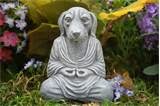
A monk asked Zen master Joshu, "Does a dog have Buddha nature or not?" The Zen master replied, "Moo!" (Japanese mu, negation, "not," "nonbeing").* Betsy went on to explain that this would be like the Archbishop of Los Angeles asking the Italian pope, "Is there a God?" and the pontiff answering, "Hell no!" A paradox, because surely a figurehead like the leader of the Catholic Church believes in his deity, so why would he negate the archbishop's question? Thinking will not arrive at an answer, but there is a way to find out. How does one solve it and, moreover, what would be the point of solving it?
 
*This famous question comes from a fragment of a koan (Case 1, The Gateless Gate). Paradoxically, another koan (Case 18, The Book of Serenity) presents a longer version, in which Joshu answers "yes" in response to the exact same question asked by a different monk.

Noah, did it blow your mind? It did ours, like a rake in a rock garden! (buddhistmedia)

Homer goes to hell for a day (Avici), and Flanders is the devil.
 
How to solve koans
Pick a finger (Gutei)
There is no thinking, grappling, ruminating, or pondering involved. That is surely a dead end. An answer/solution arrived at in this way, if it is good and particularly pithy, will "stink of Zen." The bell will ring, and the interviewer (for dokusan or face-to-face meeting) will yell, "Next!" 
 
Of course, "Next!" is what s/he'll yell even if the Zen practitioner gets it "right." But s/he won't do it with a twinkle in his or her eye acknowledging that you were onto something this time, and it is now appropriate to move on to the next public case.

Instead of "thinking," a koan is successfully resolved by grokking, that is, by a semi-subconscious remembrance of the case without straining to get anywhere in an effort to solve it. Rock/grok it gently like a baby at heart level. In this way, illumination dawns, an epiphany (satori) occurs, and a deep certainty arises that one has understood what the conscious mind could never have hammered out by mere reasoning.

Roshi Jeff Albrizze (PT)
So when Bart Simpson was asked, "What is the sound of one hand clapping?" the answer was not to slap his digits against his palms producing a muted clap. It was, instead, a way of opening the boy up to a world of conscious possibility, an awareness or knowing beyond thought and wit and reason. 
 
"Intuition" is a name for it, but it is very misleading due to the connotations we've layered on. "A knowing that surpasseth all understanding" is a Christian translation for the phenomenon that seems to approximate the wordless experience. "Direct knowledge" unmediated and unencumbered by the thought process might be a New Age way of stating it.

Budai: Fat, Happy Homer "Buddha" Simpson statue (Kidrobot)
 
"Japanese Yosemite" (Kamikōchi), Nagano Prefecture, altitude 4,900 ft. (1,500 m). The kami or kanji 神垣内 of Kami-ko-uchi are the shapeshifting mountain monsters of Japan. This water soaked site resembles the flooding Yokoji ZMC near Idylwild, California, experienced after a wildfire annihilated the earth-retaining forest all around the center.
  
Dharma talk: Zen Mountain Center to rebuild?
Fire dragon of flames (privet.ru)
Abbot Tenshin, Yokoji Zen Mountain Center (ZMC): Tenshin's "Dharma" talk was brief and to the point: There was a fire, but a fire crew made up of convicts/volunteer firefighters, who had learned to meditate at Yokoji, refused to give up when ordered to abandon ZMC by the fire department.
 
Their heroic efforts saved the Yokoji. Proving there's no such thing as karma, or that there is such a thing as karma, but that it rarely -- as happened here -- turns around to benefit one so clearly and tangibly.
 
However, karma works in mysterious ways: What fire could not do, Nature obliged the rains to take care of: Five days of California monsoon weather (due, we think, to climate chaos and our deteriorating environment) washed down tons of muddy debris on ZMC, covering most of the site under three feet of silt and ashes. Maybe it will be dug out, maybe it won't. Trees' lives hang in the balance.

Tenshin Fletcher (zmc.org)
Although the trees are all hearty redwoods, they cannot bear to have their trunks sunk underground. Donations of time, effort, and funds would help, but Tenshin is reluctant to say so. For the one thing he has learned through all of these ordeals is that he and his family will survive. Life may be full of ups and downs, but we can remain relatively steady in the ebb and flow, wave and trough, high and low. Abbot Tenshin Fletcher -- who received helpful advice from Tassajara in Big Sur (San Francisco Zen Center), which famously survived a California forest fire -- previously lived and worked at ZCLA years ago and has remained a vibrant Dharma friend of the current ZCLA Abbess Wendy Nakao and many of the center's older and disproportionately Jewish-Buddhist (JuBu) residents.

Friday, 8 November 2013

Study when practicing (Bhikkhu Bodhi)

American monk Bhikkhu Bodhi (bodhimonastery.org), making "The Case for Study" (Buddhist Publication Society) edited for Wisdom Quarterly (Access to Insight) by Dhr. Seven
The Buddha, Gandhara, ancient Indo-Greco Afghanistan (Boonlieng Wongchaowart/flickr)
 
Wisdom: leaf from the Bodhi tree
The recent upsurge of interest in Buddhism, both East and West, has been marked by a vigorous practical orientation. There is a drive to discover the peace and freedom to which the practice of Dharma (Pali, Dhamma) leads.
 
This zeal for practice, however, has often been accompanied by another trait -- the tendency to neglect or even belittle the methodical study of the historical Buddha's teachings. This is not likely to be fruitful.

Arguments are offered in defense of this anti-study attitude; they have already become familiar currency among us, for example:
  • Study is concerned with "words and concepts," not with realities.
  • It leads only to learning, not to wisdom.
  • It can change our ideas but fails to touch us at deeper levels. 
To clinch the case, the testimony of the Buddha himself is sometimes enlisted. The Kalama Sutra is misunderstood and misquoted. His famous remarks that to learn much without practicing much is like counting the cows of others or like carrying a raft on one's head instead of using it to cross over to the further shore (nirvana).
 
This contention, to be sure, has its aspect of truth. But it also suffers from a one-sided emphasis that may actually thwart rather than aid our progress on the Buddhist path.

It is certainly true that learning without practice is fruitless. But the other side of the issue should also be considered. Should a person gather cows if s/he knows nothing about how to take care of them? Should one try to cross a rough and dangerous body of water without knowing how to operate a raft?
 
Past buddhas revealed by the Budda, Theravada art, ancient Thailand (Trianons/flickr.com)
 
The Buddha insisted that followers learn and transmit the Dharma -- both in the letter and the spirit.
 
Rather than appealing to traditional formulations and facile quotes, let us inquire ourselves into the value and function of Dharma-study.
 
The point at issue, it must be stressed, is not study as an academic discipline or the accumulation of a wealth of learning. It is, instead, about the acquisition of a sound and solid working knowledge of basic Buddhist doctrines.
 
To see why this is essential, we must recall that the entire practice of the proper Buddhist path develops out of the act through which we enter the path -- the going for [guidance] to the Triple Gem [Budddha, Dharma, and Sangha].

If we have taken this step honestly, with correct motivation, it implies that we have acknowledged our need for spiritual guidance and have entrusted ourselves to the Buddha as our guide and to this teaching as our vehicle of guidance [and to those who have successfully completed the path, the Noble Sangha or "Community of Enlightened" individuals, both lay and monastic].

By taking [guidance from] the Dharma, we accept not merely a technique of meditation that we can use at liberty for our own self-appointed purposes, but a profound and comprehensive teaching on the true nature of the human condition. This is a teaching designed to awaken in us a direct perception of  Truth as the means for reaching the full and final end of suffering (nirvana).
 
In the Buddha's Words
The liberation offered by the Dharma comes, not from simply practicing meditation in the context of our own preconceptions and desires, but from practicing upon the groundwork of the right understanding and optimal intentions communicated to us by the Buddha.
 
This cognitive character of the Buddhist path elevates doctrinal study and intellectual inquiry to a position of great importance.
 
Though the knowledge that frees the mind/heart from bondage emerges only from intuitive insight and not from a collection of doctrinal facts, genuine insight always develops on the basis of a preliminary conceptual grasp of the basic principles essential to right understanding. In the absence of it, growth will inevitably be obstructed.

The study (suta) and systematic reflection (anussati) through which we arrive at this preliminary and preparatory right view necessarily involve concepts and ideas.
 
Before we hasten to dismiss Dharma-study as being, therefore, only a worthless tangle of words, let us consider that concepts and ideas are our indispensable tools of understanding and communication.
 
Concepts can be valid or invalid tools of understanding; ideas can be fruitful or useless, capable of bringing immense benefit or of entailing enormous harm. (Few things are worse than grasping Buddhism correctly, which is likened to taking hold of a snake by the tail rather than the neck. Grabbing it by the tail is easy, but then it reaches back to bite and destroy one; taking it by the neck is difficult but safe. Then something useful, like the basis of an antidote to snakebites, can be extracted).

The object of studying the Dharma as part of our spiritual quest is to learn to comprehend our experience correctly, so that we become able to distinguish:
  • the valid from the invalid,
  • the true from the misleading,
  • the wholesome from the unwholesome.
It is only by making a thorough and careful investigation that we will be in a position to reject what is detrimental to our growth and to apply ourselves with confidence (verifiable-faith) to cultivating what is beneficial.

Without this preliminary conceptual clarification, without having succeeded in rectifying our views, there can indeed be an earnest attempt to practice Buddhist meditation techniques. But there will not be the practice of meditation pertaining to the integral Noble Eightfold Path (which begins and ends with "right view," the first being preliminary and conceptual, the second being ultimate and the result of direct experience).

And while such free-based meditation may bring its practitioners mundane benefits like greater calm, heightened awareness, and pleasant equanimity, lacking the guidance of right view and the driving power of right motivation, it is questionable whether practice can ever lead to the penetrative realization of the Dharma, to its final goal, the end of ignorance about the Four Noble Truths and therefore the complete cessation of suffering (nirvana).
 
Bhikkhu Bodhi (dannyfischer.org)
It is difficult to give a single word of counsel on the subject of study applicable to ALL followers of the Dharma. Needs and interests vary so greatly from one person to another that each will have to strike a personal balance between study and practice that suits one's own disposition.
 
But without hesitation it can be said that ALL who earnestly endeavor to live by the Buddha's teaching will find their practice strengthened by methodically studying the Dharma!

Such an undertaking, of course, will not be easy. However, it is just through facing and surmounting the challenges we meet in life that our understanding will ripen and mature in liberating wisdom.

KOAN: One Finger Zen

Dhr. Seven, Roshi Jeff Albrizze (PasaDharma.org), CC Liu, Wisdom Quarterly, The Book of Equanimity, Case 84 "Gutei's One Finger"; The Gateless Gate (Mumonkan)
Alt pop idol Avril Lavigne, following Zen Master Gutei's example but misunderstanding which digit he used, points out the path: middle finger, middle way.

 
PREFACE TO THE ASSEMBLY
Zen zero (Stanoin/etsy.com)
One hearing, a thousand awakenings;
One understanding, a thousand [results].
A superior person with one realization takes care of everything.
Mediocre and inferior persons, though they hear a great deal, mostly don't have faith.
Let's try to show the most accurate, simple point and see.

MAIN CASE
Attention!
Great Zen Master Gutei, whenever he was questioned, simply raised one finger.

APPRECIATORY VERSE
Eminem's Lose Yourself is Buddhist?
Old Gutei's fingertip Zen.
For thirty years, inexhaustible
Truly a person of the Way has limitless stratagems,
But common people can't see it in front of them.
What is gained is so utterly simple,
Yet expedients become endless in number.
Thousands of lands and seas swallowed up by a hair-tip.
Boundless dragons falling into whose hands?
Ninko's holding the fishing pole is appreciated.
I, too, raise one finger and say, "See?"
 
Tenryū-ji (天龍寺) is the head temple of the Tenryū branch of Rinzai Zen Buddhism in Kyoto, Japan, founded by Ashikaga Takauji in 1339 to venerate the Buddha Gautama. More
 
Which finger?
Nyogen Senzaki and Paul Reps (trans.), Mumonkan, "Gutei's Finger"
Juzhi Yizhi (Gutei)
Gutei raised his finger whenever he was asked a question about Zen. A boy attendant began to imitate him in this way. When anyone asked the boy what his master had preached about, the boy would raise his finger.

Gutei heard about the boy's mischief. He seized him and cut off his finger. The boy cried and ran away. Gutei called out and stopped him. When the boy turned his head, Gutei raised up his own finger. In that instant the boy was "enlightened."

When Gutei was about to pass from this world, he gathered his monks around him. "I attained my finger-Zen," he said, "from my teacher Tenryū, and in my whole life I could not exhaust it." Then he passed away. 

Mumon's comment: Enlightenment, which Gutei and the boy attained, has nothing to do with a finger. If anyone clings to a finger, Tenryū will be so disappointed that he will annihilate Gutei, the boy, and the clinger all together.
Gutei cheapens the teaching of Tenryū,
Emancipating the boy with a knife.
Compared to the Chinese god who pushed aside a mountain with one hand,
Old Gutei is a poor imitator.
It is due to this story that Gutei has commonly become known as Gutei Isshi, meaning "Gutei One-finger."

Fall Zen Retreat with Brad Warner
Author Brad Warner (There is No God and He is Always With You, Hardcore Zen, etc.), an ordained Zen monk and former punk rock musician, will lead a three-day intensive at the Mount Baldy Zen Center in the forest above Los Angeles Nov. 8-10, 2013. Includes zazen (sitting meditation), dokusan (interviews), chanting, hiking. Also yoga with Nina Snow ($350). See videos