Showing posts with label buddhist heavens. Show all posts

Tuesday, 25 February 2014

Lost Civilizations: Cambodia, Egypt, Mexico...

(Cambodia Channel) "In Search of the Lost Civilization" by Graham Hancock (3 episodes)


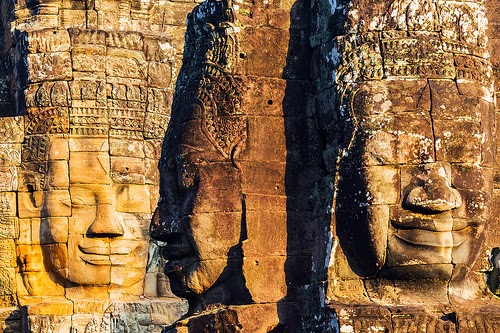
Khmer, Bayon temple, Angkor Wat (PKP)
"In Search of the Lost Civilization" with Graham Hancock features Cambodia's magnificent Angkor Wat Hindu then Buddhist temple complex, the center of an advanced jungle civilization of 1 million urban and suburban residents and a great Southeast Asian empire. It is compared to the untold treasures of dynastic Egypt, megalithic Mexico, underwater Japan, the Nazca Desert of Peru, Easter Island, Micronesia, and elsewhere.

What are the connection between Angkor Wat in the Cambodian jungle (formerly the seat of the great Khmer Empire), pyramids in the Egyptian desert, and stone monuments on Easter Island and in Micronesia?


Scanning Angkor Wat sites (livescience)

What is the underwater mystery of the stone complex in Japan? The last time it was above water was 10,000 years ago.
 
Our ancestors were certainly highly intelligent beings with technology excelling our own today. For thousands of years ago they precisely predicted a solar eclipse over Mexico that arrived in 1991.
Egypt destroyed by Aegean Sea Peoples
In this set of video recordings, writer Graham Hancock traverses the world and explains his controversial theory that an ancient civilization of highly intelligent people sailed or traversed the planet as early as 10,500 B.C. They spread advanced astronomical knowledge and built precise ancient observatories.
 
Angkor Thom, Cambodia (Dibattista)
Skeptics may scoff, but Hancock points out similarities in giant stone structures in the Egyptian desert and Cambodian jungle, and on Easter Island and in Micronesia. He points out evidence of an ancient society of seafarers. His proposals seem utterly bizarre at first, but he presents them in an understated way making use of clever computer graphics and aerial photography to illustrate the startling similarities in ancient structures found from the North Atlantic to the South Pacific.

Cambodian Theravada Buddhist monks in front of Angkor Temple, central shrine and pool


http://www.rainforestmedicine.net/
Tour Vedic and Buddhist India with Graham Hancock in 2014
http://infinite-connections.co.uk/july-2014-ireland-england-tour/

Tuesday, 5 November 2013

"Thor: Dark World" (Sakka, King of the Devas)

Dhr. Seven, Amber Larson,  CC Liu, Wisdom Quarterly; Wikipedia edit of Sakra
(MMDE) Chris Hemsworth, Tom Hiddleston, Natalie Portman, Kat Dennings, Zachary Levi, Anthony Hopkins, Jaimie Alexander, directed by Alan Taylor (Marvel, Nordic mythology), 2013.
The Buddha surrounded by space beings from akasha deva loka, Wat Bua Kwan, Thailand (WQ)
     
Sakka ousts Vepacitti told as Michael and titan/drag
Sakka (Śakra, शक्र) is the ruler of The World of the Thirty-Three according to Buddhist cosmology. His full title is Śakro devānām indraḥ (शक्रो देवानं इन्द्रः; Sakko devānaṃ indo), "Śakra, Lord of the Devas." 
 
In Buddhist texts, Sakka is the proper name, not an epithet of this shining one; conversely, Indra in Sanskrit and Inda in Pali are sometimes used as an epithet for Sakka as "lord (of lords)" or "king (of kings)," or "ruler (raja)." Nevertheless, his position as ruler is considered a station; therefore, there are many "Sakkas," at least one in each world-system, which may refer to a solar system, galaxy, or bubble-like cluster of space.
 
In East Asian traditions, Sakka is known as Dìshìtiān (帝釋天) or Shìtí Huányīn (釋提桓因) in Chinese and as Taishakuten (帝釈天) in Japan. In China, Sakka is sometimes compared to or conflated with Taoism's Jade Emperor (Yùhuáng Dàdì, 玉皇大帝 often simplified in Yùhuáng, 玉皇). Both share a birthday on the ninth day of the first lunar month of the Chinese calendar (usually in February).
 
What is a "Sakka"?
Deva, "shining one," like Sakka
The Sanskrit sakra, "powerful," as an epithet of Indra, is found in several Vedic verses from the ancient sacred Indian text, the Rigveda. Sakka seems to be the root source for the Nordic myth of the Nordic space alien (and Marvel Comic hero) "Thor" casting out his evil brother (Loki) and St. Michael casting out that infamous rebellious "being of light" Lucifer (later conflated with the devil, Satan, Belzebub, etc.)
  
In Buddhist lore, Sakka "cast out" one of the titan (asuras) chiefs, Vepacitti (which some might conflate with Mara Devaputra or as someone under Mara's control). There is in the story the additional complication of Sakka being married to Vepacitti's daughter, the titan princess Sujā.

Karma works (itself out) in mysterious ways.
Such are the startling entanglements of karma, because it is not that "God works in mysterious ways" so much as "karma works itself out in mysteriously incomprehensible ways." Both expressions are saying the exact same thing, the former with a personified character of all-encompassing "law" or regularity in the universe, the latter free of a personal agent controlling a natural and predictable (albeit bafflingly complex) pattern.

These parallel "myths" -- actual events attested to by the ancients -- are no coincidence, but are either remembrances colored by cultures of actual events or stories deriving from the wisdom of the East -- ancient Vedic and Buddhist cosmologies, particularly as inherited by ancient Greece when the great empire extended into ancient Northwest India (Bactria, Sogdiana, and the various Alexandrias like Kandahar, Afghanistan).
 
In Buddhist texts, Sakka's myth and character are different from those of the Vedic Indra. According to G.P. Malalasekara (Dictionary of Pali Proper Names), "Sakka and Indra are independent conceptions. None of the personal characteristics of Sakka resemble those of Indra. Some epithets are identical but are evidently borrowed, though they are differently explained."

 
Great Brahma/Odin creating the world
The World of the Thirty-Three that Sakka rules is located on the top of Mt. Sumeru (cf. Meru, a kind of Mt. Olympus, abode of the Greek gods), imagined to be the polar axis of the physical world extending through space, around which the Sun and Moon revolve. 

The World of the Thirty-Three is the highest of the celestial planes in direct contact with Earth. Like the other devas of this world, Sakka is long-lived but mortal. When one Sakka dies, the position or station is taken by another deva who becomes the new Sakka. It is a position in addition to being that being's name, as is the case with many Buddhist figures including the Buddha, with it cyclical conception of history and staggering view of time.
 
Buddhist stories about Sakka (past and present, in the past having been named Maghavā from Macala, an echo of "Michael") are found in the "Birth Tales" (Jātakas) as well as in sutras, particularly those preserved as part of the collection known as the Connected Discourses (Saṃyutta Nikāya or "Kindred Sayings").
 
If the glorious devas or "shining ones" were so different from the angry asuras or "titans" (often referred to as "demons" for their warlike ways), how is it that Sakka could be married to Suja, the daughter of his chief rival, Vepacitti (Sanskrit, Vemacitrin), one of the titan kings? 
 
Many long-lived "gods" have come down from space to be worshipped by mortals (Hilti)
 
The strange workings of karma, which connects beings as much by attraction as aversion -- love like hate being very sticky -- seems to be the ironic explanation.
 
But despite this intimate relationship, a state of war generally exists between the many inhabitants of the World of the Thirty-Three [lords or ruling devas] under Sakka and the titans, who formerly peacefully co-inhabited this celestial plane. Sakka, newly reborn into the position of "lord of the 33 lords" and "king of kings" (ruler of the immediately subordinate sky/space world of the Four Great Kings (Catu Maha Rajikas), ousted by Vepacitti and the titans after getting them drunk on "heavenly" beer or brew (sura). 

This is the legend of how they came to be called a-suras. They were cast onto Earth and, realizing that they had been duped, swore off drinking beer. Sakka thereby managed this ousting feat and has resolved subsequent "wars in heaven" with minimal violence and no loss of life. For Sakka is reputedly and unambiguously the world-system's most famous stream-enterers, having gained the first stage of enlightenment by hearing the Dharma from the Buddha.

Sakka is thus doubly splendid in being partly enlightened and ruling, partying (at the many balls, cotillions, feasts, and get togethers among the devas of the Sensual Sphere or kama loka, a sphere which includes our human plane, as exemplified by a sutra that recounts a visit to such a party in a large mansion/vimana/ship by Ven. Maha Moggallana, who shook it with his toe by a magical feat to bring the devas out of their careless diversions and sensual distractions). 
 
How could Sakka be in any way "enlightened" in the lineage of the "noble ones" (ariya)? Liberating insight that uproots some defilements and weakens others makes it so, even if one does not then immediately start behaving like a stereotypical "saint" or in anyway seem different to the casual observer. This is evident from verses in praise of stream entry in the "Jewel Sutra" or "Gem Discourse" (Ratana Sutta). The Three Jewels, or "Triple Gem," are the Buddha, Dharma, and enlightened Sangha -- the Teacher, the Teaching, and the successfully Taught.

Those who clearly comprehend the Noble Truths
Well taught by him of wisdom deep
Although they may be very neglectful,
They can never undergo an eighth birth.
Truly, in the [Noble] Sangha is found this precious jewel.
By this truth, may there be happiness.

For one after the acquisition of insight
Three things are immediately abandoned:
Self-illusion, doubt [about the Path or the Buddha], 
And clinging to useless rites and rituals
[as a means of gaining enlightenment]
Whatever they may be.
From the four states of [subhuman] misery,
One is absolutely freed
And is now incapable of committing six heinous deeds.
Truly, in the [Noble Community] is found this precious jewel.
By this truth, may there be happiness.

Whatever unskillful actions one does --
Whether by body, speech, or mind,
One is incapable of hiding it.
For it has been said that such an act [of concealment] is
Impossible for one who has seen the Path.
Truly, in the [Noble Community] is found this precious jewel.
By this truth, may there be happiness.
  
The Buddha in space visiting his former mother reborn in the World of the Thirty-Three
 
In fact, regardless of how one behaves after partly awakening to the Truth, however negligent, one has delimited rebirth to no more than seven more lives and can never be reborn onto any plane lower than the worlds comprising the "human plane" (manussa). Sakka accomplished this breakthrough while he was a deva king with great longevity and many sensual distractions, yet we often find ourselves to distracted with sensual pursuits and worries.

Sakka at one time frequently interacted with the Earth, visiting and questioning the Buddha, and is said to still protect and keep an eye on the progress in virtue of the Earth's inhabitants through his regents, the Four Great Kings.
 
Enlightened and humble (CB)
Sakka is mentioned in many Buddhist discourses. He is often shown consulting with the Buddha on questions of proper conduct, virtue, ethics, and morality (sila) -- behavior that leads beings to fortunate rebirths on Earth and in superior celestial worlds like his and higher. (The Bodhisatta, who eventually became the Buddha, was many times reborn as a Sakka).
 
An entire discourse explains what karma led to Sakka's very fortunate rebirth, and we are all capable of it, given our "divine nature," given our ability to be reborn as a deva (called a devaputra, "son of god," when deva is loosely translated as "god" in the ancient Greek, Roman, and Indian sense of the word).  Together with Brahmā -- a mythical god like Thor's father, Odin, or Cronus (father of the "king of the gods" Zeus)  -- Sakka is considered a Dharmapala or protector of the Buddhist Dharma. More

King Nemi-raja, ruler of Mithila, would make merit and teach Dharma to his subjects so that whenever one of them passed away, they would go onto a better rebirth. His reputation spread across the three spheres, and when it reached the devas, they were keen to meet him. Sakka got his vimana-charioteer, Matali, to take his ship to pick up the king. In Sakka's mansion, the king was invited to live there but declined and returned to the human world to do more good (Nemiraja Jataka, watnavaram.org).

"Heaven" or sky means space (video)


(Mike Gallis) An animation was rendered using the measured redshift of all 10,000 galaxies in the Hubble Ultra Deep Field image. A short script leads viewers through a quick history of both deep field images and this video. It ends with a fly-through of the Ultra Deep Field, where every galaxy in the image is in its proper distance as viewed from the telescope's line of sight. Hubble cosmological redshift animation courtesy of hubblesite.org.


National Geographic presents the first accurate non-stop voyage from Earth to the edge of the universe using a single, unbroken shot through the use of spectacular CGI (computer-generated imagery) technology. Building on images taken from the Hubble telescope, "Journey to the Edge of the Universe" explores the science and history behind the distant celestial bodies or "heavens" in the solar system.

This spectacular and epic voyage across the cosmos takes us from the Earth past the Moon, neighboring planets, out of our solar system, to the nearest stars, nebulae, galaxies, and beyond -- right to the edge of the universe itself.

With the unbroken shot we are able to explore what we would find if we were able to travel the entire length of the universe. Venturing past Neil Armstrong's footsteps still sealed on the Moon, the special soars over brightly illuminated Venus onto Mercury, a small planet said to be made almost entirely of iron, which may perhaps be the remnants of a much larger planet.
 
Mars is a planet of extremes with tornadoes, volcanoes, and canyons unlike anything seen on Earth. Jupiter's ever-present red storm is three times the size of Earth and has lasted for centuries. Reaching Saturn's moon Titan, we find a landscape closely resembling Earth. But Titan's rivers, lakes, and oceans are not made of water; they are liquid methane. Could life exist here?

Travelling more than 90 trillion kilometers from Earth, viewers step inside the Epsilon Eridani star system, where spectacular rings of dust and ice resemble the formation of our solar system 4.5 billion years ago.
 
Even further out is star Gliese 581, about the same age as our sun with a planet that is just the right distance to possibly support familiar life. Passing the Pillars of Creation, viewers see deep inside these clouds where huge stars are being birthed, bringing light and life to the universe.

Thursday, 31 October 2013

Halloween: Is there a "devil' or a "God"?

Dhr. Seven, Maya, Pat Macpherson, Amber Larson Wisdom Quarterly HALLOWEEN SERIES
Is the Devil "Death" (Mara) personified? (Patrick Woodroffe/skeptically.org)
Why do we carve pumpkin jack o' lanterns for Halloween? (merinews.com)
  
Does Wisdom Quarterly believe in the Christian "devil"? 
Sakka (St. Michael) conquers the titan Vepacitti
No, not as such. Just as we do not believe in a "God" as Christians say. But there is something, and we think that would surprise most readers.
 
There is little reason to believe in an "all evil" entity motivating unwholesome karma. This would take away the agency of individuals, of ordinary beings to engage in unskillful conduct on their own. By ourselves is "good" and "evil" done or left undone. We often cite the quote, "No one saves us but ourselves; no one can and no one may; we ourselves must walk the path; buddhas only point the way." 
 
The devil "made" me do it
"Simpsons Bloody Simpsons" with evil Moe Sizlak, Homer, and famous bar patron
 
There are supernatural agencies. There is the famous case of Maha Moggallana recounting a discussion with Mara Namuci ("the Evil One," the onerous tempter figure who tried to dissuade Siddhartha from liberation during his time under the Bodhi tree and constantly harassed him to stop teaching).

In that sutra (MN 50), a previous mara, Mara Dusi (or Mara "the Corrupter"), incites Brahmins to unduly rebuke enlightened Buddhist monastics then later incites other Brahmins to unduly praise them, each time in the hopes of revealing a defilement Mara Dusi might exploit, each time unsuccessful, but each time leading to heavy karmic results for the Brahmins involved: The first are mostly reborn in miserable destinations, the second are mostly reborn in desirable destinations. How could this be if it were Mara Dusi's karma, not the Brahmin's intentional deeds?
 
Happy what? - Grumpy Cat (Huffington Post)
 The Commentary goes to great lengths to explain how; it was, in fact, both Mara Dusi's and the Brahmin's doings: Mara Dusi did not "make" them do what they did. He merely filled their heads with blameworthy or praiseworthy visions of the monastics through his supernatural power to influence their minds.
 
They reacted in a predictable manner as he hoped they would. Seeing visions of hypocrisy, for example, they reviled and cursed the arhat monastics. Mara Dusi met with his karmic results, a dreadful rebirth in Avici, the "waveless" or "unrelenting" infernal waste, a hell of the most horrific torments. The Brahmins went on to meet with their just deserts, which may not sound "fair" to us, but that is mainly because we do not normally realize that the magnitude of our karma does not merely depend on the doer and intention; it also has a great deal to do with the virtue of the recipient. What we do toward enlightened beings -- whether they be stream enterers, once returners, non-returners, arhats -- bears the greatest results.
 
We got power!
Wonder Women and Super Men
We can be affected by others, both seen and unseen beings. The "devil" can sort of make one do something, sort of. Even we have that power: we can discourage or encourage, lead or mislead, help or ruin others. How difficult is it? But to say that we "make" anyone do anything is not quite correct. We inspire or incite. We can do it for good or ill. 
 
God, the judge of all deeds? Or is it karma?
That is not to say that these monolithic polar opposite figures, the devil and God, can take all the credit. We are involved. We are co-creators. We are "GOD" (Brahman, the ALL, not to be confused with a personal Brahma), just as Jesus (both the mythical Christ and the historical Jewish radical from Nazareth who bears the mantle of so many Church legends and popular misconceptions) is reputed to have said. We have the potential for "divinity" -- to be reborn as devas ("shining ones," light beings, celestial citizens in superior albeit impermanent space worlds, and even in rarefied immaterial planes of existence, all of which are referred to as "heavens" (sagga). 
  
"Teacher of gods and humans," the Buddha, Himalayas (Michael Foley/blog.dwbuk.org)
 
Buddhist jack o lantern (Tracy Lee/flickr)
As humans we can even reach much higher than that -- to the end of all rebirth and suffering. This goes beyond Maha Brahma, other brahmas, as well as sensual-sphere devas, rupa-devas (fine-material-sphere light beings), and arupa-devas (immaterial-sphere beings). We are capable of enlightenment, be it final knowledge in this very life, or stream entry, which ensures that we are reborn here or elsewhere no more than a maximum of seven times. We would never again be susceptible to falling into births in worlds of deprivation lower than the human plane. One might live for millions of years, even for aeons, in superior worlds before final knowledge and complete liberation. That is more than any ordinary deva or brahma, any angel or god, can claim. It is a "change of lineage" (gotrabhu) from mundane to noble.
 
The devil in me
What motivates unskillful behavior? Asavas
We are often agents of good, but WE are the Ahriman, the antithesis, members of "Mara's Army" (subject to asavas or "defilements" of the heart/mind, the taints, the fetters), who could be called the Devil. There are demons, asuras (titans), yakkhas (ogres), narakas (denizens of hell), nagas (reptilians), pretas (spirits, ghosts, general shapeshifting troublemakers).
 
God: angry, sexist, and racist
God (Maha Brahma, YHWH, Allah, the Alpha and the Omega) is not really the "God" adherents think -- an all-good, omniscient, omnipotent, omnipresent  creator or uncaused first cause of everything in the universe. Those beings (yes, there are many gods of all kinds) may claim or believe themselves to be all that, but they are not. It is hyperbole and overestimation, a deceptive and deluded reputation. They can be so grand and glorious that it seems like they are -- dazzling, long lived, judgmental, humble, vengeful, exalted, arrogant, angry, loving, compassionate, beneficent, equanimous...
Sexism, racism, slavery, war, genocide by and for God? (See the Bible's Book of Judges for murder, mayhem, and human suffering ordered by the angry jealous tribal Jewish God. Who follows a character like this? The world much prefers the peaceful son and the Marys.)
 
The many visitors from space who manipulated human DNA to make these physical forms as they are did not thereby create the "being" (gandhabba, atman) reborn in this form on this planet. Various theologies attribute this kind of "creation" to the God of their conception of reality. It is as if something (an eternal soul) came out of nothing (dust and breath, materiality and prana). But "we" have gone on and on -- as have all living beings -- in this cycling samsara (the "continued wandering on") or Wheel of Rebirth and Death.
 
Devils are real
There are "devils," inimical spirits, of all kinds as in China (Greal-Wall-Hikers/flickr)
 
If, then, there is no devil as Christians say, Is there a being like him? Yes, we think so. This belief of ours comes from a shaman mentioned in the anthropological research of Michael J. Harner (The Sound of Rushing Water, 1968):
 
"Many times the Christian missionary had told [the shaman medicine man] Mashu of the devil feared by white men. But since he had never seen the spirit, Mashu remained skeptical. Some time later, after drinking natema [the local variety of ayahuasca], Mashu was confronted by this figure of the "white man's devil." Since that time, Mashu has remained convinced of this spirit's reality."
 
There are many divine goddesses or devis
So we think something exists, some quite scary beings -- devils (maras), serpents/dragons/seamonsters (nagas), demons (yakkhas, asuras), shapeshifters (petas, politicians), avians (garudas), and so on. But one all-inclusive "devil" who is the epitome of evil, the source of everything bad, the defiler of all humankind, who ruined the first Adam and the first Eve? No, these are all oversimplifications based on things that may have actually happened. Early genetic synthetic experiments, a kind of "creationism," led to the Adama, a race of humans, "modern humans" millions of years ago. (See Michael Cremo for the real age of Homo sapien sapiens, modern humans, who are in fact very ancient). This did not happen once, but happens again and again, for samsara is cyclical in staggering stretches of time (kalpas) too big to conceive of. The truth is much stranger than myth and fiction.

"When the dust has settled, and you're born again, maybe as a [Martian], maybe then you'll see that your reality was squashed into banality, was squashed into banality!" - Nick Blinko

"The God-idea"
Ven. Nyanaponika (BPS, BuddhaNet.net, ATI)
Buddhism has sometimes been called an atheistic teaching, either in an approving sense by freethinkers and rationalists or in a derogatory sense by people of theistic persuasion. Only in one way can Buddhism be described as atheistic, namely, in so far as it denies the existence of an eternal, omnipotent God or godhead who is the creator and ordainer of the world.
 
The word "atheism" -- however, like the word "godless" -- frequently carries a number of disparaging overtones or implications, which in no way apply to the Buddha's teaching. Those who use the word "atheism" often associate it with a materialistic doctrine that knows nothing higher than this world of the senses and the slight happiness it can bestow. Buddhism is nothing of that sort. In this respect it agrees with the teachings of other religions... More