Showing posts with label Graham Hancock. Show all posts

Sunday, 10 August 2014

Could I be EVIL? (TED Talks)

This episode, TED speakers uncover surprising realities about violence.
Gunshot to the face or head right through the windshield? (Sascha Burkard/iStockphoto)
 
The Violence Within Us
Violence and brutality are grim realities of life. In one hour, four TED speakers explore the sinister side of our dim human nature -- and ask whether we're all capable of violence.
 
"Pray to the Moon when it's round. Death with you shall then abound..." sings Slayer (from "Hell Awaits"), one of the most popular bands for U.S. militants, along with all things porn, songs serial killers might whistle while engaged in their doings.

(Slayer) See Minute 4:15. Slayer and rap music were PMRC targets

U.S. tanks come equipped with CD players and premium music systems. Why? American soliders like to enjoy some music to kill by. "Driven by the instinct of centuries of horror/ Implanted along the brain of the sickening parasite/ Linked together by one trait/ The hell-filled need to kill, kill, kill, kill, KILL" (Slayer, "At Dawn They Sleep"). But the No. 1 song on the military hit parade is "Bodies" by Drowning Pool: "Let the bodies hit the floor"! What is more "evil" (Pali papa) than industrial-scale killing?

Philip Zimbardo explains his infamous Stanford Prison experiment at a TED conference.
Psychology Prof. Phil Zimbardo on his Stanford Prison Experiment
Jim Fallon's work analyzing the brains of psychopaths lead to a surprising personal discovery.
AUDIO: What does the [brain] of a killer look like? (Jim Fallon)
  
TED Censorship?


(RT, June 2014) Graham Hancock breaks the set on TED CENSORSHIP, Lost Civilizations, and War on Consciousness: Abby Martin interviews author Graham Hancock about the mysteries of ancient civilizations, hidden societies of the past, and censorship by TED Talks and the difficulty of getting new ideas accepted by mainstream archaeologists and historians.
 
The Super Full Moon Tonight
The perigee moon, or supermoon rises over Mount Eden in Auckland, New Zealand on Sunday morning.
Moon over Auckland (TG)
 Supermoon lights up skies around the world – in pictures. The perigee Moon, or Supermoon, rises over Mount Eden in Auckland, New Zealand, on Sunday morning. A dramatic Supermoon is set to accompany this year's Perseid meteor shower, one of the most anticipated events on the skywatcher's calendar. Given a dark, clear sky in a normal year, it is common to see more than 100 of the meteors an hour during the second week in August. But this year the Perseids have a bright shining rival. On Sunday, two days before the meteor shower reaches its peak, the Moon will become full. Coincidentally, it will also have reached the point in its orbit that is closest to the Earth, known as perigee. The Supermoon will be up to 14% bigger and 30% brighter than other full moons during the year. On one level, this is bad news, according to Dr. Bill Cooke from NASA's meteoroid environment office. "Lunar glare wipes out the black, velvety backdrop required to see faint meteors, and sharply reduces counts." More

Wednesday, 26 February 2014

Graham Hancock: amazing discoveries (video)

Graham Hancock (News, Feb. 24, 2014); Pat Macpherson, Wisdom Quarterly

11,000-year-old settlement found under Baltic Sea
Evidence of a Stone Age settlement that may have been swallowed whole by the Baltic Sea has resurfaced near Sweden, revealing a collection of well-preserved artifacts left by nomads some 11,000 years ago.

Dubbed by the local press “Sweden's Atlantis” after the fabled island which, according to the Greek philosopher Plato, sank around 9600 B.C. in the Atlantic Ocean, the newly discovered site was in fact some sort of dump in which nomadic Swedes discarded objects, according to a report by the Swedish daily The Local. More


(Knowledge Center) Sunken Civilizations: Secrets of Underwater Lost Cities Underwater

Grainy digital images presented as evidence of structures constructed on the 400C surface of Mercury
First it was the face on Mars. Then it was the Nazis on the Moon. Now is it buildings on the surface of Mercury? One UFO expert is convinced NASA photos show a city on the red-hot planet’s surface.
 
UFO Sightings Daily author Scott Waring is set to sell more books after revealing what he claims are recently built structures “without breaks or fissures and clean with no dirt of dust blanketing them over time, which tells me…they are occupied.” More

Source of Stonehenge bluestone rocks identified 
Scientists have found the exact source of Stonehenge's smaller bluestones, new research suggests.

The stones' rock composition revealed they come from a nearby outcropping, located about 1.8 miles (3 km) away from the site originally proposed as the source of such rocks nearly a century ago. The discovery of the rock's origin, in turn, could help archaeologists one day unlock the mystery of how the stones got to Stonehenge. More

"Microbial Pompeii": 1,000-year-old plaque preserves bacteria, microscopic particles of food
A "microbial Pompeii" has been discovered, preserved on the teeth of skeletons which are around 1,000 years old. A research team discovered that the ancient human oral cavity carries numerous opportunistic pathogens and that periodontal disease is caused by the same bacteria today as in the past, despite major changes in human diet and hygiene. More

Early Christians in Viking Denmark
Excavations at the Domskirke in Ribe, Denmark, began in 2008, and analysis of the results lend new insight into early Christianity, where this may have been one of the first places in the country where a small enclave of Christians worshipped and died.

Studies have now shown that there may have been Christian Vikings in Ribe around 865 A.D. Denmark officially became a Christian country around the year 965 A.D. when Harald Bluetooth announced his deed on the Jelling stone. More

People who believe HELL are less happy
Fire, brimstone, eternal-seeming suffering -- hell is not a pleasant concept. But research has pointed to the societal benefits of a belief in supernatural punishment, including higher economic growth in developing countries and less crime.

But there are also drawbacks, even in this life. A new study links believing in hell, and perhaps even thinking about it, with lower levels of happiness and satisfaction in life. More

A Guide to Psychoactive Plants in the Bible
Holy Anointing Oil (Leviticus 10:6) - Then took Mary a pound of ointment of spikenard, very costly, and anointed the feet of Jesus, and wiped his feet with her hair: and the house was filled with the odor of the ointment (Exodus 29:7). Then shalt thou take the anointing oil, and pour it upon his head and anoint himMore

After 400 years, mathematicians find new class of solid shapes
The work of the Greek polymath Plato has kept millions of people busy for millennia. A few among them have been mathematicians who have obsessed about Platonic solids, a class of geometric forms that are highly regular and are commonly found in nature. More

Hundreds of tiny satellites could soon deliver free [government-Google spying and] Internet worldwide
Developers say they are less than a year away from deploying prototype satellites that could someday soon broadcast free and universal Internet all over the globe from high in orbit.

The “Outernet” project being bankrolled by the Media Development Investment Fund (MDIF) of New York is currently in the midst of conducting technical assessment of the project. More


Tuesday, 25 February 2014

Lost Civilizations: Cambodia, Egypt, Mexico...

(Cambodia Channel) "In Search of the Lost Civilization" by Graham Hancock (3 episodes)


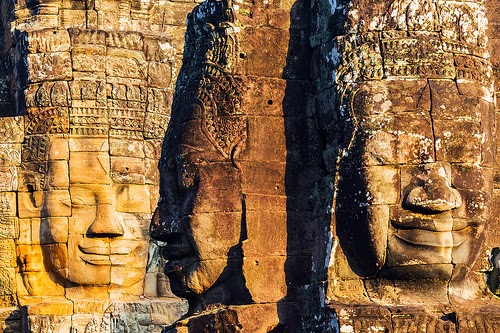
Khmer, Bayon temple, Angkor Wat (PKP)
"In Search of the Lost Civilization" with Graham Hancock features Cambodia's magnificent Angkor Wat Hindu then Buddhist temple complex, the center of an advanced jungle civilization of 1 million urban and suburban residents and a great Southeast Asian empire. It is compared to the untold treasures of dynastic Egypt, megalithic Mexico, underwater Japan, the Nazca Desert of Peru, Easter Island, Micronesia, and elsewhere.

What are the connection between Angkor Wat in the Cambodian jungle (formerly the seat of the great Khmer Empire), pyramids in the Egyptian desert, and stone monuments on Easter Island and in Micronesia?


Scanning Angkor Wat sites (livescience)

What is the underwater mystery of the stone complex in Japan? The last time it was above water was 10,000 years ago.
 
Our ancestors were certainly highly intelligent beings with technology excelling our own today. For thousands of years ago they precisely predicted a solar eclipse over Mexico that arrived in 1991.
Egypt destroyed by Aegean Sea Peoples
In this set of video recordings, writer Graham Hancock traverses the world and explains his controversial theory that an ancient civilization of highly intelligent people sailed or traversed the planet as early as 10,500 B.C. They spread advanced astronomical knowledge and built precise ancient observatories.
 
Angkor Thom, Cambodia (Dibattista)
Skeptics may scoff, but Hancock points out similarities in giant stone structures in the Egyptian desert and Cambodian jungle, and on Easter Island and in Micronesia. He points out evidence of an ancient society of seafarers. His proposals seem utterly bizarre at first, but he presents them in an understated way making use of clever computer graphics and aerial photography to illustrate the startling similarities in ancient structures found from the North Atlantic to the South Pacific.

Cambodian Theravada Buddhist monks in front of Angkor Temple, central shrine and pool


http://www.rainforestmedicine.net/
Tour Vedic and Buddhist India with Graham Hancock in 2014
http://infinite-connections.co.uk/july-2014-ireland-england-tour/