Showing posts with label Vietnamese. Show all posts

Wednesday, 19 February 2014

World's largest cave: Buddhist Vietnam (video)

Vicki Win, Ashley Wells, Wisdom Quarterly; Cindy Hong/NatGeoTV.com; ABS Travel, Asia
Descending into "Eden," a lush and otherworldly cave system, Son Doong (abstravel.asia)


Man on bridge, Mountain River Cave
Buddhist Vietnam's Son Doong or "Mountain River" Cave is part of the Phong Nha-Ke Bang National Park grotto system in Vietnam's central Quang Binh Province. It is the world's largest cave to ever be discovered. Son Doong, which was found by a local more than 20 years ago, is more than 200 meters wide, 150 meters high, and at least 6.5 kilometers long.

(NatGeo) Carsten Peter is a photographer, climber, diver, and caver in some
of the world's most extreme environments like Hang Son Doong cave system.

Rappelling to go spilunking
But explorers say they have been unable to explore it fully. British researchers have recently determined that Son Doong is much larger than the world's biggest known cave.

The biggest section of Son Doong is five kms in length, explains Howard Limbirt of the British Cave Research Association team searching the area April 10-14, 2009. Son Doong is much larger than Deer Cave in Malaysia, currently considered the world's largest, an explorer said. (Deer Cave is only 90 meters wide, 100 meters high, and two kms long). More (ABStravel.asia)
 
Tent camping at the cave entrance for travel deep into Son Doong (abstravel.asia)

Friday, 31 January 2014

Happy Lu New Year 2014! (video)

Editors, Wisdom Quarterly; TetFestival.org ASIAN LUNAR NEW YEAR 2014
(Ttinova) 2014 Lu New Year festivities are exotic and integrating into America
 
Tet parade, Orange County (magnumasi.com)
Each year Americans of Vietnamese descent celebrate the coming lunar year with Tết Nguyên Đán, the most celebrated and significant holiday on the traditional lunar calendar, which also marks the beginning of spring.

The Fung Brothers and Priscilla Liang joke and rap about the 626 (predominantly Asian and Mexican San Gabriel Valley) in suburban L.A. to "Thriftshop" by Macklemore.
  
The Year of the Horse (buddhistedu.org)
The community is proud and honored to present annually the largest Tết Festival in the entire world, attracting over 100,000 patrons from throughout the country and abroad. Visitors are immersed with a vibrant array of traditional foods, live entertainment, festive games, and customs celebrating the new year. This year is the Year of the Horse (Năm Giáp Ngọ).
 
Enter the Horse and exit the Dragon, it's spring and a brand new year!
 
By now the country's largest China town is not in San Francisco or Downtown Los Angeles but in the San Gabriel Valley (area code 626) with its massive mainland Chinese, Mexican, Vietnamese, Taiwanese, Japanese, Thai, Korean, Filipino, Latin American, and Indian communities.

(SoCalUVSA) A recap of 2013 Lu New Year celebrations in Southern California
That Tet Festival was held between Feb. 8-10, the Year of the [NSA] Snake.
 
2014 (latetfest.com)
VNCSC Tet Festival 2014
A three-day festival organized by the Vietnamese Community of Southern California at Garden Grove Park starting January 31st 2014 and running until February 2nd. 
This year there are 11 beautiful contestants each competing for the grand prize of $2,000 and the title of Miss Vietnam San Diego 2014! Come to the festival... 
The 2014 Tet Festival is NOT going to be in Garden Grove this year.
Famous Tet festival heading to Orange County fairgrounds
Organizers of the largest Tet Festival in the U.S. -- an event long linked... Negotiations between the two sides for the 2014 celebration... 
(OCRegister.com) Garden Grove gets new operator for Tet festival 
(TetFest.net) Event: The tenth annual LA Tet Festival 2014

Thursday, 26 December 2013

Buddhism in SWEDEN is growing fast!

Buddhism in SWEDEN

It is evident that Europe is changing very rapidly, economically and socially. Although these changes are widely discussed in the media, there are a few that attract very little attention.
 
The change in demography, in particular the growth of alternative religions, is one notable item. Sweden is no exception.

Due mainly to the arrival of Diasporas and the organic growth of Eastern traditions, such as Buddhism, many domestic people are paying attention. Buddhism is still relatively small in Sweden. But in recent years it has seen tremendous growth. It is trending, and estimates on new Buddhists are on an upward swing.
In April 2011 (the last year for which reliable data are available) it is estimated to have risen to around 35,000 to 40,000 or 0.38-0.43% of the Swedish population, making it the third largest religion after Christianity and Islam.
 
Most practitioners have Asian backgrounds from Thailand, China, and Vietnam. According to official reports in 2011, Buddhism is proportionally the fastest growing religion.

There are now several Buddhist temples in Sweden, including Stockholm (Theravada Thai and Sri Lankan), Borås, Eslöv, Gothenburg, Fredrika, and other parts of Sweden.
 
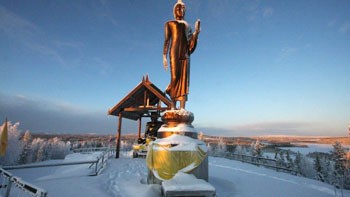
A BNN reader reports that a giant project in the northernmost part of Sweden is underway. It is supposed to be the biggest Buddhist center in Europe. It has now, however, had to scale back its plans to get clearance for its application to build. But once the project is completed, Sweden will have an enormous Buddhist center that can facilitate more followers.
 
Stockholm Buddhist Vihara
 
Stockholm Buddhist Temple
The Stockholm Buddhist Vihara (monastic residence) is a Buddhist temple in the Theravada tradition. Like old centers in Washington D.C., Los Angeles, and elsewhere, it was established by the Sinhalese community to continue an ancient tradition of spreading the Dharma or Dhamma. The center was built in Sweden in 1985 by the Sri Lanka-Sweden Buddhist Association (SIDA) in conjunction with the arrival of the first resident monastic in Stockholm. It is the first ever Buddhist temple formed in Scandinavia, and the members are mostly of Sri Lankan origin.

A Scandinavian home
SIDA came into being in 1983 as a result of the energetic efforts and dedication of ardent Buddhist devotees who gathered in Stockholm during the winter of 1982 to discuss the possibility of forming an association.

Their courage and determination resulted in establishing a temporary organization, which became permanent after a general meeting in March, 1983 at the SIDA Auditorium in Stockholm.
 
Once established in 1985 the Stockholm Buddhist Temple moved to several temporary locations until the monastics and devotees succeeded in acquiring a permanent building for the center in Jakobsberg in 1995.

Thai Temple in Gothenburg
Thai Buddhist Temple in Gothenburg, SwedenIn 2005 Mrs. Eh and her husband Stein donated five hectares in northern Rörum for a temple building. However, lack of municipal water and sanitation would have meant additional costs if it had been built there.
 
So in 2006, Mrs. Eh and her husband found a property, one owned by a Thai/Swedish family, was for sale. They jumped at the opportunity to create a temple in southern Sweden and decided to purchase the property.
 
The temple has been built by Theravada Thai Buddhists and their partners living in southern Sweden. They have received help from the monks of Wat Pa in Copenhagen under the direction of Abbot Phar Kru Somsak.
 
Theravada temple in Skåne Åstorpsvägen
Thera Vada Buddhist temple – Skåne Åstorpsvägen
Buddhism is not a law or set of dogmas. It is a direct path to enlightenment, something to be undertaken and verified for oneself. Since it is not a "religion" in our Western sense, one need not abandon any faith or creed to practice.

It is often spoken of as an Eastern philosophy or a way of life, says the Buddhist monk Bhikkhu Assati. All are welcome here to meditate, not only Buddhists. When the temple at Railway Road 13 in Åstorpsvägen was recently inaugurated, about 100 people attended. Most were Sri Lankan Buddhists from southern Sweden who previously had to travel to Stockholm or Copenhagen, where there are already Buddhist temples.
 
"Some attendees were not Buddhists," says Mr. Nandi Dei Zylva, Chairman of Standing Behind the Temple, a Sri Lankan Buddhist cultural association in Skaane. "My wife, for example, is a Christian."

"We’re neighbors with Björnekulla Church, and the pastor and his family came here," continues Mr. Dei Zylva. "They were very friendly and accommodating and said that our visitors were free to use their parking [lot]."

Buddhism in SWEDENThe temple in Åstorpsvägen was financed by members and is a Sri Lankan Buddhist temple, unlike the Bjuv, which is Vietnamese. Bhikkhu Assati explains the difference:
 
"Buddhism, which originated in Nepal and India, has two branches -- ours called Theravada [Teaching of the Buddha's Elder enlightened disciples] and the Bjuv called Mahayana [Great Vehicle]. Theravada is more conservative than the Mahayana. It is much like the difference between Catholicism and Protestantism."
  • [A more apt comparison might be Sufism to Islam or Judaism to Christianity because both are related but one is a popularization and is ten times larger.]
"Regardless of the difference, we have a good working relationship with the temple in Bjuv," adds Mr. Dei Zylva. "Before we got our own [Theravada] temple, we went there often."
 
The temple’s representatives wish many Åstorpsbors will come to visit and meditate. They welcome all who feel the need to replace their daily stress with a moment of contemplative rest.
 
Buddhism in SWEDEN

In addition to the Bjuv Buddhist temple of Sweden, there is a Vietnamese temple in Katrineholm.

Friday, 8 November 2013

Sitting with Thich Nhat Hanh (2013)

Yogi David Ibrahim (DivineYogaLA.com), CC Liu, Ashley Wells, Wisdom Quarterly, time with Thay, Oct. 20, 2013
Thich Nhat Hanh (R) with peace activist and civil rights leader Dr. Martin Luther King, Jr. when Christians and Buddhists worked together for peace, justice, and an end to racism.
  
Bell rings. "Breathing in, I feel tension; breathing out, I release."

​People are so busy today we do not live anymore. We suffer. But compassion (karuna, active efforts to help others out of friendliness, kindness, love) heals. It can even heal chronic inflammation in the body. 
 
Caretakers must listen to the suffering of many people. If they do not know how to nourish themselves -- to nurture, heal, create joy, and happiness for themselves and those around them -- then there is no source of nourishment to continue. One tires from being touched by other people's suffering, never regenerating their own. We need to produce the energy of compassion, which is an energy like light. We are like plants being energized, like suns brightening worlds. Every breath and every mindful step helps us produce it.
 
​ We all need moments of joy and contented happiness or we will not have enough material to feel compassion. And without nourishing, how can we heal? We may need to learn how to produce that energy daily or risk running out. Compassion is a life force. It is goodness. But we need to learn how to generate it daily to take care of ourselves and by extension others.

We run out of it because we are tired and draining without replenishing. Everyone experience suffering (dukkha, discontent, disappointment, lack of fulfillment, woe), anger, and despair. But most of us do not have time to take care of the pain. Do we have time for the pain? Apparently. We do not have time for self-care, which means we must have time for the pain. We feel it unpleasant to "waste" time caring for ourselves. What are we afraid of?
 
We are afraid of are own pain, that we will be overwhelmed by it. So we run from it, even in thought. We cannot block the pain, so we block the very thought of it. We will not "indulge" in self-care! If we eat, it might not be out of hunger but to stuff or stifle our pain, to cover it up. We have an inner loneliness. 

Reading magazines, gossiping, fascination with celebrity -- this is our entire civilization. We run and run from themselves. They (we) have no time to heal themselves or others. We must run. If we never learn or take the time to heal ourselves, how are we really helping others? Martyrdom, resentment, robotic behavior?
 
"How can I run?" That becomes the real question. What can I immerse myself in? Parenting? Gadgets? Volunteering? Drinking? TV? TV, the ultimate time dump.

American kids use electronics more than eight hours a day. Parents in the US are "busy," always busy, too busy to care about themselves or others. Home and work are falling apart, but workaholism is also a popular distraction. We are overworked, and nearly everyone is undercompensated. Where can we find refuge? Videogames? Weed? Weightwatchers?

We are not immune to toxic conversations -- news of neighbors and faraway strangers, news filled with despair. We take in and take in these toxins. Even an hour is too much, but it's not nearly enough. We fill our brains with toxins until they're overflowing. Suffering grows in us.

How do we handle it? In other words, how do we heal ourselves?

There is no one close to ask, as two people who suffer can hardly communicate. In anger, we block communication. "I can hardly bear to look at you; how am I to speak?!" So what time is there for family, for "us," for anything but me? But I will not even take time for that most precious person, the one I know best, the one I wake up with every single day...me.

But, but, but...
There is a popular belief that happiness is impossible without enough money or social recognition. So in our desire for happiness, we run after objects of our craving. We chase them, hunt them down, and claim we'll do anything to get them. Happiness is not possible. Who has time? We're too busy running, but this time chasing as we run.

We harm body and mind. When is there time to heal, to nurture? Maybe in the hospital, maybe when the body finally says, "No!" Dr. Gabor Mate warned about this well in advance, but what time did we have to listen?

We think money cures insecurity and fear. We live in fear of fear. We are even afraid of the problem itself, which soon becomes stress, the great debilitator and exterminator of happiness.

If only we could learn compassion to make energy! That would protect us far better than money!

The Buddha had a benefactor who was very generous and conscientious. He gave, he supported others (even the poorest, a practice after which he was given the name Anathapindika), he provided for strangers in need and friends. But he went bankrupt. His friends, and he had many, helped him rebuild his fortune. The Buddha helped teach business leaders. Why? We can be happy and successful here and now -- with compassion. We can learn to go home, here and now, learn happiness right here and right now, learn to live happily in the present moment. (There never is any other moment after all. As Thich Nhat Hanh's special watch says where we expect to find numbers to tell us the time, "Right Now").
​ How to balance life and work? If we work until we are sick, we may end up using all our earning to make ourselves well again. We could have done it ourselves, but we like writing checks to Big Pharma and big medical institutions. We must. We do it enough.

Buddhism asks us how we walk from the parking lot to work, which may be say 300 feet (100 meters). We cannot take the car into the office or we surely would: we would drive up to desks or machinery and reach out of the window like we were reaching for extra fries and a sugar-loaded soda.

Do we walk quickly or take our time, living now, mindful of every step? We think and think, and our minds race when we could be focusing on our in breath and out breath, which are only ever happening right now. Come into the present moment. "Be here now" rather than later. Arrive in the here and now. The past is past and gone. The future is future and not here. All nourishment is in the now, the present moment, this moment. It does not pass. It is always now; look at the watch.

Why not live as if this were life rather than a dress rehearsal for life? What if this were life? Can you imagine how silly we would feel to have been putting it off as if life would be lived later, and later, and later, always in the future?

Our appointment with life is the here. It's right now.
 
Touch the wonder of life. What wonder? Walk like a buddha, with the bearing of a healer, with every step. We train ourselves to walk. Who else could train us? Others only advise. Only we can break the habit of running.

Only we can keep the present moment in mind without leaving it behind. Maybe our parents could? Maybe our bosses? Maybe our underlings? Maybe our spouse? Maybe our god, gods, angels, and idols?

Who will train us in the Dharma (the path to liberation)? A book, a teacher, a good friend (kalyana mitta) might advise, but we would have to walk the way. Walk. Don't run.

Walk. Every mindful step is healing. Every mindful step is nourishing...

Monday, 30 September 2013

Mindfulness, Suffering, Engaged Buddhism

Dhr. Seven, Wisdom Quarterly; Thay (Plum Village), Krista Tippett, OnBeing.org, NPR
Mindfulness, Suffering, and Engaged Buddhism
Host Krista Tippett (onbeing.org/CCP)
Vietnamese Zen master, peace activist, and poet Thich Nhat Hanh (Thay, "teacher") was forcibly exiled from his native country more than 40 years ago. On Being (NPR's discussion of faith and existence) visits the Buddhist monk at a Christian conference center in a lakeside setting in rural Wisconsin.
ON TOUR NOW (tnhtour.org)
Thay offers stark, gentle wisdom for living in a world of anger and violence. He discusses the concepts of "engaged Buddhism," "being peace," and "mindfulness." This message gets through to violent, hyper-vigilant police officers eager to kill at a moment's notice. Thay agrees to lead them on a Buddhist mindfulness retreat that manages to change their lives and their capacity to carry guns as "warrior" or "fierce" bodhisattvas (beings bent on enlightenment, not as Tippett defines it already enlightened beings staying on Earth). A person may take vows to become a bodhisattva, which generally means refusing enlightenment and liberation for the presumed sake of helping others. It would make more sense to help oneself and others by striving for enlightenment. But such is Mahayana Buddhist logic that martyrdom has been mistaken for a nobler goal. This historical Buddha was a bodhisattva not forestalling his own enlightenment but for the sake of becoming a supremely enlightened teaching buddha. This meant foregoing attaining as a disciple or as a nonteaching (pacceka) buddha. But it never meant dissuading others from attaining or from striving to reach the goal as quickly as humanly possible, bringing the ten perfections to maturity. More

Thich Nhat Hanh comes to Pasadena, CA on Oct. 4, 2013