Showing posts with label Zen. Show all posts

Friday, 11 July 2014

Obon means ghosts and remembering the dead

Ashley Wells, CC Liu, Wisdom Quarterly; Japanese-city.com; NHBT

I went into the sanctuary and could feel the ancestors around me (rpv-team/flickr).

What is Obon?
Animist, Buddhist, Pagan, and Catholic Mexican-Americans in Los Angeles may have the Day of the Dead (just after all ironic, nominal Christians celebrate Halloween).

But Japanese Buddhist and Shinto practitioners have much the same thing in this month's Obon Festival, which is being celebrated concurrently with the unrelated Lotus Festival and commencement of the annual Rains Retreat just a few miles apart.

Obon is an annual Buddhist event for commemorating one's ancestors. It is believed that each year during Obon, the ancestors' spirits return to this world in order to visit their relatives.
 
Traditionally, lanterns are hung in front of houses to guide the ancestors' spirits, Obon dances (bon odori) are performed, graves are visited, and food offerings are made at house altars and temples
 
At the end of Obon, floating lanterns are put into rivers, lakes and seas in order to guide the spirits back into their world. The customs followed vary strongly from region to region.

Obon is observed from the 13th to the 15th day of the 7th month of the year, which is July according to the solar calendar. However, since the 7th month of the year roughly coincides with August rather than July according to the formerly used lunar calendar, Obon is still observed in mid August in many regions of Japan, while it is observed in mid July in other regions. 
 
The Obon week in mid August is one of Japan's three major holiday seasons, accompanied by intensive domestic and international travel activities and increased accommodation rates. In recent years, travel activity in mid August.
  • Event Location: Nishi Hongwanji Buddhist Temple
  • 815 First Street, Los Angeles, CA 90012
  • Obon Festival + Bon Odori Schedule: http://bit.ly/bLkTf
Japanese Obon Festival and Bon Odori Schedule

    Monday, 30 June 2014

    The Truth About Religion (audio)

    Wisdom Quarterly; the Right Reverend Alan Watts (alanwatts.org)
    "Mirror, mirror on the wall, which truth is the truest of all?"
    The Episcopalian minister turned Zen Buddhist priest Alan Watts blows the lid on the real meaning of religion as it is practiced in the West and East. It is staggering what we have come to in the West looking to the insights of the East for guidance. Watts originally delivered this two part talk under the name "Democracy in the Kingdom." Part 2 will be played on the first Sunday in July at 8:00 am. This one was aired on June 29, 2014 at 8:00 am. AUDIO: PLAY

    Thursday, 26 June 2014

    What is Mahayana Buddhism? (video)

    Amber Larson, Seth Auberon, CC Liu, Wisdom Quarterly; Alan Watts ("Eastern Wisdom and Modern Life," KQED TV, San Francisco); The Partially Examined Life
    Mahayana pantheon of saints surround Catholic-style Kwan Yin (Dlakme/flickr)
    Mahayana monastics of the "northern" school, Far East (Ian's/flickr.com)

    What is the later "Great Vehicle" (Maha-yana) school of Buddhism, and why is it so mixed up with ancient Vedic Brahmanism and modern Hinduism?

    Monday, 23 June 2014

    Buddhism makes it into the White House

    Amber Larson (ed.), Wisdom Quarterly; Danny Fisher; /Zenpeacemakers
    Bring up Tibet and China! The Dalai Lama would have, but he's so nice. (phayul.com)
    Bhikkhu Bodhi and Danny Fisher in Washington, D.C. to visit White House (ZPS)

     
    Danny Fisher's visit to the White House in the historic first Dharmic Religious Leaders' Conference 
    Co-hosted by the White House Office of Public Engagement and White House Office of Faith-Based and Neighborhood Partnerships with Hindu American Seva Charities, the conference brought together a large group of religious and institutional leaders from Buddhist, Hindu, Sikh, and Jain communities to discuss service with various government departments and agencies.

    I gotta go meet with some Buddhists NOW.
    [In 2012] I had an interesting weekend: I was in Washington, D.C., at the White House as a participant in the historic first Dharmic Religious and Faith Leaders Conference: Community Building in the 21st Century with Strengthened Dharmic Faith-Based Infrastructures.
     
    The conference brought together a large group of religious and institutional leaders from Buddhist, Hindu, Sikh, and Jain communities to discuss service with various government departments and agencies. [Did the Conference find signs of the Dharma already at 1600 Pennsylvania Avenue?]

    Michelle's Way [in the White House]: Lessons in Buddhism from the First Lady
    (Huff Post); Pat Macpherson and Crystal Quintero, Wisdom Quarterly
    2009-04-09-0mkids.jpg
    Michelle loves all the children! (HuffingtonPost.com)
    Tonight, for the first time in history, our First Lady will attend a Passover Seder in the White House with her two daughters, as the president honors the Jewish people. For the last week she has been electrifying Europe with her warmth and her fearlessness in showing that she cares. She is adored wherever she goes for one simple reason: She brings hope. The hope that the world can be a caring and compassionate place, and the hope anyone of any color or background can fulfill their dreams.

    [That was 2009, the heady days before the world found out that Michelle's husband, B.S. Obama, was following in the footsteps of Dick Cheney, George Bush II, George Bush I, Donald Rumsfeld, Colin Powell, Condoleezza Rice, John Ashcroft, World Banker Paul Wolfowitz, and other alleged war criminals.]

    It brought tears to our eyes when the children at the school Michelle Obama visited in London jumped up and down and hugged and hugged her, and she hugged them back. We could see in their faces that, because of her, they too felt they had a chance. Her charisma and confidence make others feel comfortable in her presence. Deb, being English, was delighted to finally see someone arm in arm with the Queen!
     
    A generous heart, kind speech, and a life of service and compassion are the things that renew humanity.
    -The Buddha

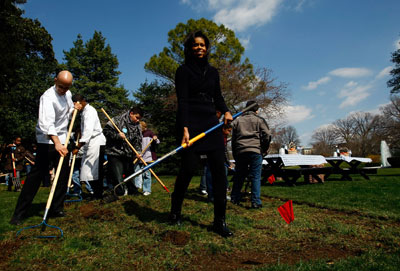
    2009-04-09-0garden.jpg
    Greening the White House lawn (HP)
    When we read this quote we thought the Buddha could have been saying this about Michelle Obama! She is setting an extraordinary example by doing things her own way and being true to herself.
     
    From having bare arms [which is what arms are for, hugging not war], to serving lunch to the homeless [in a planned photo op that serves as an example to us...to get an official photographer to follow us around until we do something nice then send it out with a press release] in a soup kitchen, to planting a vegetable garden [hooray for organic Nature] at the White House, she is making us take a fresh look at the role of the First Lady and at our own prejudices and opinions about what we think is right and wrong [right and left, black and white, implicitly-racist and what is just a function of white-privilege].
     
    A person who gives freely is loved by all. It's hard to understand, but it is in giving that we gain strength. But there is a proper time and a proper way to give, and the person who understands this is strong and wise. By giving with a feeling of reverence for life, envy and anger are banished. A path to happiness is found. Like one who plants a sapling and in due course receives back shade, flowers, and fruit, so the results of giving bring joy. Through continuous acts of kindness the heart is strengthened by compassion and giving.
    - the Buddha
     
    [For more awesome, freely translated "quotes" without citations, echoes of the Universalist Mahayana/Hindu school of Buddhism beloved by many and by disaffected Jewish people in particular, see here.]
    Danny and Dharma in the White House
    Anti-Tar Sands/Keystone XL protest at WH
    Among others, we met with representatives of the Department of Education, Department of State, Department of Homeland Security, and the Office of Faith-Based and Neighborhood Partnerships.

    We also heard from and dialogued with a large group of interesting speakers, including Joshua Stanton, founding co-editor of the Journal of Inter-Religious Dialogueco-director of Religious Freedom USA, and co-editor of O.N. Scripture - The Torah; former U.S Senator Harris Wofford; and Rev. Suzan Johnson Cook, U.S. Ambassador-at-Large for International Religious Freedom.
     
    Overall, I concur...that the gathering was hugely important symbolically: to see Buddhists, Hindus, Sikhs, and Jains gathered together at the White House to spend a day in dialogue with the government about service and community-building felt like a huge step forward in terms of addressing the lack of attention to and representation of Dharmic religious practitioners in Washington.

    The Buddhist Delegation (with White House and Seva Charities representatives), D.C., April 20, 2012. Author is in the back row, second from the left (Phil Rosenberg/SGI-USA).
     
    (In Religion Dispatches in 2009 I talked about the lack of a Buddhist representative on the White House’s Advisory Council on Faith-Based and Neighborhood Partnerships. See article).
     
    The conference agenda [felt] a little overstuffed to me. And things were done in relatively broad strokes. I think we might have benefited more from smaller groups and more precise focus on unique issues in particular communities, with some attention to broader concerns. But it was certainly a great start. And I thought Joshua Stanton did a really nice job of illustrating the effect the conference had on one person outside these communities looking in. See his piece at State of Formation.

    Burmese Democracy Leader, The Lady, Daw Aung San Suu Kyi at White House (AFP)
     
    The Buddhist Delegation (BGR)
    In addition, here is the official press release about the conference, as well as a substantial post at Hindu American Seva Charities’ official blog.
     
    [UPDATE: Ven. Bhikkhu Bodhi, the American Theravada scholar-monk, offers his take at Buddhist Global Relief.] And I have pictures to share at DannyFisher.org.
     
    What a thrill to be in the White House, a joy to see old friends and make new ones, and participate in something so important. Many thanks to the White House Office, Hindu American Seva Charities, and my friend Bill Aiken at Soka Gakkai International-USA. I’m humbled and at your service.

    First-Ever White House Conference of Dharmic Faiths
    Bhikkhu Bodhi (BuddhistGlobalRelief)
    Bhikkhu Bodhi and monks (BGR)
    Until recently conferences on interfaith cooperation in the U.S. have almost always centered on the Abrahamic religions of Judaism, Christianity, and Islam. Yet, over the past 40 years America has become a much more diversified and pluralistic society.

    WH celebrates many Jewish holidays (AP)
    The relaxing of restrictions on immigration, followed by the post-war upheavals in Southeast Asia in the 1970s, has dramatically transformed our population.
     
    Large numbers of Americans now have religious roots that go back, not to the deserts of Judea and Arabia, but to the plains, mountains, and villages of ancient India.
     
    Buddhist flags on Lantau (m.gin/flickr)
    For convenience, these are  grouped together under the designation “the Dharmic faiths.” They include Buddhists, Hindus, Jains, and Sikhs, and their national origins range from Pakistan to Japan, from Burma to Vietnam, and from Mongolia to Sri Lanka. Not all are immigrants. At least one whole generation of people of Asian descent has been born and raised in America and think of themselves principally as Americans following a Dharmic religion. More

    A Zen Master's Guide to the Bible (video)

    Ashley Wells, Amber Larson (eds), Wisdom Quarterly; Clark Strand (spiritualityhealth.com)
    COMING SOON: Wisdom Quarterly investigates the gay raping perverted Bible.

    A Zen Master's Guide to the Bible
    Short intro to world’s first Buddhist Bible study group
    In the fall of 1999, my family and I were traveling aboard a commercial airliner out of Memphis, Tennessee, when the cabin filled with smoke and the plane suddenly plunged.
     
    In popular cinema, the flight crew are all over such moments -- stowing trays, returning seats to upright positions, making announcements designed to get your attention but not cause undue alarm.
     
    In real life, they’re nowhere to be found. It’s easy to follow a manual when the plane seems to be winning its battle against gravity. When it loses, suddenly the term “safety belt” is exposed for the lie it always was. At that moment, you feel it all at once -- I suspect everyone feels it. That’s when you start to pray.

    Zen-Daddy, are we going to die?
    As it turned out, that was also when my 6-year-old daughter, Sophie, reached across the aisle to hold my hand. “Daddy, are we going to die?” she asked. I’d forgotten that young children pray to their parents in such moments. Not knowing what to say, I closed my eyes, took a deep breath, and asked the same question myself, listening to see if anyone would reply. And, indeed, I did hear a voice.
     
    Speaking in a whisper, with imperturbable calmness, it said four simple words directly into my ear.

    “I don’t think so.”

    I'm a Black Middle Easterner in the Bible.
    Bizarre as those words were, coming from the one being in all the universe who ought to have been able to answer that question with a yes or a no, they calmed me down a bit, and I actually was able to relax. So I repeated them to my daughter, who passed them along to my wife, Perdita, who reached over to hold hands with my son, Jonah, who, like his biblical namesake who slumbered at the bottom of the storm-tossed boat, remained blissfully asleep throughout the whole ordeal. And 10 minutes later, we were safely on the ground.

    “I don’t think so” wasn’t an answer you’d have gotten from the God I grew up with down South -- the one with an opinion on everything political and a punishment for every liberal act. That God was certain about everything, especially when it came to homosexuals, feminists, Hindus, and the Jews. He’d have killed a planeload of ordinary sinners to get one certified Christ-killer, or saved us all to his greater glory on a whim.

    I’d run as far away from that God as I could get, which turned out to be a Buddhist monastery, and even that sometimes felt too close. But a God who admitted calmly -- serenely, even -- that he didn’t know for certain whether my family and I were going to die? That was another matter entirely. [We felt the same experience watching the cartoon God of Marjane Satrapi's "Persepolis" and the man God of Alanis Morrisette's line in All I Really Want: "I am humbled by his humble nature."]

    (History Channel) This is some of the literature cut out of the Bible like it never existed. Was it God's first draft, or did men know better [than the seers and composers of the very ancient Sumerian, Egyptian, Babylonian, Phoenician, and Bedouin texts, myths, and histories that became the Hebrew/Jewish and Christian Bible]?

    "When Jesus was a boy, did he kill another child? Was Mary Magdalene a prostitute -- or an apostle? Did Cain [and Lot] commit incest? Will there be an apocalypse, or is this [a] trick to scare us? The answers to these questions aren't found in the Bible as we know it, but they exist in scriptures banned when powerful leaders deemed them unacceptable for reasons both political and religions. BANNED FROM THE BIBLE reveals some of these [back stories and explanations] and examines why they were "too hot for Christianity [to handle]."

    It gave me the feeling that we would be taken care of either way -- that, in fact, we couldn’t lose as long as we surrendered [gave up, let go, islam, accept what is] fully to whatever came next. If God could relax enough to stay open to what the next moment would bring -- whether it brought a soft touchdown or a fireball of shrapnel -- then, God willing, so could I.

    Meeting the God of My Understanding
    Young bodhisattvas Jay and Sid (Mr_Walker/flickr)
    That was my first experience of what the 12-step recovery movement calls “the God of my understanding.” That God wasn’t interested in theology and had a hard time telling Jains [vegetarian Indian pacifists from a teaching slightly older than Buddhism] from Jehovah’s Witnesses or jihadis [jihad= "struggle with oneself"] from Jews.

    But he came when you called him -- even if he sometimes turned out to be a “she” or an “it,” and was so indefinable that, in most cases, you just gave up and let the matter slide. In relationship with that God, the emphasis was on realizing your dependence upon a power beyond the self.

    Whether that power manifested in the laws of physics or in random acts of kindness mattered little, as long as you were willing to ask for help and wait for guidance, even if the help wasn’t always what you expected or the guidance turned out to be, “Relax and trust. And stay open to whatever happens next.”

    Religion and Math are terrible things (Calvin & Hobbes).
    That was a revelation that had eluded me for more than 20 years of Zen practice. By the time I found myself on that plane out of Memphis, I’d been a Buddhist monk, a senior editor for the largest Buddhist magazine in America, and a meditation teacher for more than a decade. But I still hadn’t learned how to live fully in the moment.

    The trick is to believe in a power beyond the self, even if you couldn’t say exactly what that power was. I got on another plane the next morning, a different person than I had been the day before, although I didn’t know it yet. I should have realized that my days as a Zen teacher were over, but it took a while to grasp what had happened.

    When I finally understood it, I did something very peculiar and started the world’s first Buddhist Bible study group.

    A New Spiritual Community
    You can't just invent your own user-friendly Messiah
    That January, I posted a flier around Woodstock, New York, advertising a new kind of spiritual community called “Koans of the Bible,” after those paradoxical sayings of the ancient Zen masters [like Jesus, whom the BBC Documentary says was a Buddhist monk as does other evidence from Nicolas Notovitch, Swami Abedananda, and other researchers] that made sense only when you learned to stop making sense of them.
     
    It read, in part: You are invited to participate in an ongoing study of the mystical teachings of the Bible. Participation in the group requires nothing more than a willingness to spend some time with the Bible’s more puzzling stories, parables, and sayings -- from Genesis to the book of Revelation -- reading them as a question, not an answer; cultivating openness...

    Please note, however: This study group is ecumenical [welcoming of all traditions] and is, therefore, open to anyone of any religion whatsoever -- or no religion at all. These last words were meant to warn pious churchgoers that we welcomed atheists

    After all, this was a spiritual study group, not a religious one. We weren’t out to convince anyone of anything. They could bring the God of their understanding to reading the Bible, even if that was no God at all. More
    Under fire in Iraq: BBC caught in ISIS gun battle - BBC News
    ISIS: Onward Christian Muslim soldier
    VIDEO: BBC caught in crossfire as ISIS claims more Iraqi cities
    (NPR) The Sunni group has taken over four western Iraqi towns since Friday. A BBC crew captured the scene when militants opened fire.
    The Bible is definitely not cool, but it is interesting...and sexist, incestuous, racist, violent, patriarchal, elitist, and re-written as well as heavily edited by humans. The great Prof. Elaine Pagels sheds light on the lost "Gnostic Gospels," texts that help explain the big Book.

    ZEN LOVE: "From one's heart extend with compassion a kind word, for that one kind word the other person may change, and you yourself may change" (Ara Sensei/michaelsaso.org).