Showing posts with label aung san suu kyi. Show all posts

Monday, 23 June 2014

Buddhism makes it into the White House

Amber Larson (ed.), Wisdom Quarterly; Danny Fisher; /Zenpeacemakers
Bring up Tibet and China! The Dalai Lama would have, but he's so nice. (phayul.com)
Bhikkhu Bodhi and Danny Fisher in Washington, D.C. to visit White House (ZPS)

 
Danny Fisher's visit to the White House in the historic first Dharmic Religious Leaders' Conference 
Co-hosted by the White House Office of Public Engagement and White House Office of Faith-Based and Neighborhood Partnerships with Hindu American Seva Charities, the conference brought together a large group of religious and institutional leaders from Buddhist, Hindu, Sikh, and Jain communities to discuss service with various government departments and agencies.

I gotta go meet with some Buddhists NOW.
[In 2012] I had an interesting weekend: I was in Washington, D.C., at the White House as a participant in the historic first Dharmic Religious and Faith Leaders Conference: Community Building in the 21st Century with Strengthened Dharmic Faith-Based Infrastructures.
 
The conference brought together a large group of religious and institutional leaders from Buddhist, Hindu, Sikh, and Jain communities to discuss service with various government departments and agencies. [Did the Conference find signs of the Dharma already at 1600 Pennsylvania Avenue?]

Michelle's Way [in the White House]: Lessons in Buddhism from the First Lady
(Huff Post); Pat Macpherson and Crystal Quintero, Wisdom Quarterly

2009-04-09-0mkids.jpg
Michelle loves all the children! (HuffingtonPost.com)
Tonight, for the first time in history, our First Lady will attend a Passover Seder in the White House with her two daughters, as the president honors the Jewish people. For the last week she has been electrifying Europe with her warmth and her fearlessness in showing that she cares. She is adored wherever she goes for one simple reason: She brings hope. The hope that the world can be a caring and compassionate place, and the hope anyone of any color or background can fulfill their dreams.

[That was 2009, the heady days before the world found out that Michelle's husband, B.S. Obama, was following in the footsteps of Dick Cheney, George Bush II, George Bush I, Donald Rumsfeld, Colin Powell, Condoleezza Rice, John Ashcroft, World Banker Paul Wolfowitz, and other alleged war criminals.]

It brought tears to our eyes when the children at the school Michelle Obama visited in London jumped up and down and hugged and hugged her, and she hugged them back. We could see in their faces that, because of her, they too felt they had a chance. Her charisma and confidence make others feel comfortable in her presence. Deb, being English, was delighted to finally see someone arm in arm with the Queen!
 
A generous heart, kind speech, and a life of service and compassion are the things that renew humanity.
-The Buddha
2009-04-09-0garden.jpg
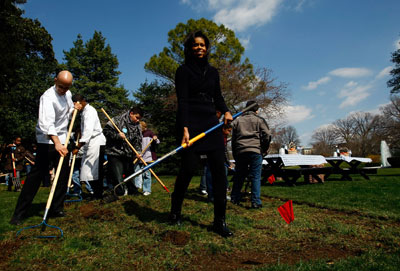
Greening the White House lawn (HP)
When we read this quote we thought the Buddha could have been saying this about Michelle Obama! She is setting an extraordinary example by doing things her own way and being true to herself.
 
From having bare arms [which is what arms are for, hugging not war], to serving lunch to the homeless [in a planned photo op that serves as an example to us...to get an official photographer to follow us around until we do something nice then send it out with a press release] in a soup kitchen, to planting a vegetable garden [hooray for organic Nature] at the White House, she is making us take a fresh look at the role of the First Lady and at our own prejudices and opinions about what we think is right and wrong [right and left, black and white, implicitly-racist and what is just a function of white-privilege].
 
A person who gives freely is loved by all. It's hard to understand, but it is in giving that we gain strength. But there is a proper time and a proper way to give, and the person who understands this is strong and wise. By giving with a feeling of reverence for life, envy and anger are banished. A path to happiness is found. Like one who plants a sapling and in due course receives back shade, flowers, and fruit, so the results of giving bring joy. Through continuous acts of kindness the heart is strengthened by compassion and giving.
- the Buddha
 
[For more awesome, freely translated "quotes" without citations, echoes of the Universalist Mahayana/Hindu school of Buddhism beloved by many and by disaffected Jewish people in particular, see here.]
Danny and Dharma in the White House
Anti-Tar Sands/Keystone XL protest at WH
Among others, we met with representatives of the Department of Education, Department of State, Department of Homeland Security, and the Office of Faith-Based and Neighborhood Partnerships.

We also heard from and dialogued with a large group of interesting speakers, including Joshua Stanton, founding co-editor of the Journal of Inter-Religious Dialogueco-director of Religious Freedom USA, and co-editor of O.N. Scripture - The Torah; former U.S Senator Harris Wofford; and Rev. Suzan Johnson Cook, U.S. Ambassador-at-Large for International Religious Freedom.
 
Overall, I concur...that the gathering was hugely important symbolically: to see Buddhists, Hindus, Sikhs, and Jains gathered together at the White House to spend a day in dialogue with the government about service and community-building felt like a huge step forward in terms of addressing the lack of attention to and representation of Dharmic religious practitioners in Washington.

The Buddhist Delegation (with White House and Seva Charities representatives), D.C., April 20, 2012. Author is in the back row, second from the left (Phil Rosenberg/SGI-USA).
 
(In Religion Dispatches in 2009 I talked about the lack of a Buddhist representative on the White House’s Advisory Council on Faith-Based and Neighborhood Partnerships. See article).
 
The conference agenda [felt] a little overstuffed to me. And things were done in relatively broad strokes. I think we might have benefited more from smaller groups and more precise focus on unique issues in particular communities, with some attention to broader concerns. But it was certainly a great start. And I thought Joshua Stanton did a really nice job of illustrating the effect the conference had on one person outside these communities looking in. See his piece at State of Formation.

Burmese Democracy Leader, The Lady, Daw Aung San Suu Kyi at White House (AFP)
 
The Buddhist Delegation (BGR)
In addition, here is the official press release about the conference, as well as a substantial post at Hindu American Seva Charities’ official blog.
 
[UPDATE: Ven. Bhikkhu Bodhi, the American Theravada scholar-monk, offers his take at Buddhist Global Relief.] And I have pictures to share at DannyFisher.org.
 
What a thrill to be in the White House, a joy to see old friends and make new ones, and participate in something so important. Many thanks to the White House Office, Hindu American Seva Charities, and my friend Bill Aiken at Soka Gakkai International-USA. I’m humbled and at your service.

First-Ever White House Conference of Dharmic Faiths
Bhikkhu Bodhi (BuddhistGlobalRelief)
Bhikkhu Bodhi and monks (BGR)
Until recently conferences on interfaith cooperation in the U.S. have almost always centered on the Abrahamic religions of Judaism, Christianity, and Islam. Yet, over the past 40 years America has become a much more diversified and pluralistic society.

WH celebrates many Jewish holidays (AP)
The relaxing of restrictions on immigration, followed by the post-war upheavals in Southeast Asia in the 1970s, has dramatically transformed our population.
 
Large numbers of Americans now have religious roots that go back, not to the deserts of Judea and Arabia, but to the plains, mountains, and villages of ancient India.
 
Buddhist flags on Lantau (m.gin/flickr)
For convenience, these are  grouped together under the designation “the Dharmic faiths.” They include Buddhists, Hindus, Jains, and Sikhs, and their national origins range from Pakistan to Japan, from Burma to Vietnam, and from Mongolia to Sri Lanka. Not all are immigrants. At least one whole generation of people of Asian descent has been born and raised in America and think of themselves principally as Americans following a Dharmic religion. More

Sunday, 23 February 2014

Burma sends military to protect precious rock

Seth Auberon, Pfc. Sandoval, CC Liu, Wisdom Quarterly; (irrawaddy.org)
Myanmar's "Golden Rock," Kyaiktiyo Pagoda, Mon State, Burma (hjuengst/flickr.com)
 
Thai cave temple, Wat Umong (Decha Thapanya)
RANGOON, Burma - A massive precious jade stone recently discovered near a village in Kachin State’s Hpakant region is believed to weigh 50+ tons.

But with half the rock yet to be unearthed, its exact mass remains unknown.
 
After visiting the discovery site and sizing up the raw jade stone in Wai Ka Village amid tight security, local jade merchant U Cho said initial reports of its size were likely underestimated.
  • Jade boulders still buried (The Irrawaddy)
    [Prior to becoming a military dictatorship and, along with England, part of the inspiration for George Orwell's dystopian Nineteen Eighty-Four, Burma was the richest country in Southeast Asia. (Orwell was born in British India but stationed in Burma during his military service. See Shooting an Elephant). It is still a tremendous source of raw resources fought over by the USA and China, both aspiring to strip the land and its corrupt military dictatorship/false front democratically elected parliament to enrich themselves. Dictator and head of the ruling military junta, Gen. Than Shwe took a backseat while still pulling the levers of political control, as former U.S. Sec'y of State, and potential future presidential candidate, Hillary Clinton cut deals and helped put pressure on the junta to give opposition leader Daw Aung San Suu Kyi a seat in parliament.]
“We estimate that the stone might be bigger,” he told The Irrawaddy. “What we had heard [that the stone was thought to weigh about 20 tons] was because the body of the stone is still buried in the ground. But we don’t know how much it will be worth.”
 
Jade stone used for life-sized Buddha (R-E)
Government troops were deployed this week to guard the area where the jade stone is located. As a result, local small-scale jade miners have been completely barred from s[caveng]ing for jade in the surrounding area.

The jade [boulder], described by locals as being “as big as a Mitsubishi Pajero truck,” was found by a small-scale miner, Aung Naing Win, on Feb. 9th in Hpakant Township. The region, west of the Kachin State capital Myitkyina, is known for possessing some of the world’s best jade.
 
Theravada novices on alms (Hilde Juengst)
Contacted by The Irrawaddy on Wednesday, a staffer at the state-owned Myanmar Gems Enterprise in [the new Burmese capital and secretive military headquarters] Naypyidaw (WSJ video) said she was not allowed to comment on the jade stone discovery in Hpakant. Asked for contact details for an individual authorized to speak to the media, the staffer said she was not at liberty to provide that information.
 
The Myanmar Gems Enterprise operates under Burma’s Ministry of Mines.
 
Small-scale miners in the region operate unlicensed, and thus have no legal claim to jade that they discover. Most of them deal in the black market trade. More

(This World Rocks) Burma with its massive golden, jewel-encrusted Shwedagon Pagoda (housing the Buddha's first relics, a few hairs given to merchants shortly after the great enlightenment and decision to teach, according to legend), a testament to the country's wealth.

Tuesday, 10 December 2013

Encounters in a Forgotten Country: Burma

Ton Kraayenvanger, May 2013; Pat Macpherson, Dhr. Seven (eds.), Wisdom Quarterly
See Part 2/11

Burma has a new name -- Myanmar -- given to it by dictators. Its size is more than five times that of England, and almost twice as big as Germany. The Theravada Buddhist country is dotted with pagodas, stupas (sacred reliquaries), and monasteries.
 
Former glorious empire in 1580
Burma has a deeply-rooted Buddhist culture and many distinct ethnic groups. Walking through its Buddhist culture is intrusive -- even overwhelming. If the term were not condescending, one could probably say that it is the country's main attraction.

The former capital of Rangoon is not known for its architecture. There are some striking cottages built by the British. They are far from beautiful but quite out of place. Yet, former colonial Rangoon is worth seeing. It is immediately noticeable that the city is not as dirty as many other Asian metropolises.
 
Largest Buddha statues in Asia in Burma (WQ)
One will not be blown off the pavement by public karaoke machines and runaway scooters. It is pleasing that it is less dirty and less noisy. The center is populated by traders who use a large part on the sidewalk and the Madurodam terraces. Here one can drink green tea or eat deep fried snacks of indefinable origin. 
 
Every compassionate Buddhist resists the killing of living beings, but it seems to be no obstacle to eating the murdered remains of animals for many. 

Burma's dictator, Gen. Than Shwe
One looks around in wonder. There is trade in everything. Many places offer printed tee-shirts and laminated photographs of The Lady, Daw Aung San Suu Kyi, and her famous father for sale. This was unthinkable before due to police state crackdowns by the military junta led by Gen. Than Shwe. (See Patricia Arquette in Beyond Rangoon).
 
Suu Kyi finally free, in the White House
There are even DVDs for sale of "The Lady," a film about the life of Suu Kyi, now a member of Parliament. Its lead actress, Michelle Yeoh, was expelled less than a year ago. Apparently, people are more daring now that a sham civilian government is in power. The dictators still pull the strings from their secretive new capital, Naypyidaw.

Recent history of regards Suu Kyi's father, Aung San, is known as a freedom fighter. In the West, he enjoys a reputation as a freedom fighter that helped liberate the nation from colonial slavery. But for many Britons, who were ousted, he was a war criminal.
 
Shwedagon Pagoda (Farnesina/flickr)
Shwedagon Pagoda in Rangoon has some of the most important Buddhist structures on Earth short of the larger structures in Afghanistan (Mes Aynak, Bamiyan), Indonesia (Borobudur, a UNESCO site), and Cambodia (Angkor Wat, Siem Reap, Mount Kulen, Mahendra Parvata). 

The Shwedagon complex is situated on a high hill. Golden and well lit, Shwedagon shines and sparkles from afar. Entering the sacred sanctuary, as in many places in the country, is only allowed barefoot.
 
During the colonial period, British occupiers emphasized their superiority by blatantly disregarding this tribute and keeping their footwear on. This must have cut deep wounds in the Buddhist psyche. Today one dare not try such an offense or risk being immediately called to order.

The steps up are quite a climb. Only once one has reached the top, gasping for breath, does the stupa become overwhelming, particularly in the bright morning sun. It is blindingly brilliant. Bring sunglasses. For all that glitters is gold here.
 
Buddhist nuns in pink (AFP)
Everywhere there are people -- walking quietly, sitting on the marble ground, meditating -- others talking with one other in hushed tones. People are busy making offerings or libations of water on Buddha statues. Visiting a pagoda is an integral part of daily life.

This pagoda is a place to pay tribute to the highest aspiration (enlightenment and nirvana), individually or with a loved one, a friend, or relatives, as well as to gain ordinary happiness. People are very devout, sometimes briefly for their visit, sometimes for a long time after.

Simultaneously, the pagoda is a place to stroll around and chat. In brief, it is a place for worship as well as a social place, serene and relaxed. The city center is small enough for a pleasant walk in what was once the wealthiest country in Southeast Asia before being plundered by the British. 

Monday, 18 November 2013

The Habits of Happiness (Matthieu Ricard)

Ashley Wells, Amber Larson, Dhr. Seven, Wisdom Quarterly; Ven. Matthieu "Happiest Man in the World" Ricard, Ph.D., TEDtalks (innovations in Technology, Engineering, Design)

(TED.com) What is happiness, and how can we ALL get some? Vajrayana Buddhist monk, renowned French scientist, photographer, Tibetan translator, and author Matthieu Ricard has devoted his life to these questions. And his answer is influenced by his conviction as well as by his scientific turn of mind: We can train our minds in habits of happiness. Interwoven with his talk are stunning photographs of the Himalayas and of his spiritual community.
  • Aung San Suu Kyi to launch AIDS 2014 in Australia Nobel Peace Prize winner, the Lady (Daw), will be keynote speaker at this year’s World AIDS Day reception to be hosted by the Pacific Friends of the Global Fund to Fight AIDS, Tuberculosis, and Malaria in Melbourne on Dec. 1st.
  • Bhumi-devi (doyletics.com)
    ANASTASIA (Ringing Cedars of Russia), tells the story of Vladimir Megre's trip to the Siberian taiga in 1995, where he witnessed incredible spiritual phenomena (human or ET?) connected with sacred "ringing cedar" trees. He spent three days with a woman named Anastasia, who shared with him her unique outlook on subjects as diverse as gardening, child-rearing, healing, Nature, sexuality, religion, and more. This wilderness experience transformed Vladimir so deeply that he abandoned his commercial plans and, penniless, went to Moscow to fulfill Anastasia's request and write a book about the spiritual insights she so generously shared with him. True to her promise this life-changing book, once written, has become an international bestseller and has touched hearts of millions of people worldwide.
  • UFO intrigue flies high (Newcastle Herald)
森の木琴,   ドコモのサイトでステキな映像発見。 (Touchwood) 

Go to the woods of Kyushu (Japan), engineer a massive xylophone down the slope of a forested hill. Take a wooden ball, place it at the top, and push it. What do you get? Bach's treatment of a traditional church hymn! All this for a Japanese commercial for a curved smartphone with the tagline, "Touch Wood" (onbeing.org).

Wednesday, 23 October 2013

Shwedagon Pagoda, Burma's history (video)

Ashley Wells (editor), Wisdom Quarterly
The First Buddhist Shrine: Shwedagon, Burma, was first built to enshrine strands of the Buddha's hair given to ancient merchant travelers who saw the Buddha on the road on his way to set in motion the Wheel of the Dharma in the Deer Park at Sarnath, Varanasi, India (L'altra faccia della politica estera/Convegno alla Farnesina/Coop. allo Sviluppo).

 
The Legend of Shwedagon Pagoda
Roger Bischoff (Buddhism in [Burma]: A Short History, BPS Wheel 399), edited by Dhr. Seven
The massive shrine complex that is Shwedagon in central Rangoon, the former capital of Burma before military dictators renamed everything and built a secretive bunker compound in Naypidaw and called that the capital (airpano.com)
 
The Ancient Arrival of the Hair Relics
Buddhist nuns at Shwedagon (AFP)
Two traveling merchant brothers, Tapassu and Bhallika from Ukkala* [identified as Okkalapa near Rangoon, but which some like the Indian government in Orissa believe to be in modern Orissa (Utkala) on India's east coast], were going through Uruvela. They were directed to the Buddha by their familial deva (nat, sprite, nature spirit, angel).
 
The newly enlightened Buddha had just come out of seven weeks of meditation after his great awakening and was sitting under a tree feeling the need for food.
The First Two "Buddhists"
Tapussa and Bhallika (the world's first Buddhist lay disciples) saw him and, having been prompted by the deva, made an offering of rice cakes and flower nectar, seeking guidance from two of what would eventually be the Three Guides (ti-sarana), guidance from the Buddha and the Dharma. (The third, the noble Sangha, or "community of enlightened individuals," did not yet exist). As they were about to depart, they asked the Buddha for an object to remember and honor him in his place. He gave them eight hairs from his head.

(U Myintl Win)  Shwedagon Pagoda, Burma's sacred relic shrine
 
After the two returned from their journey, they enshrined the three hairs in a reliquary (stupa), which is now the great Shwedagon Pagoda in Rangoon. It is believed in Burma that the hill upon which the Shwedagon Pagoda stands was not haphazardly chosen by Tapussa and Bhallika. It was, in fact, the site where the three buddhas preceding the Buddha Gotama (Siddhartha Gautama, Shakyamuni) in this world-cycle (maha kalpa) themselves left relics:
 
Iconography...Orissa (Thomas E. Donaldson)
The Buddha Kakusandha is said to have left his staff on Theinguttara Hill, the Buddha Konagamana his water filter, and the Buddha Kassapa a part of his robe. Because of this, the Buddha requested Tapussa and Bhallika to enshrine his hair relics at that particular location.
 
Tapussa and Bhallika traveled far and wide in order to find the hill on which they could balance a tree without its touching the ground either with the roots or with its crown. Eventually, they found the exact spot not far from their home in Lower Burma, where they enshrined the holy relics in a traditional Buddhist burial mound or stupa [Shway Yoe, The Burman (Scotland 1989), pp. 179f.]. The original mound is said to have been 27 feet high. Today the Shwedagon Pagoda has grown to over 370 feet. 

The Buddha's Visits to the Region
Burmese oral tradition speaks of four visits of the Buddha to the region. While these visits were of utmost significance in their own right, they are also important in having established places of pilgrimage up to the present day. More
 
*NOTE: The Theragatha ["Psalms of the Elders"] Commentary (Vol i.48) informs us that the birthplace or residence of the travelers Bhalluka (or Bhaliya) and Tapassu (or Trapassu) was Pokkharavati in Ukkala. The sons of the caravan leader (Satthavaha) started their journey from Pokkharavati. Their destination was Rajagriha (modern Rajgir, India), and according to the Jataka (Jat I. 80) they were on their way to Majjhimadesa ("Middle India"), where they met and offered food to the Buddha and became his first lay devotees.
 
(DokusDeutsch) German documentary, in depth look at Shwedagon Pagoda

NEW ASIAN FRONTIER
Dalai Lama supports The Lady
Legend says that Shwedagon Pagoda in Rangoon (Yangon), Burma, is about 2,[6]00 years old. According to the ancient Theravada Buddhist tradition, it was built even before the Buddha's passing, which is thought to have occurred in 486 BCE. It is the most sacred Buddhist reliquary and shrine for the Burmese as it preserves the relics of four buddhas, including the hair of the historical Buddha. The life of Burmese culture, embodied in its ancient traditions, now has a new face emerging in Southeast Asia and beyond. The country has continuous and positive development and is in the process of a democratic transition [thanks to the military dictatorship, led by puppet-master Gen. Than Shwe, finally releasing pro-democracy Nobel Peace Laureate Aung San Suu Kyi, a freedom fighter known throughout the land simply as The Lady] and renewed economic dynamism.

(VB) 4-Minute History of Burma (not "Myanmar"!) John Green tells Hank about the situation in formerly rich Buddhist Burma before and after the arrest of The Lady by military dictators.
  
NUOVA FRONTIERA ASIATICA
Ellen Page reveals Asia's "Hitler," Than Shwe
Una leggenda afferma che la pagoda Shwedagon a Rangoon in Birmania abbia circa 2[6]00 anni. Secondo la tradizione Theravada, fu costruita addirittura prima della morte del Buddha, avvenuta nel 486 a.C. È la pagoda buddista più sacra per i birmani poichè conserva le reliquie di quattro Buddha. Il Myanmar vive di cultura e tradizioni millenarie ma ora il suo nuovo volto si sta affacciando sul sud-est asiatico e oltre i suoi confini. Il Paese è in continua e positiva evoluzione e sta attraversando una fase di transizione democratica e di rinnovato dinamismo economico.