Showing posts with label Theravada country. Show all posts

Thursday, 7 August 2014

Khmer convictions: Cambodia, Angelina Jolie

It is believed that up to 2 million Cambodians died under CIA/Pol Pot's regime (AFP/BBC)
.
Cambodian Tomb Raider Angelina Jolie (Lara Croft)
Most Americans are not likely aware that anything much ever happened in Cambodia -- Cambodia? Where's Cambodia? -- even as our government illegally bombed it during our war on Vietnam and our CIA fomented mass murder and crimes against humanity by cultivating dictators. 
 
It does the same now in the geopolitical Middle East just as it did all over Latin America. The CIA's activities there were exposed first hand by the highest ranking officer to ever blow the whistle:
 
Philip Agee, author of Inside the Company: CIA Diary. This seems to be in keeping with the way-of-empire and our American imperial method of making war as we learned it from England, Germany (WW II era Nazis, who came to live and work for the U.S. shadow government), Spain, France, Rome, Greece... It seems to be the Western way.
 
But Americans might know the name Pol Pot from the late 1970s, and we have all certainly heard the expression "killing fields." After all, the world's most famous Cambodian citizen is superstar actor Angelina Jolie. And America's amazing "Buddha Girl" Ratanayani is a Cambodian-American!
 
The Buddha at Battambang, Cambodia (Kim Seng/captainkino.com/flickr.com)
 
Reptilians/Nagas
Cambodia was once a peaceful Theravada Buddhist country in Southeast Asia.
 
But long before that -- mirroring the Mesoamerican empires of ancient Mexico (Aztec, Toltec, and Olmec) -- it was one of the world's greatest empires extending in the jungles from the center of the world at Angkor Wat and its suburbs, which were once home to 1,000,000 residents. It covers more ground than Paris and was built with more stone than the pyramids of Egypt, according to National Geographic.


The greatness is evident because Cambodia's former glory was not limited to the City of Angkor with its central wat (Buddhist temple). Other great stone cities have also been discovered and made much of by National Geographic, but other equally great ruins remain yet to be discovered.
 
Glass pool reservoir at Angkor Wat, Cambodia (Platongkohphoto/flickr.com)
 
But their innovative water system collapsed and their apparent worship of nagas (reptilians, snakes, Quetzalcoatl-like off-planet overlords) ushered in their ruin as a "Rome," "Washington," or "Vatican" -- the capitals of other massive empires.
 
"The Killing Fields," winner of three Academy Awards, tells the story of a New York Times reporter and his Cambodian aide harrowingly trapped in Cambodia's 1975 Khmer Rouge revolution. Sam Waterston, John Malkovich, and "Best Supporting Actor" (Oscar and Golden Globe winner) Haing S. Ngor star in this shattering true story. Rated: R.
 
Jolie's Cambodian shaman/Buddhist tattoos
Americans would have heard of the expression "The Killing Fields" from the popular film, and Pol Pot from the chorus of the Dead Kennedy's ironic and popular punk classic "Holiday in Cambodia," its stone building sunk in jungle thickets from Angelina Jolie as actress (Lara Croft: Tomb Raider) and UNHCR Goodwill Ambassador.

WARNING: Graphic and gruesome violence! (CNN.com, May 1, 2009) CNN's Dan Rivers profiles members of the Khmer Rouge, as they face justice before a U.N.-backed trial.

Top Khmer Rouge leaders convicted: found guilty of crimes against humanity
Ancient megalithic Angkor Wat and its Buddha and kings' faces (Dvillaret/flickr.com)
.
(BBC) There was a round of applause as the verdict was reached, according to BBC correspondent Jonathan Head.

Two top Khmer Rouge leaders have been jailed for life after being convicted by Cambodia's UN-backed tribunal of crimes against humanity
 
Nuon Chea, 88, served as leader Pol Pot's deputy and Khieu Samphan, 83, was the Maoist regime's head of state. They are the first top-level leaders to be held accountable for its crimes.
 
Soum Rithy, who lost his father and three siblings, reacts to the verdict in Phnom Penh on 7 August 2014
Soum Rithy, who lost his father and three siblings, reacts to verdict in Phom Penh (Reuters)
 
Up to two million people are thought to have died under the 1975-79 Khmer Rouge regime -- of starvation and overwork or executed as enemies of the state.
 
Judge Nil Nonn said the men were guilty of "extermination encompassing murder, political persecution, and other inhumane acts comprising forced transfer, enforced disappearances, and attacks against human dignity."
 
Lawyers for the pair said they would appeal against the ruling. "It is unjust for my client. He did not know or commit many of these crimes," Son Arun, a lawyer for Nuon Chea, told journalists. They will remain in detention while this takes place. 
 
"Anger remains"
The regime sought to create an agrarian society: cities were emptied and their residents forced to work on rural co-operatives. Many were worked to death while others starved as the economy imploded. 
 
During four violent years, the Khmer Rouge also killed all those it perceived as enemies -- intellectuals, minorities, former officials -- and their families. More

"Holiday in Cambodia"
(DKs555) "Apocalypse Now" illegally in Cambodia, where the US/CIA had no right or justification to be. Yet, it dropped more cluster bombs and committed as many if not more secret war crimes in Cambodia and Laos than it did in Vietnam.


Tuesday, 15 July 2014

Living in a forest meditation cave (photos)

Seth Auberon, Pat Macpherson, Wisdom Quarterly; Majorie Chiew (thestar.com.my, 2011)
Cave-dwelling Theravada Buddhist monastic under crot or hanging mosquito net

(Ajahn Cagino) Photos from the exhibition on the wandering Forest Tradition life
Scaling new heights: Sometimes there are no roads in the forest so climbing the rocks to get over to the other side becomes necessary to continue the journey, explains Ven. Cagino. Once he pulled this stunt and fell off the ledge. Fortunately, his fall was broken by the branches of a tree before he landed by the riverside.


.
Venerable Ajahn Cagino, 43, lives in a cave with two snakes and eight bats.
 
The cave is 1.2 miles (2 km) from the nearest village in Mae Hong Son, northern Thailand. Nestled in a deep valley hemmed in by high mountain ranges that border Burma, Mae Hong Son is isolated from the outside world and is covered with mist throughout the year.
 
“I’ve had enough of wandering,” says the Malaysian monk practicing within the Thai Forest Tradition, which is a branch of Theravada Buddhism.
 
For 12 years, Ven. Cagino had been walking through the remotest jungles of Thailand, before settling down in a cave. It was all part of the spiritual training of a forest ascetic.
 
All those years in the forest have brought out the best in him. Ven. Cagino, who is back in Malaysia on a vas (a three-month annual Rains Retreat observed by Theravada practitioners during the Asian rainy season), is out to raise funds to build an orphanage in Thailand.
 
“When I was a forest monk, the villagers gave me food as alms. Now I want to give back to these impoverished tribal people,” says Ven. Cagino who hails from Seremban....
Life in the Wilderness
Floating to the other shore: Meditating on a bamboo raft for spiritual tranquility.
 
[Ven. Cagino was once an award-winning photographer.] “What used to be the best photo was not the best anymore. At the next photo contest, you’ve to improve your skills and get the winning shot,” he says. “Nothing seems to be the ultimate.”

Mr. Cagino was miserable and disillusioned and wondered if there were more to life than its never-ending challenges. At 27, he turned his back on all material pursuits, sold off his worldly belongings, and eventually became a Buddhist monk.

Over the next two years, Mr. Cagino visited forest monasteries in Thailand and New Zealand to learn more about Buddhism.

Ven. Cagino was ordained as a samanera (novice) at 29 and stayed at Ang Hock Si Temple in Perak Road, Penang, for the next year and a half.

He trained as a forest monk under Thai master Ajahn Ganha for five years and was re-ordained at Wat Pah Nanachat (The International Forest Monastery), a Buddhist monastery tailored to foreigners in northeast Thailand, in the Theravada Forest Tradition.
 
The monastery was established by the late Ven. Ajahn Chah to provide English-speaking monastics the opportunity to train and practice in the way Buddha originally taught his disciples in the forests 2,600 years ago.
 
The Thai Forest Tradition stresses meditation and strict adherence to monastic rules (Code of Discipline). Known for its orthodoxy, conservatism, and asceticism, the Thais greatly respect monks who observe this tradition.
 
A photo exhibition offers a rare glimpse of the lives of Theravada Buddhist forest monks. Silence in the streams: A monk practicing sitting meditation by the running waters of a waterfall (courtesy of Ajahn Cagino)
   
“I want to be a forest monk because Buddha himself spent much time dwelling in the forest. It is a strict, disciplined path,” says Ven. Cagino.
 
During the past 12 years, he was in and out of the forest with other monks. But six years ago, he set off alone into the deep wilderness to experience what it was like to be a forest monk. All he had with him were five pieces of cloth, an alms bowl, cup, umbrella, mosquito net, and walking stick.

“The stick is important as we can make some noise to warn snakes and other creatures of our presence when we’re walking through the forest,” says Ven. Cagino.
 
He described his wandering years as a journey of exploration and discovery, not a time of hardship.
 
“I enjoyed those years even though I know not if there was a meal for tomorrow or where I was heading. I just walked on to see the world,” he says.
 
A forest monk leads a nomadic life as he moves from one place to another to find the ideal location to practice meditation. He usually camps by the river for easy access to water supply.
 
“We stay 15 days at the most at one place -- not too long as we’re not supposed to feel attached to a place,” he explains. “If a place has ample food and shelter but is not conducive for meditation, we must leave promptly. If the place is great for meditation, the forest monk will stay a bit longer. It allows us to enhance our wisdom.”
 
Meal for the day: Monks returning with food offerings from their morning alms round.
 
Sometimes Ven. Cagino would ask villagers for directions to caves where monks had previously stayed. “There may be a fireplace and an old kettle left behind. Sometimes I will borrow a hammer and nails to make a seat for meditation,” he says.

The life of a forest monk is not without its challenges. There are times when they have to track through muddy paths, cross streams and rivers, or climb down cliffs. One can easily get lost in the jungle, too.
 
The forest monk will usually stay 1-2 miles (2-3 km) from the nearest village so that he can go for alms in the morning. He accepts only food, never money. More

A Photographic Journey of the Dhammafarers is an exhibition of 99 photos by Ajahn Cagino to raise funds for Dhammagiri Foundation to build an orphanage in Thailand. The exhibition took place  at White Box, Mont Kiara, Kuala Lumpur, Malysia then Citta Mall, Ara Damansara, Petaling Jaya, Sept. 8-20; Bandar Utama Buddhist Society, 3, Jalan BU 3/1, Bandar Utama, Petaling Jaya, from Sept. 25-Oct 2; and 1 Utama Shopping Centre, Petaling Jaya, Oct. 8-9.

Friday, 6 June 2014

Summer Guide to Los Angeles 2014

Amber Larson, Seth Auberon, Ashley Wells, Wisdom Quarterly; PasadenaWeekly.com
Thai Theravada Buddhist young woman in traditional garb (Sasin Tipchai/Bugphai/flickr.com)
Summer Guide 2014
Summer Guide 2014: Guide to Summer activities for the season
 .
Wat Phra Kaew (Naxerdam)
Thought you were traveling to the Theravada Buddhist wonderland that is Thailand? Think again. The military says elections will not be allowed any sooner than next year. And without a duly elected government, a junta of generals will be in charge. Curfew will continue.  
Thai protesters rise against coup (CNN)
And Thai-land, which means "free" land, can learn what it's like to live in a police state like neighbors Burma and Cambodia, who have endured the dictatorship of the Hitler-like Gen. Than Shwe and the Saffron Revolution he and his generals crushed and the Khmer Rouge and the Killing Fields that followed from it in the Land of Angkor and Angkor Wat. Both countries, wondrous places for spiritual-tourists, are easily accessible from Thailand. A simple bus ride across an international border used to be enough. And the "troubles" actually preserved lifestyles and temples holding them in a kind of time warp. With modernity come the trappings of modernity. So see it while you can. Few places are more "modern" than L.A., and this is sure to be a bumper year for materialistic-tourism. See a genuine Thai Buddhist temple complex in Los Angeles at Wat Thai North Hollywood. And there are a number of Burmese temples, the best and biggest perhaps being two in Azusa (Thondrarama Brahma Vihara) and La Puente, deep on the eastern border of suburban L.A.

Staying focusedStaying focused
Concentrate on the task at hand and your talent and knowledge will come to the forefront
Pain in the offing
Pain in the offing
There really is no easy way to leave your lover
What do you want?
Be fair but firm with squatting father and sibling
Anger at a friend’s "bad" behavior could be triggered by past event.
Dancing in the streets
Make Music Pasadena fest brings 150 bands to town for a Saturday filled with music
'For the free world'
That's "Entershamement"
Amy G. uses her unique comic and singing skills to battle self-doubts at the Carrie Hamilton Theatre

Monday, 2 June 2014

Military puts Buddhist Thailand on brink (video)


(BBC) 60 second background to the 2014 coup d'etat in Thailand as conservative Yellow Shirts gain upper hand over revolutionary Red Shirts by ousting the people's candidate, billionairess PM Yingluck Shinawatra, through the Thai court. Now the Yellow Shirt Royalists seem to have called in the military to enforce an economic system the majority is unhappy with.


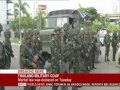
Thailand's military detained former Prime Minister Yingluck Shinawatra on Friday in the latest development of the country's unraveling political crisis. The army, which is consolidating its grip on Thailand following Thursday's coup d'état, barred 155 prominent citizens from leaving the country.
ThumbnailBBC News: Thai coup, Andrew Sarchusa
Thumbnail(Arirang) Int'l leaders denounce coup
Thumbnail(ANN) Look at the Shinawatra family
ThumbnailMay 23: Day after Thai military's coup
ThumbnailLife after Thailand's Splendid Little Coup (Journeyman Pictures)

Thursday, 22 May 2014

Thailand under curfew amid army coup

Pat Macpherson, Ashley Wells, Pfc. Sandoval, Wisdom Quarterly; BBC.co.uk
It's Orwellian, it's draconian, and it's coming to a town near you: A police state (with militarized civilian troops, deputies, and spies) is a state of collapse. Wage peace now.
  
Go Thailand! We're practicing in D.C., too!
A curfew has begun across [Theravada Buddhist] Thailand after the army announced it had taken control and suspended the constitution following months of political turmoil [as Red Shirts vie for revolutionary change and civil liberties against the conservative Yellow Shirts who want to preserve the corrupt status quo].
 
The army chief imposed the 22:00 to 05:00 curfew, along with a ban on political gatherings and suspension of normal television programming.
 
Key political figures have been detained and others ordered to report to the military. The army said it needed to restore order and enact political reforms.
 
You Occupy, we oppress (conspiracyplanet)
It declared martial law on Tuesday but then gathered political leaders together for talks on the crisis.
 
However, army chief Gen Prayuth Chan-ocha went on air on Thursday to announce the coup.
 
Several key figures at the talks, including opposition protest leader Suthep Thaugsuban and pro-government protest leader Jatuporn Prompan, were detained. More + VIDEO
 
Thai soldiers guard the "Democracy Monument" in Buddhist Bangkok (reuters.com)

Wednesday, 21 May 2014

Thai martial law: military shuts down media

Pfc. Sandoval, CC Liu, Wisdom Quarterly; BBC.co.uk, May 21, 2014
Thai Theravada monastics continue to practice during country's crisis (Butch Osborne/flickr)
Thailand is divided radicals and royalists who want to change the gov't (LillianPierson)

Thailand's martial law crisis: Local media shut down by military
I don't know what he's talking about! I'm PM!
(BBC) An emergency meeting of political leaders, called by the Thai army a day after it [unilaterally] declared martial law, has ended inconclusively.
 
She did it! Her and her brother, ousted!
Representatives from the government [which was not advised by the army that martial law would be declared], the main opposition party and protest groups all attended the meeting.
 
Local radio stations run by activists have been shut down by the military. Jonathan Head reports from Bangkok. More + VIDEO

Thai Martial Law: Coup or no Coup? (video)

Wisdom Quarterly; Panarat Thepgumpanat, Amy Sawitta Lefevre (Reuters, 5-21-14); CNN
(CNN) Kristie Lu Stout reports on pre-dawn announcement of martial law and its implications

UPDATE 3: Talks to end Thai crisis inconclusive, new round called
  • Army chief met political parties, rival protest groups
  • Meeting inconclusive, said participants
  • Army declared martial law on Tuesday, denies staging a coup
  • Acting PM says he is still in charge, proposes Aug. 3 election
Theravada devotion, Thailand (WQ)
BANGKOK (Reuters) - Thailand's rival political factions would not agree to stop street protests on Wednesday during crisis talks aimed at ending the confrontation a day after the army declared martial law, a pro-government activist said.

Although the military denied Tuesday's surprise intervention amounted to a coup, army chief General Prayuth Chan-ocha appeared to be setting the agenda by forcing groups and organizations with a central role in the crisis to talk.

Streets in the south: Phuket, 2012 (SR)
Issues raised during the meeting included reforming the political system -- a demand made by anti-government protesters -- and ending the demonstrations that have sparked violence, disrupted business, and scared off tourists.

"When asked whether each group can stop protesting, there was no commitment from either side," Thida Thawornseth, a leader of the pro-government "red shirt" political group, told Reuters. "There was no clear conclusion."

Photo
Tensions high in Bangkok (March 2010)
Puchong Nutrawong, secretary-general of the Election Commission, who was also at the talks, said all sides would meet again on Thursday.

"The army chief asked us to go back home and think about the things we discussed in order to find a solution for the country," Puchong told Reuters.

Photo
Protests continue in Thailand (2010)
Thailand has been riven for nearly 10 years by the rivalry between populist former Prime Minister [corrupt billionaire tycoon] Thaksin Shinawatra and the royalist establishment.

Echo of troubles in Venezuela (AFP)
Thaksin, a former tele-com billionaire who won the loyalty of the rural and urban poor, has lived in self-exile since 2008 but still exerts a huge influence, most recently through a government run by his sister, Yingluck Shinawatra [the latest PM to be ousted, two weeks back].

China troubles Taiwan, April 2014 (UR)
Yingluck was forced to step down as premier by a court two weeks ago, but her caretaker government remains in power, despite the declaration of martial law and six months of sometimes violent protests aimed at ousting it.

The turmoil has driven the [largest Theravada Buddhist] country to the brink of recession and even raised fears of civil war.

"HOMEWORK HANDED OUT"
Photo
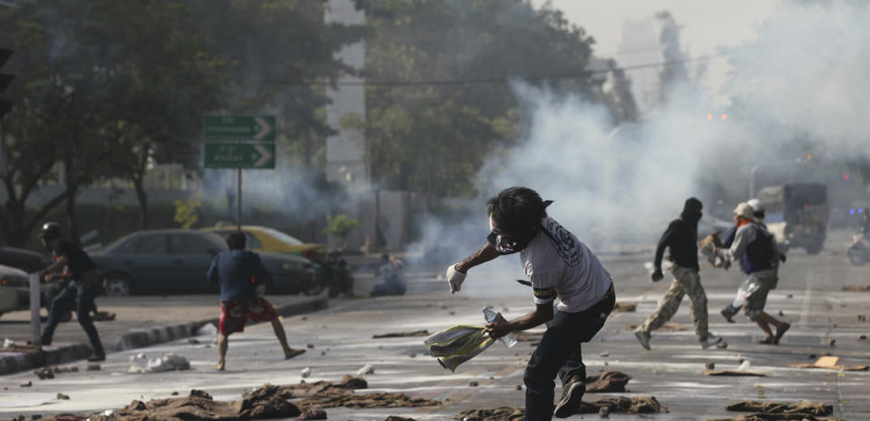
Thailand anti-government protests (2009)
The anti-government protesters are opposed to an election, which Thaksin's loyalist would be likely to win. They want a "neutral" prime minister installed to oversee electoral reforms aimed at ending Thaksin's influence.
 
[They also want to replace the PM system with a citizens' committee of leaders, a move seen as too radical by the military and business interests who need a stable platform to operate their capitalist enterprises extracting labor and resources and channeling it into private hands for the benefit of the few at a steep cost to the many.] More 

Tuesday, 20 May 2014

Martial Law declared all over Buddhist Thailand

Wisdom Quarterly; Pacifica Radio, Berkeley (KPFA.org); G.P. Malalasekera
Martial law was declared throughout the most Buddhist country in the world this morning with an announcement from the military, Pacifica is reporting from Berkeley, claiming that it is due to the interim "caretaker" governing PM refusing to step down. Monastics are presumably trapped in hermitages unable to seek alms food (pindapat') as is done daily throughout the country according to ancient tradition laid down by the Buddha.
Going on Alms round
G.P. Malalasekera; Wisdom Quarterly (Pinda Sutta)
Buddha walking (WQ)
Once the Buddha was at Pañcasālā when the day came for all young people to send gifts to one another.

The Buddha went on alms round to the village as was the custom of wandering ascetics in India. But the villagers, influenced by Māra, gave nothing, and he returned with his bowl empty.

Māra tried to influence the Buddha to go a second time, but he refused to do so (S.i.113; the incident is also found at DhA.iii., p. 257f).

The Commentary explains (SA.i.141) that Māra did not want the Buddha to accept the gifts of the maidens and to preach to them, because then they would pass beyond his lustful, fearful, delusive influence.