Showing posts with label northeast thailand. Show all posts

Thursday, 17 July 2014

Buddhist monk on Gender Equality (video)

Claralynn N.(United Kingdom); Dhr. Seven, Ashley Wells, Seth Auberon, Amber Larson, Wisdom Quarterly; Abbot Ajahn Brahmavamso (BuddhistSocietyWA, June 27, 2014)

BuddhistSocietyWAPERTH, Western Australia - Ajahn Brahm -- an enlightened Western Buddhist monk from England living in Australia after a decade in Northeast Thailand (Isan) at Wat Pah Nanachat, the International Forest Monastery -- talks about the banning of his United Nations' speech on gender equity, equality of the sexes.

Viewers who support Wisdom Quarterly and women's right to full ordination in Theravada Buddhism as well as supporting Ajahn Brahm's work striving for the equality of females within all Buddhist schools, particularly his more traditional and monastic tradition, are encouraged to consider signing the online petition here.
  • Sangha: nuns, monks, female, male supporters.
    Traditionally, it was thought that women could no longer secured full ordination due to a rule the Buddha laid down when his foster mother ordained. However, evidence found in the background stories (Vibhanga) of the Nuns' Disciplinary Code (Bhikkhuni Vinaya), research by the Theravada nun Ayya Tathaloka, shows that those rules or garudhammas are a historical impossibility. Had the Buddha laid them down with all the fanfare in front of the Shakyan women as is claimed, questions would not have arisen regarding etiquette between male and female monastics and ordination, as those would have been settled issues. But that questions did arise, as recorded in the stories accompanying the formation of each rule, those sexist and patriarchal garudhammas could not have been preexisted. The function of these additional rules seems to be little more than to subordinate female Sangha members to males and was clearly in the interest of monks to have hastily inserted at some point in time.
Let's invite Ajahn Brahm to present his gender equality paper at the 2015 UNDV conference
United Nations Day of Vesak (UNDV): Invite Ajahn Brahm to present his gender equality paper @ the 2015 UNDV conference
3,242 signers so far. Let's reach 10,000 United Nations' Day of Vesak (UNDV)
 
Supporting Buddhist women at the U.N.
Nuns are necessary for a complete Sangha
We, the undersigned, are astounded and deeply disappointed by the banning of Ajahn Brahm's paper on gender equality at the 2014 United Nations' Day of Vesak (UNDV) conference in Vietnam.
 
The paper was clearly aligned with the UN’s Millennium Development Goal 3 (Promote Gender Equality and Empower Women), which the UNDV is committed to uphold through its connection with the UN. Moreover, Ajahn Brahm's paper had already been approved for presentation when it was suddenly banned 36 hours before its scheduled presentation.
 
We value free and open dialogue. We therefore ask that the UNDV, in accordance with Millennium Development Goal 3, promotes dialogue about the participation of women in contemporary Theravada Buddhism by inviting Ajahn Brahm to publicly present his gender equality paper at the next UNDV conference in 2015.
(To view signers, go to petition2014.org. This petition will remain open until October 1st, 2014. The petition can be read in Chinese (petition2014.org/2001325991.html), Thai and Vietnamese (petition2014.org/3616363436253634365236073618-vi7879t.html), and Sinhalese (petition2014.org/35233538345835243517.html).

Tuesday, 15 July 2014

Living in a forest meditation cave (photos)

Seth Auberon, Pat Macpherson, Wisdom Quarterly; Majorie Chiew (thestar.com.my, 2011)
Cave-dwelling Theravada Buddhist monastic under crot or hanging mosquito net

(Ajahn Cagino) Photos from the exhibition on the wandering Forest Tradition life
Scaling new heights: Sometimes there are no roads in the forest so climbing the rocks to get over to the other side becomes necessary to continue the journey, explains Ven. Cagino. Once he pulled this stunt and fell off the ledge. Fortunately, his fall was broken by the branches of a tree before he landed by the riverside.


.
Venerable Ajahn Cagino, 43, lives in a cave with two snakes and eight bats.
 
The cave is 1.2 miles (2 km) from the nearest village in Mae Hong Son, northern Thailand. Nestled in a deep valley hemmed in by high mountain ranges that border Burma, Mae Hong Son is isolated from the outside world and is covered with mist throughout the year.
 
“I’ve had enough of wandering,” says the Malaysian monk practicing within the Thai Forest Tradition, which is a branch of Theravada Buddhism.
 
For 12 years, Ven. Cagino had been walking through the remotest jungles of Thailand, before settling down in a cave. It was all part of the spiritual training of a forest ascetic.
 
All those years in the forest have brought out the best in him. Ven. Cagino, who is back in Malaysia on a vas (a three-month annual Rains Retreat observed by Theravada practitioners during the Asian rainy season), is out to raise funds to build an orphanage in Thailand.
 
“When I was a forest monk, the villagers gave me food as alms. Now I want to give back to these impoverished tribal people,” says Ven. Cagino who hails from Seremban....
Life in the Wilderness
Floating to the other shore: Meditating on a bamboo raft for spiritual tranquility.
 
[Ven. Cagino was once an award-winning photographer.] “What used to be the best photo was not the best anymore. At the next photo contest, you’ve to improve your skills and get the winning shot,” he says. “Nothing seems to be the ultimate.”

Mr. Cagino was miserable and disillusioned and wondered if there were more to life than its never-ending challenges. At 27, he turned his back on all material pursuits, sold off his worldly belongings, and eventually became a Buddhist monk.

Over the next two years, Mr. Cagino visited forest monasteries in Thailand and New Zealand to learn more about Buddhism.

Ven. Cagino was ordained as a samanera (novice) at 29 and stayed at Ang Hock Si Temple in Perak Road, Penang, for the next year and a half.

He trained as a forest monk under Thai master Ajahn Ganha for five years and was re-ordained at Wat Pah Nanachat (The International Forest Monastery), a Buddhist monastery tailored to foreigners in northeast Thailand, in the Theravada Forest Tradition.
 
The monastery was established by the late Ven. Ajahn Chah to provide English-speaking monastics the opportunity to train and practice in the way Buddha originally taught his disciples in the forests 2,600 years ago.
 
The Thai Forest Tradition stresses meditation and strict adherence to monastic rules (Code of Discipline). Known for its orthodoxy, conservatism, and asceticism, the Thais greatly respect monks who observe this tradition.
 
A photo exhibition offers a rare glimpse of the lives of Theravada Buddhist forest monks. Silence in the streams: A monk practicing sitting meditation by the running waters of a waterfall (courtesy of Ajahn Cagino)
   
“I want to be a forest monk because Buddha himself spent much time dwelling in the forest. It is a strict, disciplined path,” says Ven. Cagino.
 
During the past 12 years, he was in and out of the forest with other monks. But six years ago, he set off alone into the deep wilderness to experience what it was like to be a forest monk. All he had with him were five pieces of cloth, an alms bowl, cup, umbrella, mosquito net, and walking stick.

“The stick is important as we can make some noise to warn snakes and other creatures of our presence when we’re walking through the forest,” says Ven. Cagino.
 
He described his wandering years as a journey of exploration and discovery, not a time of hardship.
 
“I enjoyed those years even though I know not if there was a meal for tomorrow or where I was heading. I just walked on to see the world,” he says.
 
A forest monk leads a nomadic life as he moves from one place to another to find the ideal location to practice meditation. He usually camps by the river for easy access to water supply.
 
“We stay 15 days at the most at one place -- not too long as we’re not supposed to feel attached to a place,” he explains. “If a place has ample food and shelter but is not conducive for meditation, we must leave promptly. If the place is great for meditation, the forest monk will stay a bit longer. It allows us to enhance our wisdom.”
 
Meal for the day: Monks returning with food offerings from their morning alms round.
 
Sometimes Ven. Cagino would ask villagers for directions to caves where monks had previously stayed. “There may be a fireplace and an old kettle left behind. Sometimes I will borrow a hammer and nails to make a seat for meditation,” he says.

The life of a forest monk is not without its challenges. There are times when they have to track through muddy paths, cross streams and rivers, or climb down cliffs. One can easily get lost in the jungle, too.
 
The forest monk will usually stay 1-2 miles (2-3 km) from the nearest village so that he can go for alms in the morning. He accepts only food, never money. More

A Photographic Journey of the Dhammafarers is an exhibition of 99 photos by Ajahn Cagino to raise funds for Dhammagiri Foundation to build an orphanage in Thailand. The exhibition took place  at White Box, Mont Kiara, Kuala Lumpur, Malysia then Citta Mall, Ara Damansara, Petaling Jaya, Sept. 8-20; Bandar Utama Buddhist Society, 3, Jalan BU 3/1, Bandar Utama, Petaling Jaya, from Sept. 25-Oct 2; and 1 Utama Shopping Centre, Petaling Jaya, Oct. 8-9.

Wednesday, 25 June 2014

U.S. bombing Buddhist Laos (video)

Laotian Theravada Buddhist devotion, Luang Prabang, Laos (William Day/flickr.com)
 
Fifty years ago this month, the United States began raining down bombs on Laos [a landlocked Theravada Buddhist nation in Southeast Asia near Vietnam, China, Thailand, Burma, and Cambodia], in what would become the largest bombing campaign in history.

From June 1964 to March 1973, the United States dropped at least two million tons of bombs on the small, landlocked southeast Asian country. That is the equivalent of one planeload every eight minutes, 24 hours a day, for nine years -- more than was dropped on Germany and Japan during World War II.
 
Bombies_laos
40 years after secret U.S. war in Laos, millions of bomblets (seen here) keep killing
 
This part of the deadly legacy of the U.S. War on Vietnam lives on: In a sense the bombing continues today because of unexploded cluster bombs (scattering bomblets), which had about a 30 percent failure rate when they were thrown from American planes over large swaths of Laos.

Experts estimate that Laos today is littered with as many as 80 million "bombies" or bomblets -- baseball-sized bombs designed into cluster bombs to scatter on impact to kill long after the initial bombing.

Since the initial bombing stopped four decades ago, tens of thousands of people have been injured, maimed, and killed as a result. Democracy Now! is joined by Karen Coates and Jerry Redfern, co-authors of Eternal Harvest: The Legacy of American Bombs in Laos (eternalharvestthebook.com).
 
The full Democracy Now! episode, June 25, 2014

Thursday, 1 May 2014

"What the Buddha Never Taught" (book)

Golden Buddha in characteristic Thai or Siamese style (Anekoho/flickr.com)
.
20th Anniversary Edition (Goodreads.com)
To understand what the Buddha taught in theory, it is good to discuss practices he did did not teach. What did he teach?

So let's have a behind the scenes look at life in a Thai forest monastery. Tim Ward wrote a classic and humorous "behind-the-robes" account of his journey to Northeast Thailand to live in a Buddhist forest monastery for Westerners as a temporary monastic.
 
"There is still a place in the jungles of Thailand, where you can leave it all behind..."

This book became a classic and a bestseller in the 1990s. It is funny and clear, a true-life “behind the robes” account of life inside one of the strictest jungle monasteries in Southeast Asia. 

In Wat Pah Nanachat, the monastics keep the 227 rules laid down by the Buddha, including refraining from all killing. But how does a foreign novice cope with a cobra in the outhouse or the temptation of a Mars Bar in his alms bowl? Find out in this newly reincarnated 20th anniversary edition, with a new introduction by the author Tim Ward and a new foreword by Wade Davis.
 
The Buddha reclining into final nirvana (kwanyinbuddha/flickr.com)

Episode 49: author Tim Ward
PodcastWard, author of What The Buddha Never Taught, talks about his experiences as a Theravadan monk (novice) in Thailand. 

This podcast has featured two former Western monastics who have written books about their experiences -- original "Buddhist Atheist" Stephen Batchelor and Stephen Schettini. Today a third guest exposes an underlying thread in their experiences -- a personal resonance with the particular form of practice was lacking. That's not to say that it's not there for many, if not most, Westerners who take robes (ordain temporarily or permanently).

But the reasons why some have left the alms bowl behind seem very similar if not identical. Many of the recent discussions on the Facebook Fan Page for "The Secular Buddhist" have centered on this topic: What's right for one individual, culturally, may not be right for another. And that's okay, of course. Secular Buddhism is about creating an opportunity for spiritual practice, self-cultivation (meditation), and fostering communities of support for those more comfortable with a secular (non-religious) worldview. Many of us are less comfortable with the trappings of organized religion and supernatural explanations. We find more resonance with practicing in our own, non-traditional way.

And as Buddhism expands in the West, it is inevitable that it find its own forms, which reflect the culture it finds itself in. Some of us deal quite well with faith approaches to meditative practice, while others take a more skeptical view. But a PRACTICE of reducing suffering, of self and others, remains. We share this vision, and however we get there, however winding the path, the core practice of that path is the same. LISTEN TO THE EPISODE

Why would anyone become a hermit?
Publisher's Weekly (review edited by Wisdom Quarterly)
Ward's funny title is based on famed book
According to Ward's delightful account of his stay in a Thai Buddhist monastery, there are many things that the Buddha never taught [but they are practiced anyway].
 
One is the extreme rigor of the Pah Nanachat monastery, involving rising at 3:00 am for [paritta] chanting, walking on gravel roads in bare feet, and eating only one big meal a day.
  • The same thing is every day practiced in California near San Diego at Metta Forest Monastery. It is a branch of the same strict revivalist Dhammayut school Ajahn Thanissaro (Geoffrey DeGraff) was relegated to after being expelled from Thailand -- for almost becoming an abbot there, an act that would have given functional Thai land ownership to a foreigner (farang), which the Thai Sangha and government were not willing to tolerate -- when his Thai teacher passed away.
Ward concludes that the final lesson is about the redemptive power of laughter.

A Canadian journalist, he traveled around Asia for six years, eventually winding up at Wat Pah Nanachat, which was built to spread Theravada Buddhism to farangs ("foreigners," non-Thais). 
 
Among the motley crew the author finds at the jungle monastery are an ex-gospel singer from England, a former accountant from China, and a former real estate millionaire from Chicago, USA.

The head monk is an Australian who used to play jazz guitar in his last life. The book is Ward's affectionate, and often very funny, account of his sojourn in this place of meditation and renunciation.

The volume could have been improved by some sharp editing, but its little redundancies and repetitions help capture the often monotonous life of the monk.

Encouraging journeys of self-discovery
Tracy Sherlock (Vancouver Sun)
Siddhartha's search for life's meaning
"If you're looking for the meaning of life, you'll benefit from seeking it out yourself," says author Tim Ward, who spent time in a Buddhist monastery in Thailand in the 1980s.
 
"I think it's really valuable for everybody, preferably in their 20s, to really come up against the question, 'Where does meaning reside?'"

"I think that there is an answer," Ward continues, "and that is that part of what it is to be human is to generate meaning." 
 
Ward wrote about his experiences in What the Buddha Never Taught, which has been released in a special 20th anniversary edition with a foreword by Canadian anthropologist and author Wade Davis. 

Young I left the household to wander
"One of the things I look at with regret in our current society is that so many of those meanings are given to kids, they sort of just jump onto meanings without having to feel what meaninglessness is like," Ward said.
 
"They want a career where they will make a lot of money, so they can live in a nice house and drive a big car because that's what successful people do. That makes me cry and tear out what last bit of hair I've got. Where's your struggle to find the meaning that's in your bones?"

"If anything, that's my hope for this book on its 20th anniversary that it will encourage younger readers to do that fighting for the meaning in their life, and not accept the values that are given to them." More

Tuesday, 31 December 2013

Tropical winter: Thailand, snow in Vietnam

Wisdom Quarterly; P. Gosselin (No Tricks Zone, Dec. 20, 2013), The Daily Sheeple
donkey1
Donkeys freezing to death where they stand in Turkey during cold anomaly 2013
 
Annual Badwater Ultra Marathon Held In Death Valley's Extreme Heat
Climate extremes: saving Death Valley
A flurry of Middle Eastern and Asian news sites are reporting an “unusual” cold sweeping across vast areas of Asia and the Middle East.
 
The Thai online Pattaya Mail reports “Hundreds of thousands of residents of northern and northeastern Thailand are suffering from the current cold snap, with many areas having been declared disaster zones....

Human Head Found
It's sunny in  80s in wicked Hollywood
“Some 100,000 people are suffering from the cold and in need of winter clothing. ”
 
The German language Thailand-tip.com reports that the “Meteorological Institute forecasts temperatures in the north to fall another 4-7°C by Thursday.”
 
Snow in Vietnam
Asia Forecast_2The Asian Correspondent reports that residents in North Vietnam “were treated to a rare sight Monday: snow,” writing that “the white stuff” is a “rare sight in this part of the world.”
 
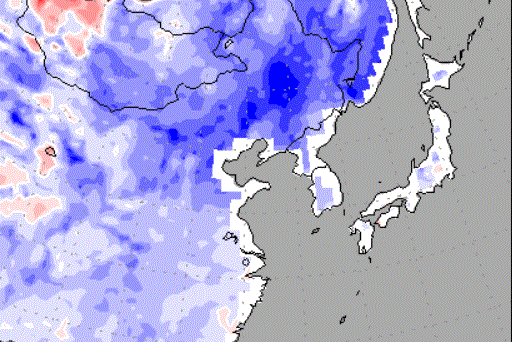
Not only is Southeast Asia being hard hit by unusually bitter cold, but also vast areas of Central Asia, the Middle East, and North Africa. Some of these regions are typically famous for very warm temperatures. More
 
Temp Anomaly
Asia to remain gripped by bitter cold. Forecast anomaly for next seven days (wxmaps.org)

Friday, 25 October 2013

British monk to visit U West from Thailand

Angela Lee (UWest), CC Liu, Ashley Wells, Wisdom Quarterly (9-24-13)
Ajahn Jayasaro with children at assembly, May 2013 (panyaden.ac.th)
 
British monk Ajahn Jayasaro to visit U West
Ajahn ("teacher") Jayasaro (my.groupt.be)
Ajahn Jayasaro (born 1958) from the Isle of Wight, England, began his monastic training in Thailand in 1978. He was among an early set of adopters who sought out the Teaching and Training (Dhamma-Vinaya) as students of legendary Theravada forest meditation teacher Ajahn Chah. Ajahn Jayasaro received full ordination as a monk in 1980 and has lived in Thailand ever since.
 
West goes East then returns to teach
In 2002, after a five-year period as abbot of the Westerner's forest-paradise known as Wat Pah Nanachat ("International Forest Monastery") made famous by the Canadian journalist Bill Ward in his comical travel diary What the Buddha Never Taught, Ven. Jayasaro took up residence in a hermitage at the foot of the Kow Yai mountains in the province of Nakorn Rachasima, Northeast Thailand (Isan). This visit is supported by UWSG, Religious Program, Chaplaincy Program, and the BudaWest Club at UWest.
 
The first Buddhist university in Los Angeles
SCHEDULE
  • Dharma Talk/Meditation (English) Fri., Oct 25, 2013, 6:00-8:00 pm
  • Day Retreat (Thai/English) veg. lunch Sat., Oct. 26, 9:00 am-4:00 pm
  • Dharma Talk/Meditation (English) Sun., Oct. 27, 9:30 am-12:00 pm
  • Location: University of the West, Locke Hall (ED 213)
  • Contacts: Peggy (818) 568-6011 or Aroon.seeda@gmail.com