Showing posts with label protection. Show all posts

Sunday, 10 August 2014

Warding off "evil" spirits (sutra)

Pat Macpherson, Dhr. Seven, Pfc. Sandoval, Wisdom Quarterly; G.P. Malalasekera (DN 32)
Covered in oil and ash with horns in San Martin Tilcajete, March 2011. The paint is used to ward off evil spirits before Lent instead of protective chants (Jorge Luis Plata/Reuters).

.
VULTURE'S PEAK, ancient India - The Four Great Space Kings having set a guard over the four quarters of the Earth's sky, visited the Buddha, saluted him, and sat down respectfully to one side with hosts of ogres (yakkhas).

King Vessavana told the Buddha that the ogres did not, for the most part, believe in the Buddha for the reason that they did not find it pleasant or agreeable to abstain from the things which he declared to be "evil" -- such as the taking of life, stealing, sexual misconduct, false speech, intoxication, and so on.
 
And in order that the Buddha's disciples, retreating to lonesome and remote parts of the forest where the ogres dwell, might find protection from them, King Vessavana suggested that the Buddha might learn the ātānātiya word-rune (rakkha).

The "Four Great Kings" guard the skies of Earth as Sakka's regents in the deva world.
 .
The Buddha consenting by his silence, Vessavana proceeded to recite it. It opens with a salutation to the seven buddhas, beginning with Vipassī Buddha. The remainder contains a list of the devas and other superhuman beings, the Four Great Kings heading the list, who are described at length. Forty-one other devas are mentioned as a kind of appendix or afterthought, all mentioned one after another with no attempt at group division and without any details, in what are, apparently, mnemonic doggerels.
 
A part of the Mahāsamaya Sutra (Sections 10-20) appears to be an improved and enlarged edition of this list of bare names.

The Buddha learned the word-rune (spell, mantra) and taught it to the monastics (wandering ascetics, recluses, hermits, Buddhist monks and nuns).
 
The Atānātiya Sutra is now regarded as a protective chant, and its influence is said to pervade a hundred million world systems (VibhA.430). And DA.iii.969 gives a long description of the ritual followed when reciting it.
 
In Buddhist Sri Lanka, for instance, it is recited with great fervor at the conclusion of ceremonies, particularly in times of illness, in order to ward off evil spirits.
 
It is included in the list of protections found in the Questions of King Milinda (p.151). On the importance of this sutra in the history of India, see Rhys Davids, Buddhist India (pp.219-37).

Sunday, 8 June 2014

College: "affirmative sexual consent" (audio)

CC Liu, Seven, Amber Larson, Pat Macpherson, Wisdom Quarterly; AirTalk (scpr.org, May 30, 2014); Savannah Badalich (Huffington Post), Michael Slate Show (KPFK.org), Sunsara Taylor

Two weeks into my 2nd year at UCLA, I was sexually assaulted by a friend and fellow Bruin during a student government retreat. I was a director within the group... More
Huffington Post? It was sold to a conglomerate (Tom Tomorrow/thismodernworld.org)
.
FEMEN says no to patriarchy and sexism
The California Senate passed a bill Thursday, which requires colleges to incorporate an "affirmative consent standard" when investigating sexual assault [from rape to harassment] complaints.
 
It's an outrage! Not in my India! (AJ)
State lawmakers say college campuses need a cultural change to prevent sexual assaults. Senators Kevin de Leon (D-Los Angeles) and Hannah-Beth Jackson (D-Santa Barbara) -- co-authors of SB 967 -- say sexual relations between students should not leave room for ambiguity.
 
California Lawmaker FBI
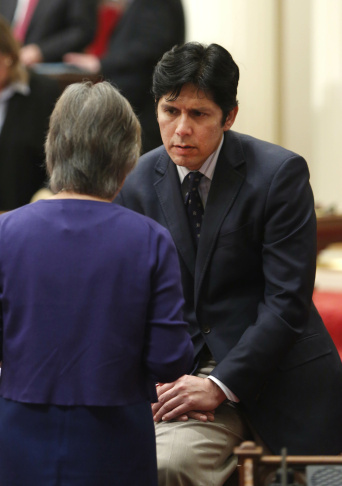
Sen. Kevin de Leon, D-LA (AP)
We know that "No means no [and only yes means yes]," but is there more than one way to give consent to sex? Is this bill primarily about spurring a new attitude toward sex for college students? How would complainants prove they never said yes, and vice versa? LISTEN (17:09)

Guests: Kevin de Leόn, (D-Los Angeles) California Senator who co-authored SB 967 and Mark Hathaway, private defense attorney in LA, whose practice includes students and others accused of sexual misconduct.

Wednesday, 12 March 2014

Native American Walkabout 2014 (March 22)

Xochitl, Pat Macpherson, CC Liu, Wisdom Quarterly; ArroyoSeco.org (Facebook)
If the Buddha -- a wanderer -- went on a walkabout, what would he be doing? "May peace and balance be restored to Mother Earth and all who walk upon her" (Eco_Bela/flickr.com)

Buddha Mind, Buddha Body: Walking Toward Enlightenment (Thich Nhat Hanh)
Tim Martinez led hikers to Hahamongna (JPL/Devil's Gate Dam), where they learned about its rich Native American heritage and how to protect it. Comments on the Devil's Gate sediment removal draft EIR were due on Jan. 21, 2014. (See here for more information).
View of flood control basin as it fills from atop Devils Gate Dam with JPL in distance
 
Old Los Angeles (tongvapeople.org)
What better way to celebrate the equinox and welcome spring than to set off on an aboriginal walkabout?

The original inhabitants of Los Angeles were the Tongva, who considered the Hahamongna watershed "sacred" land. The rain that falls in the forest rushes down the mountains and percolates through springs rising before flooding down into the Los Angeles Basin into the Pacific Ocean.

The Foundation
One of the most spectacular accomplishments of the Arroyo Seco Foundation (ASF) is reestablishing the Arroyo chub, a native fish in this major tributary of the Los Angeles River.
 
The ASF mission is to preserve and enhance the Arroyo Seco (dry gulch) from the San Gabriel Mountains down to the Los Angeles River, reforest the region, and promote environmental and cultural (Tongva/Gabrielino and Chumash) awareness of one of Southern California’s greatest natural resources. More
Hahamongna Watershed Park, next to dam and its usually dry basin (PasadenaWeekly.com)