Showing posts with label grand canyon. Show all posts

Wednesday, 6 August 2014

America's Buddhist burial mound at Sedona

Crystal Quintero, Dhr. Seven, Wisdom Quarterly; photographers Pete/Karevil, Glen Carlin
Vajrayana Buddhist prayer flags flying over Boudhanath, Nepal (Pete/Karnevil/flickr)
 
Wisdom and Compassion
The dome at the base of Boudhanath Stupa ("Enlightenment Reliquary," a UNESCO World Heritage Site) outside Kathmandu, Nepal represents the entire world. When a person awakens (represented by the opening of the eyes of wisdom and compassion) from the illusory bonds of the world, that person has reached the state of enlightenment. Complete liberation (nirvana) awaits and is already visible when this is accomplished.


America needs a great Buddhist stupa!
Xochitl, Amber Larson, Dhr. Seven, Ashley Wells, Wisdom Quarterly
Sedona's Buddhist Stupa, Sedona, Arizona (Glen_Carlin/flickr.com/collage)
 
Flags over Sedona Stupa (Glen Carlin)
We have one! We have other smaller ones, too. Every Buddhist temple in America wants its own old-world reliquary, a white mound to entomb spiritual treasures.

Pagodas, dagabas, chortans, mandala-mounds, and so on all house priceless reliquary objects -- either minute amounts of the historical Buddha's funerary ashes or relics (strange physical byproducts of enlightenment manifesting as beautiful glass-like beads and other formations that survive or are produced during cremation) or the remains of arhats, honored teachers, and world rulers (chakravartins).

Then there's the great Tibetan stupa at SMC in Colorado, too (shambhalamountain.org)
  • Small side-chortan in Sedona
    Wait a minute. How in the world could there be so many of the Buddha's cremation ashes to supply all the world's stupas? It's ludicrous; it's like all that wood the Medieval Christians sold as authentic bits of Christ's own Roman cross. The answer is very simple. If we begin with one cup of actual cremation remains, then we can divide that, but as with any precious powder, it is watered down with a neutral substance: one part relic ashes with one million parts neutral ashes = 1,000,001 parts authentic Buddha ashes. Stranger still, "relics" multiply, so they are not limited to what was available the first day. Moreover, not only the Buddha's remains are used but those of many arhats. There are still arhats, still funeral pyres, cremation remains, and so long as the Dharma is practiced even by one person, there is a chance for more.
Amazing Anasazi (Hopi) ruins at Tuzigoot, Clarkdale, Arizona (americansouthwest.net)
 
Wooden Buddha (Glen Carlin)
City councils are very reluctant to approve of such building requests. There is a campaign to bring one to Los Angeles by the Los Angeles Buddhist Vihara.
 
But one already exists, built by Tibetan Buddhists in northern California. Across the USA there are small ones and plans, or at least dreams, for more.

Buddha profile (Glen Carlin)
However, there is at least one great one already: It is in our spiritual center where Native Americans recognized vortices of power and energy, Sedona, Arizona.

Wisdom Quarterly visited with Xochitl and Dr. Rei Rei to visit the Anasazi sites and this amazing hidden gem hidden on the west side of the American Southwest's most beautiful town.

To visit, choose the cooler months. Sedona is amazing year round, with winter snows the blanket the red rocks. It is one of the most picturesque landscapes in the world, a lower extension of the once Buddhist Grand Canyon. (How could the Grand Canyon ever have been Buddhist? It was).
Hovering above the massive stupa is a gorgeous wooden Buddha carving surrounded by many American offerings: trinkets, flowers, incense, glass beads, Native American jewelry, coins, notes, flags...adding to the splendor of the U.S. Southwest (Glen_Carlin/flickr.com).
Sedona, Arizona is "the most beautiful place on earth" (visitsedona.com)

Tuesday, 8 April 2014

Were Anasazi [Native Americans] Buddhists?

Dhr. Seven (ed.), Wisdom Quarterly; Hendon Harris (chinesediscoveramerica.com)

The most famous building in the entire Tibetan plateau, Potala Pueblo, Lhasa (HCC)
Tibetan store (Aaron Berkovich/flickr)
Were the Anasazi, who are known to many as the Native Americans of the Southwest, Buddhists? 
 
Buddhism began in the sixth century BCE in India [although the Buddha was from neighboring Afghanistan -- the ancient northwestern frontier of Gandhara and to points west -- where the Dharma quickly took hold among his familial clan simultaneous with its spread in Magadha/modern Bihar, India].

It soon spread to ancient Greece and parts of its empire in Central Asia [Bactria, Sogdiana, etc., where Alexander the Great left yet another "Alexandria" in Kandahar, Afghanistan, when it was part of the Hellenic Empire], the geopolitical Middle East, and some believe to Europe (Kalmykia) as far north as Scandinavia and even North America, which was partly ancient Mexico, a spread Rick Fields documented in How the Swans Came to the Lake: A Narrative History of Buddhism in America and Edward P. Vining's Inglorious Columbus, which recounts how a group of Afghan Buddhist monks led by Chinese Buddhist missionary Hwui Shan  "discovered" America and therefore interacted with the Native Americans long before the genocidal, Polish, Jewish Christopher Columbus].

This is where the Native Anasazi (or Ancestral Puebloan people, such as the Hopi, Hisatsinom, and others) come in.
One piece of evidence is the ancient Buddhist proclivity for carving building and shrines into mountains and creating distinctive rock formations. They are now found all over the world and bear a likeness to that favored by Vedic Hinduism/Buddhism. Buddhism ultimately reached China in the first century ACE, after it had made a grand impact on Greece bringing in many Eastern philosophical idea -- the atom (kalapa), democratic voting and rudimentary parliamentary rules of order (Sangha organization according to the Vinaya), and so on.
 
The Anasazi culture mysteriously appeared in North America at an undetermined time and disappeared about 1300 ACE. Where did these incredibly advanced people come from? How and why did they just as mysteriously disappear? We know they were astronomers because we have found some of their observatories. We know they were road builders because we have found their roads. We know they were incredibly proficient at stone carving and masonry because we have found evidence of their work and architectural styles in the Four Corners area of the Southwest.
 
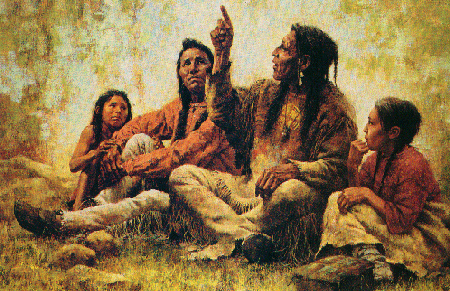
Native American indigenous Apache, remnant Anasazi spirit dancers, 1887 (Native Skeptic)
 
These architectural styles and art carved in stone provide the best evidence that the source of the Anasazi culture with its advanced knowledge and artistry was Vedic Asia.
 
This is a provocative statement likely to offend a few scholars. However, if one takes the time to examine the art and architecture, compare examples from each culture side by side, it will provide clear evidence of their connection.
 
Rock cliffs of the Grand Canyon, Arizona
If one were to start by using the image search terms “Were the Anasazi people Buddhist?” one would find that the architectural styles of the Puebloan people (Anasazi) and Chinese Buddhists are so similar that they show up interchangeably on the image page clearly demonstrating that they used the same techniques for carving out rock caves. (See examples of rock caves carved high on the cliffs of Bandelier National Park, New Mexico. They bear an incredible likeness to Asian Buddhist caves). 

Further search “Architecture-Pueblo complexes and Great Houses” or “Bandelier National Park Rock Cave Images” to see more). Compare these to the Caves of Dunhuang and the Longmen Caves in China or to the recently discovered Shangri-la Buddhist Caves of Nepal all of which are carved high up on rock faces.
 
Luoyang Shaolin Buddhist temple (G-W-H)
For evidence of IDENTICAL construction techniques used in ancient China and in ancient North America “zoom in” on these pictures of the rock-cut caves at Bandelier National Monument, USA and the Caves at Dunhuang, China.  Both locations, separated by the vast Pacific Ocean, show identical horizontal rows of small bored holes cut into the cliff faces perhaps to insert wooden pole frames for shade canopies for each location thousands of miles apart.
 
Tibetan structures are like Puebloan dwellings of the Southwest. This American adobe complex was likely built between 1000-1450 AD near Taos, New Mexico, USA (wiki).
  
Rock-cut remains, Bandelier, NM, USA
Ancient Buddhists seem to have been fascinated by rocks shaped a particular way. Here is a very unusually shaped rock in Thailand and an almost identically shaped rock in the Bisti Badlands, New Mexico. 
 
The Bisti Badlands are an interesting place in the Four Corners region, where the Anasazi people lived. However, the common opinion is that “The Canadian Goose Bisti,” “The Sleeping Lizard Bisti,” “The Flying Turtle Bisti,” and so on are simply random acts of erosion. A more plausible explanation is that these rock formations are ruins of a people exhibiting a Vedic cultural heritage because of at least three different types of rock formations there.
  1. Mushroom rocks like the ones found at Mushroom State Park, Kansas are found throughout these 45,000 acres of badlands. “Mushroom Rocks” are the chattra symbols of ancient Buddhism. Chattra is the Sanskrit word for “mushroom,” which is also the word for the Parasol, one of the Eight Auspicious Symbols of Buddhism. More

Thursday, 27 March 2014

Buddhist cave temples found in Grand Canyon

Dhr. Seven and Ashley Wells (eds.), Wisdom Quarterly, Jack Andrews, "Was the carved 'installation' in the Grand Canyon an ancient Buddhist temple?" (Lost Civilizations / in Spanish)
The Gazette headlines of April 5, 1909 document the reality of these unbelievably astounding finds, some of the greatest US archeological discoveries ever. Why were they covered up?
 
Better than feathers (Jamyang190/blog)
In the vast Grand Canyon of Arizona, USA, there is an Egyptian-style tomb full of Buddhist art showing that Asians migrated to America and brought the Dharma and advanced technology to Native Americans in the distant past. It is similar to the Valley of Kings in Luxor, Egypt. While this will be too fantastic for most readers to believe, the trail of evidence begins with an article published on the front page of the Arizona Gazette on April 5, 1909. It claims that just such a rock-cut cavern temple full of Buddhist, Vedic, and Egyptian art and architecture, hieroglyphs, and mummies -- an almost incomprehensible wealth of archaeological treasures -- was discovered.

Marble Canyon, Grand Canyon Nat'l Park
"According to the story related to the Gazette by Mr. Kinkaid, the archaeologists of the Smithsonian Institute, which is financing the expeditions, have made discoveries which almost conclusively prove that the race which inhabited this mysterious cavern, hewn in solid rock by human hands, was of oriental origin..." - Arizona Gazette, April 5, 1909

"First, I would impress that the cavern is nearly inaccessible. The entrance is 1,486 feet down the sheer canyon wall"G.E. Kincaid, 1909 

Was the carved "installation" in the Grand Canyon an ancient Buddhist temple?
 
Mt. Hengshan, China, near Datong, Shanxi Province
Photos show how ancient Chinese Buddhist monks went out of there way to carve their temples in cliff faces in remote and inaccessible cliff-lined river canyons.

Other clues to the speculation that the installation may have been used for such a purpose are broken swords and cups and other items, often used ceremonially in ancient Chinese Buddhist temples, were found in the cave in 1909. The cave lies in Marble Canyon (above photo), which is a steep limestone wall-lined canyon. It it is similar to the Hanging or Mid-Air temples on Mount Hengshan, China, southeast of Datong, Shanxi Province.

They cling precariously to the cliff face and illustrate determined isolation of the early Buddhist communities in China. 

Founded in pre-Tang Northern Wei Dynasty, the temples continued to function during the Tang period and were subsequently restored in the Ming and Qing dynasties (Tang China: Vision and Splendour of a Golden Age by Edmund Capon with photography by Werner Forman, Macdonald Orbis, 1989). 
 
Bezeklik Thousand Buddha Caves (left) high on the cliffs of the west Mutou Valley under the Flaming Mountains, 27 miles (45 km) east of Turpan near Shanshan in Western China's Uygur Autonomous Region, northeast of Taklamakan Desert, Xinjiang. The caves feature  ancient Buddhist monasteries carved into cliffs dating from ~400 AD to 1,300  AD. More
  
"Approximately 70 km. (45 miles) east of Turfan lie the Buddhist cave-cliff temples of Bezeklik, most of which were originally built in the open and joined by wooden porches.
 
Grand Canyon Egyptian finds (lightworkers.org)
"Others were carved into the living rock in the manner of cave temples. The height of activity at Bezeklik, on the evidence of surviving wall paintings, was the Tang Dynasty, when Silk Road trade brought travelers, merchants, and missionaries to the temples in search of sanctuary and spiritual comfort.

Today they are still difficult to reach, for the monks endeavored, even here in the desert wastelands of Chinese Central Asia, to build their temples as far away as possible from the real and profane world" (Ibid.)
 
Mai-Chi caves, Chinling range, China (Magnificant China, Hong Kong, Hua Hsia Publ., 1972)
 
Indian Legend
Burmese cave temple (Nadia Isakova/flickr)
It is notable that among the Hopis, the tradition is told that their ancestors once lived in an underworld in the Grand Canyon. This went on until dissension arose between the good and the bad, the people of one heart, the people of two hearts.
 
(Manchoto), who was their chief, counseled them to leave the underworld, but there was no way out. The chief then caused a tree to grow up and pierce the roof of the underworld, and then the people of one heart climbed out.

They tarried by Palsiaval (Red River), which is the Colorado river, and grew grain and corn. They sent out a message to the Temple of the Sun, asking for blessings of peace, goodwill, and rain for the people of one heart.

That messenger never returned, but today at the Hopi village at sundown can be seen the old men of the tribe out on the housetops gazing towards the Sun, looking for the messenger. When he returns, their land and ancient dwelling place will be restored to them. That is the tradition. More
The Kogi, Sierra Nevada (RinzaisMarket.com, Sedona, AZ, world-healing.com)

Wednesday, 26 March 2014

Native Buddhist artifacts, Grand Canyon (video)

xDhr. Seven, Pat Macpherson (eds.), Wisdom Quarterly; David Hatcher Childress (davidhatcherchildress.com), host George Noory (coasttocoastam.com); Karen Slaughter
Lightning bolt illuminates the Grand Canyon (news.yahoo.com, May 14, 2013)

Ancient Mesoamerican site, modern Mexico, panoramic view from pyramids (Tula)

 
Egypt in the Grand Canyon
Lost Cities: Ancient Mysteries of the Southwest
archeologist and author David Hatcher Childress discussed his research into Buddhist, Hindu (Vedic), and Egyptian artifacts found in the Grand Canyon, USA.

Did Egyptians visit North America thousands of years ago? Childress reveals his investigation into the history of the Olmecs in the south (Mesoamerica) -- with a great pyramid at La Venta, Mexico -- and the amazing technologies they possessed.

"The more and more I've looked into it over the years, what I've concluded is that, Yes, there is something to it," Childress says of the famous 1909 American media story: At that time a Smithsonian-sponsored expedition into the Grand Canyon found and collected Egyptian and Buddhist artifacts. 

Ancient bald Olmec sitting pose
Childress is off to the American Southwest, traversing the region's deserts, mountains, and forests investigating archeological mysteries. He starts in northern Mexico and searches for the lost mines of the Aztecs and continues north to west Texas, delving into the mysteries of Big Bend, including mysterious Phoenician tablets discovered there and the strange lights of Marfa. He continues northward into New Mexico, where he stumbles upon a hollow mountain with gold bars hidden inside! In Arizona he investigates tales of Egyptian catacombs in the Grand Canyon... In Nevada and California Childress checks out mummified giants and weird tunnels in Death Valley, plus he searches the Mohave Desert for the mysterious remains of ancient dwellers alongside lakes that dried up tens of thousands of years ago...
 
Noble disciple Sayalay Susila, Grand Canyon
He shares one confounding piece of evidence to mainstream history which claims that Native Americans did not practice mummification. "The Thing," a Southwestern roadside attraction, shows that mummies were found in the "New" World.

Mythical meditator (Las Limas)
This odd mummy of a woman and child together was "privately purchased in 1910," according to his sources. Childress theorized that it "may well be one of the artifacts from the caves." Speculating on why this information has been shrouded in secrecy, Childress speculated that "today, history is politically correct, not what happened, but what they want to have happened."
 
He refutes the mainstream belief that ancient peoples were fairly isolated, asserting that "Oceans were highways, not barriers." To support this idea, he points out that the Egyptians, Romans, and Phoenicians had ships bigger than those used by Columbus.

By the third hour of the interview, Childress got into his work exploring the ancient and mysterious Olmec culture of ancient Mexico, which was only discovered in the 1940s. He points out that the Olmecs were a unique looking people who may have been responsible for many works ascribed to the Mayans (Maya), such as very precise and famous cosmic calendar, which share a Buddhist/Vedic view of time measured in epochs and aeons.

Naga guides Olmec pilot (Delange)
Regarding fantastic ancient technologies, Childress discussed the discovery of an old Indian book about the ancient spacecraft, which are called vimanas in ancient India. The Olmecs described metal crafts using mercury as fuel. [This form of propulsion, which is based on manipulating gravity by swirling the mercury within the craft, was detailed in Popular Mechanics and elsewhere decades ago.] More
 
Sitchin with massive Olmec head (cae2k.com)

Friday, 4 October 2013

Environment: "A Fierce Green Fire" (film)

From the Academy Award-nominated director of "Berkeley in the Sixties," AFGF is narrated by Robert Redford, Meryl Streep, Ashley Judd, Van Jones, and and Isabel Allende.

Spanning 50 years of grassroots and global activism, this award winning Sundance documentary A Fierce Green Fire brings to light the vital stories of the environmental movement where people fought -- and succeeded -- against enormous odds. From halting dams in the Grand Canyon to fighting toxic waste at Love Canal, Greenpeace to Chico Mendes, climate change to the promise of transforming our civilization, this film is "nothing less than the history of environmentalism itself" (Los Angeles Times).