Showing posts with label New Mexico. Show all posts

Tuesday, 20 May 2014

Underground worlds: Buddhist Russia

Amber Larson, Xochitl, Pat Macpherson, Pfc. Sandoval, Wisdom Quarterly; RT News (facebook); Lindsey Bright (curatormagazine.com)
There are habitable caverns all over the planet (Buddha cave/Chatchai laka-mankong/flickr)


RT covers the US well
(RT) Many interesting things are hidden under the ground. In Odessa, Ukraine (formerly Czarist Russia and the USSR, part of Russia's Far East in Northern Asia), man made caves, caverns, and catacombs are scattered across the region -- stretching 2,500 km long, making them the longest in the world, but not necessarily the biggest, however.

These so-called catacombs were home to partisan bases during World War II. In Vladivostok -- the main Russian military naval base in the Far East -- engineers built a fortress at the beginning of the 20th century. Moreover, the largest underground Russian church is hidden in Penza, according to RT.

D.U.M.B.s
What greed overcomes the U.S. MIC?
Are there similar deep underground military bases in the United States? Better believe it. They exist under Los Angeles but are most famously concentrated in Nevada and New Mexico, particularly the Archuleta Mesa (Dulce, NM) and in and around the Grand Canyon, Arizona.

These were not built exclusively by the U.S. military, CIA, and MIC (military-industrial complex). Native Americans say they were the home of humanoids referred to as the "Ant People," who live there and saved the lives of humans on the surface from time to time by welcoming them into their subterranean cities, which are not dark or lifeless but fully fleshed out and high tech.
 
Archuleta Mesa and its off-planet inhabitants
Archuleta Mesa, a bluff in the desert mountains of Dulce, New Mexico
 
Archuleta Mesa is the central geographic feature of Dulce, New Mexico, the heart of the Jicarilla Apache Nation.... In 2009, 120 people from around the world and the area attended the Dulce Underground UFO Base Conference. One local in attendance was Horacio Garcia. I know Garcia well. I know his kids and family and have spent time with them.

Big, kind, with baggy pants, bandana often tied low on his forehead and tattoos covering his arms, he is known for his knowledge on aliens. In Dec. 2011, I asked him about the Greys and the Dulce Alien Base.

[He answered,] “I don’t have to tell you anything. In a few weeks, everybody will know. The aliens will reveal themselves,” Garcia said. A few weeks passed, and I felt, thought, saw, and believed the same. If I was looking at aliens or alien artifacts, I didn’t see them. Yet, many claim to have seen strange and bizarre sights in Dulce and Lumberton, New Mexico -- coyotes that turn into humans, big orbs of light floating in the valleys, dogs that run faster than a speeding car, Bigfoot (Sasquatches), cow fetuses with the face of a tiger (government research chimeras) -- and (extraterrestrial) aliens, specifically, the Greys. More
 
It is interesting to note that according to Hindu and later Buddhist cosmologies, "heavens," usually referring to celestial worlds, are described as existing in space as well as underground inside this planet, which Wisdom Quarterly has covered.

Russia, China beat CIA/MIC: "Pipelineistan"
Dictator Vlad Putin and China's President Xi Jinping attend a welcoming ceremony at the Xijiao State Guest house ahead of the 4th Conference on Interaction and Confidence Building Measures in Asia (CICA) summit in Shanghai on May 20, 2014 (Alexey Druzhinin/AFP).
 
Future "collateral damage," Afghanistan
While the West imposes sanctions on Russia, Russia is making a deal with China as each has something to offer the other, David Kuo, CEO of the Motley Fool Singapore financial Website, told RT. [One of the real reasons the U.S. fulfilled its longstanding plans to invade innocent Afghanistan -- after fomenting controversy by creating "the Taliban" with the help of Pakistani intelligence, demolishing the Buddhas of Bamiyan, and using 9/11 as the ultimate pretext for invasion, revenge, and an endless war on terror/fear in the Middle East and Wahabhi-Islam -- was for oil. There was a plan to build a massive pipeline to facilitate the plans of American and Western multinational corporations. "No blood for oil" protesters aware of this used to say.] More

Tuesday, 8 April 2014

Were Anasazi [Native Americans] Buddhists?

Dhr. Seven (ed.), Wisdom Quarterly; Hendon Harris (chinesediscoveramerica.com)

The most famous building in the entire Tibetan plateau, Potala Pueblo, Lhasa (HCC)
Tibetan store (Aaron Berkovich/flickr)
Were the Anasazi, who are known to many as the Native Americans of the Southwest, Buddhists? 
 
Buddhism began in the sixth century BCE in India [although the Buddha was from neighboring Afghanistan -- the ancient northwestern frontier of Gandhara and to points west -- where the Dharma quickly took hold among his familial clan simultaneous with its spread in Magadha/modern Bihar, India].

It soon spread to ancient Greece and parts of its empire in Central Asia [Bactria, Sogdiana, etc., where Alexander the Great left yet another "Alexandria" in Kandahar, Afghanistan, when it was part of the Hellenic Empire], the geopolitical Middle East, and some believe to Europe (Kalmykia) as far north as Scandinavia and even North America, which was partly ancient Mexico, a spread Rick Fields documented in How the Swans Came to the Lake: A Narrative History of Buddhism in America and Edward P. Vining's Inglorious Columbus, which recounts how a group of Afghan Buddhist monks led by Chinese Buddhist missionary Hwui Shan  "discovered" America and therefore interacted with the Native Americans long before the genocidal, Polish, Jewish Christopher Columbus].

This is where the Native Anasazi (or Ancestral Puebloan people, such as the Hopi, Hisatsinom, and others) come in.
One piece of evidence is the ancient Buddhist proclivity for carving building and shrines into mountains and creating distinctive rock formations. They are now found all over the world and bear a likeness to that favored by Vedic Hinduism/Buddhism. Buddhism ultimately reached China in the first century ACE, after it had made a grand impact on Greece bringing in many Eastern philosophical idea -- the atom (kalapa), democratic voting and rudimentary parliamentary rules of order (Sangha organization according to the Vinaya), and so on.
 
The Anasazi culture mysteriously appeared in North America at an undetermined time and disappeared about 1300 ACE. Where did these incredibly advanced people come from? How and why did they just as mysteriously disappear? We know they were astronomers because we have found some of their observatories. We know they were road builders because we have found their roads. We know they were incredibly proficient at stone carving and masonry because we have found evidence of their work and architectural styles in the Four Corners area of the Southwest.
 
Native American indigenous Apache, remnant Anasazi spirit dancers, 1887 (Native Skeptic)
 
These architectural styles and art carved in stone provide the best evidence that the source of the Anasazi culture with its advanced knowledge and artistry was Vedic Asia.
 
This is a provocative statement likely to offend a few scholars. However, if one takes the time to examine the art and architecture, compare examples from each culture side by side, it will provide clear evidence of their connection.
 
Rock cliffs of the Grand Canyon, Arizona
If one were to start by using the image search terms “Were the Anasazi people Buddhist?” one would find that the architectural styles of the Puebloan people (Anasazi) and Chinese Buddhists are so similar that they show up interchangeably on the image page clearly demonstrating that they used the same techniques for carving out rock caves. (See examples of rock caves carved high on the cliffs of Bandelier National Park, New Mexico. They bear an incredible likeness to Asian Buddhist caves). 

Further search “Architecture-Pueblo complexes and Great Houses” or “Bandelier National Park Rock Cave Images” to see more). Compare these to the Caves of Dunhuang and the Longmen Caves in China or to the recently discovered Shangri-la Buddhist Caves of Nepal all of which are carved high up on rock faces.
 
Luoyang Shaolin Buddhist temple (G-W-H)
For evidence of IDENTICAL construction techniques used in ancient China and in ancient North America “zoom in” on these pictures of the rock-cut caves at Bandelier National Monument, USA and the Caves at Dunhuang, China.  Both locations, separated by the vast Pacific Ocean, show identical horizontal rows of small bored holes cut into the cliff faces perhaps to insert wooden pole frames for shade canopies for each location thousands of miles apart.
 
Tibetan structures are like Puebloan dwellings of the Southwest. This American adobe complex was likely built between 1000-1450 AD near Taos, New Mexico, USA (wiki).
  
Rock-cut remains, Bandelier, NM, USA
Ancient Buddhists seem to have been fascinated by rocks shaped a particular way. Here is a very unusually shaped rock in Thailand and an almost identically shaped rock in the Bisti Badlands, New Mexico. 
 
The Bisti Badlands are an interesting place in the Four Corners region, where the Anasazi people lived. However, the common opinion is that “The Canadian Goose Bisti,” “The Sleeping Lizard Bisti,” “The Flying Turtle Bisti,” and so on are simply random acts of erosion. A more plausible explanation is that these rock formations are ruins of a people exhibiting a Vedic cultural heritage because of at least three different types of rock formations there.
  1. Mushroom rocks like the ones found at Mushroom State Park, Kansas are found throughout these 45,000 acres of badlands. “Mushroom Rocks” are the chattra symbols of ancient Buddhism. Chattra is the Sanskrit word for “mushroom,” which is also the word for the Parasol, one of the Eight Auspicious Symbols of Buddhism. More

Wednesday, 12 March 2014

The Tibet-Pueblo [American Indian] Connection

Xochitl, CC Liu (eds.), Wisdom Quarterly; Tricycle Magazine (tricycle.com)
The world's largest and most famous pueblo: Potala Palace, Lhasa, Tibet (Adam Lai/flickr)
Tibet's Potala Palacet under construction? No, this is the side of a Zuni pueblo complex in New Mexico, which serves as home and ceremonial center (Timothy H. O'Sullivan/GEH).

From the Roof of the World to the Land of Enchantment: The Tibet-Pueblo Connection
We look nothing like our brothers and sisters in the USA...except for many obvious signs
   
“When the iron bird flies,
the Dharma will come to the land of the red man.”
-Ninth-century prophecy by Guru Rinpoche

They look nothing like us (Elk Foot)
In the incongruous atmosphere of the Wilshire Hotel in Los Angeles, an extraordinary encounter took place in 1979. During the Dalai Lama’s first visit to North America, he met with three Hopi elders. 
 
The spiritual leaders spoke in their native languages. Delegation head Grandfather David’s first words to the Dalai Lama were: “Welcome home.”
 
The Dalai Lama laughed, noting the striking resemblance of the turquoise around Grandfather David’s neck to that of his homeland. He replied: “And where did you get your turquoise?”
 
Hopi Kachina artifacts (scpr.org)
Since that initial meeting, the Dalai Lama has visited Santa Fe to meet with Pueblo leaders, Tibetan lamas have engaged in numerous dialogues with Hopis and other Southwestern Indians, and now, through a special resettlement program to bring Tibetan refugees to the United States, New Mexico has become a central home for relocated Tibetan families.
 
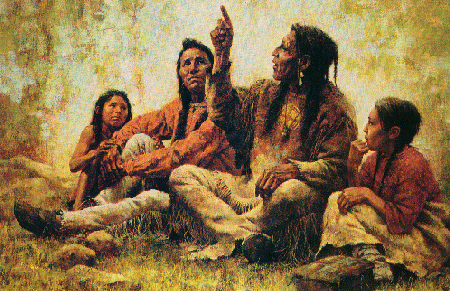
As exchanges become increasingly common between Native Americans and Tibetans, a sense of kinship and solidarity has developed between the cultures. While displacement and invasion have forced Tibetans to reach out to the global community in search of allies, the Hopi and other Southwestern Native Americans have sought an audience for their message of world peace and harmony with the Earth.

Thangka of Six Realms of 31 in the Wheel of Samsara, the cycle of rebirth and death
  
Vajrayana, Hopi? There's a relation (wn.com)
These encounters have created a context for the activities of writers and activists who are trying to bridge the two cultures. A flurry of books and articles have been published, arguing that Tibetans and Native Americans may share a common ancestry.
 
The perception of similarity between Native Americans of the southwest and the Tibetans is undeniably striking. Beyond a common physicality and the wearing of turquoise jewelry, parallels include the abundant use of silver and coral, the colors and patterns of textiles, and long, braided hair, sometimes decorated, worn by both men and women.
 
Book of the Hopi (Frank Waters/goodreads.com)
When William Pacheco, a Pueblo student, visited a Tibetan refugee camp in India, people often spoke Tibetan to him, assuming that he was one of them. “Tibetans and Native American Pueblo people share a fondness for chile, though Tibetans claim Pueblo chile is too mild,” says Pacheco.
 
Even before most Westerners knew where Tibet was, much less the extent of its people’s suffering, and almost 20 years before the advent of the Tibetan diaspora, cultural affinities between these two people were noted by Frank Waters in his landmark work Book of the Hopi (1963).
 
Waters’ analysis went below the surface, citing corresponding systems of chakras, or [subtle] energy spots [wheels] within the body meridians, that were used to cultivate cosmic awareness. 
 
Native American dancers, New Mexico
In The Masked Gods, a book about Pueblo and Navajo ceremonialism published in 1950, Waters observed that the Zuni Shalako dance symbolically mirrored the Tibetan journey of the dead
 
“To understand [the Zuni Indian Shalako dance’s] meaning, we must bear in mind all that we have learned of Pueblo and Navaho [sic] eschatology and its parallels found in the Bardo Thodal, The Tibetan Book of the Dead, in The Secret of the Golden Flower, the Chinese Book of Life, and in the Egyptian Book of the Dead.”

The Tibetan Book of the Dead (HB)
Many Earth-based cultures steeped in a shamanic tradition share spiritual motifs (hence the broad comparison made by Waters).
 
This could account for some similarities, such as Navajo and Tibetan sand painting, and cosmic themes found in Tibetan and traditional Pueblo dances. More

Sunday, 29 December 2013

ZEN: Roshi Joan Halifax (video)

Wisdom Quarterly; Krista Tippett (onbeing.org, 12-26-13), Roshi Joan Halifax (upaya.org)

"The craft of loving-kindness is the everyday face of wisdom and the ordinary hand of compassion. This wisdom face, this hand of mercy, is never realized alone but always with and through others." - Roshi Joan Halifax (upaya.org)
 
Joan Halifax on Compassion's Edge States and Caring Better
It's easy to feel overwhelmed by all the bad news and horrific pictures in the world. This is a form of empathy, Joan Halifax says, that works against us. The Zen abbess (Upaya.org) and medical anthropologist has bracing, nourishing thoughts on finding buoyancy rather than burnout -- or compassion fatigue -- in how we work, live, and care.
(Library of Congress) Joan Halifax talks about empathy and compassion
on the part of caregivers who are tending to the ill and dying. 

Joan Halifax Roshi is a Buddhist teacher, Zen priestess, medical anthropologist, and author. She is founder, abbess, and head teacher of Upaya Zen Center, a Buddhist monastery in Santa Fe, New Mexico. She has worked in the area of death and dying for over 30 years and is director of the Project On Being with Dying. For the past 25 years, she has been active in environmental work.