Showing posts with label genetics. Show all posts

Tuesday, 7 January 2014

Hominoids, evolution, and us (video)

Pat Macpherson, Dhr. Seven, CC Liu (eds.), Wisdom Quarterly; LloydPye.com; SciShow
Science vs. science: We did not evolve by gradual transition as we are taught (26:50).
Human origins? Everything we are told is wrong. But science and truth will surface.
 
The revolving evolving theory (RU)
(Nov. 2011) Lecturer Lloyd Pye puts it all together -- human origins and who we are as a species. Pye explains, with an amazing degree of scientific certainty, the four types of hominids on the Earth today (their archeological lines and distribution on the planet). Why has Wisdom Quarterly been talking about cryptozoology, "forbidden" archeology, ancient Indian and Sumerian mythology, or any other "outlandish" topic? We dare to question, to find in these verboten topics something about ourselves as earthling human beings. There are other kinds of humans, as we have pointed out before. But it will be a long time before mainstream science will admit its biases, errors, and cover-ups.

Hominoids (primates, prehumans): Yetis (upper montane, Himalayan range), Sasquatches (lower montane forests generally peaceful, probably omnivorous mainly-plant eaters, to be distinguished from cannibals, which Native Americans and Forest Service anthropologist Kathy Moskowitz Strain call "Hairy Man" and consider human), Almas (lower montane, possibly remnant Neanderthals, a human species surviving in Southern Russia and Western China), and Agogwes or the pygmies of the group mainly residing in jungles (South America [duende?], Africa, Indonesia). Where this would leave Australia's Yowie/Yahoo is unclear, but it is described as a Sasquatch by Aboriginals down under.
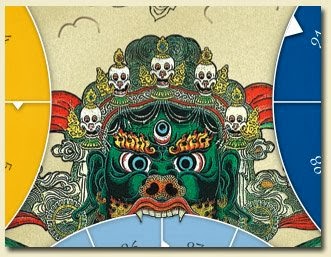
All of these "ogres" may be described by the general Buddhist, Hindu, and Jain term "yaksha" (yakshi, yakkha, yakshasa, rakshasa) -- intelligent brutes and beasts living apart from humans. The most famous is featured in the texts by the name of the Yakkha Alavaka. Yakkhas are cannibalistic hominoid* creatures so crafty and mean that the term is often simply translated as "demon." This is not to suggest that they are actually "demons" (titans, hellions) or devils, but simply brutally callous to human suffering.
The Buddha and the ogre (yakkha) Alavaka
The closest Buddhism comes to a "creation myth" is the arrival of advanced life forms on Earth (Bhumi) from space/sky (akasha deva loka) or "the heavens," a celestial plane. They then devolve into us, "Man." Interestingly, the word for the human realm is manusya-loka. This is gleaned from the Aggañña Sutra. What most fail to notice is that this discourse, often translated as "A Buddhist Genesis," does not talk about how life or existence originated. The story is about how "human" or humanoid life arrives on this planet cyclically. This did not happen one time; it happens over and over. The Buddha is famous for using Vedic lore and popular conceptions, imbuing them with a lesson, a parable of sorts. The sutra is very general and covers spans of time only Michael Cremo could countenance because ancient Indian time is measured in great aeons (maha kalpas), ages (kalpas), and epochs, which are indeterminate periods of time too large to measure and staggering to contemplate.
 
We are lied to about our origins on Earth
*HOMINOID: Some or all hominoids are also called "apes" [humans being the "naked ape" according to Desmond Morris; see below]. However, "ape" is used in different senses. It has been used as a synonym for "monkey" or for any tailless primate with a humanlike appearance. So the Barbary macaque, a kind of monkey, is popularly called the "Barbary ape" to indicate its lack of a tail. Biologists have used "ape" to mean a member of the superfamily Hominoidea other than humans, or more recently to mean all members of the superfamily Hominoidea, so that "ape" becomes another word for "hominoid." See Primate: Historical and modern terminology.

(Nov. 2013) The SciShow (Subbable, Facebook, Tumblr) explains where this over-simplified "March of Progress" magazine image of Darwin's evolution comes from. The scientist who used it was not confused, but we have been led to take this literally. What is it actually supposed to mean? SOURCES: wiki, evolution.berkeley.edu, mentalfloss.com, sci-news.com
  
The truth is much stranger than fiction.
We may be related to the "apes," but we did not evolve on Earth as they did. Archeologist Michael Cremo has found and presented evidence for the extreme antiquity of "modern" humans (Homo sapien sapiens). We are far older than 120,000 years, far older than 1,000,000 years, older than 100,000,000 years... How is this possible? What was here, what has been here and come to its demise, did not evolve from the popular fossil record many scientists use to theorize our origins on the planet. Evolution is occurring; this is not a fundamentalist Christian argument. But, as Cremo points out, we are currently devolving. Intentional genetic manipulation made us who we are, as Pye describes, and as the historical record from ancient Sumer and Egypt documents.
 
The Naked Ape
Naked Ape (amazon.com)
"A startling view of man [modern humans, the Homo sapien sapiens], stripped of the facade we try so hard to hide behind." In view of [hu]man's awesome creativity and resourcefulness, we may be inclined to regard [ourselves] as descended from the angels, yet, in his brilliant study, Desmond Morris reminds us that man is relative to the apes -- is in fact, the greatest primate of all. With knowledge gleaned from primate ethnology, zoologist Morris examines sex, child-rearing, exploratory habits, fighting, feeding, and much more to establish our surprising bonds to the animal kingdom and add substance to the discussion that has provoked controversy and debate the world over. Natural History Magazine praised The Naked Ape as "stimulating... thought-provoking... [Morris] has introduced some novel and challenging ideas and speculations." "He minces no words," said Harper's.  "He lets off nothing in our basic relation to the animal kingdom to which we belong... He is always specific, startling, but logical." More

Saturday, 28 December 2013

Lipton: Science, Spirituality, Consciousness

Wisdom Quarterly; Bruce Lipton, Ph.D. (The Biology of Belief, Spontaneous Evolution)
(Bruce Lipton) Biology of Transformation - "The Field" 2013

What part of our genome will we turn on?
Dr. Bruce Lipton is an internationally recognized authority on bridging science and spirit. His groundbreaking book The Biology of Belief: Unleashing the Power of Consciousness, Matter, and Miracles documents the amazing new awareness that is currently rewriting the science of biology and medicine -- awareness that the mind's perception of the environment, not genes, controls life at the cellular level. 

(BruceLipton.com)
Dr. Lipton describes his own life as "radically transformed" because of his research: "Though I sought science as an alternate to accepting spiritual truths, lessons learned revealed that life was not an issue of science OR spirituality; it was an amalgam of science AND spirituality."

Through Dr. Lipton's research and other leading-edge scientists, stunning new discoveries have been made about the interaction between mind and body and the processes by which cells receive information. 

(LegaliseFreedom1) Science, Spirituality, Global Shift in Consciousness

Suppose Darwin and the DNA model have missed something vital... something so vital that it changes the whole idea of who you really are. Suppose we are not who we are told we are. Suppose we are not separate, surviving in a dog-eat-dog world of competition and struggle. Suppose also that the DNA model is incomplete. Our human birthright is more magnificent than we are told, than we could ever imagine -- and it's all there already in our genetic make-up.

Research shows that genes and DNA do NOT control our biology. Instead, DNA is controlled by signals from outside the cell, including the energetic messages emanating from our thoughts. The new science of Epigenetics is revolutionizing our understanding of the link between mind and matter and the profound effects it has on our personal lives and the collective life of our species.

In Spontaneous Evolution, Dr. Lipton and political philosopher Steve Bhaerman reveal how our changing understanding of biology will help us navigate this turbulent period in our planet's history and how each of us can participate in the global shift.

DR. LIPTON began his scientific career as a cell biologist, received his Ph.D. from the University of Virginia before joining the Dept. of Anatomy at the Univ. of Wisconsin's School of Medicine in 1973. Researched muscular dystrophy with studies employing cloned human stem cells, focused on the molecular mechanisms controlling cell behavior. His research at Stanford Univ.'s School of Medicine, between 1987 and 1992, revealed that the environment, operating through the membrane, controls behavior and physiology of the cell, turning genes on and off. These discoveries, which run counter to established scientific views that life is controlled by genes, presaged one of today's most important fields of study, the scientific of epigenetics, as found in his inspiring book, Biology of Belief.

Wednesday, 4 December 2013

Life after Life: SHARED Near Death Experiences

Amber Larson and Dhr. Seven, Wisdom Quarterly; Lisa Garr, Dr. Raymond Moody, Dr. Mario Martinez, KPFK.org/Pacifica Radio/TheAwareShow.com, 12-4-13
The Wheel of Samsara shown here represents the "continued wandering on" through innumerable rebirths and re-deaths in various realms of existence (Hanciong/flickr.com)

 
Paranormal: My Life in Pursuit of the Afterlife
Host Lisa Garr engages Dr. Raymond Moody in conversation on the topic of rebirth and his latest book, Paranormal: My Life in Pursuit of the Afterlife, exploring aspects of his many years of research in near-death studies.

Dr. Raymond Moody, M.D. (lifeafterlife.com) is the bestselling author of 11 books which have sold over 20 million copies. His main work, Life After Life, has completely changed the way we view death and dying and has sold over 13 million copies worldwide. Dr. Moody is the leading authority on the “near death experience” (NDE), a phrase he coined in the late 1970s. He is best known for his groundbreaking work on the near death experience among the living and what happens when we finally actually die. The New York Times calls him “the father of the near death experience.”

SHARED NEAR DEATH EXPERIENCES are when living bystanders also experience what the nearly-dying person sees, hears, and feels. This is amazing evidence that the afterlife is real rather than a hallucination. We live again and again, life after life. These are the findings of famous psychiatrist, researcher, and author Dr. Moody, M.D. with 40 years in the field. NDEs cause profound spiritual changes in the living, including losing our fear of death.

Harvard neurosurgeon’s NDE
There are many heavens
To explore a transcendental  near death experience, we follow a neurosurgeon’s journey into the afterlife. The DVD Conversations with Eben Alexander & Raymond Moody discusses Dr. Alexander’s firsthand experience. Spend two hours with Dr. Moody, "father of the near-death-experience," and Dr. Eben Alexander, author of the New York Times’ No. 1 bestseller Proof of Heaven, as they go beyond the death experience. They explore issues surrounding the transcendental  near-death experience. Their conversation takes the discussion to a whole new level questioning the scientific and spiritual methodology, offering new insights into the ultimate human question.

(Nov. 27, 2013) Dr. Mario Martinez is a clinical neuropsychologist and founder of Biocognitive science. He lectures worldwide on how cultural beliefs affect health and longevity beyond genetics. Biocognition explores the learning of illness and the causes of health. It defies the genetic helplessness proposed by our reductionist science. Joy, on the other hand, requires sufficient self-esteem to accept it without self-sabotage. His research demonstrates that thoughts and their biological expression co-emerge within a cultural history, even as current science continues to separate mind and body. To be healthy and youthful, we can ignore the influence of cultural contexts have on the process of health. For example, cultures that view growing older as positive are associated with increased wisdom and have higher numbers of centenarians living healthier lives than cultures like ours which view aging as a process of inevitable deterioration.

Sunday, 17 November 2013

Tibetan Yeti is real: Oxford geneticist (video)


(Bigfoot Evidence) Documentary: The Government Cover-Up of Bigfoot and Cryptids

Yeti Mystery Solved says Geneticist
Yeti hand (factfictionandconjecture.ca)
An Oxford University geneticist says he has solved the mystery of the Tibetan snow creature called Yeti (“Abominable Snowman”). 

For hundreds of years the Yeti [yakshini, yakṣī, यक्षी, “ogre”] legend focuses on an ape like creature that hides in the Himalayas striking out at hunters leaving huge foot prints behind in its violent wake. Once again science stands on the verge of dispelling myth as genetic investigators present some compelling DNA evidence.
 
Has the Yeti mystery finally been solved?
Geneticist Bryan Sykes’ DNA testing is part of the Oxford-Lausanne Collateral Hominid Project (Wolfson College), which is also looking for genetic evidence of other mysterious creatures like Sasquatch in the U.S. Pacific Northwest and the Almasty in Russia. People from all over the world submitted samples to the project along with detailed descriptions in response to Prof. Sykes’ global call for said samples.
 
Yeti scalp, Nepalese ritual artifact (wiki)
Prof. Sykes studied DNA from a pair of unidentified animals killed in the Himalayas” over the course of the last 40 or so years.

The samples included a single hair and a mummified jawbone. The samples were compared to a database of known animal DNA and produced some eye-opening results. More
  • Bigfoot is a kind of "human," DNA shows The study was conducted by a team of experts in genetics, forensics, imaging, and pathology, led by Dr. Melba S. Ketchum of Nacogdoches, TX. In response to recent interest in the study, Dr. Ketchum can confirm that her team...
  • Bigfoot DNA analysis completed (audio) Coast to Coast welcomed back Dr. Melba S. Ketchum (DNAdiagnostics.com), the professional geneticist who sequenced Bigfoot's DNA from hair and flesh samples. Host George Knapp discussed the official release...
  • View from the Top of the World (film) Those who search will find a great deal of plausible evidence, such as that of Dr. Ketchum's recent DNA analysis and more DNA data being confirmed by a group that will be much more careful how they release the information...
(ABC News) Professor Bryan Sykes of Oxford tested hair samples from various sightings and makes a startling claim. (What can anyone ever expect from the mainstream media and the gatekeepers in "respectable" academia except more cover ups and diversions like this?)
  • 5 Strange Bigfoot Theories (videos) While Bigfoot seems like a North American phenomenon, there are tales of giant "wildmen" around the world -- from the Tibetan Yeti to the Australian Yowie and Siberia's Chunchunya [and Indonesian fossil evidence]. And the Almas:
The Almas (cryptozoology)
Bill Munns/Gigantopithecus
The Almas (Mongolian Алмас, Bulgarian Алмас, Chechen Алмазы, Turkish Albıs), Mongolian for "wild man," is a purported cryptozoological species of hominid reputed to inhabit the Caucasus and Pamir Mountains of central Asia, and the Altai Mountains of southern Mongolia (Living Ape-Men: The Almas of Central Asia).
 
The creature is not yet officially recognized and cataloged by science. Mainstream scientists generally reject even the possibility that such mega-fauna cryptids can exist, due in part to the improbable numbers necessary thought to maintain a breeding population, and because climate and food supply issues make their survival in reported habitats unlikely (Bengt Sjögren, Berömda vidunder, Settern, 1980).
 
1. Gorilla 2. Australopithecus 3. Homo erectus 4. Neanderthal 5. Steinheim Skull 6. Human
 
Almas is a singular word in Mongolian; the properly formed Turkic plural would be almaslar. As is typical of similar legendary creatures (Bigfoot, Bigfoots) throughout Central Asia, Russia, Pakistan, and the Caucasus, the Almas is generally considered to be more akin to "wild people" in appearance and habits than to apes (in contrast to the Yeti of the Himalayas).

Male and female (Neanderthal Museum)
Almases are typically described as human-like bipedal animals, between five and six and a half feet tall, their bodies covered with reddish-brown hair, with anthropomorphic facial features including a pronounced browridge, flat nose, and a weak chin (Michael Newton, "Almas/Almasti," Encyclopedia of Cryptozoology: A Global Guide, 2005. McFarland & Company, Inc. p. 19). Many cryptozoologists believe there is a similarity between these descriptions and modern reconstructions of how Neanderthals might have appeared. More

(Monster Quest) "The Abominable Snowman" sought in Nepal, the Himalayas, Tibet, India's Himalchal Pradesh and Sikkim, Bhutan, China, and Mongolia...
(Esoteric Haven) Some are now no ordinary bears but Ice Age hybrids