Amber Larson, Crystal Quintero, Wisdom Quarterly; Linda Mouton Howe (earthfiles.com, May 30, 2014); Cheryl Corley (npr.org, May 21, 2014)
 |
| Prof. Sherri Mason looks for microbeads in water sample from Lake Michigan. Legislation to phase out products containing the beads is pending in New York and Illinois (Cheryl Corley). |
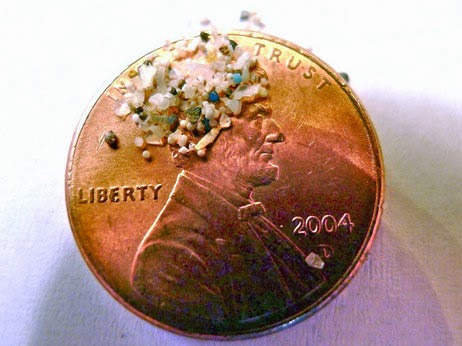 |
| Erie microbeads (Carolyn Box/AP/5gyres.org) |
From the shoreline at North Avenue Beach in Chicago, the blue water of Lake Michigan stretches as far as the eye can see. But beneath that pristine image, there's a barely visible threat, says Jennifer Caddick of the Alliance for the Great Lakes: [toxic plastic debris in the form of] microbeads.
These tiny bits of plastic, small scrubbing components used in hundreds of personal care products like skin exfoliants and soap, can slip through most water treatment systems when they wash down the drain.
Environmentalists say they're a part of the plastic pollution found in the ocean and, increasingly, in the Great Lakes, which contain more than 20 percent of the world's freshwater. Now Illinois and New York state lawmakers are a step closer to banning them.
Microbeads, says Caddick, engagement director for the Alliance, are "a bigger problem than we initially had thought."
Plastics That Look Like Food

Sherri Mason, an associate professor of chemistry at the State University of New York, Fredonia, sailed with a research team over the past couple of years to collect data on the prevalence of plastics in the lakes. They dragged a fine mesh net in the waters at half-hour intervals to snag what they could -- "anything that's bigger than a third of a millimeter," Mason says.
When the boat docked at Chicago's Navy Pier last summer, Mason showed off the sample bottles of microbeads that she and her team had collected in Lake Michigan.
Mason says her testing found, on average, 17,000 bits of tiny plastic items per square kilometer in Lake Michigan. The levels were much lower in Lake Huron and Lake Superior, but Lake Erie and Lake Ontario had much higher concentrations. LISTEN
- Do antibacterial cleansers work better than soap?
- My No-Soap, No-Shampoo, [Probiotic]-Rich Experiment...
- An Epidemic of Absence: Understanding Allergies
Plastic Microbead Trash from Oceans to Great Lakes Hurting Birds, Marine Life — and Humans?
Linda Moulton Howe (EarthFiles.com, May 30, 2014)

“We can show that the chemicals are adhering to the plastic. We can show that organisms eat the plastic. We can show the chemicals then desorb into the organism that affects the health of THAT organism!” - Associate Prof. of Chemistry Sherri Mason, SUNY, Fredonia
 |
| Trillions of plastic microbeads from human products such as toothpaste are filling up the Great Lakes and oceans with negative consequences for marine life and ultimately humans. |


