Showing posts with label prison. Show all posts

Wednesday, 16 July 2014

Ajahn Brahm: Letting Go vs. Clinging (video)

Seth Auberon, Amber Larson, Dhr. Seven, Ashley Wells (eds.), Wisdom Quarterly; Ajahn Brahm (BuddhistSocietyWA); Ven. Nyanatiloka, Buddhist Dictionary: Manual of Doctrines and Terms
(Poh Ming Tse Temple, 2014) Ajahn Brahm: Freeing Our Minds from Our Mental Prisons

BuddhistSocietyWAVen. Ajahn Brahm, an ennobled and very humorous Western monk who emerged from the Thai Forest Tradition in Isan under Ajahn Chah, now lives and teaches in Australia. He had just come from teaching at a retreat when he chose to explore ways of letting go in the Buddha's teaching. Indeed, there is danger in clinging (upadana) and liberation in letting go, internally renouncing, and freeing ourselves from suffering.

Orange is the new black, but for free robes not bound jumpsuits (dreamstime.com).


Prison is a scary place yet not nearly as fearful as our mental prisons, ones we've created as terrifying places we are imprisoned even as we walk around free to do as we like. In this video teaching by the ennobled and humorous Western Theravada monk, brought to us by the Buddhist Congress and Angulimala Fellowship, Ajahn Brahm shares his insights and wisdom on the most important prison break we can attempt. It is peppered throughout with the distinctive flavor of Ajahn Brahmavamso's trademark humor. See video below from 2010 when he began this thread.

MENTAL PRISON: Some of us are as tortured and trapped as prisoners in prison cells.
 
Non-clinging (nekkhamma) is a Buddhist Pali term translated as "the pleasure of letting go" or "renunciation." It conveys, more specifically, "giving up worldliness and leading a higher life" or "freedom from crippling lust, craving, and addictions." In the Noble Eightfold Path, it is the first practice associated with "Right Intention."

https://en.wikipedia.org/wiki/P%C4%81ramit%C4%81
In the Theravada list, it is the third of the Ten Perfections, involving non-attachment and non-clinging to suffering. How do we cling to suffering? The root of our self-injury is clinging to the Five Aggregates, to wrong views of self.

Milarepa's Tibetan Vajrayana writings are canonical Mahayana Buddhist texts that emphasize the temporary nature of the physical body and the need for non-attachment.
 
Non-clinging is also a central concept in Zen Buddhist philosophy. One of the most important technical Chinese terms for "non clinging" is wú niàn (無念), which literally means "no thought." This does not signify the literal absence of thought, but rather not clinging to or identifying with thought, the state of being "unstained" (bù rán 不染) by thought -- like a lotus flower born in water and grown up in water rising above water and remaining unstained by water.

Therefore, non-clinging is being detached from one's thoughts. That is, it is to separate oneself from one's thoughts and opinions [of course, they are not actually one's own] in detail as to not be harmed mentally and emotionally by them (see The Platform Sutra of the Sixth Patriarch translated by Philip B. Yampolsky).

I can do this monastic stint standing on my head...because I'm free (annenbergproject.org)
.
"Freedom from sensual lust"
Ven. Nyanatiloka, Buddhist Dictionary: Manual of Doctrines and Terms
Gokyo Ri peak (Hendrik Terbeck/flickr)
The real meaning of "renunciation" (nekkhamma) is an internal act not an external one.

It is not by shaving one's head and face and donning saffron robes that one moves toward enlightenment (bodhi, awakening) and nirvana (moksha, liberation from all suffering). There are many monastics who yet cling and are therefore no closer to freedom than householders).

The word is apparently derived from nir + Ö kram, "to go forth (into the wandering, left-home-life of an ascetic)." But in Pali language texts, this term is nevertheless used as if it were derived from lust (kāma as in Kama Sutra) and always as an antonym to kāma (craving for sensuality). 

It is one of the Ten Perfections (pāramīs or pāramitās as in the Prajna Paramita, the famous "Perfection of Wisdom" literature).
  
Nekkhama-sankappa, the "intention of renunciation" -- thoughts free of lust, thoughts of renunciation, is one of the three kinds of right intention or right thought (sammā-sankappa), the second factor in the Noble Eightfold Path (see Magga, 2), its antonym being kāma-sankappa, lustful thoughts and intentions.

Four Ways to Let Go and Get Free

.
What is clinging?
Maitreya Buddha, Gandhara (wiki)
"Clinging," according to the Path of Purification (Vis.M. XVII), is an intensified degree of craving. The four kinds of clinging are:
  1. sensual clinging,
  2. clinging to views,
  3. clinging to mere rules and rituals [as if they could ever in and of themselves lead to or result in enlightenment],
  4. clinging to personality-belief.
(1) "What now is sensual clinging? Whatever with regard to sensuous objects there exists of sensuous lust, sensuous desire, sensuous attachment, sensuous passion, sensuous delusion, sensuous fetters, this is called sensual clinging.
 
(2) ''What is clinging to views? 'Alms and offerings are useless [without karmic benefit to the giver]; there is no fruit and result for skillful and unskillful deeds: all such views and misconceptions are called clinging to [wrong] views.

(3) "What is clinging to mere rules and rituals? Holding firmly to the view that through [the observance of] mere rules and rituals one may reach purification [enlightenment and liberation, bodhi and nirvana), this is called clinging to mere rules and rituals.
 
(4) "What is clinging to personality-belief? The 20 kinds of ego-views [beliefs about self, identity, ego] with regard to the groups of existence, these are called clinging to personality-belief" (Dhs.1214-17).
 
This traditional fourfold division of clinging is unsatisfactory. Besides clinging to lustful objects of the sense, we would expect either clinging to fine material spheres and immaterial spheres of existence or simply clinging to continued existence (bhava-upādāna, continued being, which can never be static, and is therefore translated as becoming).

Although a non-returner, a person who has gained the third stage of enlightenment, is entirely free of the traditional four kinds of clinging, that person is not yet freed from rebirth, as one still possesses clinging to continued-becoming. The Commentary to the Path of Purification (Vis.M. XVII), trying to get out of this dilemma, explains sensual clinging as including here all the remaining kinds of clinging.
 
"Clinging" is the common rendering for upādāna, but "grasping" would come closer to the literal meaning of it, which is "uptake" or the habit of repetitive craving; see Three Cardinal Discourses (Wheel 17), p.19.

Friday, 20 June 2014

The Imperial Rulers of IRAQ: U.S.

CC Liu, Ashley Wells, Wisdom Quarterly; Peter Van Buren (wemeantwell.com); PRI.org
Emperor Bush, Neocon Republicans to their mirror image Democrats like Obama, Feinstein
Tank u, Amerikkka! We greet u as liberators. U killed my family. As-salām 'alaykum!


The U.S. Embassy as a lush campus in the middle of a uranium-contaminated Iraqi desert
This yard will be your "campus," guys. That embassy will be ours. Deal, Maliki? Deal!
.
We left Iraq a long time ago, didn't we?
Road to Ramadi is paved...
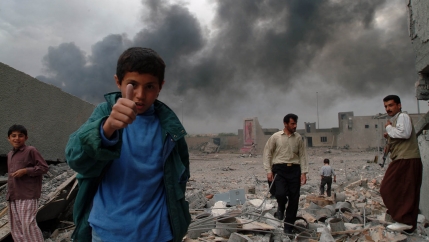
As the U.S. “relocates” personnel (rather than “evacuating” them) out of the World’s Largest Embassy [military base] in Baghdad, it is valuable to look at our one billion dollar monument to American hubris (overarching pride and ambition).

Hey, we meant well! And everyone knows the road to Ramadi is paved with good intentions.

Though likely tens of thousands of people have been inside the U.S. Embassy in Baghdad, and a great many of them have scattered photos of the place across the social media landscape, actual official photos of the embassy have been limited to a handful of narrow views. The stated reason for all this is “security.”
 
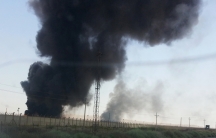
Battle for one of Iraq's major oil refineries
Of course a simple Google search [which can be done better and more privately at Startpage.com, which incorporates Google search without tracking users] will reveal many images; there even were 3-D model of the place online.
"It's heartbreaking" - veteran on Iraq crisis
US veterans are reflecting on the crisis in Iraq. Blake Hall served in Iraq in 2006 and 2007, in Mosul and in Baghdad among other places. Nowadays, Hall runs a tech company in Washington, DC, and he's been following the news from Iraq closely. That's been frustrating, he says, and heartbreaking. 
 
Still, what has been missing is a really nice color shot of the lawn. We have that now, posted online by someone:

There is a very interesting backstory to that nice lawn you see pictured above. If you’ve read my book about Iraq, We Meant Well, you may already know the story:
 
Iraq: Babylon, Mesopotamia, Sumeria
The World’s Biggest Embassy (104 acres, 22 buildings, thousands of staff, a $116 million vehicle inventory), physically larger than the Vatican, was a sign of our commitment to Iraq, at least our commitment to excess. “Along with the Great Wall of China,” said the ambassador, Chris Hill at the time, “the Baghdad Embassy is one of those things you can see with the naked eye from outer space.” 

Iraqi troops reject puppet gov't, go militant
The newly-opened embassy was made up of large office buildings, the main one built around a four-story atrium, with overhead lights that resembled sails. If someone told us there was a Bath and Body Works in there, we would not have thought it odd.

Chalabi-powell
Iraq's next PM? Peddler of WMDs
Iraq's next PM? Peddler of false WMDs The embassy itself, including juicy cost overruns, cost the American taxpayer about one billion dollars. [And never mind that Donald Rumsfeld lost a 2.3 TRILLION U.S. dollars in Iraq the day before 9/11 then never bothered to explain it. We were already illegally invading during the first Gulf War under Emperor Bush I and his boy wonder Dan Quayle threatening to use tactical nuclear weapons on Iraq.]
 
The World’s Biggest Embassy sat in, or perhaps defined, the Green Zone. Called the Emerald City by some, the Green Zone represented the World’s Largest Public Relations Failure. In the process of deposing Saddam, we placed our new seat of power right on top of his old one, just as the ancient Sumerians built their strongholds on top of fallen ones out in the desert.
 
Less Mesopotamia but more MESS
In addition to the new buildings, Saddam’s old palaces in the Zone were repurposed as offices, and Saddam’s old jails became our new jails. Conveniently for Iraqis, the overlords might have changed, but the address had not. The place you went to visit political prisoners who opposed Saddam was still the place you went to look for relatives who opposed the Americans.
 
Read in reverse, add zeros for civilian deaths
The new Embassy compound isolated American leadership at first physically, and, soon after, mentally as well. The air of otherworldliness started right with the design of the place. American architects had planned for the Embassy grounds to have all sorts of trees, grassy areas and outdoor benches; the original drawings made it look like a leafy college campus. More
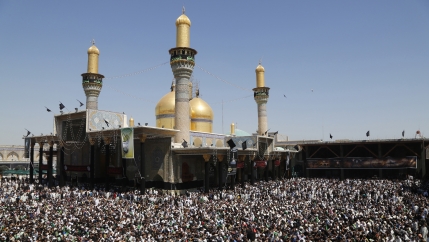
AUDIO: What's the difference between Shia and Sunni Muslims? (The World/PRI.org)

Monday, 10 March 2014

"Pussy Riot" coming to L.A. (Masha Gessen)

Amber Larson, Seven, Wisdom Quarterly; ALOUD (lfla.org)
"I was my own person again" (Slate.com)
Pussy Riot, the feminist art collective and sometime punk band, is author 's new obsession -- after exposing Pres. Vlad Putin.

A full discussion of their story as well as that of the Dictator That Could (Vladimir Putin) will take place this Wednesday in the Los Angeles Central Library.

Nadia's hunger strike (theguardian.com)
On Wednesday, March 12, 2014 (7:15 pm, Mark Taper Auditorium, Central Library, downtown Los Angeles) ALOUD welcomes author Masha Gessen (Words Will Break Cement: The Passion of Pussy Riot) in conversation with St. Mary’s College Professor of politics Suzi Weissman.
Tortured and tormented in custody (AFP)
On February 21, 2012 five young women entered the Cathedral of Christ the Savior in Moscow wearing neon-colored dresses, tights, and balaclavas (knitted face masks) to perform “A Punk Prayer” beseeching the “Mother of God” to “get rid of Putin.” 

American activists stand up for Pussy Riot
What transformed a group of young women into a collective of artists with a shared vision, and what gave them the courage to express that vision and to deal with the subsequently devastating outcomes?
 
Through the trial of three feminist punk band Pussy Riot members, Russian-American journalist Masha Gessen, author of Putin: The Man Without a Face, tells a larger story about Vladimir Putin’s Russia, with its state-controlled media, pervasive corruption, and pliant judiciary. [The free event is RSVP only and sold out, but there may be standby seating.]
 
HBO Documentaries: "Pussy Riot: A Punk Prayer"
  
“I Was My Own Person Again”
Collective of balaclava-clad artists

Monday, 30 September 2013

Marijuana versus Alcohol (radio)

Alcoholic Homer Simpson tries a new "medicine." The moral of the story? Avoid booze, avoid pot, and learning to cope with stress is a beneficial habit to develop.
Arrest photo: I'm not an alcoholic!
(Sept. 30, 2013) Uprising radio host Sonali Kolhatkar speaks to the lead author of a new book called Marijuana is Safer: So Why are We Driving People to Drink? If alcohol is worse, why are people pushed to resort to it and pressured to avoid a safer and more medicinal alternative? In the past year two states have legalized its recreational use. The financial infrastructure of legalization is in its infant stages with investors pouring in money and big banks agreeing to accept profits. Such steps were unthinkable a few years ago. Pot was thought far more dangerous as a vice than booze. The US is now closer than ever to legalizing cannabis. Even CNN’s Dr. Sanjay Gupta recently changed his position on weed. Trying to overturn the legal ban on marijuana, activists and advocates have hit upon a winning formula: point out the fact that alcohol leads to far more public violence and that having the option to use marijuana instead could lead to a safer, less criminal society. Guest Steve Fox is Director of Government Relations at Marijuana Policy Project. AUDIO

Steve Fox, Paul Armentano, Mason Tvert
(AlterNet.org) A book explains how we are steering people away from cannabis and toward the use of a very harmful and deadly substance: alcohol. The following is an excerpt from the book: It’s Super Bowl Sunday and throughout the nation millions of Americans have stocked their shelves and refrigerators with alcohol for the big game. In living rooms across the country, guests will enjoy the libations and gawk at the humorous beer commercials sprinkled liberally throughout the telecast. Like the Fourth of July and fireworks, the Super Bowl and booze are an American tradition. There is no societal stigma associated with this excessive drinking. It is all part of the celebration. Like the old saying goes: “We don’t have a drinking problem. We drink. We get drunk. No problem.” More


DemocracyNow.org (Sept. 30, 2013)
 
Cubicle criminality at the offices of the NSA
When I first met Reverend Rick Hoyt he said, “You don’t have to call me Reverend; just Rick is fine.” The First Unitarian Church of Los Angeles has taken a stand against the NSA surveillance program. The bespectacled and youthful pastor, sporting a salt-and-pepper beard, certainly didn’t look like a conventional “man-of-God.” In fact, the Unitarian Universalist church to which Rick belongs is known for defying Christian theological convention. Rick’s home at the First Unitarian Church of Los Angeles also has a history of defying political convention. The church, according to Hoyt, has been a “fierce advocate for personal liberties.” Even before Edward Snowden became a household name, the First Unitarian Church of LA became a plaintiff named in a major lawsuit against the National Security Agency (NSA) over privacy violations. Nineteen organizations have joined Hoyt’s church in an unusual coalition that includes the Marijuana legalization group, NORML, and gun rights groups like the California Association of Federal Firearms Licensees.


Fire Dog Lake: How Obama punishes Medical Marijuana patients
Troops swoop in on illegal growers (scpr.org)
(Aug. 22, 2013) Despite overwhelming support from the general public, significant backing from medical doctors, and even several prominent Republicans publicly acknowledging that cannabis has a legitimate medical use, the Obama administration officially insists it does not have one.The administration’s dodge when asked to explain this unpopular and scientifically unjustifiable position is to act as if it is a non-issue because they are not arresting medical marijuana patients. When Jessica Yellin asked why the administration refused to use its power to reschedule marijuana to make it legal for medical use, Deputy Press Secretary Josh Earnest responded: “the President and the administration believe that targeting individual marijuana users, especially those with serious illnesses and their caregivers, is not the best allocation of federal law enforcement resources.”

Cannabis is a safer plant? (hempsaves.net)
The administration pretends that since they are not arresting patients, rescheduling marijuana does not matter. The possibility of arrest, however, is only a small part of how legitimate medical marijuana patients are significantly punished because the Obama administration refuses to use its power to remove marijuana from Schedule I (an assignment shared by the worst drugs of abuse with no redeeming quality whatsoever). Over the years the legal tentacles of the so-called "War on Drugs" have been allowed to touch all parts of federal policy, from gun rights to education. According to Hoyt, some of these groups are not ones his church normally works with and “aren’t necessarily politically sympathetic with.” But the right to personal privacy is a Libertarian position deeply held by both ends of the political spectrum. Complete interview:


Why are we really fighting a war in Afghanistan, DRUGS? (TheRealNews.com)
  • VIDEO: "Herman's House" - 42 years in solitary
  • (Sept. 30, 2013) Cancer-stricken "Angola 3" prisoner Herman Wallace has been given just days to live after being in solitary confinement for 42 years His crime? Robbery then being falsely accused of participating in the killing of a Louisiana ("the incarceration capital of the world") prison guard. His actual crime was forming one of the first Black Panther chapters in prison, making him a political prisoner, which the US claims not to have. More
  • Amys_column_default
    Host Amy Goodman
    Last week, far out in the Arctic Ocean, the Greenpeace vessel Arctic Sunrise approached a Russian oil-drilling platform and launched a nonviolent protest, with several protesters scaling the platform. They wanted to draw attention to a dangerous precedent being set. The platform, the Prirazlomnaya, owned by Russian gas giant Gazprom, is the first to begin oil production in the dangerous, delicate, ice-filled waters of the Arctic.