Showing posts with label Krishna. Show all posts

Thursday, 21 August 2014

Happy B-Day, Krishna! (UFOs from Heaven)

Pat Macpherson, Dhr. Seven, Ashley Wells,  Seth Auberon, CC Liu, Wisdom Quarterly; BBC
The dark lord, blue Krishna: krsna means black or dark (Reuters/BBC.com)

What will a public UFO landing display look like? There was that War Over LA. Albert Hall during the Ultimate Fighting Championship, London, 2002 (Mike Hewitt/Getty Images).
Robert Bingham (center) guides Los Angelenos to daylight UFO summonings and sightings.
.
And this one's for patriarchy, Asherah!
Hindus believe that both the Buddha and Lord Krishna were earthly incarnations or avatars of the celestial god Vishnu.
 
India's great celestial goddess and god, Radha and Krishna, are the beloved ultimate couple.

Just as Yahweh (Jehovah, YHVH, one of the Old Testament gods of the Bible and, apparently, the only One that mattered) was once married to Asherah in Judeo-Christian tradition, Radha and Krishna are the immortals, space (akasha)-devas, who came to Earth to frolic.

Ancient Asherah bas-relief
Wait, wait, wait, and hold hold your horses! God had a wife? There is more than one God in the Jewish and Christian Bible? Yes, and yes. The whole sacred book tells of their, the plural gods' exploits on Earth, which scholars construe and misrepresent as a monotheistic -- "one god" -- text about only a single God speaking of Himself in the royal "We." But many kinds of celestial gods and space lords are referred to by name. Scholars who know better gloss this by saying, it's all names for one God. He likes lots of names and classes of names and to refer to himself always in the plural.

Birth then carried across the water in a basket reminiscent of Moses... In pictures: Hindus around the world celebrate Krishna's birthday, one of the most popular Hindu gods (BBC).
The Bible is much closer to the ancient myths (true and attested to accounts) of the Vedic Pantheon, Ancient Roman Gods, Ancient Greek Gods, and post-Vedic Buddhist cosmology. Buddhists do not worship these gods -- devas, gandharvas, apsaras, brahmas, asuras, nagas, garudas -- but they are well aware of them. And the Buddha taught that if one so wished and, moreover, undertook the appropriate courses of conduct (merit, profitable karma), one could be reborn among the devas. The devas are recollected (devatānussati) rather than worshipped for this reason.

Goddess Radha devi, the favorite consort of the lord: kids play dress up (AP/BBC.com)
.
Radha the milkmaid (gopi) was already on Earth in a scene reminiscent of Western religious tradition, as the gods -- including the Cowherd avatar or Shepherd Krishna -- found the "daughters of men" attractive and came in unto them and bore with them hybrid-offspring, heroes of old, men of renown.
 
Janmashtami is Hindu Xmas in India, Lord Krishna's birthday commemoration. Krishna has risen in popular importance above all other incarnations and manifestations of the One God of the Brahmins Brahma (called "Great Brahma" or Maha Brahma in Buddhism).
  • [There is something higher but it is not a personality, and it is Brahman, the Ultimate Reality behind the Illusion of Maya, Godhood, Godhead, GOD, realization and union. So we always distinguish: "gods" (devas, deities) from "Gods" (brahmas, divinities) from "GOD" in nontheistic Buddhism. Nontheism does not mean atheism, but rather denotes the fact that whether or not there are gods is not pertinent to enlightenment. Enlightenment transcends that discussion And whether or not their are creators (DNA splicers, cosmic magicians, manipulators of energy, mind/heart readers, powerful aggressors, peaceful enjoyers of the Brahma Viharas or "Divine Abidings"), there is no ultimate uncreated Creator God creator of all...unless one thinks of the impersonal GOD as that creator, but that is more a syncretic Hindu-Mahayana concept than anything the historical Buddha ever taught.]
How the Sumerians depicted the flying visitors from space on compact cylinders
.
The Dogon of Mali, Africa
Whether it is Buddhism, Brahmanism (the pre-Buddhist Vedic teachings of the Brahmin-caste priests, later Hinduism, Mahayana Buddhism (a kind of Buddhism steeped in Hindu concepts), Jainism, Sumerianism (of Sumer, Mesopotamia, Iraq), Zoroastrianism, Judaism (Bedouins, Hebrews), Islam, early Christianity, or later Catholicism there are "gods" who came down from on high in space. At least that's where these beings said they were from They may have come from the hollow Earth, nearby Moon, the visible planets, or from the next solar system over, but they came. Even the Dogon know they came.

In Buddhism these "shining ones" (beings of light of varying radiance) are generally referred to as akasha-devas from the akasha-deva-loka or "space light beings world" to distinguish them from the earthling-devas (bhumattha-devas).

Playground of the devas

Recollect the Devas' Merit: Mediterranean Greece as the playground of the "gods" (D&G)

What UFO abductees can teach us
David M. Jacobs with George Boory (coasttocoast.com, Aug. 19, 2014)

Documented research
Prof. David M. Jacobs (ICAR, "International Center for Abduction Research," ufoabduction.com) has conducted decades-long research into the alien abduction phenomenon. He was on last night trying to explain his conclusions to a kind, half-witted host. Jacobs outlined his early interest in UFO sightings, how he focused on alien abductions after he met Budd Hopkins, and expressed his disappointment at how academic and scientific communities generally dismiss the subject of UFOs. There is, he feels, a preponderance of evidence to demonstrate their existence.
 
ET Semjase devi (theyfly.com)
From the beginning of human civilization ,aliens have shown an interest in human reproduction, he notes. UFO abduction incidents reveal this interest. The reason for this are their programs to create hybrids, he explains, describing an early case that Hopkins shared with him in which a woman was shown a baby that looked half-human, half-alien, and was asked by the aliens to hold and nurse the baby.

"They are making hybrids so that they can come down and be here," possibly to takeover this planet, he conjectured. Jacobs also mentioned the telepathic abilities of aliens: They can transfer and access data into and out of someone's mind.
 
He theorizes that hybrids are being created with a tremendous amount of information dumped into them by some insect-like ETs (praying mantis type), who seem to direct the hybrid program, not so much the reptilians (nagas) or Nordics (devas) or titans (asuras).


The show was rounded out by aerospace and defense systems developer Sir Charles Shults talking about his work on the technology of education, as well as various advancements and innovations in the fields of space exploration and AI (artificial intelligence). More

Tuesday, 19 August 2014

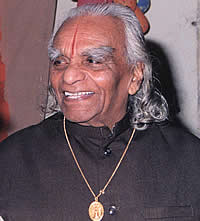
Famed yoga teacher BKS Iyengar dies at 95

Yogis Seven, Crystal Quintero, Wisdom Quarterly; BKSIyengar.com; BBC.com
If it were up to Iyengar, Lululemons would not be so tight or transparent.
.
Yogacharya B.K.S. Iyengar died today. He was a living legend who taught a modified form of yoga making the poses (asanas) more accessible and attainable to people in in the West and those with limitations. He himself, due to injuries, was limited. But he showed his teacher, Krishnamacharya, and fellow students that he could make something of this ancient science, something everyone could benefit from not just slender youthful ascetic males.
 
The Vedas teach yoga and health (Ayur-veda), how to live and eat well.

 .
Iyengar as a young man
The Iyengar style of yoga, because of its attention to detail and safety, became popular around the world. It is Hatha, bring together Sun and Moon principles together, with a gentle twist -- softened bends and rigor. It is gentle yoga of great precision. He found meaning in the yoga sutras, which are more aphorisms than discourses, by his practical search and regular practice. Therefore, he helped all to experience their wisdom. His certification of specialized teachers across the world was apparently lucrative enough to sustain him and this style making it quite respectable and the most common form of yoga found on college campuses.

We love Iyengar Yoga! It's so easy to do but so nitpicky. We just wanna have fun!
.
(BBC.com) Indian yoga guru BKS Iyengar has died in the western city of Pune, India, aged 95.

Mr. Iyengar was admitted to hospital last week and died early on Wednesday [Aug. 19, 2014] following kidney problems, doctors treating him said.

He was credited with his own brand of yoga and taught author Aldous Huxley and violinist Yehudi Menuhin, among other celebrities.

Iyengar Yoga is now taught in more than 70 countries, and the guru's books have been translated into 13 languages.

One of yoga's finest teachers, Mr. Iyengar practiced what he called an "art and science" for more than eight decades and ran one of India's top yoga schools in Pune.

He continued to practice -- "practice is my feast," he once told a correspondent -- in his old age and could still do the sirsasana -- or the headstand -- for half an hour until last year.

He used around 50 props, including ropes and mats, to align and stretch the body.

"When I stretch, I stretch in such a way that my awareness moves, and a gate of awareness finally opens," Mr. Iyengar told the Mint newspaper last year.

"When I still find some parts of my body that I have not found before, I tell myself, yes I am progressing scientifically... I don't stretch my body as if it is an object. I do yoga from the self towards the body, not the other way around.

When he first met Yehudi Menuhin, the violinist complained that he never had time to relax and never got a good night's sleep.

"Within one minute Iyengar had him snoring happily away. But Guruji did warn me: 'Relaxation doesn't mean yoga is a soft option. It's a disciplined subject -- a casual attempt only gains casual results,'" Mark Tully, former BBC correspondent in India, wrote after meeting Mr. Iyengar in 2001.

Wednesday, 12 February 2014

Sexy Hindu history book banned in India

Wisdom Quarterly; Nina Porzucki, author Prof. Wendy Doniger, PRI's The World (pri.org)
Amorous godly couple Krishna and Radha (Emuishere Peliculas/flickr.com/PRI.org)

 
Judge not. This is religious temple art (U
After years of a legal battle, Penguin Books India, a division of Penguin Random House, has agreed to pull its book, The Hindus: An Alternative History from Indian bookstores.
 
The history book, which its author [Harvard, Oxford Indologist] Wendy Doniger has described as an alternative, Howard Zinn-esque version of the history of Hinduism, has been accused of denigrating Hindus and Hindu [Brahminical Vedic] traditions.
 
(goodreads.com)
“It tells an aspect of the history of Hinduism that is unpleasant for a certain type of Hindu, what I would call a fundamentalist Hindu, to accept,” said Doniger, who is a professor of history of religion at the University of Chicago.

The lawsuit against Doniger and Penguin was filed by Dinanath Batra, a leader of the conservative Hindu group, Shiksha Bachao Andolan Samiti.
 
Among their specific accusations is that the book wrongly includes a map of India that excludes Kashmir, the subject of a territorial dispute with neighboring Pakistan. [Hey, Doniger, even we think it's going too far!
 
This isn’t the first time that Doniger has encountered an impassioned and vocal response to her ideas about Hinduism. More 
 
The Politics of Sexuality in Ancient India: The Indebtedness of the Kamasutra to the Arthasastra
Shivdasani Lecture by Prof. Wendy Doniger, November 2013
Penguin to withdraw BANNED book (MW)
The depth and extent of the influence of the textbook of politics (Arthasastra) on the textbook of sexuality (Kamasutra) is surprising, most evident in the high incidence of distrust, betrayal, and force in sexual relationships.
 
And the subsequent influence of the Kamasutra upon not only the erotic literary traditions of India but the eroticism of the bhakti [devotional] tradition, particularly in Bengal, accounts in part for the darkness of that tradition, its emphasis on divine abandonment, betrayal, and even violence.
 
Prof. Wendy Doniger [M.A., Ph.D. (Harvard University), 
D.Phil. (Oxford University)] is Mircea Eliade Distinguished Service Professor of the History of Religions in the Divinity School, University of Chicago, and in the Department of South Asian Languages and Civilizations, the Committee on Social Thought.
 
Prof. Doniger's research and teaching focus on translating, interpreting, and comparing elements of Hinduism through modern contexts of gender, sexuality, and identity. Her courses in mythology address themes in cross-cultural expanses, such as death, dreams, evil, horses, sex, and women; her courses in Hinduism cover a broad spectrum that, in addition to mythology... More
(TYT) Adopted daughter Dylan Farrow says Woody Allen molested her at age 7